Received Highest Strategy Category Score with Highest Score Possible in Solution Roadmap, Open Source Algorithms and Automation Workbench Criteria
H2O.ai, the open source leader in AI, announced it has been named a Strong Performer in “The Forrester Wave: Notebook-Based Predictive Analytics And Machine Learning Solutions, Q3 2018” report by Forrester Research, Inc. Out of the nine vendors evaluated, H2O.ai was recognized with the highest score in the strategy category based on solution roadmap and partners criteria.
Forrester notes that “H2O.ai’s future is automated machine learning” and its “bright future is in its Driverless AI product.” Based on Forrester’s research, H2O.ai received the top score possible across several categories: open source algorithms, solution roadmap, pricing and acquisition, partners and market awareness. In its assessment of H2O and Sparkling Water and Flow UI, Forrester reported “H2O.ai is best known for developing open source, distributed machine learning algorithms at a time (2011) when big data demanded them but no one else had them.” Its algorithms “still shine, and many other machine learning vendors integrate them into their solutions.”
The rise of open source machine learning has opened up immense opportunity in the enterprise’s ability to predict. With a code-first approach, notebook-based predictive analytics machine learning solutions are purpose-built for open source and have simplified the management of developing, training and deploying models.
The Forrester Wave: Notebook-Based Predictive Analytics And Machine Learning Solutions, Q3 2018 report utilizes a 24-criteria evaluation of notebook-based predictive analytics and machine learning solution providers. The report found that these solutions are equipping the enterprise with scalable machine learning, while enabling data science teams to use notebooks without the hassle.
H2O.ai is the open source leader in AI. Its mission is to democratize AI. H2O.ai is transforming the use of AI with software with its category-creating visionary open source machine learning platform, H2O. More than 14,000 companies use open-source H2O in mission-critical use cases for Finance, Insurance, Healthcare, Retail, Telco, Sales and Marketing. H2O.ai recently launched Driverless AI that uses AI to do AI in order to provide an easier, faster and effective means of implementing data science. In February 2018, Gartner named H2O.ai as a Leader in the 2018 Magic Quadrant for Data Science and Machine Learning Platforms. H2O.ai partners with leading technology companies such as NVIDIA, IBM, AWS, Azure and Google and is proud of its growing customer base which includes Capital One, Progressive Insurance, Comcast, Walgreens and PayPal.
The Era of Passive, Static VR Video Ends Now – Anyone Can Create Exciting, Interactive VR Content, Free of Cost
VeeR VR – the global VR content platform announces the release of its web-based, coding-free interactive experience creation tool – VeeR Experience. Traditional VR creation tools entirely generate passive experiences. Instead, VeeR Experience lets VR enthusiasts create engaging interactive VR content drag-and drop, share to VeeR VR with a single click and share with global audiences from 180+ regions and countries.
With a single click, the interactive content created with VeeR Experience can be viewed anytime on VeeR from the Web, on mobile, and on all major VR headsets, including Oculus GO, Oculus Rift, HTC Vive, Gear VR, Google Daydream, Windows MR, MiVR and more.
World’s first free interactive experience creation tool that supports VR video
VeeR Experience is the easy-to-use web-based tool for VR content creators who desire to tell their VR photo and video stories in a more engaging, creative and immersive way. Experience supports VR video and photo background in different formats (3D/2D 360°, 180° or any degree FOV), and allows creators to simply create an interactive story with VR/360 videos and photos and add hotspots, cards (pop-up 2D elements), spatial audio, external hyperlinks, and more.
There is plenty of static, passive VR video available, but what people are hungry for is quality interactive content that is truly engaging, said Ayden Ye, VeeR VR CEO and Co-founder. “VeeR has over 50K VR content creators and 30M users from more than 180 countries now. With the proper tools such as VeeR Experience, we can empower creators to produce more high quality engaging VR content easily. By utilizing the VeeR’s global platform, VR content will be distributed to global audience from 180+ countries and regions. VeeR is going to continue developing more advanced features that cater to the needs of VR content creators. ”
Partnership Explorer Provides Branded Video Ad Intelligence for Social Marketers
Shareablee Inc., announced their Monetize Suite’s new Partnership Explorer, a first-of-its-kind branded content planning and ranking dashboard that provides unlimited access to search advertisers individually or by industry groupings across over 5000 global categories.
To date, branded video on platforms such as Facebook, Instagram and Twitter have grown 57% since 2017, with nearly seventy percent of engagement being driven by Sports, followed by Entertainment, Food and Lifestyle Publishing. With still fewer than three percent of all videos currently branded, however, there is still a lot of room for growth which Partnership Explorer offers unprecedented visibility to inform digital strategy.
“Audience attention is hard to come by as devices and platforms continue to expand, and branded video is one of the most powerful ways for advertisers to effectively intersect culture when it comes to socially engaged consumers,” said Shareablee Founder & CEO Tania Yuki. “Our Partnership Explorer helps advertisers and media sales professionals transact more effectively on branded content, and is purpose-built to inform both sides and maximize the value of social media activations.”
For Agencies and Advertisers:
Identify the right creator and publisher partners for your campaign, to ensure maximum reach, media efficiency and ROI
Understand the real affinity of your prospective partner’s audiences, using their actual behaviors – not modelled or inferred intent
Measure the impact and effectiveness of each branded content campaign in real-time, from core social KPIs to shifts in behavior, attitudes and consumer sentiment
Ad Impressions Served Across Devices Now Matched to In-Store Visitation
Gimbal, the identity-driven marketing and advertising platform powered by physical-world data, announced the ability for advertisers to measure in-store visits based on programmatic ad impressions served to desktop, tablet and mobile devices.
In-store measurement has long been a mobile-focused effort since smartphones are a proxy to where individuals go in the physical word. Yet marketers know their prospects aren’t only consuming media on mobile devices.
Gimbal launches cross-device version of Arrival, their flagship in-store attribution product.
Since acquiring Drawbridge’s media business in May and implementing its cross-device solution, Gimbal has further enhanced its targeting capabilities to execute campaigns across mobile, tablet, desktop and connected TV.
Gimbal’s flagship attribution product – Arrival–measures foot traffic by utilizing its panel of first-party, always-on location data sighted by its location SDK against devices exposed to specific media campaigns. Gimbal can then passively capture real-time entry, exit and dwell-time data of each place visit, allowing for highly accurate measurement at scale.
Starting today, Arrival’senhanced device-level metrics now include visitation by time of day, day of week and distance between ad exposure and store visit – by screen. These deeper insights will allow advertisers and agencies to better analyze their consumers and campaign results and make better targeting decisions moving forward.
“Coupling our enterprise-grade location data and beacon technology with the most precise identity-matching technology available allows our partners to measure place visits with accuracy, precision and confidence,” said Matthew Russo, chief marketing officer of Gimbal.
Being able to connect cross-device audiences with Gimbal’s extensive location data set to measure store visitation creates the most comprehensive offline measurement suite available in the industry today. This omnichannel view provides marketers with a broader understanding of what channels are most effective in driving consumers to a physical point of interest – insights that can be used to optimize campaigns in real time to decrease ad spend and increase performance.
New Research Reveals That Immersive Technology Delivers Better Efficiency, Productivity and Safety for Enterprises, and That Augmented, Rather Than Full Virtual, Reality Will Lead the Way for Business Operations
A new report by the Capgemini Research Institute has revealed that enterprises are using augmented reality (AR) and virtual reality (VR) technologies to enhance their business operations. The report, “Augmented and Virtual Reality in Operations: A guide for investment” has found that 82 percent of companies currently implementing AR/VR say the benefits are either meeting or exceeding their expectations. However, a shortage of in-house expertise and insufficient back-end infrastructures are significant barriers to growth.
The new report, which surveyed more than 700 executives in the automotive, manufacturing and utilities sectors, with considerable knowledge of their organization’s AR/VR initiatives, found that 50 percent of enterprises currently not implementing AR and VR will start exploring immersive technologies for their business operations within the next three years.
These include using AR to remotely access real-time help from experts on a wearable or handheld device, and VR to train employees. Some 46 percent of companies believe the technology will become mainstream in their organizations within the next three years, while a further 38 percent think it will become mainstream in their organizations in the next three to five years.
Organizations are seeing the benefits of immersive technology
The report revealed that while AR is more complex to implement, organizations perceive it as more beneficial than VR. It highlights that AR generates productivity benefits thanks to streamlined workflows, citing examples such as technicians at Porsche using AR glasses that project step-by-step bulletins and schematic drawings across the line of vision, while also allowing remote experts the ability to see what the technician sees to provide feedback.
This solution can shorten service resolution time by up to 40 percent. VR improves efficiency and safety and helps manage complexities of tasks thereby boosting productivity. For instance, the report highlights that VR is used at Airbus to integrate digital mock-ups into production environments, giving assembly workers access to complete 3D models of the aircraft under production. This reduces the time required to inspect from three weeks to three days4. Additionally, according to the report, at least three in four (75 percent) companies with large-scale AR/VR implementations can attest to operational benefits of more than 10 percent.
Repair and maintenance, design and assembly form most implemented use cases
The report found that across the automotive, manufacturing and utilities sectors, the most popular uses of AR and VR are repair and maintenance, and design and assembly. Between 29 percent and 31 percent of companies using AR and/or VR are using it for repair and maintenance, specifically to consult digital reference materials (31 percent), seek a remote expert (30 percent), digitally view components not in physical view (30 percent) and superimpose step-by-step instructions on work stations (29 percent).
For design and assembly, companies using VR and/or AR are using it to view digital assembly instructions (28 percent), simulate product performance in extreme conditions (27 percent), visualize infrastructures from various angles (27 percent) and overlay design components onto existing modules (26 percent). For example, the report cites Ford’s use of VR technology to identify, and then engineer alternative actions by humans captured by body motion sensors during assembling, which has resulted in a 70 percent drop in employee injuries and a 90 percent reduction in ergonomic issues5.
AR is seen as more relevant and widely implemented than VR
The report revealed that two-thirds of all the organizations surveyed believe that AR is more applicable to their business operations than VR. While VR has been found to enhance a solo, immersive user experience that is isolated from the real world, AR connects the digital world to the real world, and therefore supports a number of breakthrough use-cases. Of companies deploying AR, 45 percent are implementing the technology, compared with just 36 percent of those companies using VR (the rest of the companies are still at the experimentation phase).
US and China most aggressive investors in AR/VR
The report found that companies in the US and China are currently leading the implementation race, with more than 50 percent of companies surveyed already implementing immersive technology for business operations. Whereas over 50 percent of companies in France, Germany, the Nordics and United Kingdom are still only experimenting with AR/VR initiatives.
“Immersive technology has come a long way in a short time and will continue to evolve. Faced with stiff competition from aggressive investors in the US and China, businesses need to streamline investment to seize the long-term growth potential this technology offers,” said Lanny Cohen, Chief Innovation Officer at Capgemini. “To drive the highest business value from AR and VR, companies need a centralized governance structure, proofs of concept that are aligned with business strategy, and to be able to drive innovation and employee change management.”
The report identified a group of “early achievers” who are driving the most benefits from their immersive technology initiatives. Representing 16 percent of the total companies surveyed, these organizations are focusing on four key strategies to expand their AR/VR initiatives:
Put a centralized governance model in place and build AR/VR awareness: 78 percent of early achievers have dedicated central teams or innovation centers to manage the organization’s overall AR/VR activities, compared with only 51 percent of other companies.
Invest in upgrading talent to gear up for future adoption: 93 percent of early achievers are investing heavily in agile, in-house teams of experts, compared with only 76 percent of the rest of companies surveyed.
Focus on the right use cases that provide lasting value and support employees: Finding the right use case and testing its applicability is one of the top three priorities for early achievers, whereas currently, the inability to identify a use case is a challenge for more than 50 percent of organizations.
Prepare technology infrastructure to integrate AR/VR: The report found that a lack of data and technology readiness are major barriers to AR/VR adoption. For enterprises, the need of the hour is to ensure smooth AR/VR integration with their existing technologies as well as their culture.
Video content is simply one tactic that has to be part of a wider marketing strategy. Regardless of what tactics you choose, a strong strategy starts with your audience. Do you want to reach people in a particular industry? A certain title? Does geography matter? Your team should also grapple with audience data including surfing habits, time spent on-site and preferred devices, long before anyone takes the lens cap off a camera. When brands reach that point, then video can be an effective way to engage people through emotion and narrative.
As a tool, video is optimal for specific objectives like brand awareness and lead generation. These goals translate well to quick explainer videos and short interviews or profiles. But the format does have several weaknesses. For example, it’s not an ideal tool for conveying a lot of complex or detailed information, especially in technical B2B fields.
As long as your strategy is balanced, that’s OK. It’s become commonplace for companies to “pivot” to video at the expense of all other content programs, but a valuable idea can live across different formats. A finance company can create a top-of-funnel video about people saving for retirement and then drill down on different retirement options in a more detailed e-book. That approach will also prevent Sc
ope Creep from draining time and talent away from the rest of your marketing content.
Once an audience is defined and a strategy has been designed, marketers can turn to distribution. If you’re going to spend a considerable amount of money and dozens of hours on a creative video project, you can’t just post it on your blog and expect everyone to find it. Video has started to dominate social platforms and mobile engagement. Per comScore, the average user watches more than 40 minutes of YouTube videos a day on mobile devices. So, whether you’re using Facebook, LinkedIn, YouTube, Twitter or a combination, there’s a growing audience for your clips. The trick is that each platform draws different people with different desires and expectations. You have to study the algorithms to learn what kind of videos get prioritized.
Finally, if you want to stay one step ahead for the future of video, revisit that audience you outlined in your original strategy. The way we consume content is moving more and more toward video, GIFs, animation, motion graphics and audio. The growing sophistication of technologies like virtual reality, voice recognition, and artificial intelligence means we will soon interact with screens very differently than we once did. For marketers to keep being successful with video content, they must continue to adapt to the changing landscape.
Digital marketing agency SalesX and its partner CallRail, the world’s most popular call tracking and analytics provider were named finalist for the Digiday Technology Awards in Best Marketing Analytics/Attribution Platform Category.
“We wish to congratulate CallRail for being recognized as an outstanding company in analytics tools that measure a key part of the marketing funnel,” said Joe Khoei, Founder and CEO of SalesX. “It is an honor to collaborate with the seasoned CallRail experts whose in-depth experience in results-based marketing and their robust platform allows our agency to deliver and exceed client advertising needs for delivering business value. Providing higher quality leads and insights into what’s resonating with customers strengthens our BVAT Business Value of Advertising Technology driven campaigns.”
“CallRail is dedicated to helping more than 100,000 businesses of all sizes optimize campaign performance and helping agencies prove their value and ROI,” said Andy Powell, CEO and co-founder of CallRail. “Our team values our partnership with SalesX and wants to continue providing results that support SalesX in achieving high growth for their clients and demonstrating value to executives.”
CallRail’s data-driven technology for example, helped SalesX reduce a client’s cost per lead by 90 percent. Prior to working with SalesX, the client’s cost per click was about $7, and their cost per lead was around $700. Within a year of working with SalesX data scientists and CallRail’s advanced call tracking technology, the SalesX client’s cost per click increased to approximately $25, and their cost per lead went down to $60, with a conversion rate of about 35 percent. This is one of several examples where the partnership between SalesX and CallRail resulted in increased visibility and optimization to laser focus on the most profitable search terms which are the best and highest converting matches for their client’s businesses.
Nevion Virtuoso media server designed for broadcast carrier class applications
Nevion, the award-winning provider of virtualized media production solutions, has announced that it will be demonstrating its latest software-defined Media Server, Nevion Virtuoso MI, at IBC2018. This new Media Server, which complements the existing Virtuoso FA appliance, is architected for high-end broadcast carrier applications.
The Nevion Virtuoso media node product family has been architected to deliver functionality through software, known as Media Functions. These Media Functions are designed to run on various Media Servers with different characteristics, such as size, number of Media Accelerators they can accommodate (for software processing) and level of modularity.
Like the Nevion Virtuoso FA, the new Nevion Virtuoso MI is designed to run various Media Functions for transporting and processing video and audio signals in real-time. It provides one of the highest media transport and processing densities available in the industry today, with a fully redundant architecture and the ability to accommodate up to eight Media Accelerators running media processing or network aggregation functions. The Virtuoso MI’s density and redundancy are perfect for demanding service provider environments. For example, a single 1RU Virtuoso MI can process 28 x JPEG2000 channels, which makes it very suited to high-end contribution such as popular sports coverage.
Johnny Dolvik
Johnny Dolvik, chief product and development officer for Nevion, said: “We are excited to showcase our new Virtuoso solution at IBC2018. Virtuoso is primarily about the software, and we have developed a substantial portfolio of media functions since the product was first launched two years ago, but the Virtuoso Media Servers are also important, as different markets require different specifications.”
Dolvik continued: “The new Nevion Virtuoso MI does not replace the Nevion Virtuoso FA, which we launched at IBC2016, and which has been extremely successful, with us shipping many hundreds of appliances. The Virtuoso MI responds to the specific needs of carrier applications, such as tier 1 and 2 managed video services, where processing density and hardware redundancy are particularly critical.”
Compliance with GDPR Privacy Rules Is Now Mandatory for All Firms Doing Business with Citizens of the European Union. A Software Product from Condusiv Technologies Helps Ensure Compliance with a Key GDPR Provision
On May 25th of this year, the European Union formally adopted an updated and consolidated set of rules for personal data privacy called the General Data Protection Regulation (GDPR). The regulation applies not only to European companies, but to any firm doing business, in person or online, with a citizen of any of the 28 nations that make up the EU. Condusiv Technologies CEO James D’Arezzo says, “Penalties for noncompliance with GDPR are severe: as much as 4% of an offending company’s global turnover, up to a total fine of €20 million.” D’Arezzo, whose company is a world leader in I/O reduction and SQL database performance, adds, “A key provision of GDPR is the right to be forgotten (RTBF), which empowers any European citizen to have his or her name and identifying data permanently removed from the archives of any firm holding that data in its possession.”
A component of the right to be forgotten is called “right to erasure,” which requires that the data be permanently deleted, i.e. irrecoverable. Many affected records consist not of fields or records in a database, but of discrete files in formats such as Excel or Word. What is needed in such a case, D’Arezzo notes, is a tool that can recover from incorrect deletions and also, in the case of confirmed valid “right to erasure” requests, permanently delete the record so that it cannot be retrieved. For Windows-based systems, this dual ability is offered by Condusiv’s industry leading Undelete product line, which ensures that—up to a point—every deleted file or version of an Office file on a Windows PC or server can easily be restored, even if it was deleted before Undelete was installed.
In the case of a data security issue such as a confirmed “right to erasure” request, however, Undelete’s SecureDelete feature will overwrite the file to help ensure it is unrecoverable, using specific bit patterns specified for this purpose by the US National Security Agency. A second feature, “Wipe Free Space”, will overwrite any free space on a selected volume, using the same specific bit patterns as SecureDelete to clear out any previously written data in that free space.
“With these two features,” says D’Arezzo, “when you select the option to delete a file with SecureDelete, you know it is virtually impossible to read/recover any of the data from that volume. Although you may have bought Undelete for its file recovery abilities, it provides you with other features to keep your data environment safe, secure, and compliant with current privacy requirements.”
Linius Technologies Appoints Former Head of Channel for Telstra and TeamViewer as VP of Channels and Alliances to Scale Company Globally
Linius Technologies‘ the only cloud platform that transforms static video into interactive intelligent content with its world-first Video Virtualization Engine (VVE) has appointed Stephen Pech as its VP of Global Channels and Alliances.
Based in Linius’ headquarters in Melbourne, Australia, Pech will drive and define the company’s growing channel program — including resellers, distributors and ISVs — across APAC, EMEA and North America. Linius has already formed a partnership with IBM, and is also available on the IBM Cloud, Microsoft Azure and Amazon Web Services.
A former head of Telstra’s ICT channel distribution division, Pech previously held positions with Fujitsu Australia and Symantec, most recently as the director of APAC sales for software company TeamViewer.
Linius CEO, Chris Richardson, said that Pech would play a key role in scaling Linius’ business during the next phase of its commercialization.
“Our go-to-market strategy remains consistent — validate Linius’ unique video virtualization technology with Proof-of-Concepts and direct sales, then capitalize on those successes through channel partnerships,” said Richardson. “With Linius now looking to rapidly expand its channel program and network, Stephen will ensure best practice enablement of new and existing partners across Linius’ core target markets, including corporate communications, news, education and sport.
“Stephen has delivered $100 million plus targets, led multi-channel sales teams, developed over 1000 partner channels, and has co-founded a cloud business. He’s the right type of person to propel Linius to new heights by signing and supporting the right partners.”
Pech said he was thrilled to join Linius at an exciting stage of the company’s development.
“Video content accounts for about 80 percent of all internet traffic,” said Pech. “And, with technology giants like IBM, Amazon and Microsoft currently investing billions exploring video virtualization services and Artificial Intelligence in the cloud, Linius is well positioned to capture a growing market.
“There is a massive opportunity for channel expansion with Linius’ unique ability to expose, enrich and exploit video content just like any other type of data. I’m looking forward to announcing several significant business and technology partnerships in the near future.”
Pay TV Operators, Telcos, and OTT Players Can Benefit from Rapid Time to Market, Access to Google Infrastructure and Total Ownership of the User Experience
Massive, the specialist UX vendor for the OTT industry, will be unveiling its customisable Android TV Operator Tier Launcher at IBC. The move follows demand from its customers around the world to bring Android TV into their multi-platform device suite. Massive’s Launcher saw a commercial soft launch during the 2018 World Cup with a major APAC telco, and will be widely available to telcos and pay-TV operators following IBC.
Massive’s Operator Tier Launcher lets operators deliver all the benefits of Android TV to their customers while keeping full control over the look and feel of the brand experience. This includes being able to redesign the UX on the fly, introduce new content layouts for different subscribers, and prioritise the operator-owned content over third-party video assets.
Underpinned by Massive AXIS, a powerful targeted UX platform, operators can also roll out advanced features such as subscriber segmentation and tailored UI personalisation. This was a key focus of the World Cup soft launch, with Massive’s Launcher used by the operator to deliver tailored experiences for different types of sports fan during the event.
“This year has shown that Android TV is a staple in every operator’s arsenal for the next generation set-top box. We’ve used our heritage in UI and personalisation with companies such as AT&T, the BBC and Telecine to feed into our Launcher, helping operators go to market with Android TV much quicker than they could with standard STB middleware,” said Ron Downey, CEO at Massive.
Massive is currently in advanced talks with several APAC and European operators to roll out its Android TV Operator Tier Launcher in the coming months.
Massive will be demoing its Android TV operator tier launcher, and the latest evolution of its AXIS user experience and content delivery platform, at IBC in Hall 14, Stand F06.
New Gartner Analyst Report on AI for Computer Vision Highlights Importance of Real-Time Behavior Recognition for Cutting-Edge Video Analytics
viisights, the developer of an innovative behavioral understanding systems for real-time video intelligence, announced that the company has been named as a Cool Vendor by the leading analyst firm Gartner.
In this analyst report, Gartner highlights the importance of “real-time behavior recognition” and states that “automated scene analysis used to generate real-time insight into human/object behavior is at the cutting edge of video analytics today.”
“We are proud to be named a Gartner Cool Vendor and, yes, we certainly agree that real-time behavior understanding is an essential for generating important new value from video analytics going forward,” stated Asaf Birenzvieg, co-founder and CEO of viisights. “We believe that this Cool Vendor recognition is important validation of the growing demand we are experiencing for our behavioral understanding systems and their unique AI-driven capability of understanding the behavioral context of scenes in live video streams.”
viisights’ video analytics technology delivers high-performance, artificial intelligence capabilities that extract new actionable insights by providing a real-time behavioral understanding of the context of scenes, events and actions within massive amounts of live video streams. By providing a contextual understanding of real-time video streams, viisights and its technology enriches the existing legacy video analytic systems, which focus only on object identification and classification.
The viisights technology is based on real-time temporal and holistic video streaming analysis. viisights uses video clips rather than discrete images for training its core AI engine, which are based on convolutional neural networks and LSTM models. These unique structures are used to create a unique event signature that includes the scene participants and their extracted features, such as positioning, movement, size and relationship with other objects. During runtime streaming, these signatures are being searched for and compared.
Based on this video understanding technology, viisights is capable of understanding the context of actions and events in live video streams and clearly distinguish between a person walking, running or falling in the street or someone behaving suspiciously or violently in a crowded public space.
viisights’ technology has applications for the safe and smart cities, smart businesses, critical infrastructures, transportation hubs, autonomous and shared mobility. The company bringing its technology and applications to market through a growing network of relationships with system integrators and similar sales channel partnerships as well as through its direct sales force.
It’s the leading format for brands and advertisers, and for good reason – consumers absolutely love video content. That’s why we decided to dig deeper to find out how, when, and where people prefer to watch videos online.
The team at PROMO conducted a study of more than 500 individuals of all ages.
We asked about their habits and preferences when it comes to watching online videos. As a result, we learned a lot about when and how people watch video, along with some powerful insights about consumer behavior that marketers can use to drive best practices and improve their business results.
The Value of Video Marketing
With the launch of FB Watch and IGTV, there’s no question that video marketing is bigger than ever. It’s not just that consumers like watching video – they’re watching a ton of it, daily.
According to our survey, 44% of consumers watch at least five videos online per day. That’s almost half of respondents watching more than five videos every single day. Even more incredibly, of those who watch five or more videos per day, about 35% say they watch more than ten videos online daily.
People enjoy watching and sharing video content so much that video marketing is the natural choice for businesses that want to widely distribute branded content.
Our study didn’t just confirm that people love video content, though.
We learned plenty about online video-watching habits, including these takeaways:
Facebook is still the platform on which people spend most of their time.
56% of people spend most of their time on social media on Facebook, while 18% spend most of their time on Instagram.
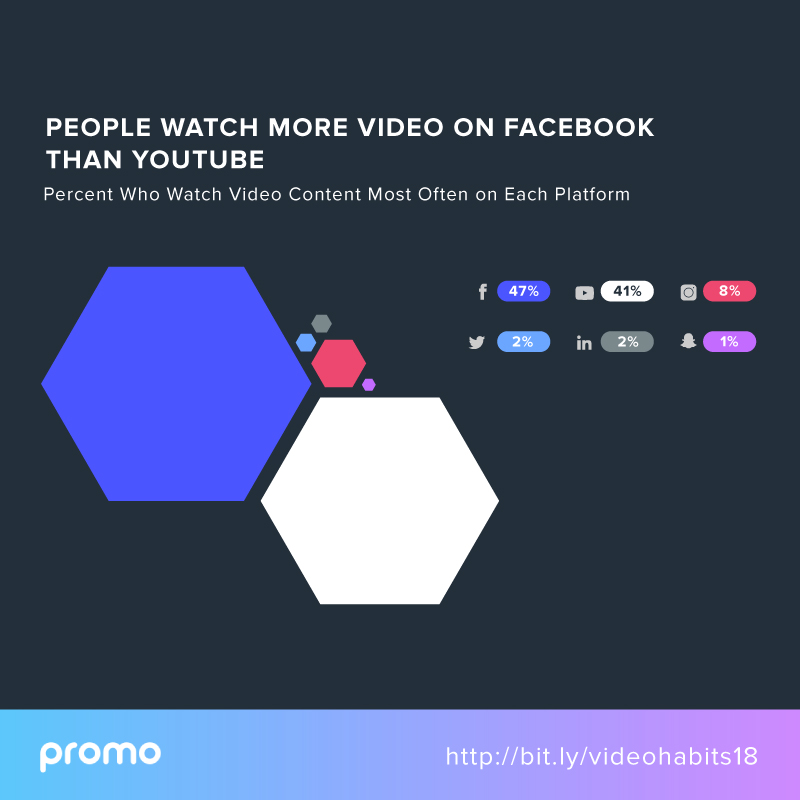
47% of people watch more videos on Facebook, while 41% do so on YouTube, and only 8% on Instagram.
71% of people said they find the sponsored videos on their Facebook feed to be “relevant” or “highly relevant” to them.
Most people read the caption text above the video quite often. Only 10% said they rarely read the caption.
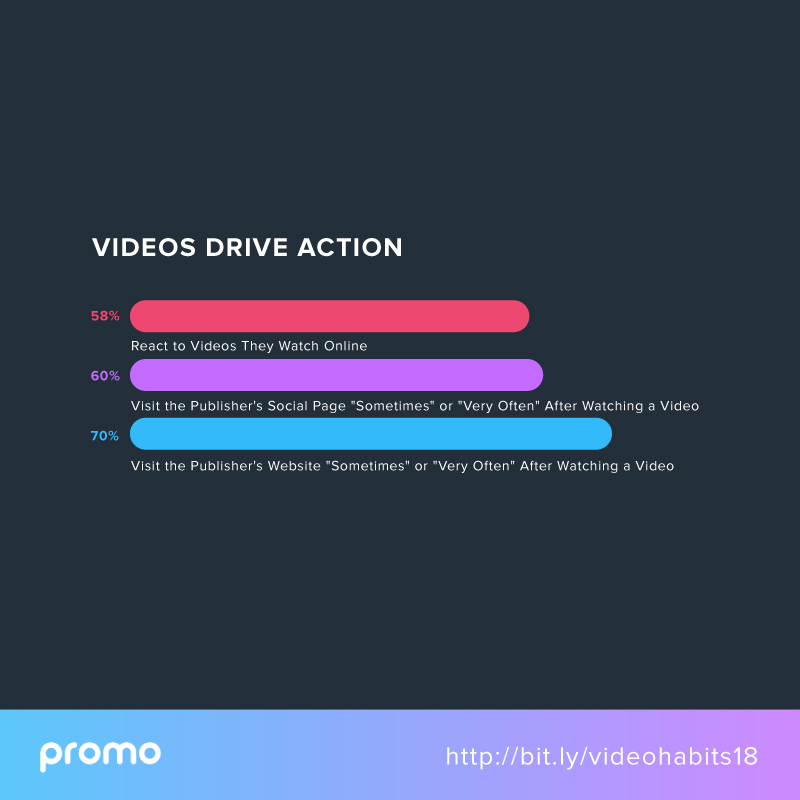
58% of people said they usually react to videos they watch online.
70% of people said they often visit the publisher’s website after watching a video.
60% of people said they visit the publisher’s Facebook page after watching a video.
Facebook and YouTube are clearly dominating the race for video content in 2018.
YouTube is now serving more than 1 billion hours of content every day. Meanwhile, in 2015, Facebook said its users were generating more than 8 billion video views every single day – a number that’s surely increased in recent years.
In our survey, users indicated that they are actually more likely to watch the majority of video content on Facebook compared to YouTube.
Of those surveyed, 47% say they watch videos most often on Facebook, compared to 41% who said YouTube. This is an interesting shift, marking Facebook’s success in transforming their platform to take advantage of the rise of online video.
For instance, Facebook has increased the reach and prevalence of native video content versus videos shared from other platforms (e.g., YouTube links). One study found that native video content receives, on average, 477% more shares and 530% more comments than videos posted to Facebook from outside platforms.
The recent algorithm changes seem to have tipped the scales in Facebook’s favor, making it the champion of video marketing in 2018.
No matter which way you slice it, the facts are clear: video is dominating as the most popular form of content across virtually every platform.
Marketers should take advantage of this trend by investing in video across social channels, but especially on Facebook. To get the most value from every piece of content, video created for one platform can (and should) be repurposed into the native format for other channels.
So, rather than sharing links to a YouTube video on Facebook or LinkedIn, it’s better to upload the video directly so you benefit from a boost in reach and engagement.
Instagram, Twitter, and LinkedIn are all lagging behind in terms of popularity, with just 12% of respondents saying they watch the majority of video content on any of these platforms combined.
Videos and Sponsored Content Are Connecting in a Big Way
When asked, “How relevant do you find the sponsored videos that appear in your feed?,” a surprising 71% of consumer said they find sponsored videos relevant or highly relevant.
This is fantastic news for marketers because it confirms their paid social budgets are going to good use. Not only are consumers watching sponsored videos, but they’re are also finding them relevant (which is, of course, critical to successful marketing).
For marketers, this also points to the extreme importance of closely targeting the right users. Consumers have come to expect that sponsored social content be perfectly tailored to their lives and their interests.
Facebook and Instagram do an amazing job of curating videos to ensure the right people see your sponsored content. As long as you’re creating high-quality videos and targeting your audience correctly, people are likely to watch and engage with your videos.
Though some might view it as a downside that Facebook has moved to a mainly paid marketing model, the fact that sponsored video is actually resonating with viewers means the play-to-pay route may be still worth the cost. The key is to make sure you’re properly segmenting and targeting your audience.
It’s clear that social videos–especially on Facebook–are connecting with users. But are they actually driving tangible results or inspiring action from consumers?
The answer from our study is a resounding yes.
Over half of respondents (58%) say they react in some way to video ads online. More importantly, a huge portion of viewers take specific actions in response to video ads.
Amazingly, 70% of those surveyed said they sometimes or often visit a company’s website after seeing a video ad online. Additionally, another 60% visit a publisher’s page or profile after viewing a social video.
These results speak volumes about the power of video ads to drive direct responses from customers and consumers. It also underscores the importance of incorporating strategic video ads as part of your marketing mix – especially when paired with a compelling CTA that’s likely to translate into consumer action.
In fact, 89% of those surveyed say they read the accompanying text or caption on social media videos either “often” or “sometimes.”
The major lesson here? Social video is an effective tool for motivating consumers. Creating great video content isn’t just about getting likes or views, videos can drive traffic to your website or social page.
In fact, video may be the best format for inspiring modern consumers to take action.
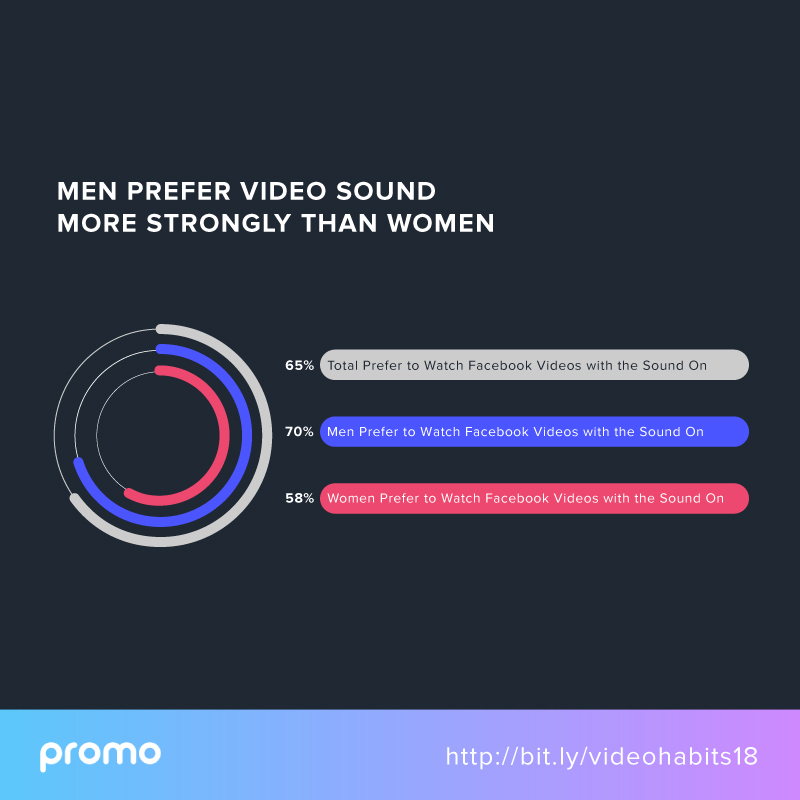
Another interesting finding from our study is that when watching a video on Facebook, 65% said they prefer to watch videos with the sound on.
However, Facebook data shows that approximately 85% of all videos viewed on their platform are actually watched without sound. (Note that Facebook counts a “view” as longer than three seconds spent watching a video, so simply scrolling past it in your newsfeed wouldn’t be counted in this measure.)
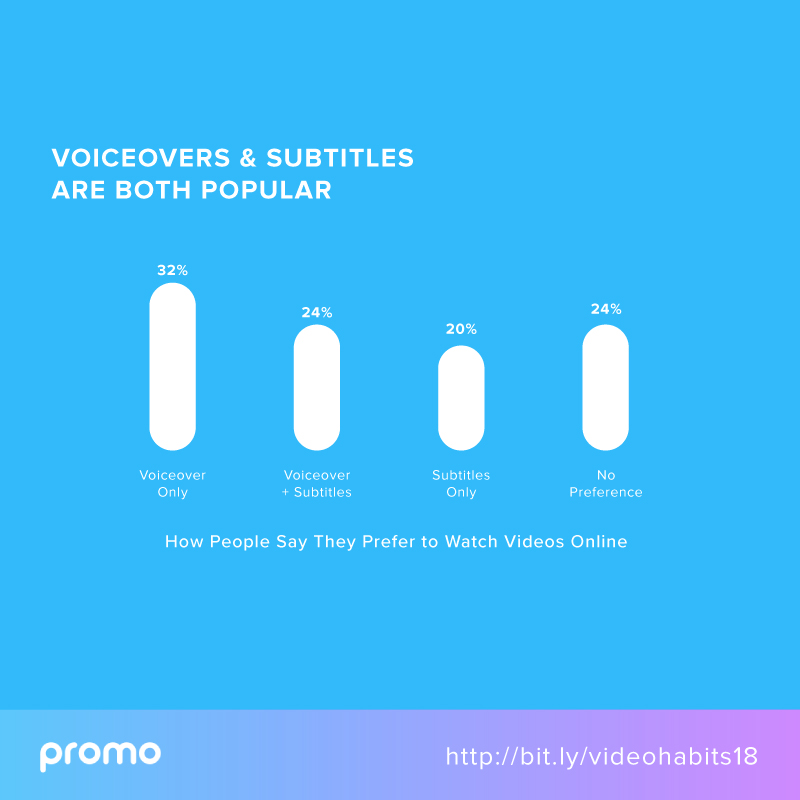
In addition, we found that nearly ⅓ of all respondents prefer to watch online videos with voiceover while just under ¼ prefer to watch with both voiceover and subtitles. About 20% of respondents say they prefer no voiceover–only subtitles–and another ¼ say they have no preference.
If we consider these insights together, we can see that although users have a strong preference for viewing videos with sound on, they might not always be in a position to do so. For instance, some viewers likely watch videos during their commute without sound to avoid disturbing those around them – even though they might prefer to watch with sound.
This suggests that marketers should create videos with both sound and subtitles in order to be accessible for the broadest audience in all circumstances.
Digging further into our survey results, we see an interesting difference in sound preference between men and women.
While approximately 70% of men prefer to watch videos on Facebook with the sound on, just under 58% of women indicated the same.
The Rise of Social Stories
Want to beat the social algorithm? Stories may just be your secret weapon.
Facebook and Instagram both adopted the concept from Snapchat and rolled out their own versions of “stories” on their platforms, allowing users to share and view time-restricted visual content. This functionality generally has its own place outside of the normal newsfeed and directly reaches all friends or followers.
In our survey, we found that 68% of respondents watch stories on Facebook or Instagram either “all the time” or “sometimes”.
Notably, only 52% of respondents say they post stories themselves. Since there are way more people viewing this content than those who are creating and sharing it, social stories could present a major opportunity for brands to get more views on a daily basis.
Lastly, the popularity of “stories” is especially high among millennial consumers, with 81% of respondents under age 34 saying they watch “sometimes” or “all the time.”
We can expect social channels to introduce even more new formats and styles for creating and sharing video content, which will open up exciting opportunities for brands to reach and engage customers online. As video continues to grow in popularity, companies that are already investing in video content will be best positioned to capitalize on emerging formats and channels.
About This Study
As the leading creative video provider for businesses, we decided to research popular online video-watching habits and uncover consumer preferences for viewing and engaging with video content.
We reached out to over 500 people worldwide to complete our survey.
To give you a bit more context for interpreting our results, here’s a breakdown of the survey respondents:
Gender split was 41.51% female and 58.49% male
Age range from teenage to senior (all ages)
8% were age 24 or younger
40% were ages 25-44
47% were ages 45 to 64
5% were over 65
Android users accounted for about 48%
iPhone users accounted for 51% (1% of respondents do not own a mobile phone)
Latest Zixi Platform Release Provides Media Industry with Three Notable Improvements in Key Areas of High-Quality Live and Live Linear Internet Protocol Video Delivery
Zixi, the market leader in delivering broadcast-quality video over managed and unmanaged networks, highlights three key features in the Zixi Platform latest software release.
Zixi is committed to making managed and unmanaged IP networks a secure and reliable solution for media industry video delivery. Key enhancements include its deep content analytics tools, improved security features such as DTLS, and patent pending hitless failover capabilities based on SMPTE 2022-7 that give managed and unmanaged networks a reliability of 99.9999%. The Zixi Platform will be featured at the 2018 IBC Show in AmsterdamSeptember 13-18th.
“Zixi’s research and development team continues to receive vital feedback from our long-time media customers focusing on the toughest problems facing the industry today. The growing importance of IP-network media tools is crystal clear as broadcasters come to appreciate the viability and flexibility in using unmanaged networks in contribution and distribution workflows.” Tim Baldwin, Director of Product Management.
The Zixi Platform Content Quality Analytics (CQA) means customers who rely on Zixi to deliver broadcast quality live or live linear video over managed and unmanaged IP networks will have better tools in their contribution and distribution arsenal. The Zixi Platform now includes real-time, in-stream content error detection, encoder quality analysis, video monitoring with alerts, and source history graphs. The Zixi Platform and ZEN Master orchestration together provide an unbeatable, comprehensive view into live video delivery workflows, enabling real-time critical decision making across 3 layers; network, transport, and content.
The Zixi Platform provides best-in-class, multi-layered stream security for delivering broadcast-quality live video in managed and unmanaged networks. In addition to restricted access control and AES encryption, the Zixi Platform now provides DTLS for its UDP video delivery protocols. DTLS is exclusive to the Zixi Platform and makes video content the most protected transport in the market today.
The Zixi Platform improves its hitless failover solution as an extension and improvement of SMPTE 2022-7 with a patent-pending IP packet sequence alignment technology analogous with DNA sequencing algorithms. When packets are not uniquely identified or numbered, the Zixi Platform can create one coherent stream out of multiple stream fragments to provide a flawless video experience for consumers.
Collectively, the Zixi Platform and ZEN Master orchestration are continuing to solve the most pressing needs of global media companies to deliver live video content over managed and unmanaged IP networks at reliability ratings at or better than satellite or fiber.
Insite Software, a leading provider of powerful digital commerce solutions, announced that Xngage, a leading B2B eCommerce services firm, has become a Platinum Sponsor for Engage 2018, Insite’s conference for customers, partners and industry experts to be held September 10-12 at Loews Minneapolis Hotel. The event will provide a venue for users of Insite’s powerful B2B eCommerce solutions to network with peers, interact with Insite’s team of experts, and hear from industry thought leaders. Platinum Sponsors for the event will be featured prominently on all conference materials and will also host the Exclusive Evening Event on September 11, 2018.
“The Xngage team has a strong reputation for architecting and delivering powerful B2B eCommerce solutions for manufacturers, distributors and wholesalers. The company has been a strategic implementation partner for many successful Insite implementations, so it makes sense for them to play a key role in launching our inaugural user conference,” said Jon Greene, Senior Vice President of Customer and Partner Success for Insite Software.
Along with sponsoring the event, Xngage Founder and CEO Joe Albrecht will present an Executive Track session entitled “Keys to a Successful Customer-Partner Relationship” with Jennie Stenback, VP of Marketing and eCommerce for 3Wire, a B2B Foodservice and Beverage Replacement Parts supply chain solution and part of the Marmon / Berkshire Hathaway family of companies. 3Wire has been an Insite and Xngage customer since 2015.
“We’re excited to help make Engage 2018 a reality for Insite’s current and prospective customers. Insite is a leader in digital commerce solutions, and this new event will provide a unique opportunity to connect in person with not only our customers, but industry experts like ourselves, as well as prospective customers”, said Xngage CEO Albrecht. “We’re eager to showcase how Insite and Xngage can power the digital transformation journey for manufacturers and distributors and create what we call ‘Digital Commerce Success’ for our clients.”
Engage 2018 is a new opportunity for Insite customers to connect, share and engage, taking the digital transformation journey beyond commerce. Attendees will gain powerful insights and tools that drive revenue, create efficiencies, and deliver enhanced customer experiences. Engage 2018 offers the chance to meet Insite subject matter experts, industry thought-leaders and Insite-certified technology and implementation partners, plus interact with Insite users from around the world. The event includes best practice presentations, customer success stories, product labs, training and one-on-one consulting.
Xngage is the leading digital commerce services provider in B2B. We deliver ‘Digital Commerce Success’ for manufacturers, distributors, and wholesalers by recognizing that digital B2B-commerce implementations are not one-off activities. Instead, these initiatives are fundamental, integrative, and transformational demanding an experienced partner who provides client leadership, top-notch project execution, deep technology skill, and laser focus on B2B buyer and seller interactions spanning organizational boundaries and processes. Our team fuses strategy, execution, innovation, and B2B domain knowledge to transform and architect our clients’ digital ecosystem with the goal to create lasting digital competitive advantage and capability.
Industry Expert Jill Tannenbaum Joins to Lead Global Marcom Function
Weber Shandwick, one of the world’s leading global communications and marketing services firms, announced that Jill Tannenbaum has joined the agency as chief communications & marketing officer. With more than 25 years of experience in building brands for a wide variety of organizations, Tannenbaum will lead global external and internal strategic communications for the firm.
“We believe in the power of the story and Weber Shandwick’s story – rooted in our mission of creating value for our clients and teams – is very much the foundation of our success,” said Gail Heimann, president, Weber Shandwick. “We are thrilled that Jill has joined the firm to help us take our storytelling – and engaging – to the next level. I know that the strength of her stewardship will make a difference for our clients and our employees.”
Tannenbaum has advised dozens of leading healthcare, consumer and professional services companies. She was most recently an independent advisor to Fortune 500 companies and leading public relations agencies, where she helped drive corporate communications strategy, managed team collaboration, advised C-suite leaders and oversaw national marketing campaigns. Previously, Tannenbaum was chief marketing officer at Cohn & Wolfe (now Burson Cohn & Wolfe), leading global brand reputation and internal and external communications for the agency worldwide. Earlier in her career, she had operational and client advisory roles at Cohn & Wolfe and other agencies, including leading Cohn & Wolfe’s Healthcare practice in New York. In the late 1990s, Tannenbaum was also a senior account lead at Bozell Public Relations, which later became part of Weber Shandwick.
In her role at Weber Shandwick, Tannenbaum will have oversight of the firm’s global communications and marketing function. She will align with the organization’s business development, human resources and thought leadership teams to develop programs that strengthen the agency’s standing in the marketplace, deliver added value to clients and foster an innovative company culture.
“I have always been impressed with Weber Shandwick’s restless spirit, particularly in the pursuit of solving new kinds of problems for clients,” Tannenbaum said. “I’m energized to rejoin an incredible team that is determined to continually innovate and push boundaries to get to new solutions.”
We were moved by the significant disruptions in the market for user-generated content and storytelling platforms. To understand the true definition of ‘success’ for marketing technology platforms in this space, we interviewed Matt Trotta, GM, North America, Playbuzz.
Html code here! Replace this with any non empty text and that's it.
Tell us about your journey and how you landed at Playbuzz?
The majority of my career has really taken place in the branded content space. Perhaps most notable is the 6.5 years I spent at BuzzFeed, where I saw the company grow from 30 to 1,300+ employees while expanding their digital advertising offerings. As SVP of Agency Strategy, I forged strategic partnerships with advertising partners to create shareable content online.
My time spent there was a great segue into my new role at storytelling platform Playbuzz. I recently joined the Disney-backed disruptor as GM of North America where I’ll be overseeing the company’s US sales, business development and operations. This includes the launch of first-to-market, interactive branded content solutions, and new avenues that enable publishers to drive revenue through engagement-based solutions.
What is agency strategy for media publishing companies and how will you apply it to your new role at Playbuzz?
With my agency-focused background in tow, coupled with Playbuzz’s high-performing solutions that I believe are the future of digital advertising – there are a few goals at the top of my to-do list.
Continue positioning Playbuzz as a resource brand experts can rely on as the clay to mold their ideas and bring them to life.
Convey the importance of meaningful storytelling to brands, while providing the means to accomplish just that.
What are the core differentiating factors that make Playbuzz’s solutions unique?
Playbuzz spent 5 years building up a network of 16K global publisher partners who utilize their tools to craft interactive editorial, getting to know their pain points and creating technology to solve them along the way.
This made the company’s dive into the branded content space a natural fit, as not only does Playbuzz provide interactive branded content solutions to drive engagement, shift perception, boost intent and increase awareness, it also boasts a distribution network to place those campaigns on, meaning brand partners can reach any target audience they desire.
Not to mention, an April 2018 Nielsen study, commissioned by Playbuzz, found that Playbuzz-powered branded stories attracted an average brand lift of 91%, performing in the top 10% of all Digital Brand Effect campaigns globally. It showed that these solutions also achieved 29X higher lifts in perception and 7X higher lifts in intent than the global norm.
What is your definition of success for Playbuzz’s partners?
Across the industry, what constitutes success has really changed. Clicks and views standalone have become meaningless and are now rightfully being measured alongside engagement-based metrics like engagements, dwell time, completion rates and more.
Publishes and brands must better understand if users had a meaningful content journey to be able to better understand their preferences.
For our publisher partners, I see success as utilizing Playbuzz branded content solutions to diversify their revenue in a manner that upholds a positive user experience. We match our branded campaigns with outlets whose audiences align with the campaign’s target audience, meaning readers are consuming paid-for, engaging content in contextual environments, rather than being forced to avoid irrelevant ad experiences that we have all grown accustomed to.
For our brand partners, I define success as being able to tell high-quality stories at scale that are personalized to the consumer and powerful enough to shift perception, boost intent, increase awareness, educate and more. Immersive storytelling tools are crucial in an unforgiving attention economy as they enable brands to create much deeper dialogues with audiences, and power content that achieves results high above industry standards.
What advice would you give to those in the industry?
Ask yourself, are you willing to pay more for higher-quality branded experiences that best tell your brand’s story, in which you simultaneously know more about the consumer’s journey while promoting a positive user experience?
Currently, it’s quite simple to purchase inexpensive digital ads against a highly targeted segment. While that might be a short-term solution, in the long-term, it doesn’t do much for you in regards to building a community of brand loyalists.
Set yourself apart by ensuring the experiences you invest in and distribute are ones of quality and depth, so you can form deeper relationships with your target audience and deliver storytelling at its finest.
What event are you attending next and why?
Up next for me is Advertising Week New York, where our Chief Storytelling Officer, Shachar Orren, is speaking on a panel alongside Loreal and COTY on “What Brands Must do to Engage Today’s Conscious Consumers.”
This event is a great place to mingle with peers and discuss not only the current happenings in the industry but what’s to come. It’s a moment to forge new partnerships and get real about what’s happening in this ever-changing environment.
MAX Chairman and Mobile Veteran Jim Payne, Who Co-Founded MoPub and Led It Through Its Acquisition by Twitter, Becomes Strategic Advisor at AppLovin
AppLovin, a comprehensive mobile gaming platform, announced it has agreed to acquire MAX Inc., a leading in-app header bidding solution, for an undisclosed amount. The acquisition will further accelerate AppLovin’s mission to give game developers a complete platform to grow and scale their businesses.
“Their goal of facilitating an unbiased auction helps increase developer monetization and that aligns nicely with our mission. Header bidding is extremely valuable to this industry, and we’re excited to develop the product together for the benefit of the entire mobile ecosystem.”
MAX will become MAX by AppLovin. Its in-app header bidding functionality provides a way for buyers to bid simultaneously on a publisher’s inventory, allowing equal access for all buyers and a way for publishers to maximize the value of their inventory. This functionality will be integrated into the AppLovin platform, which will result in all buyers now being able to access all of AppLovin’s inventory. AppLovin works with close to 90% of the top mobile gaming companies from around the world, and MAX’s in-app header bidding technology will bring AppLovin’s game developers a platform that gives them access to all buyers in the marketplace.
MAX founder and Chairman Jim Payne, who previously co-founded MoPub and led it through its acquisition by Twitter, will be named a strategic advisor at AppLovin, and MAX CEO Dan Sack, who was an early employee at MoPub, will be Vice President of Platform at AppLovin.
“MAX’s mission is to deliver effective header bidding technology to the market,” said Adam Foroughi, CEO and co-founder of AppLovin. “Their goal of facilitating an unbiased auction helps increase developer monetization and that aligns nicely with our mission. Header bidding is extremely valuable to this industry, and we’re excited to develop the product together for the benefit of the entire mobile ecosystem.”
“We are thrilled to join the AppLovin team, whose work I’ve followed and admired since the early days of mobile programmatic,” said Jim Payne, founder and chairman at MAX. “AppLovin has become a close and trusted partner for nearly every mobile gaming studio. We look forward to building a platform together that helps mobile game publishers of all sizes grow.”
AppLovin is headquartered in Palo Alto with offices in San Francisco, New York, Dublin, Beijing, Tokyo, Seoul, and Berlin. MAX is headquartered in San Francisco. The MAX team will join AppLovin in their San Francisco-based offices.
The AppLovin and MAX engineering teams will work together to integrate the MAX platform with AppLovin. AppLovin’s platform will continue to support both MAX and AppLovin customers.
[vc_wp_text]“For some online video platforms, the most profitable form of monetization isn’t advertising – it’s sponsored content. An interesting sponsored video is a lot more engaging than a traditional pre-roll ad.”[/vc_wp_text]
Tell us about your role and journey into technology. What inspired you to found Mux?
I got into software accidentally. I actually studied philosophy in college and theology in graduate school and started doing some freelance programming when I needed a job, since the market for professional philosophers is a bit thin. After learning software programming, I ran a small software agency a few years later. One of my clients needed help with publishing video, which was in the very early days of online video and around the time when YouTube was just getting started. I learned about video publishing out of necessity. The biggest challenge for video back then was “encoding,” which is processing it to a standard format so that it can play on the right devices.
Back then, encoding was expensive, slow and required a lot of expensive hardware. This is when a few friends and I saw an opportunity and launched Zencoder in 2010. Zencoder had turned this difficult problem into a simple cloud service. Rather than managing a rack of $20,000 devices, customers could use a cloud API. Two years after Zencoder sold to Brightcove, I wanted to start something new. That’s when the idea for Mux was formed.
What is Mux and how does it fit into a modern CMO’s tech stack?
Mux makes it easy to build software that streams video. A CMO could use Mux in two ways.
First, you can use Mux indirectly, since Mux makes it easier to add video to SaaS tools in the CMO’s toolbox. Video is an extremely effective way to engage audiences, but it’s a pain to work with from a technology and infrastructure perspective. Because of this complexity, many CMOs turn to SaaS platforms to manage their video. In fact, many CMOs already do use Mux through companies like Wistia, since Wistia uses the Mux Data product to optimize video performance. This enables Wistia users to get fast, high-quality video playback every time.
Second, more technologically-inclined CMOs could use Mux directly if they are building custom apps and websites. For example, if a CMO wanted to run a promotion that asked users to upload videos of them using a product, Mux could take care of all the heavy lifting behind the video upload, encoding, and streaming.
Tell us more about the Real-Time Streaming Dashboard and how it helps publishers achieve ROI from video inventory?
What sets Mux apart is its use of data to make video streaming better, and the Real-Time Streaming Dashboard is a key part of this vision. With the Real-Time Streaming Dashboard, companies who stream video can exact more precise quality control over their streams and “treat it before [viewers] Tweet it.”
Recent high-profile outages, like that which occurred during the World Cup, have highlighted the importance of monitoring live stream performance in real-time to trigger rapid response. Dashboards claiming to be “real-time” are often only so in name and feature only the latest performance analytics. Mux’s new dashboard guarantees real-time data acquisition and aggregates trends over time for more accurate impact analysis.
What are the core tenets of your business model for video technology ecosystem?
We are committed to democratizing video streaming. At scale, video is still really hard to work with. Think of the difference between video and images – if you want to add images to a website or a mobile app, you just add them, and they work. But if you want to add video to a website, and you want to own the video experience (so you can’t just use Wistia or Vimeo), you have to build complex software. Our goal is to make it so that any company can do powerful things with video without having to build complex software.
What are the challenges to modern-day video advertising? Why should brands reconsider their mobile ad-tech budgets?
Video advertising today has a number of problems, and amazingly, many of them are technical problems. Ad playback experiences are often inconsistent (at best).
The Android platform, in particular, is especially troublesome for most advertisers. On top of these problems, ad fill rates can be criminally low in some circumstances, and fraud is rampant. The bad news is that there is no silver bullet today for perfect video advertising. The good news is that things will get better.
Our first product, Mux Data, is a video performance monitoring platform that can actually help video publishers understand their ad streaming performance and answer questions like ‘How long does it take to start playing a pre-roll ad? and what is engagement like on videos with ads vs. without ads?’ What brands need to do is hold their ad-tech vendors accountable. Demand the data you need know what is actually happening in the wild, and pay attention to the Quality of Experience (QoE) that your users are seeing.
Which marketing and sales automation tools and technologies do you currently use?
What are your predictions on the most impactful disruptions in marketing operations for 2018-2020?
Companies will continue to get more and more creative in how they bring together data to drive marketing goals. “One-size-fits-all” approaches to nurture and onboarding leave a lot to be desired so there’s a lot of opportunity for deeper personalization. The tools exist today to do really creative things to engage prospects, and this will only get easier over time.
How does AI fit into your advertising and video technology offerings? What are your major differentiators in the tech-heavy landscape?
We use AI to drive the way we deliver video. For example, we have an AI model that analyzes every video in our system to determine the right way to encode a video. If you think about it, it doesn’t make sense to process a complex live-action video the same way as you process a product demo video – they have very different needs, and the best quality version of each requires different bitrates, resolutions, and settings. So our per-title encoding system actually does in-depth analysis and classification of each video to make sure we can deliver every video at the best quality while saving bandwidth.
Tell us about your predictions on TV advertising versus the web and social media advertising technologies? How do you see them converging in the future?
Online video advertising has so much potential but is still a little raw due to market dynamics and technology issues. Over the next few years, we’ll see it mature. But in the meantime, for some online video platforms, the most profitable form of monetization isn’t advertising – it’s sponsored content. A funny, useful, or interesting sponsored video is a lot more engaging than a traditional pre-roll ad – instead of annoying a user for 15 seconds before they watch the video they really want to see, sponsored video actually is the video they want to see. For example, instead of running pre-roll ads for your food-related product, why not work with Tasty to create sponsored recipes that use your product?”
How do you inspire your people to work with technology?
We’re a software company, so I usually don’t need to inspire our people to work with technology. Still, I think it’s important to stay focused on outcomes and objectives. Technology is exciting when it helps us reach objectives, but it isn’t an end in itself.
One word that best describes how you work.
Trust
What apps/software/tools can’t you live without?
Bear is the best note-taking app I’ve found. It’s beautifully designed and simple to use, and uses the Markdown formatting language, which I love as a developer.
What’s your smartest work related shortcut or productivity hack?
Distinguish between what’s urgent and what’s important. These two things are orthogonal – being urgent doesn’t make something more or less important, and being important doesn’t make something more or less urgent. Instead, work can be urgent and important (the final push on a major project), urgent and not important (answering low-priority emails), not urgent but important (personal health and team culture), and neither urgent nor important (projects that your company shouldn’t be doing at all).
The hack is to make sure you spend most of your time in the Important quadrants (both Urgent and Not Urgent). It’s much better to do Important/Not Urgent work than to do Urgent/Not Important work. If something is Urgent but Not Important, decline it, delegate it, or ignore it.
What are you currently reading?
I read quite a lot – mostly in the evenings, and also when I travel. I read a mix of fiction and non-fiction. These days, I usually read on my Kindle, but I mix in some paper too.
On the professional front, I’m reading Powerful by Patty McCord, which talks about the Netflix culture of freedom and responsibility. I don’t agree with everything she says, but Netflix is a remarkable company in a lot of ways. In 20 years, they’ve gone through three major revisions to their business model, from DVDs to streaming to content. Most businesses don’t survive major changes like this, but Netflix has built something special.
For fun, I just re-read Seveneves by Neil Stephenson, which is great, and I’m about to start The Secret History by Donna Tartt. Before that, I read (and highly recommend) Golden Hill by Francis Spufford and The Book of Strange New Things by Michel Faber. In general, I enjoy books that combine good storytelling and good writing with interesting ideas.
What’s the best advice you’ve ever received?
“Make something people want.” This is the mantra of Y Combinator, and it’s the most important thing any company can do. It’s an incredible simplification of something really complex (building a company). Think of it this way: if you succeed at making something people want, you’re almost certainly on the right track, but if you don’t make something people want, you’re almost guaranteed to fail.
Something you do better than others – the secret of your success?
I think I do a good job of understanding customer needs. I spend a lot of time talking with users (both current and prospective) – I’ve had hundreds of 1:1 or small group conversations with customers over the last 8 years, across my time at Zencoder, Brightcove, and Mux. Building a technical product in the video industry, it’s also helpful that I’m a former developer. With this background, I really try to empathize with customers and their problems.
Tag the one person (or more) in the industry whose answers to these questions you would love to read:
John is a co-founder at Mux where he builds software to help online video get better. Before that, he was co-founder of Zencoder, and then VP of Technology at Brightcove, two pioneering companies in the world of online video. John moved to San Francisco from Minneapolis in 2011 with Zencoder. He has two kids, a graduate degree in philosophy and theology, and enjoys writing in the third person.
Mux is a software company that develops infrastructure and monitoring tools for developers and publishers of online video. Founded in 2015 by experts in online video, including the creators of the biggest open-source video player on the web (Video.js), the largest transcoding service in the cloud (Zencoder), and the premier conference for engineers working with video (Demuxed), Mux empowers publishers of all sizes to provide high-quality online video viewer experiences. Trusted by leading providers of online video like PBS, Livestream, and Funny or Die, and backed by investment from Accel Partners, SV Angel and Y Combinator, Mux is headquartered in San Francisco, CA.
The MTS Martech Interview Series is a fun Q&A style chat which we really enjoy doing with martech leaders. With inspiration from Lifehacker’s How I work interviews, the MarTech Series Interviews follows a two part format On Marketing Technology, and This Is How I Work. The format was chosen because when we decided to start an interview series with the biggest and brightest minds in martech – we wanted to get insight into two areas … one – their ideas on marketing tech and two – insights into the philosophy and methods that make these leaders tick.
Google Unveils Smart Campaigns, a New Advertising Tool in the UK
Smart Campaigns Uses Machine Learning Technology to Create Relevant Ads Based on Information Provided by a Business
Today, Google is rolling out its new advertising tool, Smart Campaigns, to all businesses across the UK. Smart Campaigns uses machine learning technology to create relevant ads based on information provided by a business, its website, and its Google My Business listing.
Google is also planning to launch another feature, called Image Picker, later this year. It would be specifically for Small Businesses. Smart Campaigns could test a combination of images and texts to deliver a more relevant and personalized display ad. The combination would leverage businesses’ existing digital media assets, including images, logos, headlines, and descriptions.
How Smart Campaigns Add Value to Advertising Stack and Performance ROI?
Smart Campaigns is a powerful machine learning-based tracking tool for advertisers. Through Smart Campaigns, advertisers can track how their ads are performing and see how effective they are at attracting potential customers. Advertisers can track the number of times customers have viewed and taken action on their ad, such as clicking it to the business’ website or placing a phone call. This makes making investments into advertising campaigns more focused.
Businesses can choose the goals they care about most like incoming phone calls, actions such as sales or inquiries on their website, and store visits.
Machine learning then goes to work to deliver results, automatically creating sample ads in minutes that can appear across Google Search and over 3 million sites and apps on display. Once the ad campaign is set up, the machine learning technology works to automatically optimize the ad campaign to deliver results the business cares about.
Smart Campaigns By Google
Stuff You Can Do with Smart Campaigns
Other insights include–
Impressions of an ad: see how often any version of your ad has been viewed by potential customers.
Clicks: see how often any version of your ad has been clicked.
Call clicks: see the number of times that potential customers tapped the ‘Call’ button in your ad from mobile devices. Knowing the approximate number of calls coming from your ad can help you to understand your ad’s effectiveness in driving business.
Verified calls: see how often you received calls to the Google forwarding number in any version of the ad.
Map actions: track the number of times that people saw your ad and then clicked your business pin on Google Maps or get directions to your business.
Analytics goals: by linking your Google Analytics and Google Ads accounts, you can use tracking IDs and tags to monitor traffic from your ads.
Amount spent: see how much your ad has spent in the current month.
Improve your ad’s performance
If your ad isn’t performing to your expectations, ask yourself these questions to identify ways to improve it.
Google will continue to add new features to Google Ads that help drive results with ease and simplicity. For instance, it is testing “Auto-Optimized” landing pages: automatically creating web pages for small businesses that are optimized for ads; showcasing the right information about a product or service to match the ad creative. These web pages will be tailored to drive conversions with reporting built in – so small businesses can get the most from their advertising spend.

























 Mux is a software company that develops infrastructure and monitoring tools for developers and publishers of online video. Founded in 2015 by experts in online video, including the creators of the biggest open-source video player on the web (Video.js), the largest transcoding service in the cloud (Zencoder), and the premier conference for engineers working with video (Demuxed), Mux empowers publishers of all sizes to provide high-quality online video viewer experiences. Trusted by leading providers of online video like PBS, Livestream, and Funny or Die, and backed by investment from Accel Partners, SV Angel and Y Combinator, Mux is headquartered in San Francisco, CA.