Home Blog Page 4177

KT’s AR Market Wins OVUM’s Best Innovation of the Month

0
KT's AR Market Wins OVUM's Best Innovation of the Month

KT AR Market Won First of 92 Global Innovative Services Rated by Ovum

A new mobile shopping service using Augmented Reality (AR) developed by KT Corp. , South Korea’s largest telecommunications company, has earned global recognition for its innovative approach to the user experience.

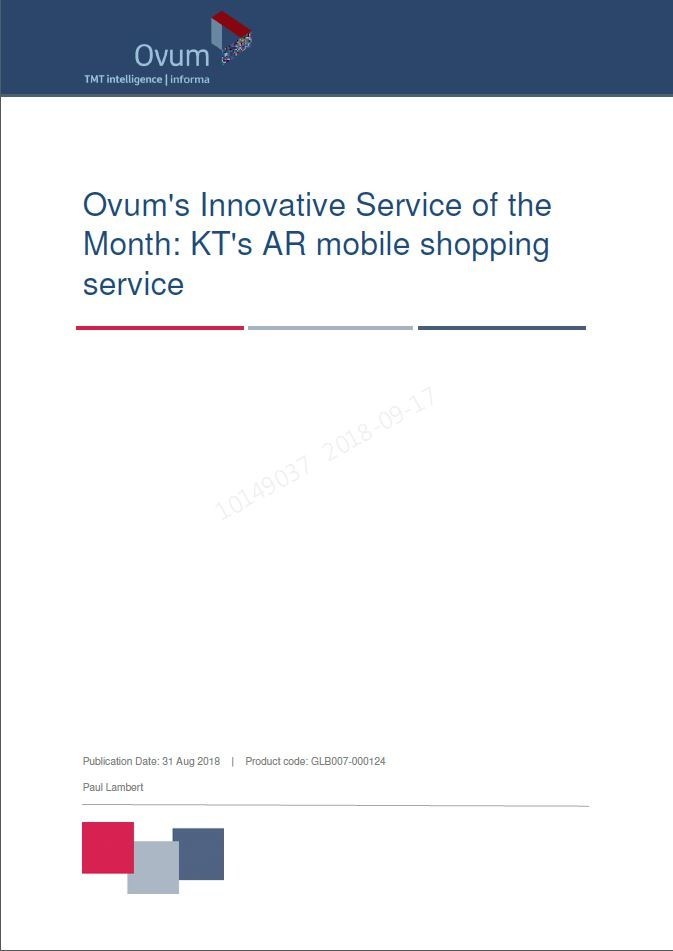
The cover of OVUM’s report for Innovative Service of the Month, published on August 31.

KT’s AR Market, an AR-powered mobile shopping service first launched in South Korea, was recently selected for Ovum’s Innovative Service of the Month. Ovum is an independent analyst and consultancy firm based in London. The British firm reviewed 92 different innovative services launched by service providers around the world in July and announced its selection of AR Market on August 31.

Also Read: Sprinklr and Snaps Drive Human-Robot Collaboration for a New Era of Customer Care

“The service is an excellent example of how a telco can try to secure competitive advantage in emerging technology by developing an advanced in-house technical capability,” Ovum wrote in a report about its selection of AR Market. “By developing extensive AR capability in-house, KT has put itself in a strong position to become a player not just in South Korea’s AR market, but also in the global AR technology movement.”

The Korean telecom leader is developing immersive shopping and media services by applying next-generation Information and Communication Technologies (ICT), featuring not only AR but also Artificial Intelligence (AI) and 3D modeling. KT Chairman Hwang Chang-Gyu announced last week that KT also plans to launch VR Theater, a Virtual Reality (VR) service on Internet Protocol Television (IPTV), later this year.

Also Read: Clari Names Cornelius Willis as Chief Marketing Officer

KT first introduced its AR solutions for mobile shopping during the 2018 PyeongChang Winter Olympic Games in February. AR Market gives mobile users an online shopping experience that is more similar to browsing through a physical store. Shoppers can view 360-degree AR videos of different products on their smart devices.

KTH Co., KT’s T-commerce unit, launched KT’s first commercial AR solutions in July through K Shopping’s mobile app. K Shopping, a frontrunner in South Korea’s T-commerce market, introduced AR Market for lifestyle products, fashion and consumer electronics last month. NS Home Shopping, the country’s largest home shopping business for groceries, also debuted KT’s AR Market.

KT began accelerating its immersive media business late last year. It launched two VRIGHT VR theme parks in Seoul this year in partnership with GS Retail Co., a major convenience store chain operator in South Korea. KT plans to franchise its VR entertainment business next year both at home and overseas.

Recommended Read: Bitsclub Vision Program Enters Strategic Partnership With Contentos to Create Decentralized Global Content Ecosystem

Nearly Half of Businesses Spend More Than $500,000 on Digital Marketing

1
Nearly Half of Businesses Spend More Than $500,000 on Digital Marketing

Businesses Today Prioritize Their Online Presence, Devoting More Resources to Digital Channels That Get Them in Front of Customers, According to Data from a Recent Survey

Almost half of businesses invest at least $500,000 in digital marketing every year, according to a new survey from The Manifest, a business news and how-to website.

Forty-one percent (41%) of businesses spend at least $500,000 on digital marketing annually, and 81% spend at least $50,000.

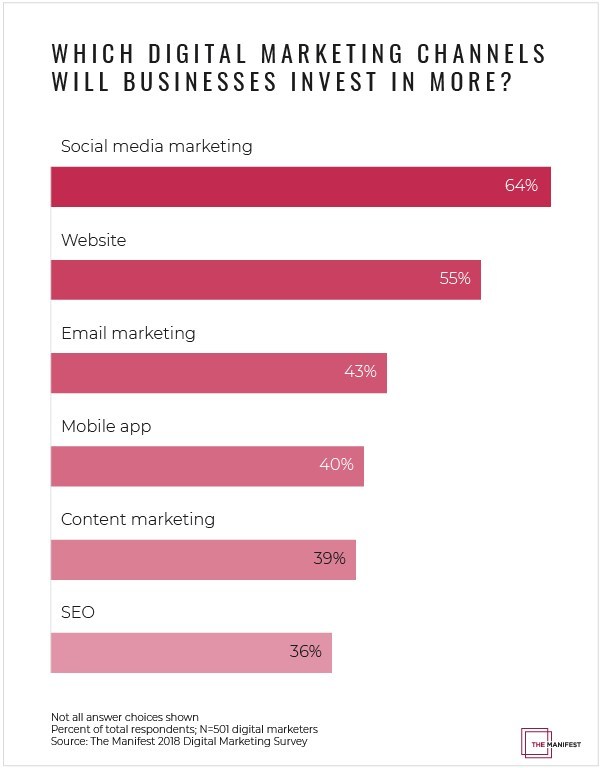
Businesses will spend more on social media (64%) and websites (55%) as part of their digital marketing strategies in 2018-2019, according to a survey by The Manifest.

“There’s been a significant uptick in digital marketing spend because it’s where consumers are,” said Flynn Zaiger, CEO of Online Optimism, a digital marketing agency in New Orleans. “If you’re trying to be in front of your customers, the screen is the place to be.”

Also Read: Location Marketing Platform HYP3R Raises $17 Million in Series A Funding

Ninety-Nine Percent of Businesses Will Increase Digital Marketing Spending by Mid-2019

Almost every business plans to invest more time and money in digital marketing.

Among businesses that use digital marketing, nearly all (99%) plan to increase their investment in at least one channel in the next year.

Businesses place considerable value in digital marketing and want to invest more in it because customers spend much of their time online.

“Everyone is online, all the time, and digital marketing is crucial in reaching this huge audience where they are,” said Aylin Cook, head of content marketing at digital marketing agency Single Grain.

Also Read: Unacast Launches “Clear View Data Pledge,” Unlocking the Black Box Surrounding Location Data

Businesses Will Spend More on Social Media and Websites

Most businesses plan to increase their investment in a combination of digital marketing channels, with social media (64%) and websites (55%) topping the list.

Experts say both channels are easy investments for businesses and deliver clear returns.

“[Social media marketing and websites are] the strategies that business owners are most comfortable with,” Zaiger said. “If you’re trying to make a decision that will at least guarantee some sort of results, chucking money at social media or your web designer will make something happen.”

Businesses want to invest more in social media and a website because they are easy investments with measurable results.

Also Read: Agora.io Brings Live Video and Broadcasting Solutions with Global Scalability to IBC 2018

One-Third of Businesses Plan to Outsource Digital Marketing

Among businesses that rely solely on in-house staff and software for digital marketing, nearly one-third (32%) plan to outsource their digital marketing within the next year.

Outsourcing digital marketing can help a business receive essential external perspective, experts say.

“[Companies] should be getting an outside perspective because sometimes extra minds can be a really big bolt to someone’s system,” Zaiger said.

Overall, the survey indicates that businesses across all industries value digital marketing and will continue to spend more on it every year.

The Manifest’s 2018 Digital Marketing Survey included 501 digital marketers from US companies with more than 100 employees.

Recommended Read: Adobe Announces Innovations in Video Suite at IBC 2018

Kochava’s New Audience Insights Enable Marketers to Take Maximum Leverage of Targeting

0
Kochava’s New Audience Insights Enable Marketers to Take Maximum Leverage of Targeting

Kochava’s New Audience Insights Enable Marketers to Take Maximum Leverage of Targeting And Be More Precise in Their Marketing Endeavors

Kochava is an industry leader when it comes to measuring solutions for Smartphones and connected devices. The company recently announced the release of its brand new ‘Audience Insights’ tool which facilitates visualizing key audience characteristics within Kochava Collective, which is the company’s independent mobile data marketplace.

Reaching the correct set of the audience is the holy grail for marketers, although, they know that this is also one of their biggest challenges. Marketers can map an ideal audience persona for targeting. However, without accurate data about how this audience is placed, marketing campaigns are less likely to succeed.

There are many enterprises today that specialize in providing extensive audience datasets. This data stack is spread out demographically and/or between several devices. The data provide some insights to marketers about locating their ideal buyer but is still insufficient. In order for marketers to derive wholesome insights from this distributed data, they will need to combine this data which is a back-breaking task. This is exactly where marketers can leverage Kochava’s capabilities.

Also Read: Adobe Announces Innovations in Video Suite at IBC 2018

Grant Cohen, GM of the Kochava Collective said, “marketers might think they know their users, but the Audience Insights tool offers cohesive data to either confirm their assumptions or reveal new characteristics. Audience Insights is a simple, versatile tool, effective for advertisers and supply-side partners alike. Marketers can use it to better understand their audiences for targeting or even product development. Supply partners can show their advertisers evidence of the kinds of audiences they are selling.”

Kochava believes that the key factors to form the perfect audience set are based on combining data from certain key aspects. These aspects are –

Device Information

Data coming from a device’s make, model, carrier, language, and location.

Audience Behavior Data

Data collected from audiences’ application preferences, applications on a consumer’s mobile phone and visiting patterns to online content.

Also Read: Ooyala and ODMedia Collaborate Streamlining Video Processing and Global Delivery

Demographics

Data collected about a person’s demographics (age, sex, gender, location etc.)

When marketers combine data from these elements it is possible for them to understand exactly where they can target their campaigns. They can also compare their existing dataset to see if it’s the right fit for their targeting initiatives. Utilizing one or all of the aforementioned data points, marketers can build their own custom audience sets. These derived insights can then be exchanged with enterprise stakeholders to solidify marketing strategies.

This tool has been made available as part of the Kochava Collective.

Recommended Read: Marketing Technology Bulletin Covering the Week Gone By

Snappy Kraken Named WealthManagement.com 2018 Industry Awards Winner

0
Snappy Introduces Personal Gifting Plugin for ChatGPT

Adviser Lead-Gen Innovation Recognized for “Social Media Leadership” (Technology Providers)

Snappy Kraken, a MarTech company focused on helping financial professionals automate their marketing and business processes, was selected as a winner of the WealthManagement.com 2018 Industry Awards, the only awards program of its kind to honor outstanding achievements by companies and organizations that support financial advisor success. The awards were announced last night at a black-tie gala event at the Ziegfeld Ballroom in New York City. The winners were selected by a panel of independent judges made up of top names in the industry.

“We are humbled to receive the award in our first year of nomination,” said Robert Sofia, Snappy Kraken CEO and co-founder. “The Snappy Kraken team has done an exceptional job of developing technology and creating high-quality visual products that will benefit advisers in all stages of their client communication and marketing goals. We are pleased to be recognized for our efforts in 2018, but in reality, we’ve only just begun to show what we can do. Stay tuned for more exciting developments as we look toward the end of 2018 and round the corner to 2019.”

Also Read: Mel Edwards Named Wunderman’s Global CEO

SELECTION PROCESS

A judging panel of industry luminaries selected Snappy Kraken as the winner in the category of “Social Media Leadership” (Technology Providers) for their dedication to developing visually stunning content, affordable digital marketing campaigns and professional video production services for financial advisers.

“We’ve received an incredible response from the industry to our ‘Seminar Freedom’ program, which automates adviser marketing to capture leads, boosts attendance at virtual seminars and converts cold leads into hot prospects without taking up any more of the adviser’s time,” Sofia said. “We are committed to creating and developing additional dynamic, marketing products in the new year, bringing marketing automation and fresh concepts to help advisers streamline workflows and fill their client pipeline. It is a true honor to be recognized by WealthManagement.com as a leader in our field.”

Also Read: Vonage’s Nexmo Connect Partner Program Launches with over 100 Partners Ready to Build Innovative Solutions for Enterprise Customers

Snappy Kraken, is a SaaS marketing solution that helps financial advisers personalize, automate, and track marketing campaigns and business processes. Users can choose from a number of ready-made campaigns, each containing combinations of professionally designed and written email drip series, social media posts, ads and more. Clicks, opens, and shares are managed and tracked from within a single dashboard.

Snappy Kraken recently was awarded the 2018 WealthManagement.com Industry Award in Social Media Leadership, Technology Providers, the only awards program of its kind to honor outstanding achievements by companies and organizations that support financial adviser success.

Recommended Read:  MarTech RADAR 2018: Top 150 B2B Technology Companies You Should Follow

Webgility Expands Operations in the US with Additional Office in Scottsdale, AZ

0
Webgility Expands Operations in the US with Additional Office in Scottsdale, AZ

Leader in Ecommerce Automation Expands To New Location to Support Business Growth

Webgility, the leader in ecommerce automation software for multichannel sellers has officially announced its US expansion in Scottsdale, Arizona. Headquartered in San Franciscowith an international office in India, this important milestone indicates significant growth for Webgility, a pioneer in automating back-office ecommerce operations since 2007.

Webgility is hiring aggressively and looking for talented professionals in customer success, sales, support, and engineering.

Trusted by thousands of ecommerce businesses to process millions of orders each month, Webgility’s Unify software enables sellers to boost profits and productivity by integrating their apps, automating operations, and providing powerful business analytics. By harnessing the power of ecommerce data, Webgility Unify helps sellers

Also Read: SOCi Releases SOCi Go Enabling Multi-Location Brands to Access and Manage Social Content from Anywhere

  • keep all their sales channels and apps in-sync;
  • optimize orders, inventory, shipping, and accounting; and
  • uncover actionable insights to reduce costs and grow revenue.

The high demand for Webgility Unify among ecommerce businesses has driven this expansion and the company has multiple positions open in all departments and locations.

Also Read: Discourse.ai Unveils the First AI-Based System of Record for Customer Conversations, Unlocking the Value of Customer Conversation Data

“It’s an exciting time, both for Webgility and the entire ecommerce industry,” said Parag Mamnani, Founder and CEO, Webgility. “Our expansion into the greater Phoenix area was a necessary step to support our growth. We’re hiring aggressively and looking for talented professionals in customer success, sales, support, and engineering. I look forward to making new friends and creating another home for the Webgility family.”

Webgility provides ecommerce and accounting automation solutions by integrating ecommerce and POS applications, streamlining data flows, automating accounting and back-office operations, and providing actionable insights to maximize ROI. Webgility manages millions of customer transactions through thousands of online stores every month.

Recommended Read: DocuSign drives innovation in Fall ’18 Release

Keith Sedlak Joins Harte Hanks as Senior Vice President of Sales for Marketing Services

0
Keith Sedlak Joins Harte Hanks as Senior Vice President of Sales for Marketing Services

Brings Deep Expertise in Marketing Solutions, Business Development and Client Relations

Harte Hanks announced that Keith Sedlak will join the Company as Senior Vice President of Sales for Marketing Services. In this role, Mr. Sedlak will draw on his significant background in marketing solutions, business development and client relations to help advance Harte Hanks’ strategy and bring the Company’s innovative approach to a broad range of clients and industries.

Most recently, Mr. Sedlak served as Senior Vice President for business development at The Engine Group, a New York-based marketing firm. Mr. Sedlak has worked with multiple Fortune 1000 companies across a variety of industries, including CPG, Automotive, Retail, Healthcare, Financial Services, Management Consulting, Travel and Technology. He brings deep experience developing data-driven solutions across all media channels and marketing technology platforms.

Also Read: Clari Names Cornelius Willis as Chief Marketing Officer

Mr. Sedlak, who will be based in New York City, will report to Martin Reidy, Member of the Harte Hanks Board of Directors and the Office of the CEO. The Company also announced that Chief Marketing Officer Frank Grillo has resigned effective September 17.

“We are excited to welcome Keith, whose proven track record of success and client service will be invaluable as we enter a new and exciting period for our Company,” said Mr. Reidy. “With a technology-focused, data-driven approach, Keith is ideally suited to lead growth in Marketing Services and to collaborate with the leaders of Harte Hanks’ other practice areas.”

Also Read: Forbes Names Hootsuite Among ‘Best and Brightest’ Private Cloud Companies in Cloud 100

“This appointment is an important step as we continue to bring in top talent to Harte Hanks and focus on driving growth and financial performance,” said Jack Griffin, Member of the Board of Directors and Chairman of the Office of the CEO. “We are excited about the opportunities in the marketing services space, including potential M&A activity, as we seek to accelerate growth and improve profitability. Keith’s background in these areas provides Harte Hanks a significant advantage moving forward.”

Recommended Read: Optimizely Introduces Adaptive Audiences To Personalize Digital Experiences Through Machine Learning

World’s First AR, VR & MR Marketing Conference Announces Speakers and Agenda

0
World’s First AR, VR & MR Marketing Conference Announces Speakers and Agenda

Mixed Reality Marketing Summit takes place on Nov. 5 in New York City

Mixed Reality Marketing Summit, the world’s first AR, VR, MR conference completely focused on educating marketers, entrepreneurs and business owners on how to successfully enter the augmented reality and virtual reality space, will take place at the PlayStation Theater in New York City Nov. 5th. The groundbreaking, one-day summit will equip marketers on how to successfully enter the immersive space or continue experimenting with AR, VR or MR in their marketing mix.

“Augmented reality and virtual reality will present new challenges and opportunities for marketers. Now is the time for marketers to get educated on these immersive technologies and prepare themselves and the brands they represent for the next computing platform,” said Manny Ruiz, partner at Mixed Reality Ventures, the holding company for Mixed Reality Marketing Summit.

Also Read: Agora.io Brings Live Video and Broadcasting Solutions with Global Scalability to IBC 2018

The expert line-up includes:

— Keynote speaker: Kaitlin McGirl, Snap’s Head of Creative Strategy East Coast
— Hollywood director of “Lawnmower Man” & “Virtuosity” Brett Leonard
— Nonny de la Peña, the Godmother of VR, world renowned pioneer of AR/VR and CEO of Emblematic Group
— Niantic’s former lead creative for Pokemon Go! John Zuur Platten
— Dorothy Dowling, CMO, Best Western Hotels & Resorts and an early adopter of AR marketing strategies
— HP’s Global Head of Virtual Reality for Location Based Entertainment, Joanna Popper
— Former Cooking Channel Star & immersive entrepreneur, Gabriele Corcos
Chris Bobotis, Director of Immersive at Adobe
— Arun Batra, General Manager, Digital Operations at Wayfair
— Charlie Fink, AR/VR consultant, Forbes columnist, speaker, and author
— Tim Greenberg, Chief Community Officer at the World Surf League
— Resh Sidhu, England’s Queen of VR and Creative Director at AKQA
— Chris Barbour, Facebook, AR Camera & Content Creation Partnerships Lead
— Cathy Hackl & Samantha G Wolfe, co-authors of the 1st VR & AR marketing book: Marketing New Realities
— Stewart Rogers, Director of Marketing Technology at VentureBeat
— VR/AR Association Founder and CMO of Quantum Capture, Nathan Pettijohn
— And many more speakers to be announced

The Mixed Reality Marketing Summit provides marketers with necessary tools to succeed in a new and evolving medium. Content include keynotes and panel discussions, brand and agency roundtables on how to develop immersive marketing strategies, best practices, measuring success, and much more.

Also Read: Sprinklr and Snaps Drive Human-Robot Collaboration for a New Era of Customer Care

The agenda includes:

— Why Mixed Reality is Now Truly Ready for Primetime
— The Power of Play & The Rise of Camera Marketing (Snap)
— Creating Content in the New Era of Mixed Reality Marketing
— Start with Strategy: Planning Your Brand’s Road Map for Mixed Reality Marketing
— From eCommerce to XR Commerce
— Looking at AR From a Social Lens
— Thinking Outside the Headset: The Next Generation of Mixed Reality Marketing
— From ROI to Return on Engagement: The Evolving Metrics of Mixed Reality
— The Next Wave of Experiential Marketing

Other Mixed Reality Marketing Summit partners include the VR/AR Association, Media Village, Hype, VR Voice, PRODU, and Exma.

This event is for entrepreneurs, CMOs, agency managers/owners, educators and any professional in the marketing, digital, communications, advertising and public relations industries, who are interested in learning from some of the world’s leading VR/AR marketing leaders and want to future-proof their careers for the coming revolution in mixed, augmented and virtual reality marketing.

Resolving the Ecommerce Identity Crisis

2
Resolving the Ecommerce Identity Crisis

s6.ioBy requiring logins for purchases, ecommerce platforms gain access to some of the most valuable first-party data in the ecosystem. Even after a single purchase, ecommerce platforms know a lot about an individual, from where they live to what kinds of products they prefer to what brands they prefer and general inferences on the socioeconomics of households and individuals. This knowledge enables a great deal of effective loyalty and retention marketing, particularly via email and direct mail. But as it relates to a person’s larger online journey—the more than 24 hours a week that the average American spends across various connected devices, a number that more than doubles when you include connected TVs—most ecommerce platforms are failing to connect the dots.

The challenge that ecommerce platforms face in this regard is that many users stay anonymous to them as they browse on platforms while logged out. Without the ability to connect these users’ unknown profiles to their resolved and unresolved IDs, ecommerce platforms’ attribution modelling and recommendation tools are severely limited in their effectiveness.

Ecommerce platforms today need to get a better handle on the identity of their users across devices and be able to layer on intelligence about activities that occur when people are not logged into the platforms themselves. By doing so, ecommerce platforms will see drastic improvements across the following three critical functions.

Also Read: How WhatsApp Can Optimize For Ecommerce

Multi-Touch Attribution

When a user logs onto an ecommerce platform and makes a purchase, that sale has real value to the brand. But if the ecommerce brand doesn’t understand how and why that user came to make that purchase—where the user encountered ads and which ones seemingly drove the user closely to final purchase—then the ability of the e-commerce platform to replicate those sales is severely diminished.

One of the biggest challenges ecommerce platforms face in proper multi-touch attribution is the fact that a single user possesses many IDs—across browsers and devices, some with and some without any historical data connected to them. To truly understand the customer path to purchase, ecommerce platforms must be able to link the many user IDs a single customer generates from their activity on mobile web, in-app, desktop, connected TVs and other devices.

Read More: How MarTech Can Help You Step Up Your Multicultural Marketing Game

Audience Profiling

Beyond attribution, gaining a better cross-device understanding of customers will enable ecommerce platforms to forge deeper relationships with those individuals. When ecommerce platforms can tie multiple IDs to a single user, their view of users shifts dramatically. Without a cross-device understanding, an individual essentially fractures into multiple users. On one ID, an e-commerce platform might see a high-income person in the 20-29 age range. On another ID, the platform might see a man living in Amsterdam. On yet another, no information is available. Yet, all three represent a single individual. If an e-commerce platform can reconcile that identity and understand it is looking at the same high-income young man in Amsterdam across all three IDs, the user journey for that person can become infinitely more tailored—and ultimately beneficial to the retailer.

In addition, ecommerce platforms need to be able to match profiles of logged-in users with those users’ non-logged in behavior. Without this capability, the platforms miss out on the ability to properly retarget to users on sites and platforms other than their own. It also severely limits their ability to conduct proper A/B testing and fully leverage recommendation tools.

Read More: Five Things to Consider When Marketing to College Students

Audience Amplification for Recommendations

Going a step beyond audience profiling, ecommerce platforms should seek to target known users with recommended products—even when those users are not logged into their platforms. If the ecommerce brand is able to resolve the identity of individuals across platforms, whether or not they are not logged, they can tailor recommendations to the person’s previous searches or on-platform browsing behaviors derived from their deterministic, logged-in profiles. These recommendations are a key requirement for effectively driving repeat purchases.

Although ecommerce platforms retain a wealth of first-party data on their customers, they must go beyond that knowledge to acquire a full-cross device understanding of those valued individuals. Only in doing so can they hope to reap the benefits of effective multi-touch attribution, as well as comprehensive retargeting and product recommendations across the entire customer journey.

Read More: A Beginners Guide to Positioning a Strong Online Brand

SpotX Announces 100% ads.txt Compliance

1
SpotX Announces 100% ads.txt Compliance

Spotx Releases Infographic Tracking Adoption of IAB Initiative

SpotX, the leading global video advertising and monetization platform, announced the launch of a new infographic that highlights its 100% compliance with the IAB’s ads.txt specification version 1.0.1.

Since June 2017, SpotX has advocated for ads.txt adoption and helped educate publishers on the benefits of the Authorized Digital Sellers initiative, which is designed to empower publishers and distributors to declare who is allowed to sell their inventory. This improves transparency for programmatic buyers and the wider ecosystem as illustrated in the infographic.

Also Read: Location Marketing Platform HYP3R Raises $17 Million in Series A Funding

To be 100% compliant, SpotX has ensured, since July, that when an ads.txt file is present, all bid requests to a demand side platform (DSP) are only from sellers within an ads.txt file. This guarantees the business will run in a fully compliant manner.

The infographic shows that 85% of SpotX publishers have adopted ads.txt, which is above the industry average of 60% adoption. It also depicts that ads.txt-enabled sites monetizing through SpotX deliver 12% higher viewability rates and 15% higher eCPM compared to sites without ads.txt. Although having an ads.txt file on a site does not guarantee it’s fraud-free, sites without ads.txt have approximately four times more invalid traffic on average, something SpotX actively works to eliminate via its in-house Brand Safety Team.

Also Read: Unacast Launches “Clear View Data Pledge,” Unlocking the Black Box Surrounding Location Data

Mike Shehan, co-founder and CEO at SpotX explains, “SpotX is committed to working with publishers and advertisers to ensure the industry benefits from the positive results of ads.txt. A crucial trend we have observed is the growing support of DSPs including dataXu, MediaMath, and The Trade Desk whose increased implementation is driving industry-wide adoption.”

SpotX is the leading global video advertising platform that enables media owners and publishers to monetize premium content across desktop, mobile and connected TV devices. As a modern ad server with programmatic infrastructure, data enablement, and monetization solutions for OTT, outstream, and addressable TV, SpotX gives media owners and publishers the control, transparency, and actionable insights needed to understand buyer behavior, manage access and pricing, and maximize revenue.

Recommended Read: Adobe Announces Innovations in Video Suite at IBC 2018

Have We Lost Sight of Viewability?

0
Have We Lost Sight of Viewability?

Remember viewability? It seems like only yesterday that it was the digital ad industry’s cause de guerre. After all, what good is an ad if it can’t be seen by the consumer. Ads that are served “below the fold,” or that fail to load sufficient pixels to be read and understood, have no chance to influence consumers purchasing decisions.

In 2015 wave-making CMOs like P&G’s Marc Pritchard and Unilever’s Keith Weed dominated the conversation with public calls for digital to clean up its act and provide guarantees that digital inventory would be viewable. As late as 2017 media buying heavy-hitters like Group M were pushing for more stringent viewability standards. More recently, it seems that the conversation around viewability has died down. So what happened? Did all the ads suddenly become viewable?

Also Read:  Keeping up with Everyone’s Insatiable Appetite for Visual Content

The answer, unfortunately, is both yes and no. One reason that viewability has fallen off the radar of industry thought leaders and marketing trades is that we have made some progress. It was once considered standard to assume that anywhere from 30-50% of a digital ad buy would be wasted on non-viewable impressions. This type of waste was seen as the cost of doing business, at scale, in an unruly digital environment.

Today, through the combined efforts of technology providers and major platforms, as well as pressure from industry leaders willing to back up their tough talk with reduced ad budgets, the baseline conditions of viewability have improved. While some advertisers still expect only 60% of their impressions to be in-view, it is now possible to push those numbers as high as 95% by employing smart buying strategies and verification technology. The cost of viewability is high, but greater viewability is possible.

Also Read: People-Based Marketing: 5 Ways to Win

Things are getting better for viewability, but that still leaves a lot of ads unseen, so why has the industry conversation quieted down? Another factor driving the shift in focus is the rise of competing topics that impact media quality. In late 2017, P&G’s Marc Pritchard decreed that brand safety, not viewability, would be the key issue of 2018. After a year that featured wildly unpredictable news cycles, the spread of hate speech on social media, a wave of politically charged brand boycotts, and the continued rise of fake news it’s no surprise that brand safety has sucked up a lot of oxygen in the conversation about digital advertising. I get it, sometimes it’s sexier to talk about avoiding fake headlines and inflammatory content than to deal with the dirty details of how many pixels of your ad are in-view and for how long. But viewability is still a critical issue that’s causing smart marketers to waste valuable dollars and we can’t take our foot off the gas.

Also Read: Why Millennials Gravitate Towards Minimalistic Branding

Most of the progress that’s already been made on the challenge of viewability was the result of collective action on the part of the digital advertising industry. The push to improve viewability standards came from marketing leaders at major brands who adjusted their spend to prioritize viewable inventory. It also came from major media buyers setting new standards that forced the industry to produce higher quality inventory, from publishers who optimized their sites to deliver that inventory, and from technology partners who helped marketers to identify and target in-view impressions.

The cumulative impact of this action was improved viewability conditions for all. However, that work isn’t done yet. Desktop viewability has improved dramatically, but there is still work to be done in mobile and video to ensure that these emerging channels provide value for marketers without wasting their money. Organizations like the MRC can continue to push for high standards of viewability across all channels and marketers can continue to prioritize those demands with their dollars. The outcome of continuing the conversation around viewability can and should be 100% viewable inventory, across all channels, for all.

Also Read: A Beginners Guide to Positioning a Strong Online Brand

TechBytes with Edward Chu, Director of Software Engineering, Bedrock Analytics

0
TechBytes with Edward Chu, Director, Software Engineering, Bedrock Analytics

Edward Chu
Director, Software Engineering, Bedrock Analytics

Most CMOs would agree that the power of data intelligence and automation tools helps drive efficiencies in reporting and analytics. Edward Chu, Director, Software Engineering, Bedrock Analytics, shares his predictions about the future of Analytics-as-a-Service, and the key skills needed to succeed in the sales analytics space.

Html code here! Replace this with any non empty text and that's it.

Tell us about your role at Bedrock Analytics and the team and technology that you handle.

I’m the director of software engineering at Bedrock Analytics, an intelligent analytics and insights automation platform for the Consumer Packaged Goods (CPG) industry. We offer a cloud-based analytics platform and insights automation tools that enable sales managers and business analysts to harness the power of data in order to craft powerful sales presentations. My job is to make sure our analytics and data tools are as powerful as possible yet at the same time are intuitive and easy to use. The team consists of several other engineers and a data scientist. We work very closely with the Sales and Product teams to understand what our clients need and deliver innovative solutions to the market. The CPG industry is being transformed by Big Data and advanced analytics right now, so it’s a very exciting time to be involved in it!

What are the core tenets of your data-driven analytics?

There are several core tenets driving our business. The first is the combination of power and simplicity. We distill complex datasets from market syndicators and retail outlets into the simple, powerful storylines that matter most for CPG manufacturers, and we present the data through a simple, easy-to-use dashboard that anyone in the organization can use. Our goal is to put the power of advanced analytics directly in the hands of every salesperson, marketing manager, and business executive, so that they don’t have to rely on data scientists or BI analysts to get the insights they need to drive their business forward.

Another important tenet to our business is efficiency and automation. We automate the data analytics process so that CPG companies can access important insights in less time and with fewer resources. We believe in the power of data intelligence and today’s automation tools to help drive efficiencies in reporting and analytics. A lot of the tools that we build are intended to help people do their jobs faster, smarter and more efficiently, so they can focus less on querying data and more on what they do best.

And one more tenet is the idea of storytelling. After all, data by itself is meaningless. The point of data and analytics is to tell a story so that people can make informed decisions based on certain outcomes. We’re not talking about stories as pieces of fiction, but stories in terms of narrative structures that help give clarity and insight into the true definition of things. Our data and reports are structured in a way that helps people tell convincing narrative stories that support sales and grow their business.

What are your predictions on Analytics-as-a-Service for 2018-2020? What are the key skills needed to succeed in the sales analytics space?

Analytics-as-a-Service will definitely become the primary vehicle for buying and selling analytics services by 2020, if not much sooner. It is simply easier for the end-user to access analytics through the web than have to deal with software maintenance and updates. This means that to succeed in sales analytics there’s a lot less need for hand-holding and training during the setup and integration periods, and a lot more opportunity to serve as a consultant to our clients. The sales role becomes less of a facilitator and more of a strategic consultant who spends less time getting the software integrated and more time demonstrating the true value it brings. That’s a win-win for analytics providers and their customers.

What impact would analytics and reporting tools have on traditional sales automation platforms?

Across just about every industry, from advertising and media to CPG, we are seeing sales become much more of a data-driven effort. This is especially true in CGP. Retailers used to allocate shelf space primarily to big brands or those companies that they had a pre-established relationship with. But now, companies that have the data to show who their products sell to, at which price point, in which market, and so on are winning over retailers and securing shelf space for their products. This has opened the door for a number of CPG companies to compete in areas that they were blocked out of before. And it basically means that any type of sales tool or automation platform has to have analytics and reporting tools at the very heart of what it does.

How do you see trends in Data Management influencing the adoption of analytics tools for non-marketing and non-sales processes?

Most analytics tools are built to support sales and marketing processes, but the third constituent of analytics users include all of the corporate executives who need insight into how their businesses are growing. With data management becoming more accessible, executives have more power than ever to dig into advanced analytics on their own, without the need for a BI analyst to run queries and produce reports for them. It will take them down paths that they might not have even thought of before because they will learn to think more analytically about their businesses and get better answers to their questions. This mentality will also trickle down to the rest of the organization and help the entire business adopt a more data-driven culture.

What role do you see for AI/ML in sales data reporting and visualization? What does Bedrock’s product roadmap look like for 2018-2022?

Machine Learning and Artificial Intelligence already play a huge role in sales data reporting and visualization, especially in the CPG industry. One area that we apply machine learning to, for instance, is to sync together all of the disparate data sources that CPG companies get from retailers, measurement firms, and so on and make them all match up. This alone can save a company countless hours of time having to reconcile the reports manually, by using machine learning to understand things like category names and product descriptions. We don’t want to give our whole product roadmap away, of course, but let’s just say that ML and AI will come in very handy to help extract meaningful insights from the mountains of data that are available and even make predictions in terms of how a product is expected to perform in certain areas or among certain demographics. The industry is just scraping the tip of the iceberg in terms of what AI and machine learning can do, and we aim to be at the cutting edge of innovation in this area.

Thanks for chatting with us, Edward.

Stay tuned for more insights on marketing technologies. To participate in our Tech Bytes program, email us at news@martechseries-67ee47.ingress-bonde.easywp.com

Interview with Matthew Wasserlauf, CEO and Founder, Torrential

0
Interview with Matthew Wasserlauf, CEO and Founder at Torrential

[vc_wp_text]“While TV advertising will remain an important medium in the greater mix, it’s importance will diminish as millennials access video across devices.”[/vc_wp_text]
[easy-profiles profile_twitter=”https://twitter.com/mattbbe?lang=en” profile_linkedin=”https://www.linkedin.com/in/matthew-wasserlauf-13360364″]

Tell us about your role and journey into technology. What inspired you to find Torrential?

My role in the tech industry was born out of an epiphany I had in 1998 at the Warner Bros. lot in Burbank, CA. Jeff Weiner (now CEO of LinkedIn) was walking us through CityWeb; a digital product merging the worlds of Warner Bros. with Time Inc. in a never-seen-before, internet destination that absolutely blew me away.  “You mean I can click on a video of Jennifer Anniston in Friends and buy her sweater?”

I was sold.

I told myself at that moment that I need to figure out this world of web video.

Six years later, I would start BBE and go about building the foundation of the Online Video industry.  My role and journey in technology then solidified.

After selling BBE in 2010, the next logical place to go was figuring out the world of “mobile video.”  To do that, I partnered with Doug McCurdy and Tarun Yadav, both instrumental in my building BBE, to found Torrential.  Five years later we sold Torrential to ITN, an unwired broadcast network.

It’s been an amazing ride.

What is Torrential and how does it fit into a modern CMO’s tech stack?

Torrential is and was a mobile video platform that opened the doors for major marketers to the world of premium video. From the onset, Torrential has been serving video ads into the apps that provide the mobile devices their full episode player (“FEP”) video programming. What that led to is the fast scaling world of OTT (“Over the Top”). OTT is the inventory of premium video that CMOs most covet in media today. CMOs pay a premium rate for this inventory as it represents today’s best programming with high viewability, accessed increasingly by the 18-34 millennial demographic.

What are the core tenets of your business model for mobile advertising ecosystem?

The core tenets of Torrential’s business model is a CPM to advertisers for 100% viewable media aligned with the mobile video’s highest demand programming.  Torrential, today ITN Digital, represents all of the FEP’s premium network programming and provides a one-stop solution for advertisers seeking to leverage the best mobile video has to offer.

What are the challenges to modern-day video advertising? Why should brands reconsider their mobile ad-tech budgets?

Mobile Video has created its own obstacles that advertisers are now having to plan for and guard against. Some of the earliest mobile videos were “gaming” where advertisers were presented the most scale to buy an audience. While gaming was certainly fine programming and highly engaging for the audience, it wasn’t the best presentation for marketers and forced the ad messaging to an audience that was less than receptive.

Additionally, other providers presented content that was sketchy in nature (terrorist video, profanity, etc) with YouTube headlining this roster. Marketers including P&G and AT&T had to step in and lead the industry’s efforts to clean up the mess. Even other publishers drove “fraudulent” traffic across mobile video further upsetting the ecosystem. Marketers over the past few years have had to really re-assess their efforts in mobile video and the result has been a resetting in the space that has put a great many actors on notice.

How does AI fit into your advertising and video technology offerings? What are your major differentiators in this tech-heavy landscape?

AI has been held up as something of a panacea for advertisers that has yet to really be fleshed out. AI, which stands for Artificial Intelligence, is fast evolving and could present an automated solution to root out the bad versus good inventory that exists not only across mobile video but also OTT in general.

Tell us about your predictions on TV advertising versus the web and social media advertising technologies? How do you see them converging in the future?

TV advertising remains the go-to for most major advertisers and has been provided a longer sunset as mobile video endures its growing pains that I mentioned above. While TV advertising will remain an important medium in the greater mix, its importance will diminish as millennials access video across devices. Certainly, social media is driving this phenomenon.

The earliest form of convergence of TV advertising and mobile video can be seen in the emergence of OTT. Examples of providers in OTT such as my company ITN Digital and Gannett’s Premio are good examples of this. Major media companies from Comcast to Hulu are also becoming major players that are driving OTT.  This convergence will only grow as the audience shifts from traditional linear TV toward device driven media consumption.

How do you prepare for an AI-centric world as a CEO?

AI, as mentioned earlier, is the technology that’s automated processing and can help provide solutions to the myriad problems that exist in the digital ad ecosystem today. One good example is in the simple instance of data-targeting. A publisher, let’s say Amazon, will sell a new Mom a baby’s crib. Deploying AI or “artificial intelligence” tools, Amazon can use this sales data to now advertise, promote and sell this new Mom baby clothes, toys and any other such things as the baby grows up. All of this data targeting will become more widely deployed in the coming years and as a CEO, I am preparing my companies for that future by opening up my platforms to these new capabilities.

For advertisers, data-targeting in particular and AI, in general, will be a pre-requisite to doing business going forward and as a CEO, it’s imperative to leverage these new tools to build your company in advertising.

Which marketing and sales automation tools and technologies do you currently use?

The Sales and Marketing Automation Tools we use today are growing. A couple of examples of these tools include ad-serving and tracking and data tools.  Programmatic buying and selling is another example that is emerging in advertising and AI is another. The digital advertising industry is inundated with these automation tools and some consolidation would be healthy. Still, automation is a trend that will only grow in importance as the industry scales.

What are your predictions on the most impactful disruptions in marketing operations for 2018-2020?

Marketing disruptions that I predict will impact the Ad Operations space over the next three years are Original Content platforms and blockchain. Original Content, headlined by Jeffrey Katzenberg’s NewTV, will emerge as a prominent marketing channel and the ad tech necessary to distribute, track and measure will emerge over the next few years. NewTV will have to contend with a myriad of smaller players in addition to the major tech companies such as Apple, Facebook and YouTube. Amazon is also planting its flag in the ground here, and like everything else they do, they must be taken seriously.

Blockchain will also emerge over the next three years but its impact is harder to predict. With a lot of trust lost across the digital video industry, Blockchain can go a long way toward fixing this. Expect a lot of new companies and start-ups to pop up in this exciting new sector over the next three years.

What startups in the technology industry are you watching keenly right now?

There are a number of start-ups I’m keeping a close eye on. For starters, I advise a marketing Influencer company called #paid. The company is based in Toronto Canada and is moving quickly now in the States. They market a great many new YouTube stars with an exciting platform. A second start-up I’m watching is Jeffrey Katzenberg’s NewTV. NewTV raised a billion dollars. Yes, billion with a B, and is seeking to produce the next generation of mobile video content. Very ambitious and very exciting. Finally, I’m intrigued by Fresno, a start-up founded by Rob Goldberg which is bringing the video marketplace great new content distributed across Facebook and all the new social nets. There’s a ton of exciting companies out there.

How do you inspire your people to work with technology?

To inspire my people to work with technology, I compel my engineers to create as simple and easy a product as possible and work at building relationships between my tech people and everyone else. My companies always adopted the attitude that if our company didn’t use our technology, no one else would. With that as a mantra, we’ve always set out to ease our customers into adopting our technology and wherever possible, customizing that tech, to meet their needs specifically. Mastering the relationship side of technology has always been the winning formula for our companies.

One word that best describes how you work.

Passion

What apps/software/tools can’t you live without?

There are a few apps, I absolutely cannot live without. The first is MyFitnessPal. After selling Torrential in 2016, I lost 40 lbs. by focusing on my health and wellness using MyFitnessPal. I track everything I eat and document all my exercise via this App. 40 lbs. later, I’m healthy and feel great. I simply cannot live without MyFitnessPal. The second App I can’t live without is “Notes.” I document EVERYTHING. I have hundreds of notes which outline most everything in my life from my goals to the byline I’m writing right here. It’s all in my notes on my mobile phone. Can’t live without it! Lastly, I can’t live without my social networks: Facebook, Instagram, LinkedIn, etc. They are the future of distribution and media and I’m a media and distribution guy. I remember presenting to Facebook in 2006 when their head of sales walked me to the elevator. He asked me if I was on Facebook and I told him I wasn’t. He explained to me that if it was Facebook that I wished to sell partnership with, it was probably a good idea to get on Facebook. As soon as I got back to my office, I got on Facebook and haven’t looked back since.

What’s your smartest work related shortcut or productivity hack?

My biggest shortcut or productivity hack is my mobile phone. I simply do everything on my phone. I remember in 2004 when I started BBE, I bought a mobile phone at the Sprint store in the Flatiron district and told myself that I wouldn’t need an assistant or anyone else for that matter because I’d organize myself with my mobile phone.

15 years later, it’s proven to be my best hack!

What are you currently reading? (What do you read, and how do you consume information?)

Just finished Grant by Ron Chernow and the Book really changed my life. You cannot understand this great nation, The United States, without a firm understanding of the Civil War and the great General that brought the War to its close. I strongly recommend Ron Chernow’s Grant.

In addition to Grant, I read anything I can get my hands on about Blockchain. As I mentioned earlier, I believe Blockchain will have a profound impact on the digital advertising industry and I’m fascinated by those prospects.

What’s the best advice you’ve ever received?

The best advice I ever received came from Jim DePalma, my mentor and boss from my days at CBS.com in the late-90’s. When I started BBE in 2004, I asked Jim, who is a financial guy, by training, how I should go about raising the necessary capital to start the company.

He asked me if I could sell.

“Of course I can sell!”

“Then you don’t need to raise any money,” Jim explained.  Just sell and you’ll have the revenues as your capital.

It was exactly what I did at BBE and it was without question the greatest advice I ever received.

Something you do better than others – the secret of your success?

Emotional Intelligence. That’s my secret sauce. I have worked very hard over many years to build strong relationships with good people. I’ve made it my business to stay close and work in partnership with those good people and it’s manifest into two successful companies that have laid a foundation for the multi-billion dollar online video industry.

Tag the one person (or more) in the industry whose answers to these questions you would love to read:

Jeff Bezos— would love to learn his story and answers to these questions

Thank you, Matthew! That was fun and hope to see you back on MarTech Series soon.

[vc_tta_tabs][vc_tta_section title=”About Matthew” tab_id=”1501785390157-b58e162d-0ae25a4b-c27aca64-108e51b0-80edaf37-bd3d357a-6c46d712-3b68db8f-23cbac8a-8bde”]

Matthew Wasserlauf is known as the visionary who revolutionized advertising by enticing television advertisers to invest their marketing dollars online. In short, he is the OG of OTT. He founded Broadband Enterprises (BBE), the industry’s first online video company and co-founded the mobile video platform Torrential. He currently works with television production company ITN, the leading unwired broadcast network. Matt is often used as an expert resource and byline contributor in the exciting world of OTT.

[/vc_tta_section][vc_tta_section title=”About Torrential” tab_id=”1501785390320-2d44fa50-740c5a4b-c27aca64-108e51b0-80edaf37-bd3d357a-6c46d712-3b68db8f-23cbac8a-8bde”]

Torrential_Logo

Torrential is tomorrow’s broadcast television for a mobile-first, multi-screen world. Our innovative, mobile-first Open Syndication System (OS2) video technology platform connects agencies and Fortune 500 brand advertisers with millions of “always-on” consumers through premium media, original programming and big data across smartphones, tablets, CTV, online, and television.

Torrential provides its diversified client base of agencies, brand advertisers, content creators and media companies with transparency and measurable results, while enhancing the overall digital experience for people.

Founded in 2013 by proven entrepreneurs and former BBE executives Matt Wasserlauf, Doug McCurdy and Tarun Yadav, Torrential is headquartered in New York City.

[/vc_tta_section][/vc_tta_tabs]
[mnky_heading title=”MarTech Interview Series” link=”url:https%3A%2F%2Fmartechseries-67ee47.ingress-bonde.easywp.com%2Fcategory%2Fmts-insights%2Finterviews%2F|||”]

The MTS Martech Interview Series is a fun Q&A style chat which we really enjoy doing with martech leaders. With inspiration from Lifehacker’s How I work interviews, the MarTech Series Interviews follows a two part format On Marketing Technology, and This Is How I Work. The format was chosen because when we decided to start an interview series with the biggest and brightest minds in martech – we wanted to get insight into two areas … one – their ideas on marketing tech and two – insights into the philosophy and methods that make these leaders tick.

New Research from GumGum Shows a Resurgence in Contextual Targeting in Advertising, but Highlights Room for Industry to Grow

0
New Research from GumGum Shows a Resurgence in Contextual Targeting in Advertising, but Highlights Room for Industry to Grow

Use of Contextual Advertising on the Rise but Still Not Mainstream Despite New Technologies, Brand Safety and Data Protection Concerns

Almost half (49%) of businesses in the US are using contextual targeting in their advertising mix with 32% relying on contextual targeting in the UK, according to a new research report “Contextual Advertising: The New Frontier.” The report, released and commissioned by GumGum, an artificial intelligence company with deep expertise in computer vision, explores the current state of contextual advertising, to discover how it is seen by advertisers and agencies across the US and UK.

Contextual targeting, which can be defined by placing relevant ads alongside content that users have an interest in,was revealed as the most widely used form in the US, followed by demographic (46%), geo-location (44%) and behavioural (25%). However, the results also showed that for most firms targeting is cumulative. In both the US and the UK, roughly two thirds of respondents (61%) said they wouldn’t consider using contextual targeting on its own in the future. Twenty-eight percent of respondents use contextual targeting all the time.

Also Read: Interview with Ben Plomion, CMO, GumGum

Adding to the Targeting Mix

Contextual advertising’s ability to increase the relevance of advertising was seen as the main benefit by respondents in both the US and UK. Similarly, its ability to improve the user experience followed shortly behind. Respondents in the US were also notably more impressed with the way contextual targeting improves campaign planning and brand perception, than their UK counterparts.

The research also revealed promising investment plans for contextual advertising. Whilst 61% of respondents kept spending on contextual constant last year, 24% increased it. A further 31% were planning to spend more next year. Approximately two-thirds of companies in both the US and UK (70% and 64% respectively) agreed that change was being driven by technological factors such as the ways that advertising can be targeted to consumers.

Despite the growing numbers, the research found that a quarter (25%) of respondents from the US and 37% of the UK were not using any targeting in their online advertising at all.

Also Read: Location Marketing Platform HYP3R Raises $17 Million in Series A Funding

Emerging New Technologies

One of the reasons contextual marketing is making a comeback, is the rise of semantic technology that allows machines a far deeper understanding of the contents of a page, both words and images, which enable advertisers to create much more sophisticated links between the content and the advertising. This provides a far greater ability to target customers. Moreover, the speed at which today’s targeting systems operate, reduces the latency issues that used to damage the customer experience.

Machine learning and artificial intelligence are at the forefront of what contextual will be able to deliver in the future – the research showed that 66% of those in the US are already using contextual targeting based on images, for example, which has only recently been automated.

Brand Safety Concerns

The renaissance of contextual marketing can also be attributed to brand safety concerns. The research highlighted that marketers are still approaching brand safety with extreme caution. When asked whether the advertisers who pulled their advertising from YouTube in the wake of The Times investigation in 2017 had made the right decision, 79% of UK respondents said yes. In the US, that figure was 65%. New contextual tools offer the ability to examine the content of a page in far more detail, including imagery, opening up more opportunities to reduce risk and deliver ads in brand safe, contextually relevant environments.

Also Read: Unacast Launches “Clear View Data Pledge,” Unlocking the Black Box Surrounding Location Data

The Impact of Data Protection

Less access to third party data, as a result of the EU General Data Protection Regulation (GDPR), is also driving the renaissance of contextual marketing and its value in the UK. This discrepancy between UK and US attitudes to GDPR is only a matter of time according to the report. Whist it might not be top of mind for US companies at the moment, because commerce and data move freely across international borders, many firms in the US and across the globe will need to conform to its guidelines. Its implications will be far reaching and contextual will play a huge role in enabling brands to be smarter in their targeting.

Ben Plomion, CMO, GumGum, commented: “We have seen a number of factors come together in recent months to increase the value contextual targeting brings to online advertising – from brand safety concerns and data protection regulations. But our research also revealed deeper trends such as advertisers desire to associate themselves with better quality content.

Irrelevant advertising and disconnected ads can now be a thing of the past. With the significant technology advances available, and specifically the ability to analyse images and not just keywords, has really thrown contextual back to the forefront of advertising – brands need to take advantage.”

Recommended Read: Marketing Technology Bulletin Covering the Week Gone By

Acceleration Partners Establishes Asia – Pacific Headquarters in Singapore

0
Acceleration Partners Establishes Asia–Pacific Headquarters in Singapore

Acceleration Partners, the largest global affiliate marketing agency, has established a regional headquarters in Singapore and hired Janice Tan-David as Managing Director for their Asia-Pacific region.

“We are thrilled to be officially launching Acceleration Partners in APAC and to have found an incredible leader in Janice,” said Robert Glazer, founder and CEO of Acceleration Partners. “Our ‘Global Strategy, Local Context’ approach to affiliate marketing and program management has allowed our global teams to address the unique challenges clients face when expanding into a new market. We’re excited to build on that with our Singapore headquarters and help existing and future clients positively promote their brands and acquire new customers in APAC and beyond.”

Also Read: Bitsclub Vision Program Enters Strategic Partnership With Contentos to Create Decentralized Global Content Ecosystem

Acceleration Partners has launched and expanded affiliate marketing programs for leading brands in diverse verticals around the globe, including the US, Latin America, the EU and Asia.

“Navigating the nuances of how business is conducted in different countries and stakeholder diversity are the primary challenges for most companies expanding globally. In many parts of the APAC region, which generally encompasses 38 different countries, languages, compliance regulations, states of development and consumer personas, a successful expansion requires a shift in mindset, resources and strategic priorities,” said Tan-David.

Also Read: Optimizely Introduces Adaptive Audiences To Personalize Digital Experiences Through Machine Learning

Performance-driven partner marketing is strong in APAC and offers exceptional growth potential for companies in multiple industries, including online marketplaces, travel and tourism, consumer lifestyle, retail/e-commerce and financial services.

Recommended Read:  MarTech RADAR 2018: Top 150 B2B Technology Companies You Should Follow

Buzzvil Charts Rising Interest in Mobile Lockscreen Advertising

0
Buzzvil Charts Rising Interest in Mobile Lockscreen Advertising

US Marketers Discovering Lockscreen Campaigns that Avoid Ad Clutter and Deliver Fivefold Increases in Consumer Engagement

Mobile lockscreen advertising is emerging as a successful element of US marketing campaigns as once-skeptical businesses reap impactful consumer engagement, according to a new white paper by Buzzvil, a lockscreen advertising platform.

The report, ‘The State of Lockscreen Advertising: Engagement, Revenue and Apprehension in a New Era of Mobile Advertising,’ documents a growth spurt in the nascent use of lockscreen advertising in the US market, coupled with an outlook of the lockscreen’s full potential as more ad spending is directed toward mobile campaigns.

“This is a pivotal time for mobile advertising, and what is possible with lockscreen advertising solutions,” said Robert Seo, CEO, Buzzvil US. “The record-high spending on mobile advertising we’re seeing doesn’t always deliver a corresponding increase in engagement, except for lockscreen campaigns’ delivery of unprecedented levels of consumer interaction.”

Also Read: Mel Edwards Named Wunderman’s Global CEO

 The Buzzvil white paper highlights the new revenue streams and user engagement marketers are achieving as competition for clicks meshes with efforts to avoid negative, ad-driven mobile experiences. Several case studies point to lockscreen campaigns delivering 5x higher Click Through Rates (CTR) compared to average banner ad results.

Key Findings

Buzzvil looked at trends among the 5.4 billion monthly consumer impressions earned among its partners’ lockscreen programs to highlight the reversal of industry issues, including avoidance of accidental ad clicks which can skew actual campaign results. Data analyzed across Buzzvil’s 17 million global users revealed:

  • The average CTR on lockscreen campaigns is 0.28 percent compared to .04 percent of traditional ads
  • 7 times higher CTR than mobile banner ads
  • 0 percent of lockscreen ads resulted in an accidental click
  • The most popular lockscreen incentives offer cash, gift cards or donations to charity

Also Read  Vonage’s Nexmo Connect Partner Program Launches with over 100 Partners Ready to Build Innovative Solutions for Enterprise Customers

 “Publishers are discovering that when they ask consumers if they want a lockscreen program, either to receive loyalty incentives or for ads that speak to consumers’ brand affinity, consumers are overwhelmingly giving them the chance to be the first impression of every mobile interaction,” Seo said.

The paper further explores how lockscreen advertising results in higher engagement with users and improved mobile app download retention that delivers better Average Revenue Per User (ARPU). Examples include:

  • OK Cashbag, a loyalty program lockscreen app that has 600,000 daily active users contributing to $1.2 million in monthly revenue
  • An NBC lockscreen campaign that supported a premiere of Chicago Justice that made 11 million impressions for a 91 percent lift in awareness among fans
  • A British Airways lockscreen campaign that drove 17 percent growth in brand awareness in less than two months
  • A Dell lockscreen campaign that used algorithmic targeting with data from browsed content and downloaded apps to deliver 5.6 million impressions

Recommended Read: Adobe Announces Innovations in Video Suite at IBC 2018

The Benioffs Acquire the TIME Media Brand for $190 Million

0
The Benioffs Buy TIME Media Brand for $190 Million

Meredith Corporation Have Sold the 95-Year-Old Mass Media Group to Marc and Lynne Benioff

Will this be the world’s biggest Marketing Technology-Print merger?

As the print versus digital divide widens, America woke up to the exciting news from the marketing technology landscape. Meredith’s TIME magazine, one of America’s most iconic news magazines, will now be a part of Marc Benioff’s stable. Just days ahead of the biggest and the most trailblazing marketing technology event on the planet – Dreamforce, Salesforce owner Marc Benioff has bought Meredith’s Time Inc. for $190 million. The news comes within a year of Meredith’s purchase of the magazine for $2.8 billion.

The announcement by Meredith said that the Benioffs would not be involved in the day-to-day operations or journalistic decisions at Time.

In an official press release, Meredith has confirmed the sale of the news magazines to Marc and Lynne Benioff for $190 million in cash. The transaction is subject to customary closing conditions and regulatory approvals and is expected to close within 30 days. Marc Benioff is one of the four co-founders of the #1 CRM company, Salesforce. Meredith had completed the purchase of Time along with other publications of Time Inc. earlier this year.

MarTech RADAR 2018: Top 150 B2B Technology …

Now, Marc Benioff could well control the Top 100 most influential names on the planet. Rewind to  1989, when the Time-Warner merger saw one of the ugliest battles, initiated by Paramount Communications (formerly Gulf+Western) to own the iconic news magazine. Since then ‘TIME’ has truly changed. Now, it’s owned by Benioff.

Post this acquisition announcement, Marc Benioff tweeted,

According to sources, The Benioffs are purchasing Time personally, and the transaction is unrelated to Salesforce.com, where Benioff is chairman and co-CEO and co-founder. The announcement by Meredith said that the Benioffs would not be involved in the day-to-day operations or journalistic decisions at Time. Those decisions will continue to be made by Time’s current executive leadership team, the announcement said.

Nielsen And Meredith Corporation Renew Multi …

TIME is a global, breaking news multimedia brand that reaches a combined audience of more than 100 million readers in print and online, including over 50 million digital visitors and 40 million social followers each month. An essential destination for reporting on the people, places, and issues that matter, TIME captures the events that shape our lives through exceptional reporting, writing and photography. TIME’s major franchises include the TIME 100 Most Influential People, Person of the Year, Best Inventions, Genius Companies, World’s Greatest Places, and more.

Meredith President and CEO Tom Harty, said, “We’re pleased to have found such passionate buyers in Marc and Lynne Benioff for the TIME brand.”

Read More: Meredith Continues Aggressive Execution Of Time …

Tom added, “For over 90 years, TIME has been at the forefront of the most significant events and impactful stories that shape our global conversation. We know TIME will continue to succeed and is in good hands with the Benioffs. We thank the TIME team for its ongoing hard work and passionate commitment.”

Meredith acquired TIME as part of its purchase of Time Inc., which closed on 31 January 2018.  Shortly thereafter, Meredith announced it was selling Time Inc.’s news and sports brands – TIME, Sports Illustrated, Fortune and MONEY – to focus on brands serving its core audience of American women. Meredith expects to announce agreements for the remaining asset sales in the near future.

“We are honored to be the caretakers of one of the world’s most important media companies and iconic brands,” said the Benioffs.

They continued, “TIME has always been a trusted reflection of the state of the world, and reminds us that business is one of the greatest platforms for change.”

How America’s Top Marketers Are Helping The …

TIME Editor-in-Chief Edward Felsenthal, said, “On behalf of the entire TIME team, we are very excited to begin this next chapter in our history. We can’t imagine better stewards for TIME than Marc and Lynne Benioff. The team is inspired by their commitment to high-quality journalism and by their confidence in the work we have done to transform and expand the brand in new directions.”

As part of the transaction, Meredith will provide short-term business continuity services and has entered into a multi-year agreement with the Benioffs to provide services such as consumer marketing, subscription fulfillment, paper purchasing, and printing. Meredith will also be able to include the TIME brand in large corporate advertising buys.

Meredith plans to use proceeds from the transaction to pare down debt. Meredith expects to reduce its debt by $1 billion during fiscal 2019. Citigroup Global Markets Inc. served as financial advisor to Meredith and Cooley LLP served as legal advisor. BDT & Company served as financial advisor to the Benioffs and Goodwin Procter LLP served as legal advisor.

(To participate in our Dreamforce-themed program, drop us a line at news@martechseries-67ee47.ingress-bonde.easywp.com)

Zoomdata Launches Global Reseller Partner Program Based on Customer Demand

0
Zoomdata Launches Global Reseller Partner Program Based on Customer Demand

With 3x Channel Growth, Zoomdata Launches ZAP! – the Zoomdata Application Partner Program – to Provide Channel Partners with Resources for Enterprise-Wide Deployments

Zoomdata, the company reinventing BI, announced that it has launched ZAP! – the Zoomdata Application Partner program. Over the past year, Zoomdata has witnessed 3X growth in sales via channel partners. Much of this growth has been international, with an emphasis in Europe and the Asia Pacific regions. As customers across the globe increasingly seek the help of Systems Integrators (SI) with specific use case or domain expertise, Zoomdata is also expanding its partnerships in the US market.

The company currently has more than ten core partners worldwide, including global SI’s such as Deloitte, Atos, Hitachi INS, and Infosys, and 30 regional SI’s representing specific territories and vertical markets including pharma and life sciences, telecom, and financial services. Most recently, Zoomdata signed a partnership agreement with RCG Global Services in the US Other recent reseller partnerships include Datalytyx in the UK, Semantix in South AmericaMoviri in ItalyZeal Corporation in Japan, and ICT Intelligence in South Africa.

Also Read: Discourse.ai Unveils the First AI-Based System of Record for Customer Conversations, Unlocking the Value of Customer Conversation Data

“Performing analytics in a world of rapidly moving data has been a challenge for our customers that need to develop, implement, and (most importantly) visualize real-time insights. Using Zoomdata’s unparalleled features and flexibility, our customers can finally harness big data and gain actionable insights they weren’t able to access previously,” said Rick Skriletz, Global Managing Principal, Data & Analytics, RCG Global Services. “We are excited to partner with Zoomdata because their solution enables our customers to make all data, regardless of type, quantity or location, available to users, so they can make timely, informed, and data-driven decisions.”

Enterprise customers often seek the help of SIs with specific use case or domain expertise to develop custom interfaces, configure big data environments, and provide managed services. New and existing partners – both international and domestic – will enjoy other benefits of the company’s reseller and partner program, including:

  • Dedicated, in-house support representatives and integrated support systems, to better provide seamless joint technical  support
  • Advanced training and timely updates as new features and functionalities roll out, so they are informed and well-equipped to support their customers
  • Direct access to Zoomdata marketing, sales, and master class resources to ensure they are able to maximize their impact and reach
  • Deal registration and tracking through the Zoomdata partner portal

Also Read: Forbes Names Hootsuite Among ‘Best and Brightest’ Private Cloud Companies in Cloud 100

“Big data is still a major issue for organizations across all industries. Zoomdata built ZAP! to connect our customers with SIs who have the necessary deep domain expertise to implement and manage big data ecosystems,” said Russ Cosentino, Co-founder and VP of Channel Sales. “We work with the best and most innovative SIs in the industry to ensure our customers can address real-time industry specific challenges by unlocking the true power of big data.”

Customers can work with their Zoomdata Application Partner on a QuickStart Implementation package. Over the course of a QuickStart Implementation, a team of experienced ZAP! consultants will optimize data models, security protocols, setup users, configure Smart Connectors and build initial dashboards and analytics. Upon completion of a QuickStart, customers will have a fully configured Zoomdata implementation that not only meets the customer’s initial requirements, but a platform that is scalable and ready to expand to support additional projects.

Recommended Read: SOCi Releases SOCi Go Enabling Multi-Location Brands to Access and Manage Social Content from Anywhere

Location Marketing Platform HYP3R Raises $17 Million in Series A Funding

1
Location Marketing Platform HYP3R Raises $17 Million in Series A

HYP3R, the leading innovator in location-based marketing, announced its Series A financing of $17 million with participation from Structure Capital, Rokk3r Fuel, Thayer Ventures, Silicon Valley Bank and other strategic investors. Earlier this year, HYP3R graduated from Salesforce Accelerate and was named one of the World’s Most Innovative Companies by Fast Company.

“Travel and retail are multi-trillion dollar industries experiencing significant disruption,” says Jillian Manus, managing partner at Structure Capital. “HYP3R bridges the digital and physical worlds in ways never seen before, bringing companies closer to their customers and building brand advocates through marketing that customers actually welcome.”

Also Read: Sprinklr and Snaps Drive Human-Robot Collaboration for a New Era of Customer Care

This new funding expands the company’s ability to build more enterprise-level relationships and continue to deliver unprecedented marketing efficiency to its partners. Some of the leading companies in travel, retail, fitness, and entertainment use HYP3R to acquire and engage high-value customers in the context of location. The HYP3R platform geofences hotels, casinos, cruise ships, airports, fitness clubs, stadiums and shopping destinations across the globe.

“We partnered early with HYP3R and have seen incredible results,” says Craig Smith, president and managing director of Marriott International, Asia Pacific. “They not only enable us to engage seamlessly with our guests but also deliver valuable insights into what guests are thinking and care about. Our partnership with HYP3R has helped us enhance loyalty and increase market share.”

Also Read: SOCi Releases SOCi Go Enabling Multi-Location Brands to Access and Manage Social Content from Anywhere

“Our mission is to make marketing efficient for businesses and delightful for consumers,” explains Carlos Garcia, HYP3R CEO and co-founder. “We achieve this by helping our partners reach high-value customers — people who have been to the company’s or competitor’s locations. We then make it easy to retain customers long-term through real-time, authentic engagement.”

Thayer Ventures managing director, Chris Hemmeter, says, “We look at a lot of companies focused on travel. At HYP3R, we found a dynamic team with the energy and talent to lead innovation in travel and hospitality marketing.”

HYP3R has the ability to surface trends and show competitive threats, such as whether customers are jumping to competitors. The platform also provides rich insights into what consumers value and choose to share.

Also Read: Forbes Names Hootsuite Among ‘Best and Brightest’ Private Cloud Companies in Cloud 100

Unacast Launches “Clear View Data Pledge,” Unlocking the Black Box Surrounding Location Data

1
unacast

Unacast, the leading transparent and contextualized location data platform, announced a new initiative designed to help location data buyers better understand the attributes and insights of a location data set.

The Clear View Data Pledge is a promise by Unacast that its data is accurately described, aggregated from trusted sources, free of the issues plaguing the location data space, and that the company will continually improve and update vetting processes to maintain these standards. These persistent problems include double counting, where a data point from a device is inaccurately associated with multiple points of interest (POIs) at the same time, the ability to understand time spent is not provided, which leads to inaccurate measurement of consumer “visits” to these venues or an inability to understand what they are buying. Unacast encourages all other location data providers to take the pledge and provide a crystal clear view into their data assets.

Also Read: Discourse.ai Unveils the First AI-based System of Record for Customer Conversations, Unlocking the Value of Customer Conversation Data

“As a Nordic company, we’ve been outspoken about transparency from the beginning,” said Thomas Walle, CEO of Unacast. “Our belief in the value of trustworthy, transparent data has been integrated into all of our product offerings, and this is our call to action for others in the industry to take a stand as well. Data providers should be able to provide buyers with answers and clarity into every aspect of the products they’re selling. The new standard has been set. We should all rise to meet it, for the sake of individuals and companies alike.”

In its 2018 Location Intelligence Market Study Report, Dresner Advisory Services found that two-thirds of respondents consider location intelligence “critically important” or “very important” to their businesses, following five straight years of increased importance levels. This growing interest and scrutiny on location data — and the insights that it provides — makes it all the more important for companies to be transparent about their data.

Also Read: Adobe Announces Innovations in Video Suite at IBC 2018

The Unacast Clear View Data Pledge includes a greater effort to educate buyers about the questions to ask and information to request when they’re shopping for a location data vendor. As part of this pledge, Unacast makes the following promises to its customers, prospects and partners:

  1. We promise that we will never tell you that a device was in two places at the same time – and our product will give you the ability to know if we did
  2. We promise to provide all of the information needed (not just AdID, venue name and timestamp) within a dataset to assess its accuracy and quality through the transparency fields that you select, enabling you to become a product expert
  3. We promise that our platform will always maintain GDPR compliance standards
  4. We promise to provide you with the ability to understand the sources of our data so you can perform analysis against them and only use the data that’s best for your products
  5. We promise to put all suppliers through a consistent and ever-improving vetting process
  6. We promise to maintain an ethical code of conduct in handling all data
  7. We promise to deliver data in a timely manner so you have what you need, when you need it – and if there is ever an issue, we will contact you proactively
  8. We promise to accommodate all data into a single standard format for your ease of ingestion and use
  9. We promise to be up front about methodology and provide you with the qualifications needed to evaluate our data

Also Read: Marketing Technology Bulletin covering the Week Gone By

Agora.io Brings Live Video and Broadcasting Solutions with Global Scalability to IBC 2018

0
agora.io

Agora.io, a global leader in real-time communication solutions, announced that it will showcase its high-definition, ultra low-latency voice, video, and live broadcasting solutions at the 2018 International Broadcasting Convention (IBC) in Amsterdam from September 14-19. Agora.io team members will be on hand at IBC in Hall 14, Stand D54 to share information, hold live demonstrations, and answer questions about Agora’s RTC solutions.

Powered by a powerful proprietary software-defined real-time network (SD-RTN™) that boasts 99.995% uptime and a machine learning-based dynamic routing algorithm that monitors traffic in real-time to automatically choose the most efficient path, Agora is the only globally deployed solution capable of delivering true quality of service (QoS) with an average end-to-end global latency of under one second at scale.

Also Read: Clari Names Cornelius Willis as Chief Marketing Officer

Agora currently processes between 300 million to 500 million minutes of communications per day through its network, providing Real-time Communication and Real-time Interactive Broadcasting solutions for a wide range of industries and verticals, including social discovery, online dating, retail, telehealth, mobile gaming, education, enterprise productivity, and more. The Agora SD-RTN™ is the only mobile-first platform created to empower next-generation mobile applications, including real-time use cases like live trivia, social gaming, and much more.

With over 200 globally distributed data centers, Agora’s SD-RTN™ delivers uninterrupted, high-quality voice and video to end users around the world. Agora’s suite of APIs gives developers access to its robust network so they can easily integrate voice, video, and interactive broadcasting into existing applications with ease.

Also Read: Sprinklr and Snaps Drive Human-Robot Collaboration for a New Era of Customer Care

The demand for live and interactive voice and video functionalities embedded within existing mobile and web applications has seen an uptick in recent years as brands look to better engage audiences and customers, create new channels for monetization, and increase user stickiness. “As we continue to invest in our proprietary network and developer community, we’re committed to moving the RTC industry forward into the global era as we explore exciting new use cases in media & entertainment, social media, social discovery, collaborative gaming, and more,” says Tony Zhao, founder and CEO of Agora.io.

“We provide a lot of value to our customer through a simple and affordable communications platform as a service solution (CPaaS), and we’re excited to be able to do that by harnessing the true power of public internet,” says Reggie Yativ, Agora.io’s CRO & COO. “Our customers know better than to pay unnecessary premiums to private network providers for lower quality solutions. We continue to grow and evolve our global operations to provide developers, customers, and partners not only with the highest QoS value for their money, but also excellent service and customer experience.”

Also Read: Impact Announces the Acquisition of Mediarails