Home Blog Page 4190

Twitter Acquits Itself of Shadow Ban Antics

0
Twitter Acquits Itself of Their Shadow Ban Antics

Twitter Clarified on This Week’s Issues and Has Officially Acknowledged the Technical Issues Leading Users to Believe It Was Deploying Shadow Ban Tactics

This week, there is a certain meltdown in the social media ecosystem. Yes, these are hard times for social media platforms, with issues like the purge, data portability, Facebook shares’ debacle, and Scroll-Free September making big news during the week. Some say this is an Apocalypse Week for social media, especially Facebook and Twitter. Well, we believe in facts and numbers, and those are optimistic, despite both companies going through some really hard times.

Accused of shadow banning, Twitter has taken to its official blog to clarify their stance and their operational efficacy. According to the blog, Twitter doesn’t ‘shadow ban’ their customers.

What is Shadow Banning?

Twitter revealed shadow banning as ‘deliberately making someone’s content undiscoverable to everyone except the person who posted it, unbeknownst to the original poster.’

Is it a political vendetta or harpooning at an oncoming battle between government and social media companies?

Not exactly, though it’s impacting a large number of political groups globally. Twitter has clarified that they don’t shadow ban anyone based on their political viewpoints or ideology.

In May this year, Twitter had encouraged their users to promote ‘healthy conversations’. This would generally improve public to address engorging challenges on Twitter, including social bullying and troll-like behavior. The new approach, powered by AI and machine learning, would help identify social bullies to ensure healthy public conversations on Twitter.

Twitter provided how they rank any account and tag it as a deviation from their healthy conversation algorithm.

Factors considered are:

  • Tweets from accounts that are active and audience are particularly interested in evidently rank highly
  • Tweets about popular events, interesting topics rank higher
  • Tweets from bad-faith actors, manipulative forces and fake news sources that are focused on dividing ‘healthy conversations’ are ranked lower

Twitter did agree that a part of their shadow ban saga could be connected to “ issue where some accounts weren’t auto-suggested in search even when people were searching for their specific name”. The company acknowledged it in their blog and have assured that the issue is now resolved.

The challenges to shadow ban and social bullying are massive, yet we are optimistic about using technology to make the space better, healthier and safer for all – people, businesses and political parties.

At the time of this post, no comments were available from Twitter officials.

NCC Media Taps TV and Digital Pioneer Bob Ivins as Chief Data Officer

0
NCC Media Taps TV and Digital Pioneer Bob Ivins as Chief Data Officer

NCC Media, the national advertising sales, marketing and technology company owned by Comcast, Charter and Cox, announced it has named Bob Ivins as chief data officer. In the newly created role, Ivins will be responsible for developing and extending the company’s advanced television and media offerings, helping brands intelligently connect with viewers across NCC’s unparalleled collection of linear and addressable inventory. Ivins will report directly to Nicolle Pangis, president and CEO of NCC Media.

“Due to its ownership, NCC is in a unique position in the TV ecosystem and can offer advertisers unmatched inventory and harmonized data to improve efficiency and effectiveness of television campaigns”

Ivins has played a pioneering role in the development of the data-driven advertising ecosystem over the past three decades, holding executive roles at comScore, Mindshare, Comcast, Yahoo and Nielsen. He served as the first chief data officer for media agency Mindshare where he led the firm in putting data at center of the company, linking real time insights to marketing that adapted on the fly. As VP, data products at Comcast, Ivins led the development of the Audience Interconnect database underlying Comcast Spotlight’s cross-platform ad offering. Prior to Comcast, he was SVP/MD, Europe for comScore where he led the company’s Europe operations from launch to pan-European leader in web measurement and web analytics.

Also Read: adsquare Implements Unacast’s Transparent Location Data to Build Cutting-Edge Mobile Marketing Measurement, Insights and Targeting Solutions with Unprecedented Clarity

Ivins joins NCC from Rakuten-owned, digital commerce company Slice Technologies, where he served as SVP/GM. He got his start in the digital ad space in the mid-nineties as VP, research for advertising startup I/PRO where he developed some of the world’s first tools to measure the effectiveness of online advertising. At NCC he will play a central role in advancing the company’s position as the leader in bridging the worlds of traditional and addressable television within a single platform.

“Bob has tremendous experience developing large-scale, data driven technology platforms that improve the media experience for brands and consumers alike,” said Nicolle Pangis, president and CEO of NCC Media. “We look forward to his leadership in partnering with advertisers to maximize the effectiveness of their linear and addressable TV buys through the growing slate of advanced media offerings on our platform.”

“Due to its ownership, NCC is in a unique position in the TV ecosystem and can offer advertisers unmatched inventory and harmonized data to improve efficiency and effectiveness of television campaigns,” said Ivins. “I look forward to helping lead the company in the next stage of its development.”

Recommended Read: ZPPR Raises $1.2 Million, Debuts Content Operating Platform at Outdoor Retailer

Quotient Technology Names Christy Wyatt to Board of Directors

0
Quotient Technology Names Christy Wyatt to Board of Directors

Quotient Technology announced that Christy Wyatt, President and CEO of Dtex Systems, has been appointed to its Board of Directors.

Quotient Technology Names Christy Wyatt to Board of Directors

“We’re thrilled to have Christy join our Board of Directors,” said Mir Aamir, President and Chief Executive Officer of Quotient. “Christy’s deep experience in technology will prove invaluable as we continue to expand our digital solutions for our retail partners and CPG customers while enhancing our flagship consumer property, Coupons.com.”

“It’s an exciting time for retailers and CPG brands as they look to transform their businesses to compete in today’s environment,” said Christy Wyatt. “I look forward to bringing my experience in technology and mobile to Quotient as the company continues to innovate and stay in front of this large technological shift. I can’t think of a more exciting time to join Quotient’s board of directors.”

Also Read: Opt-In Video Advertising is Preferred Ad Choice for Consumers According to New Nationwide Survey; Adoption May Deter Ad Blocking

Prior to Dtex Systems, a behavior intelligence and insider threat detection security company, she served as President and CEO of Good Technology, a mobile security company that was acquired by Blackberry in 2015, and she has held leadership positions at Citigroup, Motorola, Apple, Palm and Sun Microsystems.

Inc. Magazine named her one of the Top 50 Women Entrepreneurs in America in 2015. She was also on the 2011 list of “Most Influential Women in Wireless” by FierceWireless.

In addition to Quotient, Wyatt serves on the boards for Centrify, a leading identity and access management solution provider and Abilities United, a nonprofit that works with individuals with developmental disabilities and their families.

Wyatt is Quotient’s eighth board member. The others are: Steven Boal, Mir Aamir, Jody Gessow, Steve Horowitz, Michelle McKenna, David Oppenheimer, and Scott Raskin.

Recommended Read: Aragon Research Names Contentstack ‘Hot Vendor’ in Dynamic Experience Management

Fireside Chat with Lindsay O’Neill

0
Lindsay O'Neil

[easy-profiles profile_twitter=”https://twitter.com/MamaONeillCooks” profile_linkedin=”https://www.linkedin.com/in/mamaoneill”]

Lindsay O’Neill talks about her journey in The linknexus, her reputation as a ‘Storyteller’ and how she stays on top of every marketing and sales trends.

Tell us about your role at linknexus and how you got here.

I run sales and business development for linknexus. Last November I attended a small surprise party for one of my best friends and got seated next to this cool dude, John Lim (linknexus’ CEO). We started chatting about his “job” and he told me all about linknexus.

Fireside Chat with Lindsay O'Neil

As the former VP of the Enterprise group at RocketFuel, and GM of Aperture at PulsePoint, I was intrigued. My focus shifted after the RocketFuel IPO to content marketing, and I took a few years off from AdTech/MarTech. After speaking (and drink lots of wine) with John, I begged him for an account for my blog MamaONeill.com. I tested the platform and fell in love with it. In March John asked me to join his team as the SVP of Business Development. I could not be more excited to lead the charge in bringing linknexus to the marketplace… and don’t tell John this, but the platform really sells itself. My job is fun and easy!

How do you leverage your reputation as a ‘Storyteller’? How do you stay on top of every marketing and sales trends?

My reputation as a ‘Storyteller’ allows me to maintain relationships with contacts throughout my career. I’m not your typical salesperson, I truly care about every client and their business. So I use my storytelling mentality to find the best strategies for growth for my clients (personally & professionally).

With linknexus, I get to give a tremendous amount of power to marketers, and so the stories of transparency, optimization, and productivity are sure to flow! Oh my, there’s no way to stay on top of trends – and I never quite considered myself a follower of trends. I have a great group of young and motivated sales and account managers whom I could not do my job without. They help me identify what trends we could follow, and which we can create… you could call us the linknexus ninja trend-setters!

Why did you join linknexus? What do you cook and brew at linknexus to keep your peers motivated?

In 2009 the LUMAscape slides were starting to get out of control. There were tech companies popping up on the daily. My reason for joining ANY company, especially linknexus, is a belief that I can help bring value to the marketplace. It’s very similar to the reason I decided to become a chef.

Fireside Chat with Lindsay O'Neil

I love to feed people, make them happy, soothe their soul, spark creativity, give them energy and stabilize their health… I believe technology can do the same. I recently grilled chicken wings and made a homemade sauce. We had so many leftovers I brought them in for the linknexus team, and they loved it. I look forward to grilling more delectable treats for my new work family!

Tell us about the company’s growth and your plans for the future?

Linknexus is on fire. Every call and meeting we have turns into a new client. In July we’re hosting 2 roundtable discussions with CEO/CMO’s in the NY Metro area… both events sold out within minutes. We are closing out our BETA this month, and are moving at the speed of light to onboard new customers. By the end of 2018, linknexus will have dozens of big brand name clients, new Rockstar team members, and a strategic plan to (positively) disrupt the marketplace like never before.

Are marketing technologies pushing the boundaries of present-day brand engagement and customer experience? 

How often do you measure the performance of your marketing analytics and sales reporting? Okay, my answer may sound a little existential, but I believe we are all put on this planet to experience happiness. Technology as a whole is causing our society — anxiety and fear. We consume more information, faster, and with less validation and truthful oversight.

Consumers, which we ALL are, are bombarded with messages. Marketers have to find ways to break through that clutter and tell compelling stories that drive awareness and action. Then, once they get those consumers to engage, the brand gets stuck in the walled garden of data. The big companies who control the internet… who sell ads and provide reporting, do not give marketers the full picture.

So we ALL lose.

Fireside Chat with Lindsay O'Neil

The marketer cannot make decisions on how to engage with prospective customers, so they waste time and money. The customers either get creepily targeted or vague experiences, which is frustrating. And the technology is always trying to catch up and help both sides, inside of a black box. So how do we make EVERYONE happy? That is exactly what we set out to solve at linknexus, and what we’re doing for our customers.

What are the dynamic elements driving your B2B customer engagement model? How do you execute Engagement Economy vision, Strategy, Product and Corporate development at linknexus?

Not gonna lie, this question confuses me. I get really deep in the weeds on many things, but with linknexus, we keep it simple:

  1. Know your cost per customer (not click) on your site, by a media source.
  2. Know how many people are “in play”, and there they are in their journey.
  3. React at the speed of the customer (without technical engineers) to drive sales faster, provide a better customer experience, and save time and money.

Know My Team

How big is your team and what drives them to succeed in meeting small-term and long-term goals at linknexus?

Our team is growing quickly. We have an office in NYC, Stamford, and Europe. We have a similar mentality to the Marines – if we are all performing at our highest level, we will all be kept at our highest level. If someone is dipping in performance, we work together as a team to bring the collective performance up. However, a single individual will not be allowed to sink the ship. We are moving fast, and we have to be productive while having fun and growing our work family.

How tech-savvy is your marketing, sales and branding teams? How do you rate them on a scale of 1-10?

We all eat, breathe and live linknexus. Even our janitor is tech-savvy. We employ the best, attract the best, and will settle for nothing less.

How do you think young sales professionals should train themselves to master MarTech skills?

As sales professionals I think we get too concerned with what we say, or how well we know the pitch. I tell my team to ASK QUESTIONS. Take notes. Come back with ideas. Be strategic. No one wants to buy something they don’t need, but everyone wants to buy something they want – something useful, valuable.

How far do you think AI/machine learning can take a start-up company in achieving business goals?

Like all things, I think AI needs to evolve. John talks about “micro AI” all of the time… and it makes so much sense. AI and Machine Learning is vital in many aspects of business but gets really valuable when you get down to the micro level in marketing decisioning.

Marketing and Sales Alignment: Social Media and Content Marketing Strategies

What are the tools and strategies you use to create effective B2B content at linknexus?

Our marketing team comes up with some crazy stuff! Like David and Goliath, where we (linknexus aka David) take on Google & Facebook (Goliath) in fun and engaging content… stay tuned.

Could you provide us a sneak peek into your MarTech acceleration strategies? Our main strategy is to STAY HUMAN. We create technology for the human because the internet lacks common sense. Our acceleration strategies are mostly centered around having powerful conversations – hence our roundtable events and webinar with eMarketer on the State of the Industry: Trust at the Crossroads.

What are the types of content (web and social) you create in a day, week, month, and a quarter?

We have all of the typical content (listed below), but as trendsetters, we have to innovate new ways to tell stories. Events and one-on-one conversations, customized presentations and decks have gone a long way to prove a point and get marketers drooling over linknexus.

Out of all marketing collateral, including whitepaper, brochures, e-book, playbook, case studies, webinar, research reports, and infographics, which resonates the most with  our customers — Well, we believe in customized demos and personal conversations… we all want to feel special because we are special, so we try to make our clients feel special from the first meeting all the way through our partnership.

Customer Success and Technology Insights

From a tactical standpoint, how often does your organization revisit the automation stack?

John tries to put us out of business daily, so I would say every morning 🙂

How does the technology involved impact your customer building/partnership model?

Our tech is built for the human, so the two are intertwined.

How do you see the technology you use impact the customer acquisition and success rate?

We are opening the kimono on data that has always been hidden and protected. Technology does that. The marketer can choose what to do with that… and the technology enables them to turn that choice into action.

Do you see sales and marketing technologies unifying or evolving together to deliver higher ROI to CMOs?

That would be awesome! We could all sit around this fireside chat together and sing Kumbaya! Sorry, my new yorker just came out with the sarcasm. I think there will be some strategic acquisitions and mergers… but I LOVE working in co-opertition (competition + cooperstaion) with companies in the same space. The executive team at linknexus is not an ego-driven group, so we would love to entertain any and all partnership opportunities.

What is that one piece of advice you received that you would like to pass on to the MarTech industry?

Anyone that tells you “you can’t have it all!” is full of sh*t. I have a wonderful husband, 3 little girls, 2 full-time jobs, and love to volunteer to help out people in my community. Each day you have to prioritize your health and happiness first, then the rest falls into place.

Tag a living person from the industry that you would like to read answers from, in our Fireside Chat:

I would LOVE to have you interview my husband, Eric O’Neill!

Thank You, Lindsay,  for answering all our questions. We hope to see you again at MTS, soon.

Google Stops Allowing Direct Uploads of Public URLs

0
Google Stops Allowing Direct Uploads of Public URLs

Google Announced That It Is Stopping URL Uploads for Indexing with Immediate Effect. What Might Have Prompted Google to Do So?

When Google Webmasters tweeted about blocking public URL submissions, the news spread like wildfire. This feature was a hot favorite among Google users because it truly opened the world’s biggest search engine for people.

What Is the Exact Change?

Prior to this announcement, Google had enabled people to upload weblinks directly into the search engine. This permitted users to get their web pages indexed in the Google Search Engine, in turn, facilitating such links to be valid search entries. This was promising for users to appear as answers to search queries.

Most of these weblinks were being submitted by individuals who were trying to promote their work, products or services. This was a brilliant opportunity for users to showcase themselves hassle free and without any expenses.

Individuals and enterprises have to route themselves via SEO methodologies in order for their ranking to improve in Search Engines. This process is usually costly and time-consuming.

Users can still upload web links for free but Google is not promising that these links will be a part of their database.

Also Read: Amazon Versus Google Search: Who Is Winning the Battle and How?

Why Is This Change Needed?

Google has been politically correct to not dictate the exact reason for such a huge decision. However, only if anybody would scratch the surface the evident reasons seem to be that of spamming and abuse.

Changing times have empowered people to speak discreetly but freely about controversial issues. The emergence of such content in Google’s search results jeopardizes Google as a brand and hampers people’s trust.

This has also become very important due to Google’s dominance and authority about being the primary source for people to find information about everything. Hence, Google has a huge responsibility towards its global audience to not mislead them. Google processes 1.2 trillion searches per year worldwide.

Google is realizing that eventually, it might become impossible for them to control data exchange. Hence, they have started to take measures in resisting data that might turn out to be unsolicited.

This move is similar to what Google is doing with content quality on its search engine. Google employes 10,000 ‘Quality raters’ globally. Google intends to get critical feedback about the quality of search engine answers from this ‘reviewing army.’ The data insights are helping them to strengthen their algorithm to keep knowledge seeking authentic.

Hence, most industry stalwarts believe that Google wants to scrutinize content before agreeing to publish it.

What Does This Mean?

2012 was the last time that Google had updated its rules about content submission tools.

The current situation is such that Google has asked people to submit content only through Search Console’s Fetch as Google tool or via sitemaps.

For users habituated to easy uploads, this may sound like bad news. Although, this move is promising in the context of safeguarding information.

Ater making this announcement, Google took down the public submit URL section, completely.

Recommended Read:  Alphabet Inc. Integrates Google Duo with Google Assistant Enabling Easy Access to Users for Video Calling

WOM Welcomes Key Strategic Advisors, Including Coinstreet’s Sam Lee, to Its Impressive List of Board Members

0
WOM Welcomes Key Strategic Advisors, Including Coinstreet’s Sam Lee

The WOM Token, Which Introduces a New Way to Incentivize Honest Word-Of-Mouth Content, Will Debut on Yeay, a Video Commerce Platform for Generation Z and Millennials

WOM Token Ltd., the company enabling brands to tap into the 2.1 billion peer-to-peer recommendations that happen online everyday, announces the addition of strategic advisors to its advisory board. The WOM Token connects content creators and loyal “fans” with their favorite brands through blockchain technology.

Boasting experts from the finance, tech, and blockchain world, WOM’s advisory board members add substantial industry expertise to the company.

The key advisory board members include:

  • Samson (SAM) Lee, Founder & CEO of CoinStreet, has over 20 years’ experience in numerous positions in the AI and blockchain sphere including Founding Chairman of Belt & Road TechFin Association, Co-founder of the Blockchain Centre of Hong Kong and Co-founder of Ethereum south China community.
  • Björn Wagner, Co-founder of Parity Technologies – one of the leading blockchain technology providers. Parity has been commissioned by the Web3 Foundation to build the Polkadot network, a brand new protocol that will allow independent blockchains to exchange information.

Also Read: Epiphany Selects Amobee for Ad Tech Collaboration

  • Hartej Sawhney, Co-founder and President of Hosho – one of the global leaders in blockchain security and smart contract auditing.
  • Christopher Emms, CEO of TokenSky and MP of fullstack blockchain provider, Decentralised Ventures, has worked in Europe’s most exciting technology startups and is currently advising companies on blockchain ecosystems, design and architecture.
  • Timothy Armoo, 23-year-old CEO of Fanbytes, a video influencer company that helps global brands like Universal, Warner and Apple Music reach Generation Z on Snapchat and Instagram.
  • Jan Denecke, CEO and co-founder of WENN Digital, the company behind the KODAKOne platform. Jan is a serial-entrepreneur with more than 10 years’ experience as a copyright lawyer.

YEAY, a video commerce platform for Generation Z and Millennials, will be the first platform to partner with WOM, to create a brand new ad-free marketing channel that incentivizes and rewards honest word-of-mouth recommendations. Now, with WOM Token Ltd., brands have a way to optimize their marketing through user-generated content, while ensuring content creators and curators are fairly rewarded for the value they bring to brands.

“We are thrilled to welcome Sam Lee, a highly respected expert, to our team of advisors. With the support of Sam, we are excited to continue growing our network and to let our customers continue doing what they do best – promoting their favorite products to one another through creative and honest content,” said Melanie Mohr, founder of YEAY and creator of the WOM Token.

“An ad-free future for marketing – that’s powerful. Who wouldn’t rather listen to a real recommendation from a friend over a self-serving advert? WOM finally gives brands a way to turn word-of-mouth content into a scalable, measurable marketing channel, while making sure that everyone receives their fair share of the reward,” said Sam Lee, Founder and CEO of CoinStreet.

Recommended Read: Zero Opt-Outs Is the New Holy Grail for Marketing Automation, This Year’s Nucleus Value Matrix Shows

TechBytes with Kevin Dean, President and General Manager, Experian

0
Kevin Dean

Kevin Dean
President and General Manager, Experian

In this interview, Kevin Dean, President and General Manager at Experian, explains the extent to which Product Innovation teams have managed to bridge the gap between UX and CX and how Experian delivers it to the customers.

Html code here! Replace this with any non empty text and that's it.

Tell us about your role at Experian and the team/technology you handle. 

My role at Experian is to lead the vision and strategic direction of our Marketing Services division. We are committed to helping brand advertisers put consumers at the heart of their strategies. We use data and technology to help advertisers better understand their audiences, make more informed marketing decisions and have more meaningful interactions with people across multiple channels.

What is the current state of Identity Resolution in 2018?

Most marketers view identity resolution as a significant challenge in 2018 – primarily because hundreds of digital attributes exist for almost every person. With so many different touchpoints, it can be difficult for marketers to gain a single customer view. And, because of the difficulty in solving for identity, some brand advertisers may limit themselves to the context of a single touchpoint. Unfortunately, any “one” single touchpoint isn’t an indicator of a person or their interests.

How did you find the gaps and opportunities in Identity Resolution before launching MarketingConnect? What was the driving force behind this latest launch?

People consume information and perform daily activities through a variety of portals, whether it’s mobile, desktop, in-store or email, among others. And, this creates hundreds of offline and online touchpoints for marketers. Now multiply that by millions of people. The challenge becomes, how do marketers consolidate this information and accurately identify customers to deliver relevant communications to them?

The solution has long been to use disparate tools to properly solve the identity challenge. Oftentimes, that leads to the use of different data sets and conflicting platforms. With MarketingConnect, we set out to enable marketers to achieve identity resolution via a single platform, make better marketing decisions and more easily connect with people on a personal level.

How do personalization and hyper-personalization fit into your technology suite?

It is fast becoming mission critical to link together disparate systems of audience insights and engagement metrics to create a more seamless and personalized customer experience across all channels. Whether you’re an agency, advertiser, publisher, media platform, or data owner, Experian’s MarketingConnect provides the extensive and diversified toolset to solve identity challenges with precision and repeatability, enabling marketers to reach their prospects and customers on any device, in real-time, with personalized messaging.

In 2018, to what extent do Product Innovation teams manage to bridge the gap between UX and CX? How do you achieve that at Experian?

An important first step here is understanding the distinctions between UX and CX, and defining these practices as key components of the guiding principles of the product innovation mission. For example, if CX suggests an expansive relationship with a brand (e.g. B2B or B2C customers of a company), UX might imply a somewhat smaller but critically important subset relating to said customer’s relationships and engagements with a company’s products and solutions.

We constantly source feedback from our internal teams, clients and market research to better understand how we can align our product and solutions to help brands move the needle on CX and UX.

How do you connect every customer data with marketing automation and targeting tools?

As a recent Forrester report highlights, accurately establishing and maintaining customer identity is one of the most perplexing challenges facing marketers today. Customers have footprints in the offline and online worlds and tend to seamlessly transition across various channels and devices – presenting a unique challenge to truly understand who they are. But, the ability to stitch these disparate components of information together means marketers can make better decisions and can have more meaningful interactions with their customers. And for customers, that means advertisements that matter to them.

Like most competitive differentiators, the mission-critical components to accurately determine an identity reside within the suite of identity management tools at the marketers’ disposal and the expertise required for proper execution – a struggle for most marketers.

To properly implement from the get-go, and to avoid having to bolt on disparate technologies down the road, emerging industry trends and success stories suggest marketers need a neutral technology service provider that can provide each of these solutions via a single, unified platform. A vendor that can build a solid identity management foundation comprised of omnichannel targeting and attribution, cross-device resolution, online-offline linkage management, and data onboarding form the nexus of a cohesive identity strategy, built to last.

What does your product and solutions roadmap look like for Mobile Marketing and Omnichannel Customer identification?

While the subject of identity resolution continues to garner increased attention, there ought to be an emphasis on shifting the paradigm from point solutions to more holistic identity resolution management platforms. Omnichannel customer identification and cross-channel marketing are effectively table stakes for the marketer seeking to attain a single-customer view.

Falling short of making these identifying connections, data loses value as these fragmented attributes lead to blind spots in true customer identity. Despite our recent launch of MarketingConnect, we continue to explore new data advancements and technology to help brands create a single-unified identity and make better marketing decisions.

What technologies in AI/machine learning have you deployed, or plan to deploy in the coming?

We’re constantly exploring and testing new technologies and use cases for AI and machine learning. Through our research and development group, Experian DataLabs, we’re helping brands better understand what is possible with their data and giving them greater insight to make better decisions.

Thanks for chatting with us, Kevin.

Stay tuned for more insights on marketing technologies. To participate in our Tech Bytes program, email us at news@martechseries-67ee47.ingress-bonde.easywp.com

Marketing Architects Meets Massive TV Demand with New Hires

0
Marketing Architects Meets Massive TV Demand with New Hires

Ad Agency Increases Staff by 12% to Support Its Rapid Growth of Tv Advertisers

More digital marketers are seeing firsthand what TV advertising can do. With the right strategy, a single TV spot can cause a dramatic lift in every relevant online marketing metric. Minneapolis-based Marketing Architects, the broadcast advertising agency, has refined their attribution models to quantify TV’s online impact, allowing advertisers to confidently grow budgets. Marketing Architects announced four new hires to keep up with demand for the agency’s services.

“By bringing on so much new talent, we’re enabling disruptors to reshape their online marketing with TV.”

Ryan Van Der Meide was hired as a Senior Application Developer for the technology team. In his new role, Ryan will be developing proprietary technologies that streamline agency operations and enable more detailed results reporting. He’ll be optimizing the agency’s programmatic buying platform and the response engine that handles text messaging, as well as building what’s next to come to help clients. Prior to joining Marketing Architects, Ryan worked for The Nerdery and Virtual Radiologic.

Also Read: ResponseTap Appoints David Turner as the New VP of Engineering

Chloe Holton and Greta Larson were hired as Account Associates for the Client Services team. They’ll be managing projects for advertisers in categories like interior design, insurance, hair loss, education, debt consolidation and mobility. Prior to joining the team at Marketing Architects, Chloe worked for Tailormade by Design, and Greta worked for Tweak Social Media and Marketing.

Alicia Verchota was hired as a Media Associate for the media team. In her new role, Alicia will utilize state-of-the-art media buying tools, network with stations and help Media Buyers pinpoint national TV intersections that generate the biggest return for advertisers. Prior to joining the team at Marketing Architects, Alicia worked as a Traffic Manager for Novus.

Marketing Architects also increased staff by bringing on interns to support Business Development, Analytics and Media Buying Services. They’ve also announced several open positions: Media Director, Senior Director of Business Development, Senior Media Buyer and Vice President of Client Services. The agency is now accepting applications for all of these positions.

“TV has always made a massive impact online, but now we’re able to quantify the lift with more precision,” said Chuck Hengel, Chief Executive Officer. “By bringing on so much new talent, we’re enabling disruptors to reshape their online marketing with TV.”

Recommended Read: Helpshift Moves Into New San Francisco Office Space to Accommodate Accelerated Growth — and More Community Events

How Often Do You Oil Your Social Media Strategy?

1
How Often Do You Oil Your Social Media Strategy?

What Stops Modern Marketing Teams from Oiling their Social Media Strategy Regularly Compared to Their Marketing Automation and Email Marketing Stack!

Way back during my college days, I read a post somewhere on a popular social pin-up board – “If you want to sell ice-creams to your audience, start from Social Media.” Today, social media strategy is more than just selling ice-creams, I am sure.

Time has flown since then, and it shows in the numbers for social media popularity. YouTube is cool, Facebook is newsy, Twitter never sleeps, and Instagram is the new queen bee of social media. All these social media platforms have their own ways of engaging customers. Yet, they are all tied with that single thread of ‘attention’ that everyone craves for, audience and businesses alike.

Social media is the new family album, the customary office hangout, the novel from your life’s pages and in some cases, your favorite place to read the news and watch videos. People have learned classic culinary styles, driving and flipping on bikes, and what not. It’s a crazy place, agreed? But, is social media the place today that it could have been for businesses as predicted at the start of the decade? Probably not yet…

Most businesses online have a sizeable social media presence, and they stash out billions to keep their presence healthy, clean, and active. Yet, not many social media teams can justify their effectiveness or how productive they are in turning a loyal audience base into a sustainable customer base. For most, it’s a good thing to have – just because your competition is doing it – or for that matter, everyone loves doing it.

Yeah, right!

As the MarTech landscape continues to grow at a brisk pace, the number of new social media platforms actually saw a significant jump compared to the regular technologies. This makes it much harder for marketing teams to identify what’s hot and what’s not unless the social media platforms themselves have results to show.

Even in 2018, measuring the social media performance remains a hard metrics to analyze. Apart from the number of followers, automated posts and time spent on the posts, it’s a plain field beyond these numbers. Most marketers continue to see how much revenue a particular Facebook post has brought, or how audiences react to a YouTube video.

It does not take a rocket scientist to say that the number of likes, shares, and followers, are in no way telling how the content is working and how it could convert attention into dollars.

Based on our interactions with global marketers, business leaders, and CMOs, we have identified the top challenges that hinder social media ROI.

Today’s marketers face seven interesting things we learned about social media and their role in turning into sizeable revenue streams –

  1. Social Media is a good thing to have in a CMO’s tech stack.
  2. Most marketing teams would prefer a tool or a generalist human marketer to handle social media channels. Specialists in social media are still hard ROI governors.
  3. Beyond Facebook, Twitter, and YouTube, most companies have not made any solid social media plans to grow.
  4. Social media strategy for LinkedIn for businesses remains the most organized, effective and value-based medium to connect with customers, partners, and other businesses in general.
  5. If you do Instagram advertising right, chances are higher you would sail through the next phase of disruptions in the industry. It’s got everything that other’s missed in 2018, including live video streaming.
  6. Content and social media marketing teams are working in silos. The ownership lies with social media teams, but content rules. Does that affect ROI? Yes, it does.
  7. Social Media is like a goalie. It’s not how many you saved, but how many goals you let in. Well, we are referring to those fake news, memes, offenses, and political comments you made and later repented. Plus, are you following those chatbots, aye! Red card…

In our numerous posts on social media marketing, quantifying social media success could be connected to audience data and making it more personalized. It is lagging, but that does not mean it is failing. Marketers love social media, and they are firmly in line tracking their social media efforts regularly.

Nobody gets it right the first time on social media. Social media strategy still depends on a lot of try-and-test approaches. To succeed with social media effectiveness, find your right approach and use technology (AI, data science, etc) to track social media’s impact on your bottom line. It’s worth an investment.

Slack Eliminates Competition, Buys Hipchat and Stride from Atlassian

0
Slack Eliminates Competition, Buys Hipchat and Stride from Atlassian

As a Part of the Deal with Slack, Atlassian will Discontinue Hipchat and Stride from February 2019

Slack took the saying ‘make love, not war’ to heart and decided to take over Atlassian’s workplace messaging apps Hipchat and Stride. The love story started with Atlassian sending over a cake to celebrate Slack’s first anniversary and Slack returning the gesture with a box of cookies for the launch of Stride. The ‘happily ever after’ riding into the sunset was announced by Slack’s CEO Stewart Butterfield in a series of tweets.

Hipchat, which launched in Beta 2009, dominated the workplace chat space for a long time before Slack, which launched in 2013, took over the throne. Atlassian then launched Stride in 2017 to regain the Hipchat glory. Unfortunately, it couldn’t do that. Now Slack, as it purchases the intellectual property rights for both Hipchat and Stride, is looking for complete workplace domination. (Psst! Facebook might try and stop Slack with Redkix, but more on that later).

Also Read: Malicious Bots And Bad Apps: Why The Twitter Purge Matters?

As part of this partnership, Atlassian will discontinue Hipchat and Stride, as of February 2019, and provide a migration path to Slack for all their customers. Atlassian is also making “a small, but symbolically important investment” in Slack.

Slack Eliminates Competition, Buys Hipchat and Stride from Atlassian

“We’re also committing teams on both sides to build deeper and more powerful integrations between Slack and the Atlassian family of products, which includes adding new functionality to the existing Slack integrations for Jira Server and Cloud (which, by the way, Slack uses daily) Trello, and Bitbucket, and building out new integrations with Confluence and other products. More details about these changes are available on the Atlassian website,” wrote April Underwood, Chief Product Officer, Slack in a company blog officially announcing the partnership.

Also Read: What’s Cooking at Salesforce? SessionM’s 23.8 Million Series E Funding Led by Salesforce Ventures

Atlassian VP of Product Management, Joff Redfern called the move as the “best way forward” for its existing customers in the company blog. “Over the past year, however, the market in real-time communications has changed pretty dramatically. And throughout that change, one product has continued to stand out from the others: Slack. While we’ve made great early progress with Stride, we believe the best way forward for our customers and for Atlassian is to enter into a strategic partnership with Slack and no longer offer our own real-time communications products,” wrote Redfern.

Slack still faces steady competition from Microsoft’s Teams platform, Google’s Hangouts Chat, and Facebook’s Workplace.

Recommended Read: OK Google: Why Your Brand Needs to Talk?

TabMo and zeotap Partnership Delivers ‘Precision Advertising’ for Mobile

0
TabMo and zeotap Partnership Delivers ‘Precision Advertising’ for Mobile

Verified Deterministic Mobile Data and Easy Creative Process Enables Advertisers and Agencies to Meet Campaign Objectives

TabMo, the first mobile creative demand-side platform (DSP), has announced a partnership with global mobile data platform zeotap that will enable advertisers to develop their own creatives and deliver them with precision targeting to specific audiences.

tabmo+ZeoTap Logo

Partnering with large telecoms and exclusive enterprise partners, zeotap has access to anonymised, ID-verified mobile data as well as raw data on app downloads and usage that is updated every day. Because data is up-to-date, verified and deterministic (real rather than scaled through modelling), advertisers are able to achieve better results. A 2017 audit undertaken by industry association AIMC in Spain showed zeotap’s data to be up to six times more accurate in terms of on-target reach than equivalent data measured by Nielsen and comScore.  Launched in 2014, zeotap’s data is now used by over 50 of the top 100 global brands.

zeotap’s intelligent data platform, zeoCore, uses this data input to develop highly accurate audience segments for mobile advertising; these are now available to customers using Hawk, TabMo’s mobile DSP.

Also Read: Pressboard Launches Pressboard University to Educate Brands and Marketers on How to Create Great Content and Storytelling

Hawk is the first DSP to combine programmatic ad buying with proprietary creative ad units.  Used by 250 trading desks and agencies around the world, it simplifies the creative process by enabling advertisers to build their ad directly within the advertising platform, while offering the control and transparency of self-service. Having created their ads, advertisers and agencies, use the Hawk data marketplace to select the audience segment that best suits their campaign needs.

The collaboration between TabMo and zeotap is a sign of the growing mobile market.  Mobile internet use will account for 26% of global media consumption in 2019, up from 19% in 2016 , while mobile is set to account for 67.3% of digital ad spend and 29.2% of total media advertising in 2018, according to the eMarketer Global Ad Spending Forecast for 2018.

Léonard Steger, country manager at zeotap, says: “Our mission is to democratise access to accurate and relevant data in every major advertising market. The partnership with TabMo matches a sophisticated but straightforward creative process with unique data segments to drive advanced campaign results.”

Renaud Biet, co-founder at TabMo says: “Mobile usage, and consequently mobile advertising, continues to grow at an exponential rate.  However, there’s a world of difference between good and bad ads; if brands want to be effective they need the right technologies.  Having a great creative only works when seen by the right people.  Working with zeotap helps us to deliver ‘precision advertising’ to our customers.”

Recommended Read: comScore Launches Enhanced Custom Reporting to Advance Mobile Capabilities

Five Easy Ways to Plan Your Social Media Marketing Strategy | Infiniti Research

0
Five Ways to Plan Your Social Media Marketing Strategy | Infiniti Research

Infiniti Research, a world-renowned market intelligence solutions provider, has announced the completion of their latest article on the five easy ways to plan your social media marketing strategy.

Most marketers are investing ample time and money into formulating the right social media marketing strategy to lure customers.

Research says, around 79% of the Americans using the internet are active on social media. This evidently proves that social media is now “the place to be” for brands targeting to reach out to a larger target audience. Most of the brands are investing time and money in devising the right social media marketing strategy to attract customers. But this task is generally not as easy as it sounds. There are many players in the marketplace fighting for the attention of the same group of customers. So, to be noticeable in this chaos, it is imperative for organizations to wisely build the right social media marketing strategy.

Create a Winning Social Media Marketing Strategy in 5 Easy Ways

“Most marketers are investing ample time and money into formulating the right social media marketing strategy to lure customers,” says an industry expert from Infiniti.

Also Read: Socialbakers Named a Leader in Social Media Marketing Suites, Analytics, Management and Monitoring

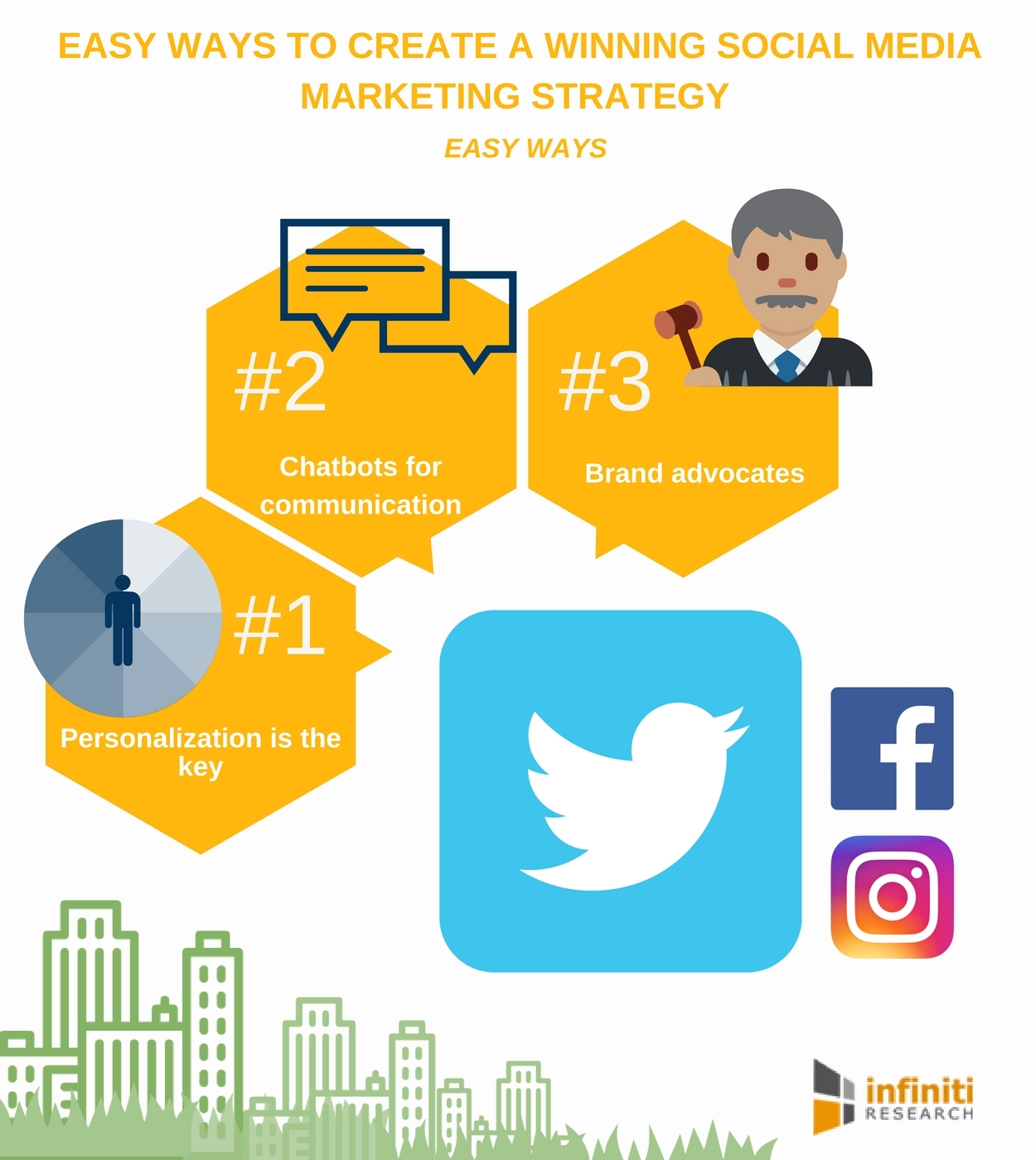
Easy ways to plan your social media marketing strategy:

  • Personalization is the key: There are so many ads on social media at present that customers frequently tend to consider them as ‘spammy’ content. Personalization is a serious social media strategy that will help surpass this problem. Personalizing the content of your ads to fit the needs of a certain customer will make them feel more associated with the brand. There is a higher chance of conversion and brand loyalty by personalizing the advertisements.
  • Chatbots for communication: Chatbots are found in most of the popular websites today and most of us are familiar with it. Chatbots are a great tool that let companies answer customers’ queries effectively without any human interference. In addition, chatbots integrate with the platforms that consumers now feel most happy interacting through – social media. Hence, integrating chatbots is a great social media marketing strategy to convert potential customers into sales and also answer their queries quickly.
  • Brand advocates: Using brand advocates is an extremely positive social media marketing strategy that many popular organizations swear by. Brand advocates are pleased customers of the brand, or in some cases, companies also bring in social media influencers for this task.

Infiniti Research is a global market intelligence company offering strategic insights to help look beyond market disruptions, study competitive activity, and develop intelligent business strategies. Listed below are the five easy ways to plan your social media marketing strategy.

Recommended Read: Amplify media + marketing Accepted to Exclusive Invite-Only Google Partners Initiative Program

Looker Enhances Data Science Capability With Integration for Google BigQuery ML

1
Looker Enhances Data Science Capability With Integration for Google BigQuery ML

Removes Machine Learning Bottlenecks and Empowers Business Users with Self-Serve Predictive Metrics

Looker, a leading data platform company, announced an integration with Google Cloud BigQuery ML (BQML) that accelerates the time-to-value of data science workflows and allows business users to operationalize insights with interactive predictive metrics.

@lookerdata builds integration for Google BigQuery ML, optimizing data science workflows. @googlecloud #datascience #machinelearning #GoogleNext18

With Looker and BigQuery ML, data teams can now save time and eliminate unnecessary processes by creating machine learning (ML) models directly in BigQuery via Looker – without the need to transfer data into additional ML tools. BigQuery ML predictive functionality will also be integrated into new or existing Looker Blocks allowing users to surface predictive measures in dashboards and applications.

“Much of the work in machine learning centers around data preparation and ML model evaluation and tuning,” said Lloyd Tabb, Looker Co-founder, Chairman and CTO. “Looker and BigQuery ML are great together in that Looker handles the data preparation and BigQuery ML does the learning. Looker can also help you evaluate and tune ML models to integrate predictions into dashboards and data workflows. We look forward to continuing our work with Google and bringing BigQuery ML capability to Looker Blocks.”

Also Read: Onix Achieves The Infrastructure Partner Specialization In The Google Cloud Partner Program

“BigQuery ML brings machine learning closer to where customers are storing large datasets, so they can quickly create and deploy models, at scale,” said Sudhir Hasbe, Director of Product Management, Google Cloud. “Looker’s integration with BigQuery ML adds powerful capabilities for our joint customers who can now use Looker to run ML models directly in BigQuery and surface the predictive insights across their organizations.”

“Looker and BigQuery have allowed us to arm our content creators, producers and every department at BuzzFeed with the data and insights they need to make decisions and iterate rapidly,” said Nick Hardy, Data Scientist at BuzzFeed. “With the introduction of BigQuery ML, we can further expand the ways these products are impacting our Data Science workflow — we’re excited to see what new opportunities it unlocks.”

Looker Accelerates the Data Science Workflow

Looker provides a single, governed lens into an entire organization’s data. It accelerates the data science stack by removing the struggle to prepare data and freeing up time for data scientists to leverage ML at scale and use their unique skill set to perform higher-value tasks. Unified and cleaned data also delivers efficiency and clarity by quickly and accurately surfacing business insights for better context. Businesses can now move from data to decisions faster by leveraging leading analytic technologies to operationalize the outputs of ML models and take action instantly.

Recommended Read: Figure Eight Enters Into New Collaboration with Google Cloud

Interview with Jeff White, Founder, Gravy Analytics

0
Jeff White

[vc_wp_text]“The ability to understand – in a privacy-friendly way – the places and events that a marketer’s target audience visits are a much bigger frontier.”[/vc_wp_text]
[easy-profiles profile_twitter=”https://twitter.com/Jeff_White1347″ profile_linkedin=”https://www.linkedin.com/in/jwhite1347/”]

Tell us about your role at Gravy Analytics and how you got here. What made you start a Customer Intelligence platform? 

Gravy Analytics started in 2011 as a local events discovery company, recommending interesting things to do in your area. Knowing that events are often the greatest indicator of interests and passions, and seeing the gap in understanding what customers do in the physical world, in 2016, we pivoted to become a consumer intelligence platform. Events – and the unique context that they add to location data – remain foundational to our business and are one of our biggest differentiators.

What’s the most fascinating aspect of leading a Customer Intelligence analytics team in a tech-heavy industry?

We offer an entirely new type of customer intelligence based on what people actually do – the places they visit, the events they attend – in real life (everything from a 50,000-person trade show to a swim meet at the local YMCA). Until recently this was a blind spot for marketers, but a huge opportunity for ad targeting, customer relationship management and competitive intelligence…and, we’re still figuring out more applications for this data. We’re working with customers to do things like better inform real estate or investment decisions, and even help combat ad fraud. It’s exciting stuff.

Given the changing dynamic of marketing analytics and customer insights, where do you see Gravy Analytics fitting into a CMO’s tech stack?

Fundamentally, we’re a data and intelligence provider. You can use our audiences to reach your ideal customer with your digital advertising campaigns; our data to enrich your customer database, understand meaningful customer behaviors, and benchmark against your competitors; or license our consumer attendance data for myriad purposes. Our data has become a key component of our customers’ marketing and analytics efforts.

What is the ‘State of Customer Data and Analytics’ technology in 2018?

It’s an understatement to say that technology in this area is rapidly changing and evolving. We think it’s similar to the web cookie and its associated impact – but 100x faster. The creation of the web cookie gave marketers a view of web users’ digital footprints, and a host of web analytics companies emerged. The ability to understand – in a privacy-friendly way – the places and events that a marketer’s target audience visits are a much bigger frontier. We have just scratched the surface of its impact for marketers.

What does your ‘Ideal Customer’ Profile look like?

Our ideal customer is a B2C or B2B marketer with a desire to better understand, target and activate prospects, as well as conquest against their competitors. For these customers, we can help them identify their best prospects (and find more like them), benchmark against their competition, and enhance their CRM systems with real-world behavioral data about their current customers.

Which new geographies are you currently targeting?

Today, we are exclusively focused on the US market. 

How do you leverage AI/ML and Data Science at Gravy Analytics to scale your marketing efforts?

We recently added a virtual assistant to our website, which has really helped drive quality leads. We’re also firm believers that the best way to market our data is to let the data speak for itself. Whether we’re analyzing foot traffic patterns of home improvement chains, determining the most popular restaurants, or illustrating a profile of our ‘Sports Fans’ audience. Our Data Science team plays a central role.

What are your predictions on the most influential disruptions in B2B Customer Analytics industry?

We strongly believe that the ability to capture and target the attendees at industry events and tradeshows is reshaping how B2B marketers think about their strategies. Across the US, there are tech meetups, support groups, training classes and more happening every night that collectively creates large-scale reach and provides insights to power a B2B marketer’s arsenal.

What startups in the technology industry are you watching keenly right now?

We pay close attention to Artificial Intelligence (AI) and Machine Learning (ML) startups that are developing next-generation analytical capabilities that can be applied to our data sets. We work with our own tech stack and associated partners to create real intelligence with our data, so understanding new companies with innovative technology is especially important for us.

What marketing and sales automation tools and technologies do you currently use?

Our marketing tech stack continues to evolve and grow with the company. Currently, we use WordPress as our CMS, and Hubspot for CRM, email marketing and social media management. We use Yoast for SEO and Google Analytics for reporting. Drift is behind our online virtual assistant, and Zoho supports our sales efforts. Zapier powers integrations between systems. On the advertising front, we use Taboola for native content promotion, Google for display and search campaigns, and LinkedIn for social campaigns. Internally, we use tools like Sisense for data visualization and Slack for collaboration.

Could you tell us about an outstanding digital campaign at Gravy Analytics? 

We’re using the Gravy blog to educate the market about our products and to showcase customer successes. We target this content to marketing professionals and business executives and measure campaign success both in terms of website traffic and sales leads. We continue to optimize our blog content and targeting accordingly: our “Top 5 Audiences” and “Event of the Month” posts that cover use cases and showcase interesting events (one of Gravy’s big differentiators) are top performers. Blog content now accounts for just under half of our total website traffic.

How do you prepare for an AI-centric world as a business leader?

One of the expressions we live by at Gravy is to never confuse a clear vision with a short distance. We have the foresight to envision a time when AI will drive our typical business day – from the autonomous car that drives us to the office, to the virtual assistant that continuously optimizes our day, finances, and even remembers to buy our spouse an anniversary gift. While we know we aren’t there yet, we understand that the key to AI enablement is data, and that the data we gather and create is fueling the future for marketers. Until then, we have to buy our own anniversary gifts.

How do you inspire your people to work with technology?

At Gravy, our employees have the chance to shape the direction of our technology and company. We give our engineers ownership of their projects, and the flexibility to make suggestions and introduce improvements to our systems. Great innovations can happen at any level within the organization.

One word that best describes how you work.

Early.

What apps/software/tools can’t you live without?

For business, Google’s G Suite Business across the board. We recently adopted Slack, but I’ll confess I’m not a big user …yet. Also, as a business founder, I think LinkedIn is an indispensable networking tool. On a personal level, I rely on Google Maps and Calendar to ensure I’m in the right place at the right time. For fun, I play the occasional game of Clash Royale or Hearthstone.

What’s your smartest work related shortcut or productivity hack?

I start work early, because I do my best work before noon. I also make time to exercise daily – even if just for a few minutes. It gives me the energy that I need to run a company, and at the same time, I get better results from my workouts.

What are you currently reading?

I do most of my reading online using Apple’s News app. It bring me stories from multiple sources (including USA Today, one of Gravy’s original investors), which I think is critical — especially today when it’s essential to have a complete picture of current events.

What’s the best advice you’ve ever received?

“Visions can be blinding.” As an entrepreneur, it’s easy to become myopic and ultra-focused on executing against a vision or idea. That can create blind spots to iterations or pivots that might make all the difference.

Something you do better than others – the secret of your success?

As a former athlete, I was told that you can’t control playing against bigger or faster people than you – but you can control how hard you work. So, I work hard. I have always vowed to not be out-hustled or out-worked.

Thank you, Jeff! That was fun and hope to see you back on MarTech Series soon.

[vc_tta_tabs][vc_tta_section title=”About Jeff” tab_id=”1501785390157-b58e162d-0ae25a4b-c27aca64-108e51b0-80edaf37-bd3d357a-6c46d712-3b68db8f-23cb33ea-b6f5″]

Jeff is the Founder and Chief Executive Officer of Gravy Analytics. He is passionate about building disruptive technologies with the potential to change entire industries. Prior to Gravy Analytics, he founded several technology companies and led them to successful exits.

[/vc_tta_section][vc_tta_section title=”About Gravy Analytics” tab_id=”1501785390320-2d44fa50-740c5a4b-c27aca64-108e51b0-80edaf37-bd3d357a-6c46d712-3b68db8f-23cb33ea-b6f5″]

Gravy Analytics
Gravy Analytics delivers real-world location intelligence to advertisers and brands. Where we go is who we are. Gravy’s patented technology, AdmitOneTM, verifies consumer attendances at millions of places and events, providing unprecedented insight into consumer activities and interests. Advertisers rely on Gravy Audiences to power precision-targeted mobile advertising campaigns. Brands trust Gravy Insights to provide unmatched customer and competitive intelligence. Gravy Analytics processes billions of location signals each day from its nationwide base of opted-in mobile devices for unparalleled reach and scale.

[/vc_tta_section][/vc_tta_tabs]
[mnky_heading title=”MarTech Interview Series” link=”url:https%3A%2F%2Fmartechseries-67ee47.ingress-bonde.easywp.com%2Fcategory%2Fmts-insights%2Finterviews%2F|||”]

The MTS Martech Interview Series is a fun Q&A style chat which we really enjoy doing with martech leaders. With inspiration from Lifehacker’s How I work interviews, the MarTech Series Interviews follows a two part format On Marketing Technology, and This Is How I Work. The format was chosen because when we decided to start an interview series with the biggest and brightest minds in martech – we wanted to get insight into two areas … one – their ideas on marketing tech and two – insights into the philosophy and methods that make these leaders tick.

Telaria Is First Dedicated Premium Video SSP to Launch Comprehensive Fraud Prevention Solution with White Ops

0
Telaria Is First Dedicated Premium Video SSP to Launch Comprehensive Fraud Prevention Solution with White Ops

Platform-Wide Guarantee of Protection Against Fraud for Premium Video Inventory Across All Screens

Telaria Inc., the complete software platform to manage video advertising for premium publishers, announced a partnership with White Ops to prevent invalid and fraudulent traffic from entering the bid process for any demand-side platform (DSP) transacting on Telaria’s Video Management Platform (VMP). Every ad request on Telaria’s VMP, across all screens and formats, will now be scanned by White Ops to prevent DSPs from purchasing fraudulent traffic.

“Insatiable demand makes digital video advertising a high-risk area for fraud, as fraud operations inflate supply with spoofing and bots watching videos”

This partnership means that Telaria will eliminate almost all chances of fraud before it ever reaches the buyer. In fast growing, high value areas like CTV and premium video, where Telaria is a leading force, the allure of high CPMs and a rich audience profile raises the potential for fraud. White Ops and Telaria’s integration is an aggressive step to stop fraudulent activity.

Also Read: Ada and Zendesk Unite to Improve Chatbot Experience for Customer Service

Doug Campbell, Chief Strategy Officer of Telaria, said, “This integration with White Ops definitively helps combat fraud in the programmatic video ecosystem as close as we can get to the point of entry, in the process creating a more efficient, clean and trustworthy work process between Telaria and our demand side partners. It is critical to the growth and health of the premium video supply market that advertisers feel confident in the quality of the content that supports the advertising experience, as well as in their advertising ROI. It is only when they are confident that they will grow their investments in exciting areas like OTT and CTV. This partnership, along with the fact that our platform is 100% ads.txt compliant across all our video supply, is part of our commitment to our demand partners that they can have a high level of confidence when they transact on the Telaria VMP, and that they will never pay for fraudulent inventory.”

“Insatiable demand makes digital video advertising a high-risk area for fraud, as fraud operations inflate supply with spoofing and bots watching videos,” said Michael Tiffany, President & Co-founder of White Ops. “Controlling ad fraud takes a combination of business and technology processes. White Ops is proud to bring a technology layer to eliminating bot-driven ad fraud from Telaria’s supply. Our partnership not only helps protect this important part of the advertising ecosystem, but also signals to the broader market that there is no tolerance for fraudulent traffic.”

The White Ops partnership is a part of Telaria’s Fraud Fighter solution, a first-to-market program that offers buyers protection against fraud for premium video inventory monetized on the company’s platform, including CTV, the fastest-growing video segment in the industry. The program exemplifies Telaria’s drive to lead the industry in content quality and underscores its approach to partnering with those companies equally committed to a fraud-free ecosystem.

The Fraud Fighter solution is an ongoing, platform-wide initiative that reinforces to DSP partners and their clients that video inventory transacted on the Telaria platform will meet or exceed industry brand safety standards. Telaria’s Fraud Fighter program creates an unprecedented level of accountability in the industry while assuring clients and prospective clients that Telaria is a safe place to do business.

Recommended Read: comScore Launches Enhanced Custom Reporting to Advance Mobile Capabilities

LiveRamp Partners with Inscape to Add Smart TV Data into Omnichannel Identity Platform

4

The Partnership Would Improve  Marketing Campaigns, Advertising Creative and More Accurately Target, Optimize and Segment Specific and Relevant Interactions Based on Smart TV Data

Inscape, the leading provider of smart TV viewing data and LiveRamp®, an Acxiom® company, have announced a partnership to bring Smart TV data for omnichannel identity resolution. This would help to connect LiveRamp’s IdentityLinkTM ID with Inscape’s ACR-generated, glass level insights from nearly nine million smart TVs. Further, this will allow marketers to better understand and connect with their customers. In turn, consumers will be able to benefit from more relevant brand interactions that are coordinated across digital and traditional channels.

This partnership brings the largest screen in the home, the TV, into the fold of devices measured for data-driven marketers and provides a holistic view of consumer audiences with TV viewing data that has granularity, precision, and scale. Bringing together the largest independent deterministic identity graph in the market from LiveRamp with the largest single source of opt-in smart TV viewing data from Inscape, allows platform partners and marketers to match online and offline data to smart TV viewing data. This intelligence helps inform marketing campaigns, advertising creative and more accurately target, optimize and segment specific and relevant interactions with consumers.

At the time of this announcement, Allison Metcalfe, General Manager of the TV at LiveRamp, said, “This is a very strategic integration that brings the speed, scale and transparency of Inscape’s smart TV viewing data to LiveRamp’s ecosystem platform partners, agencies and brands who leverage LiveRamp for identity resolution.”

Read More: Key Martech-Focused Takeaways from Mary Meeker Internet Trends 2018

Allison added, “By tying viewership to LiveRamp’s IdentityLink ID, LiveRamp is making it possible for marketers to take a data-driven approach to better plan, target and measure their omnichannel marketing efforts.”

Marketers can map granular program or ad viewing data at the device level to any IdentityLink matched data set. Matching against near-real-time smart TV data gives marketers access to the information needed to better personalize and optimize marketing campaigns, understand ad exposures against cross-device/platform KPIs and measure business outcomes. LiveRamp platform partners can ingest smart TV viewing data tied to IdentityLink and bring TV touchpoints into their services offered for cross-platform analytics and measurement.

“As new advanced television efforts and initiatives evolve, having a strong identity link between device-level television viewing data and first and third-party data sets is imperative,” said Greg Hampton, VP of Business Development at Inscape.

Greg added, “LiveRamp is making it possible for marketers to plan future marketing initiatives based on real data and better understand the results of omnichannel campaigns.”

Currently, Inscape is a TV intelligence company that captures highly accurate, up-to-date viewing data from millions of smart TVs. The company is a leading provider of automatic content recognition (ACR) technologies and comprehensive cross-screen metrics. Inscape’s TV audience viewing data is leveraged by OEMs, brands, agencies, networks, measurement companies, DMPs and marketing technology platforms to power massive transformations in the industry. Its glass-level insights bring a new level of speed, transparency, and actionability to the global TV marketplace.

Recommended ReadNow, Keep Your Best Customers Happy with the Oracle Loyalty Cloud

Tribune Broadcasting TV Ad Sales Open 24-7-365 With WideOrbit’s Programmatic Marketplace

0
Tribune Broadcasting TV Ad Sales Open 24-7-365 With WideOrbit

In a first for the local broadcast television industry, Tribune Broadcasting, a division of Tribune Media Company, has launched an ‘always-open’ TV ad sales operation thanks to a technology partnership with programmatic TV leader Wideorbit.

“Tribune’s embrace of an ‘always-open’ programmatic sales operation will make its local broadcast TV ad inventory as easy to purchase as any other media option.”

As an early adopter of machine-assisted sales of local spot advertising, Tribune collaborated with WideOrbit on enhancements to WO Programmatic Open Marketplace. In particular, a new rule-based Auto-Acceptance feature enables Tribune to accept complying offers for ad time around the clock – even outside of normal business hours. Tribune’s sales management will be able to use WideOrbit’s Auto-Accept feature to intelligently adjust pricing for sell-out levels and offer dynamic floor pricing for the first time ever in the history of linear TV.

WideOrbit’s Open Marketplace allows advertisers to review and order spots on Tribune’s 42 owned or operated local television stations reaching more than 50 million US households, including in the nation’s top three markets and seven of the top ten. In addition to inventory from its primary channels, Tribune will also offer multicast advertising opportunities in WideOrbit’s Open Marketplace. In total, Open Marketplace offers access to ad inventory from more than 1,000 stations that reach nearly 95% of US households.

Also Read: Opt-In Video Advertising is Preferred Ad Choice for Consumers According to New Nationwide Survey; Adoption May Deter Ad Blocking

“We have to compete on audience programming value and ease of use to service advertisers,” said Kerry Oslund, VP Strategy and Business Development at Tribune Broadcasting. “Automating sales workflows with WO Programmatic allows us to take orders from ad buyers based on pre-set parameters anytime just like digital self-serve platforms.”

“Programmatic ad sales platforms that allow our valuable audiences to be sold in both high tech and high-touch environments will increase demand in our Local Spot sector. We applaud WideOrbit’s efforts in this space and will continue to work with them and others in advancing it,” said Angela Betasso, Chief Revenue Officer at Tribune Media.

“Tribune’s embrace of an ‘always-open’ programmatic sales operation will make its local broadcast TV ad inventory as easy to purchase as any other media option,” said Eric R. Mathewson, Founder and CEO at WideOrbit. “We believe all broadcasters must streamline their transactional processes to be competitive with both digital and national media. We will continue to focus on software solutions that keep highly effective media like local TV as appealing to ad buyers as any competing media platform.”

Recommended Read: Epiphany Selects Amobee for Ad Tech Collaboration

Google Revises ‘Quality Rater’ Guidelines, Once Again!

1
Google Revises 'Quality Rater' Guidelines, Once Again!

Yet, again, Google has revised its content quality guidelines for contractual reviewers. Google works with 10,000 ‘quality rating professionals’ to assess content quality for its search engine results

Quality raters now have their hands on the latest edition of Google’s ‘content quality reviewing guidelines.’ At 164 pages, this is one of the many revisions that Google has made to these guidelines. The first set of rules was published by Google circa 2015.

Google has an army of 10,000 ‘content quality reviewers’ globally, for content evaluation. Google issues reviewers real search queries to review. Post that, Google expects its ‘quality raters’ to rate the quality of content. This is content generated as a search result of the user’s query.

Jennifer Slegg, who has spoken at SMX Advanced confirms that there are several key changes in this latest guidebook. She has been writing and observing these changes from the genesis of the ‘quality rater’ guidebook.

Also Read: How Can Event Data Help Enterprises Build Customers?

Key Changes in the Latest Google ‘Quality Rater Guidebook’

Rating contributors

Google has strictly asked its ‘content reviewers’ to check not just for the quality of content but also the quality of the contributors. Google is of the opinion that irrespective of the website’s reputation, the reputation of the contributors may jeopardize a website. Websites are trying to inculcate rich content but their author personas appear lackluster.

Websites need to be careful about accepting content contributions from writers who do not work for the website.

Ranking as per reputation

Google wants to rank pages higher if the content creators have a big reputation. They want to create a richer experience for the user reading search results. Google believes that content coming from someone with a bad reputation detests its users.

This also means that good writers with bad bios need to hone up on working on their reputation. Google will apply these rules not just for content in text, but also for content in video and social media.

Google’s immediate critical goal seems to make content appear without the adulteration of conspiracies or fake news.

Killing Clickbait

As a part of its war against Clickbait, Google has asked its ‘quality raters’ to filter sensationalized titles or haphazard content. Google has been observing a refined format of spam recently. The analysis of their quality raters will enable Google to develop algorithms to counter Clickbait.

Meaningful Content

Google believes that websites are creating content for Google. Sites are packing their content with keywords just so that they organically rank higher in search results. Such content is not useful for the user. All sites want is for the user to somehow buy what they are selling.

Google has specifically asked its quality raters to hand-pick chunks of content that are not beneficial to its users. Google may eventually plan to eliminate such instances from its search results.

Hence, content writers, SEO professionals or websites need to take precaution while developing new content or editing the existing one.

How Does Google Plan to Apply ‘Quality Rater’ Results?

Quality raters cannot make changes to Google’s result data directly. Their inputs will help Google optimize their current and future algorithms. Google wants to automatically rank pages. Over a period of time, Google’s algorithm will affect both, low ranked reviewed pages and un-reviewed pages.

Also Read: Have Facebook and Google Done Enough to Restore Advertiser Trust?

What does this mean for the Content Community?

Content Creators

Content creators should focus on writing rich content that users can benefit from and delve deep. Content writers should educate themselves with emerging capabilities of writing in order to deliver potent content. They should not only focus on keywords but try and focus on quality content that helps their readers.

Marketing professionals

Marketing professionals need to be very cautious before initiating marketing campaigns. They need to leverage technologies like programmatic advertising to direct their campaigns towards the right audience set.

Marketing professionals will always find it handy to know the best Ad Stack available to promote advertisements.

SEO Professionals

The only thing that SEO’s should keenly focus on is optimizing pages with legit methodologies. They should collaborate with content creators and find out the best possible ways of creating content that readers find intriguing.

Also Read: Not Social Media, But SEO: Customers Still Search for Businesses Through Search Engines

inPowered Eliminates Paid Media Waste to Scale Content Distribution for Brands Using AI

0
inPowered Junks Paid Media Waste, Scales AI-Based Content Distribution

inPowered, the Pioneer of the Cost Per Engagement Model, Now Offering AI-Powered Dynamic Pricing to Dramatically Reduce the Cost for 15 Seconds of Engagement with Content

inPowered, the programmatic content amplification company that enables advertisers to promote their content at scale and only pay for post-click engagement, introduced and made available its artificial intelligence (AI) driven dynamic cost per engagement pricing model (dCPE). Using machine learning, its technology doesn’t optimize for clicks, but rather, time on site.

“inPowered’s AI technology doesn’t just give brands what they’ve always wanted, engagement with their content, but it does so at the most efficient price possible.”

As the technology learns more over time it gets smarter and smarter with how it bids and optimizes – resulting in the gradual reduction of cost per post-click engagement by up to 80%. It can accomplish this by creating thousands of permutations to find the best combination of content, audience and channel that are delivering post-click engagements most efficiently. Budget is then shifted to only those most successful permutations. The cost savings is then passed to the advertiser in the form of even more engagements.

Also Read: Digital Marketing Veteran Michael Perlman Joins Jumpshot as Chief Revenue Officer

“We’ve known for a long time that programmatic content amplification inherently has inefficiency built into the cost per click (CPC) model,” said Peyman Nilforoush, CEO and co-founder, inPowered. “We reintroduced our cost per engagement pricing model powered by AI today to permanently solve for this.”

In 2014 inPowered’s technology helped brands identify and amplify third-party content (earned media) resulting in nearly a 400% lift in purchase consideration, as compared to standard online advertising, and up to 14x ROI. Later it began amplifying branded content (owned media), too. After listening to its customers, who wanted to pay for post-click engagement and not clicks, inPowered introduced the first ever cost per engagement (CPE) pricing model in 2015.

Most advertisers are used to buying programmatic native advertising only on a CPM or CPC basis – paying for impressions and clicks. According to Chartbeat Analytics, two out of three users that click on a native ad unit bounce before 15 seconds or less. As a result, up to 66% of programmatic native advertising budgets are wasted.

Also Read: TrendKite Acquires Social Technology Leaders Insightpool and Union Metrics to Create the First Digital PR Solution

By only charging for users that spend a minimum of 15 seconds reading or watching content, inPowered enabled brands to stop wasting ad dollars on invaluable clicks and to focus on the time consumers spent with promoted content. Ultimately, this led to more meaningful conversations with consumers and raised the bar on quality content amplification – helping brands to expect true engagement from native advertising campaigns.

According to Rebecca Lieb, Analyst and Founding Partner at Kaleido Insights, “inPowered’s AI technology doesn’t just give brands what they’ve always wanted, engagement with their content, but it does so at the most efficient price possible.”

In the past year, inPowered has formed large scale strategic partnerships with leading brands to determine the price to charge for 15 seconds of post-click engagement based on the actual cost it would take to deliver that engagement. The San Francisco based company now has API and RTB integrations with 35+ native advertising and social channels and has developed AI and machine learning over the last three years to offer brands the ability to only pay for the cost it takes to get consumers attention for 15 seconds in real time.

Recommended Read: Wibbitz Introduces Storyteller Circles to Connect Global Community of Creators


Telestream Integrates Live Video Production with Microsoft Stream and Office 365 via Wirecast S

0
Telestream Integrates Live Video Production with Microsoft Stream and Office 365 via Wirecast S

Telestream, a leading provider of digital media tools and workflow solutions, announced it has developed a new version of its Wirecast live streaming and production software exclusively designed to enable studio-grade production for live events in Microsoft Stream, an enterprise video service that allows users to securely upload, stream live, and share video. Called Wirecast S, the new software will be available as a free 30-day trial download when Microsoft enables live event streaming and scheduling for its Stream customers, and as a monthly subscription thereafter.

Great news: @Telestream Integrates #LiveVideo Production with @MicrosoftStream and @Office365 via @Wirecast S #streaming #VideoMarketing #CorporateCommunications

“Our customers rely on video to create engaging communications that reach across their organization,” said Microsoft Partner Group Program Manager, Vishal Sood. “The integration with Wirecast S will enable our customers to produce highly customizable, live streaming content by using software that seamlessly integrates with Microsoft Stream.”

Also Read: Seismic Deepens Partner and Product Ties with Microsoft

Wirecast S makes creating a live video feed for corporate environments easy, simple and fast. Combined with Microsoft Stream and Office 365, users can be up and streaming to their company or group quickly by using a number of quick-start templates for town halls, presentations and announcements. Broadcasting a company meeting to all satellite offices and remote employees has never been easier, cheaper and more professional looking. Users can launch Wirecast S directly within Microsoft Stream and begin streaming quickly with user friendly features that support beginners with little or no training required. To create high-production value webcasts, Wirecast S makes it extremely easy to switch between multiple cameras and add Skype feeds, images, titles, and sound tracks within the application.

“Wirecast S makes corporate live video broadcasting accessible to any company or employee using the Microsoft Stream platform within Office 365. Our goal was to make a tool that was lightweight, flexible, and easy to use and run while still enabling a professional look and feel for any broadcast,” said Scott Murray, VP Product Management at Telestream. “Working closely with the Microsoft Stream product team, we have developed a solution that integrates tightly with their platform, streamlining live video creation and encoding into a unified, secure process that extends and facilitates communication within an organization’s existing Office 365 infrastructure.”

Recommended Read: Adobe Delivers New Adobe Sign Innovation; Advances Microsoft Partnership