Home Blog Page 4204

Interview with Maher Jaber, CEO and Co-Founder, BrandFIT

0
Maher Jaber

[vc_wp_text]“It is essential to create robust knowledge bases that drive operational efficiencies, scalability and growth that can be automated through AI.”[/vc_wp_text]
[easy-profiles profile_twitter=”https://twitter.com/MaherJaberCEO” profile_linkedin=”https://www.linkedin.com/in/maher-jaber/”]

Tell us a little bit about your role at BrandFIT?

My role at BrandFIT is essentially the visionary and the driving force behind the organization. I saw a need for a business like ours a few years ago and believed it was the right time to jump into this space. That said, I wanted to develop a platform like no other, one that was unique, easy to use, cost-effective, and that would truly be valuable to brands, agencies and influencers. Now that the platform is in place, I oversee the strategic direction of the company but leave the day-to-day to the staff who I’ve entrusted to move the company forward.

What are the core tenets of BrandFIT’s Influencer Marketing platform?

The core tenets of the BrandFIT platform are neutrality, empowerment and trust, which are essential to influencer marketing.

How does BrandFIT enable personalized engagement for brands?

We have developed a unique online platform enabling brands to directly access and hire celebrities and influencers to endorse their products and services through multiple social media networks. Our platform also enables brands to have control over their message, giving them the power to further personalize the messaging and engagement. Our extensive post-campaign reporting also allows brands to measure campaign effectiveness and make the necessary modifications. All this is done in a safe and confidential environment.

What is the one piece of advice you have for B2B marketers in 2018?

Marketers need to focus on authentic storytelling rather than pragmatic marketing and advertising. Concentrate on a content strategy especially based on influencer marketing as it is not only cost-effective, but it creates better customer loyalty and trust. Consumers are seeking quality information versus someone trying to sell to them. Engage with your audience and they will keep you top of mind.

How do you see the B2B marketing landscape evolving, in the years to come?

Marketers need to create ads personalized for their business. Content marketing is replacing legacy marketing and advertising, as it creates value and provides consumers with concrete information. Thought leadership content is increasingly popular. It’s not enough to let a business know that you offer a certain product or service, it’s important to let them know why you (and subsequently your business) is an expert in that field.

Which sectors is BrandFIT looking to target to expand its reach in 2018?

We are looking to integrate more niche influencers into our roster and concentrate on custom content generation.

What startups are you watching/keen on right now?

Social media marketing has thrived in the last few years and has become a multi-million dollar industry, with many interesting startups. My interest is in digital marketing space and quite frankly, there are too many to name.

What does BrandFIT’s martech stack currently consist of?

Our stack currently consists of a digital marketplace. We offer detailed information on each of the influencers we work with, including their reach, engagement rates, audience interests, geographic location and areas of interest so we can best connect brands with influencers who will reach their target demographic on a global scale. We have also integrated a real-time messaging system that allows brands to directly message the influencer at any point during a campaign. Our digitally integrated platform also provides valuable data to measure the effectiveness of each campaign.

Can you tell us what makes a standout digital campaign?

A great campaign begins with authentic and relatable content, leading to true engagement and trust, and consequently to an excellent ROI.

How do you prepare for an AI-centric world as a business leader?

We are currently working with some of the greatest minds to integrate AI into our platform to better serve our clients and run successful campaigns.  With each campaign we run, our platform gams more data points to ensure campaigns are optimized.

As a business, we are always looking at emerging technology for internal use and to better serve our clients.

One word that best describes how you work.

Fair

What apps/software/tools can’t you live without?

I can’t live without the SMS on my iPhone.

What’s your smartest work-related shortcut or productivity hack?

Empower employees to reach their full potential and in turn, they will help your business become successful.

What are you currently reading?

Invisible Influence: The Hidden Forces that Shape Behavior by Jonah Berger and The Gulag Archipelago by Aleksandr Solzhenitsyn

What’s the best advice you’ve ever received?

Monitor your activities and the results will take care of themselves

Something you do better than others – the secret of your success?

I truly care about the success of my employees and clients. When you take care of the human side of the business, you can’t fail. People to people is key.

Tag the one person, whose answers to these questions you would love to read:

Richard Branson. He’s innovative and always pushing the envelope.

Thank you, Maher! That was fun and hope to see you back on MarTech Series soon.

[vc_tta_tabs][vc_tta_section title=”About Maher” tab_id=”1501785390157-b58e162d-0ae25a4b-c27aca64-108e51b0-80edaf37-bd3d357a-6c46d712-3b68db8f-23cb475c-11c3″]

Maher is a leader, entrepreneur and innovator who found his passion before the age of 30, he has managed eight international offices and directly managed over 500 people for a past employer. Today Maher is one of today’s top International business leaders and under his leadership comes a strategic vision for BrandFIT. This vision is accompanied with an international team of world-class engineers and regional sales people, keeping BrandFIT at the forefront of the industry and attracting countless of brands and influencers to our platform.

[/vc_tta_section][vc_tta_section title=”About BrandFIT” tab_id=”1501785390320-2d44fa50-740c5a4b-c27aca64-108e51b0-80edaf37-bd3d357a-6c46d712-3b68db8f-23cb475c-11c3″]

BrandFIT Logo

BrandFIT has developed an online platform that enables brands to hire celebrities and influencers to endorse products and services on social media. With over 30,000 influencers in our database, we reach more than 1 billion consumers worldwide.

[/vc_tta_section][/vc_tta_tabs]
[mnky_heading title=”MarTech Interview Series” link=”url:https%3A%2F%2Fmartechseries-67ee47.ingress-bonde.easywp.com%2Fcategory%2Fmts-insights%2Finterviews%2F|||”]

The MTS Martech Interview Series is a fun Q&A style chat which we really enjoy doing with martech leaders. With inspiration from Lifehacker’s How I work interviews, the MarTech Series Interviews follows a two part format On Marketing Technology, and This Is How I Work. The format was chosen because when we decided to start an interview series with the biggest and brightest minds in martech – we wanted to get insight into two areas … one – their ideas on marketing tech and two – insights into the philosophy and methods that make these leaders tick.

Spiceworks Study Reveals Employees Spend 26 Days Per Year on Websites Unrelated to Their Job

0
Spiceworks Study Reveals Employees Spend 26 Days Per Year on Websites Unrelated to Their Job

Large Organizations Restrict the Most Internet Activity; Facebook, Snapchat and Instagram Most Commonly Blocked Social Channels

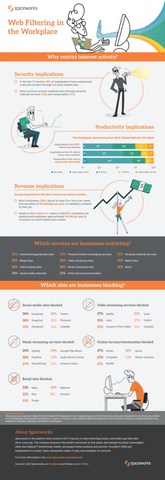
Spiceworks announced the results of a new survey examining the use of web filtering in the workplace and the implications of restricting certain online properties. The results indicate among organizations that don’t restrict any internet activity, most employees (58 percent) spend at least four hours per week, the equivalent of 26 workdays per year, on websites unrelated to their job. In other words, based on the median US salary of $45,812, these organizations are paying full-time employees approximately $4,500 per year to spend 10 percent of their time consuming non-work-related web content.

Spiceworks infographic: Web Filtering in the Workplace - the security, productivity, and revenue implications of restricting internet activity on corporate networks.
Spiceworks infographic

Among organizations that restrict one or more website on the corporate network, the results show 85 percent restrict illegal and unethical/inappropriate sites, and 61 percent restrict online dating sites. Fewer organizations restrict social media channels (38 percent) or personal instant messaging services (34 percent), and about a quarter of organizations restrict video streaming services, music streaming services, and online forums/communities. Additionally, 21 percent restrict personal webmail services, and 13 percent restrict online retail sites.

Also Read: Analytics Ventures Launches New AI Venture Dynam.AI

Blocking social media channels can help keep employees on task

Among social media channels, Facebook, Snapchat, and Instagram are most commonly blocked on corporate networks: 36 percent block Facebook, 36 percent block Snapchat, and 35 percent block Instagram. Additionally, 32 percent block Twitter, and 31 percent block Pinterest, but only 16 percent block LinkedIn.

Although social media channels are only blocked by approximately one-third of organizations, the results indicate productivity levels in the workplace can peak when social media is restricted on the corporate network. In organizations that block or limit the use of social media, only 30 percent of employees spend more than four hours per week on non-work-related-sites compared to nearly twice as many employees (58 percent) in organizations that don’t block social media.

Large organizations restrict more websites than their smaller counterparts

When examining the data by company size, the results show large businesses are more likely to restrict internet activity, including social media channels, personal instant messaging services, music streaming sites, video streaming sites, and personal webmail. In fact, 96 percent of large businesses with more than 1,000 employees restrict at least one online property, compared to 92 percent of mid-size businesses with 100 to 999 employees and 81 percent of small businesses with one to 99 employees.

As a result, the results suggest more employees are staying on task in larger organizations. In large companies, only 28 percent of employees spend more than four hours per week on websites unrelated to their job, compared to 45 percent in mid-size businesses and 51 percent in small businesses.

Also Read: Spiceworks Hires James Pinckney As Senior Vice President Of Revenue

Security incidents primarily stem from personal webmail and social media sites

In addition to productivity implications, the findings indicate there are also security implications when there is little to no web filtering enforced in organizations. In the last 12 months, 38 percent of organizations experienced one or more security incidents through the use of non-work-related websites on the corporate network.

These security incidents primarily stem from the use of personal webmail services (15 percent) and social media channels (11 percent). However, less than 40 percent of organizations block these online properties, which may contribute to the problem. Security incidents stemming from illegal (5 percent) or unethical (7 percent) websites were less common over the last 12 months, perhaps because 85 percent of companies block these sites.

Peter Tsai
Peter Tsai

“It’s evident web filtering is effective at keeping employees on task and reducing security risks,” said Peter Tsai, senior technology analyst at Spiceworks. “But in a world where IT professionals are constantly performing a balancing act between protecting networks and enabling and trusting employees to do their jobs, sometimes it’s not possible to block every potentially dangerous website. As a result, web filtering should only be one part of a multi-layered security strategy, instead of being viewed as a cure-all.”

Recommended Read: Spiceworks Study Reveals 40 Percent of Large Businesses Will Implement Intelligent Assistants or Chatbots by 2019

Simplifying Mobile Programmatic Advertising

0
Simplifying Mobile Programmatic Advertising

Mobile Programmatic Advertising Simplifies the Mathematics Behind the Complexity of Advertising on the Web. Useful Insights for Marketers to Grasp Mobile Programmatic Advertising Concepts

Mobile Programmatic advertising was first initiated in the year 1994. Its potential and application are vast for the marketing community. Programmatic advertising further simplifies and optimizes targeted advertising. It also nullifies the role of human beings in ad-trade wherever possible. Before programmatic advertising, ad-buyers and sellers traded ad-space manually.

Till 2019, 85% of mobile ads in the US will be programmatic.

There will more than five billion mobile phone users by 2019, globally.

Hence, targeted advertising for mobile phone users should be a core part of the marketing strategy. Marketing enthusiasts looking to take a sneak peek at this technology should find this writing interesting.

Also Read: Encouraging Trend in APAC: Bringing Programmatic Home

Programmatic ad buying in a nutshell

Programmatic ad buying essentially means when software is used to buy advertisements. This advanced software ensures that customer data is used at scale while buying ads. The selection of rich customer data ensures precise product placement. The software program also drastically reduces the need to swarm for a campaign, saving marketing budgets.

Marketers can leverage this capability by streamlining their role in the process of manual advertising purchase through RFI’s, negotiations etc. This saves marketers a lot of time and ambiguity about choosing ad space. The second advantage that marketers have is that they can then indulge in more creative endeavors regarding their marketing campaign design.

Will machines replace marketers in the near future?

Highly unlikely! Marketers will eventually phase out of tasks traditionally performed by them. These would be tasks like collaborating with ad publishers and dealing with advertisement tags. On the bright side, this does allow marketing teams to explore the software on a deeper level.

First-hand information is recommended to learn the tricks of the trade in order to better marketing campaigns.

Also Read: Five Key Trends for Programmatic Advertising in 2018

How does Mobile Programmatic Advertising work?

Programmatic Advertising’s growth and development as an entire ecosystem have been fairly fast. Discussing here are key components that map Programmatic Advertising.

Demand-Side Platform (DSP)

A platform owned by willing advertisers, Demand Side Platform will scan through a large chunk of consumer data to find the optimum set of consumers. This platform is connected with Supply Side Platforms (SSP) and Ad and Data Exchanges to make the maximum impact out of the campaign.

Supply Side Platform (SSP)

A supply-side platform or sell-side platform (SSP) provides DSP’s with the necessary inventory so that they can publish their targeted advertisements and meet their advertising goals.

Ad Exchange

An ad exchange is a digital form of the marketplace that equips both advertisers and publishers to trade ad space.

These components essentially define how programmatic advertisements are sold.

Programmatic Buying Types

Open Auction

Publishers post their inventory on an ad exchange that acts as an interface to an advertiser. Using DSP’s advertisers place a bid for the inventory space. The winning bidders get the advertisement published.

Open Auction is also sometimes referred to as a Real Time Bidding (RTB) although RTB differs slightly to an open auction.

Private Marketplace (PMP)

Private Marketplace (PMP) is a channel facilitated by established publishers. This niche web inventory is only sold to a handful number of buyers. PMP acts as a golden middle to acquire premium web inventory before it is sold in an open auction.

PMP offers a closer business relationship between the collaborating buyer-seller community. Buyers get better insights and control on their campaign. Sellers also initiate customized deals for buyers.

Programmatic Direct

This channel allows buyers to be guaranteed about procuring an ad-space via a seller. Established industry players opt-in for this option so that they can advertise on an app or a mobile website where they know they have an audience for.

Controversies around Programmatic Advertising

2017 saw programmatic advertising get a lot of negative publicity. The eco-system was rigged with fraud, was part of a lawsuit and experienced the YouTube ad boycott. Even then, analysts predict that programmatic advertising will thrive. Buyer trends will change. They are expected to shift to buy from a private marketplace more than open exchanges.

Also Read: Does the Programmatic Advertising Landscape Have a Trust Deficit?

Why do clients benefit from Programmatic advertising?

Web marketing makes digital media users get bombarded with commercials. Before the rise of programmatic advertising, web marketing was not in-sync with its core target audience. Clients and brands, both entities require value out of marketing campaigns. Customers were being shown ads that were nowhere related to their product preferences.

Now with ‘Programmatic’ taking roots strongly into the online/mobile marketing sphere, brands are finding it easier to build personal relationships with their clients. Marketing campaigns are getting more efficient and consumers and advertisers are not functioning in silos.

As marketers explore programmatic advertising capabilities further, they are finding ways to handle complex marketing campaigns rather easily. US markets will be spending 36.09 billion dollars in programmatic mobile advertising in 2019. Marketers should take full advantage of programmatic advertising to maximize revenues and quality of their marketing campaigns.

Recommended Read: Think Your Website is Too Small to be Hacked? Think Again, Says Sitelock

AppNexus Grows Connected TV Marketplace 748% Year-Over-Year

0
AppNexus Grows Connected TV Marketplace 748% Year-Over-Year

AppNexus, the world’s leading independent advertising technology company, announced advertiser spend in its connected TV marketplace grew 748% percent year-over-year in the second quarter of 2018 versus the second quarter of 2017, and grew 69% percent quarter-over-quarter in the second quarter of 2018 versus the first quarter of this year. Client adoption of AppNexus’ connected TV marketplace includes five of the world’s largest sports and news broadcast networks, five of the company’s largest programmatic video buyers, a Fortune 25 marketer, and three of the top ten global ad agency networks. AppNexus now sees more than 20 billion monthly connected TV impressions per month across Smart TVs, set top boxes, and game consoles.

Eric Hoffert
Eric Hoffert

“Programmatic connected TV provides the ideal environment to target audiences in their living rooms with entertaining, high-definition creatives,” said Eric Hoffert, SVP Video Technology, AppNexus. “It’s a perfect fit for many advertisers seeking highly engaged viewers, particularly in the entertainment, news, and sports verticals. We’re thrilled to see an increasing number of clients selecting our connected TV technology platform.”

Clients including Operam, a leader in programmatic buying in the movie and entertainment industry, and Tubi, a leading free movie and TV streaming service with a library of more than 7,500 titles and an average view of 60+ minutes per session, have leveraged AppNexus’ marketplace to reach and monetize audiences on connected TV devices.

Also Read: Edina Realty Launches “Emma Marketing” Automation for Agents

Brian Lam
Brian Lam

“Our movie studio clients come to us to deliver campaigns to promote films to millennials, cord cutters, and pay TV subscribers,” said Brian Lam, Director of Programmatic, Operam. “In less than one year, we’ve ramped our connected TV budget as a percentage of total digital ad spend on AppNexus from zero to approximately 50% or more, making connected TV a critical component of our strategy. With contextual targeting by movie genre and TV network, we’ve seen completion rates of 97.5% or higher on AppNexus connected TV sellers like Tubi while improving cost effectiveness.”

Tyler Fitch
Tyler Fitch

“AppNexus helps us connect our valuable datasets and premium inventory, including Oscar-winning films and Emmy-winning TV shows, to top advertisers,” said Tyler Fitch, VP of Programmatic Partnerships, Tubi. “We’ve seen a 293% revenue increase across this partnership from Q1 to Q2, showing the momentum of AppNexus’ connected TV growth.”

As connected TV viewership continues to rise—eMarketer estimates 181.5 million people in the US will use connected TVs at least once per month in 2018—AppNexus’ video technology and marketplace enables advertisers and broadcasters to reach and monetize engaged audiences on these devices in their homes. The AppNexus Programmable Platform enables connected TV advertising buyers to buy connected TV at scale using high definition creatives. AppNexus Programmable Data enables connected TV buyers to use their own data assets to activate audiences based on real-time signals without reliance on cookies. For connected TV sellers, AppNexus supports client and server-side ad insertion, connected TV SDKs, segmented audience targeting, with access to hundreds of daily active video buyers and industry leading external demand partners.

Recommended Read: 87seconds Joins Global Digital Marketing Group Datawords

Maverick AV Solutions Announces Global Agreement with Zoom Video Communications

0
Maverick AV Solutions Announces Global Agreement with Zoom Video Communications

Maverick AV Solutions, a specialized solution business of Tech Data announced a new distribution agreement with Zoom Video Communications, Inc. Maverick AV Solutions will support Zoom in expanding its global footprint, beginning with North America and Europe, enabling growth into new customer segments, and supporting the growth of Zoom Rooms, Zoom’s cutting-edge workplace collaboration solution.

The Zoom platform integrates with all hardware systems to ensure that customers can utilize existing room equipment or upgrade to create an experience to suit their meeting and collaboration style. It is ideal for any collaboration space, from small focus rooms or offices to world-class training and broadcasting centers.

Maverick AV Solutions will draw on its ecosystem of market-leading collaboration vendors to work with the Zoom team globally and build tailored solutions to help integrators create simple, intuitive room systems with fast deployment. Zoom already boasts partnerships with a number of Maverick’s vendors including Logitech, Dell and Crestron.

Also Read: Kochava Part Of New Google Measurement Partners Program

Jon Sidwick
Jon Sidwick

“Zoom Video Communications is one of the most exciting businesses to enter the meeting room space in recent years, and the quality of the user experience is giving it a vital ingredient—rapid user adoption,” said Jon Sidwick, vice president, at Maverick AV Solutions. “Zoom Rooms offer a great opportunity for our resellers, and with our global footprint, Maverick AV Solutions is able to offer Zoom a consistent experience for multi-country roll-outs. Our understanding of and specialization in audio visual technologies will help Zoom deploy quickly through the channel and help integrators to bring Zoom Rooms into the market rapidly.”

Laura Padilla
Laura Padilla

“Zoom’s partnership with Maverick will delight our customers by providing consistent packaging of Zoom Room solutions in conjunction with our hardware-optimized partners,” said Laura Padilla, head of business development and channel, at Zoom. “This relationship represents an exciting point in our global expansion plans to extend our footprint into new markets, simplify the solution-purchasing process and grow our ecosystem of partners. We look forward to executing on the value of our partnership with Maverick quickly, and improving our customers’ and partners’ experiences.”

Maverick AV Solutions is a specialized solution business of Tech Data, the world’s leading end-to-end distributor of technology products, services and solutions. Our dedicated experts work with the world’s leading brands to provide customers with specialized audio-visual (AV), collaboration and smart signage solutions, as well as unmatched logistical and financial services. Through product breadth, in-depth knowledge, activation services and e-commerce systems, Maverick AV Solutions is helping customers acquire the most complete AV solutions in the channel.

Recommended Read: Clari and Marketo Announce Strategic Partnership to Break Barriers Between Sales and Marketing

Is Google’s Responsive Search Ads the Ultimate Advertising Hack You Need?

0
Is Google’s Responsive Search Ads the Ultimate Advertising Hack You Need?

Experts are Calling The Machine Learning-powered Responsive Search Ads the Next Big Thing After 2016’s Google Expanded Search Ads

Google just is rolled-out a new optimization feature for advertisers at Google Marketing Live. Termed the Responsive Search Ads, Google says that through it, the company is ‘putting machine learning into the hands of every advertiser’.

“Consumers today are more curious, more demanding, and they expect to get things done faster because of mobile. As a result, they expect your ads to be helpful and personalized. Doing this isn’t easy, especially at scale. That’s why we’re introducing responsive search ads. Responsive search ads combine your creativity with the power of Google’s machine learning to help you deliver relevant, valuable ads,” writes Jerry Dischler, Vice President, Product Management, Google, in his blog post on the company website.

Also Read: Instagram’s IGTV Competes With YouTube, Finds Takers in Influencers, Vloggers, As Well As Publishers

So how does this new feature work? Responsive Search Ads combine different creatives – headlines and descriptions – with the help of machine learning, thereby helping deliver more bespoke targeting. Advertisers are expected to provide anywhere between 3 – 15 headlines and 2-4 descriptions. Google will then automatically test different combinations of headlines and descriptions, and find out which combinations perform best. Responsive Search Ads will serve the best message to different searchers depending on the keyword they search for, their device, their past browsing behavior, and other factors.

“We know this kind of optimization works: on average, advertisers who use Google’s machine learning to test multiple creative see up to 15 percent more clicks,” claims Dischler, adding, “Responsive search ads will start rolling out to advertisers over the next several months.”

Also Read: Is Your Facebook Engagement Working For You?

Maximize Lift for YouTube

Machine learning will also help Google maximize relevance and performance on YouTube through a new smart bidding strategy called Maximize Lift. “People watch over 1 billion hours of video on YouTube every day. And increasingly, they’re tuning in for inspiration and information on purchases large and small. That means it’s critical your video ads show at the right moment to the right audience. Machine learning helps us turn that attention into results on YouTube,” writes Dischler.

Available currently in Beta, Maximize lift will be ‘rolling out to help you reach people who are most likely to consider your brand after seeing a video ad,’ later this year. Maximize Lift automatically adjusts bids at auction time to maximize the impact your video ads have on brand perception throughout the consumer journey.

Recommended Read: Is Amazon Ads The Right Move for Your Business?

Agora.io Releases React Native SDK For In-App Voice & Video Calling

0
Agora.io Releases React Native SDK For In-App Voice & Video Calling

Agora.io, a global leader in real-time communication solutions, announced the release of the Agora React Native SDK, an open source developer toolset for adding voice, video, and live broadcasting functionality to mobile apps using the React Native framework. The new SDK enables cross-platform building across iOS and Android platforms, making it easier and quicker to deploy and maintain embedded voice and video communication features within native mobile apps.

React Native is an open source project started by Facebook that lets developers build cross-platform mobile apps using JavaScript and React. With React Native, code is shared between platforms so developers can write across different mobile operating systems concurrently. Since its introduction in 2015, React Native has built a massive developer community and is used by companies like Facebook, Instagram, Bloomberg, and Skype.

Also Read: Enterprises Embracing Video Calling To Drive Customer Service Innovation, Finds New Research From Sinch

Tony Zhao
Tony Zhao

“React Native is becoming a popular framework in the developer community because it offers a number of advantages like efficiency and consistency. Developers no longer have to create two versions of the same app from the ground up,” said Tony Zhao, founder and CEO at Agora.io. “With our React Native SDK, we wanted to give developers future-proof solutions with the same level of simplicity and reliability that they’d get from our platform-specific SDKs.”

As more developers adopt the React Native framework to build cross-platform apps, Agora’s React Native SDK enables them to integrate real-time voice chat, video conferencing, and interactive broadcasting into iOS and Android apps without recreating the code from scratch for each platform. The React Native SDK will also help developers shorten implementation time and minimize inconsistencies between platforms as they roll out new updates.

Also Read: Unify Square Announces New Microsoft Teams and Machine Learning Expansions for Market-Leading PowerSuite Software

Reggie Yativ
Reggie Yativ

“Native mobile apps have become a core component of digital strategy for modern businesses, so it’s no longer enough to be on just one platform,” said Reggie Yativ, Chief Operating & Revenue Officer at Agora.io. “At the same time, we’re seeing more and more apps across a wide range of industries experiment with live video. Our React Native SDK was designed to give developers more options as they deploy these new interactive features that are proven to boost user engagement and monetization.”

The React Native SDK is the latest addition to Agora’s growing lineup of developer tools aimed at providing robust voice and video functionality that delivers truly native user experiences. Available on GitHub, the React Native SDK delivers the same benefits as Agora’s flagship Voice & Video SDK, which ensures extreme low latency, high quality video backed by a global network of 200 distributed data centers and a priority dynamic routing algorithm.

Recommended Read: Pegasystems Named a Visionary in Gartner’s Magic Quadrant for Sales Force Automation

Globosat Chooses Harmonic for Live UHD Broadcast of International Football Tournament

0
Viaccess-Orca and Harmonic Team Up to Optimize Content Protection for Live Sports Streaming

Harmonic’s Solution Provides Superior UHD Video Quality, Low Latency and Maximum Bandwidth Efficiency

Harmonic, the worldwide leader in video delivery technology services, announced that Globosat, Latin America’s largest content and program creator, has selected Harmonic’s Ultra HD (UHD) contribution solution for broadcast of the world’s largest football tournament, being held in Russia.

Roberto P.
Roberto Primo

“Harmonic video delivery solutions have been a cornerstone of our infrastructure for years, providing high reliability and excellent video quality,” said Roberto Primo, CTO at Globosat. “For the broadcast of this premiere sports event, watched by billions of television viewers around the world, we needed a solution that provides the lowest latency and best video quality. With the Harmonic contribution platform on the ground in Russia, we will be able to dazzle viewers with the best video quality that UHD has to offer.”

Also Read: Searching for a CMS: A Guide to Pick the Right Platform for Any Project

By delivering one of the most-watched sports events to viewers in UHD, pay-TV operators can boost viewer satisfaction and take advantage of new revenue opportunities. Harmonic’s ViBE CP9000 contribution platform preserves video quality at the front of the broadcast chain, processing uncompressed UHD signals with maximum bandwidth efficiency.

Alvaro Martin Armendariz
Alvaro Martin

“Soccer is greatly adored and watched all around the world, making this the perfect opportunity to showcase UHD for live sports applications,” said Alvaro Martin, vice president of sales, LATAM, at Harmonic. “We’re thrilled to work with Globosat on one of the first UHD broadcasts of this major sporting event. By maintaining the detail, sharpness and color gradients that UHD has to offer, Harmonic’s contribution platform will enhance viewers’ quality of experience.”

Recommended Read: Transcosmos Powers Global Omnichannel Customer Service with Bright Pattern Cloud Contact Center

What Makes Influencer Marketing Platforms So Exciting?

0
What Makes Influencer Marketing Platforms So Exciting?

Understanding Influencer Marketing Technologies Help Marketers Effectively Apply This Amorphous Marketing Strategy

“A brand is no longer what we tell the consumer it is — it is what consumers tell each other it is.”

– Scott Cook

What is Influencer Marketing?

Jennifer Polk who is a research director for marketing leaders at Gartner states that Influencer Marketing is a core component of Social Marketing. It is a powerful tool to mold the audience’s beliefs and behaviors towards brands.

An Influencer is an individual who is famous and has has a large social media following. Essentially, brands engage influencers to market products for a targeted audience set.

‘Influencer Marketing’ as a term is coined exclusively when marketing is implemented on digital mediums.

Involving key people in marketing campaigns took roots from the late 18th Century with the pope endorsing patented medication.

Today, Influencer Marketing has evolved. 67% of Marcomm professionals want their content promotion to happen through influencers.

Influencer marketing for Instagram is now a $1.07 billion industry and will double in revenues by the year 2019.

Evidently, Influencer Marketing hints loudly at having tremendous potential. Marketers should consider this capability to be very critical and absorb it at the earliest.

Influencer Marketing is also challenging!

Marketing professionals should know

  • Who are Influencers?
  • Why is Influencer Marketing fun?
  • Which platforms to leverage for a strong Influencer campaign?

Also Read: Influencer Marketing Software Soon to Be a Part of Every CMO’s Stack

Who are Influencers and why is Influencer Marketing on the rise?

Influencers are people who have made a huge impact on their audience. Influencers add tremendous value to people’s lives via their area of expertise. This value can emerge from spheres ranging from spirituality to business.

Hence, Influencers can be

  • Celebrities:
  1. They are individual media contributors who have amassed massive fan following across all age groups throughout the world.
  2. They don’t always personally connect with their audience because of a very high follower count.
  3. Celebrity Marketing is the strongest on Instagram due to the tremendous following.
  • Industry stalwarts

Industry achievers are influencers because:

  1. Their thoughts are extremely valued and respected
  2. They have a huge following which is engaging and meaningful
  3. Enterprises truly cash in via their firebrand
  4. Enterprises also automatically empower their own brand
  • Bloggers

Original content creators that create text which deeply relates and connects with their fans are popular influencers. This also includes microbloggers. Enterprises center their marketing strategy around them because

  1. They have the maximum connect with their followers
  2. They have personal relationships with their fans
  3. They do create original content for the brand
  • Micro Influencers

Micro Influencers usually start their Social Media journey from scratch. They influence their followers because-

  1. They have a personal relationship with all their followers
  2. Their followers completely resonate with them
  3. Companies can target their fans and initiate personalized marketing campaigns.

The genesis of Social Media has fairly democratized the process of ‘being famous.’ Before Social Media, people had movies, magazines, television etc. dictating celebrity lists.

Now, anybody can become famous and amass following. Influencers are spread out in diverse subjects. This is excellent for Influencer marketers because they can incorporate marketing campaigns for a range of products.

Influencer marketing also works because

  • Teenagers, 70% of them, find YouTubers more relatable than celebrities
  • After family and friends, 88% people trust the verdict of Influencers
  • Other formats of online marketing are getting saturated

What makes Influencer Marketing Platforms so exciting?

Influencer marketing has visibly added a dimension to the big blue marble of digital commerce. Backed by a strong theory and successful in practice, marketers are eager to adapt to and learn methodologies about the nature of Influencer marketing.

The sentiment of marketers around the globe is abuzz as they are eager to apply new and functional capabilities to future marketing campaigns. In order to do so, marketers would need tools to maximize digital strategy reach.

The digital market today is assisted by a plethora of functional software tools. A big set of these tools are dedicated to Influencer marketing platforms.

Hence, the combination of a stylish and new marketing platform coupled with the need to absorb a key method in marketing strategy has generated a lot of excitement within the marketer community.

Learning something new and applying it quickly may be stressful, so here are a few tools to make the marketer’s life easy.

Also Read: Influencer Marketing is the Fastest-Growing Online Customer Acquisition Strategy

Influencer Marketing Platforms

Retaining the excitement around Influencer marketing

Famebit

Platform Influence

Famebit wants to attract brands that cater to a younger audience. This is visible from the platform’s bright color theme and pictures of millennials having loads of fun.

How does it work?

Famebit provides information about potential influencers for a brand and their follower count on every Social Media Platform. Their analytics are not as deep as other platforms but their goal is to provide fun content. They want to make reach their content to all targeted users for brand promotion. The best part, it’s inexpensive!

NeoReach

Platform Influence

An upstart that wants to completely define itself. Their website uses PewDiePie’s images liberally which says a lot about their affinity towards influencers.

How does it work?

They have two models for creators-

  • Self-Service
  • Influencer campaign management

They possibly house the entire Influencer database which amounts to over three million users. That’s across all Social Platforms including follower demographic information. Hence, they have an edge over the competition, because other platforms only display specific Influencer information. Creators can manage their campaign on an end-to-end basis on NeoReach.

Webfluential

Platform Influence

Webfluential has an Influencer first approach. Influencers can host their profile on this platform. Webfluential then becomes a matchmaker between Influencers and brands that they can associate with.

How does it work?

Webfluential allows Influencers to put up their entire portfolio along with previous statistics allowing them to approach brands. This helps Influencers be proactive about which brands to work with. Basically, any influencer who knows his/her creative forte will eventually find good work. They can also manage their bids on this platform, putting creative in the driver’s seat which is not really a unique selling point of any other Influencer Marketing platform.

Upfluence

Platform Influence

Upfluence is an Influencer content-centric Platform which focuses on content marketing and Native advertising.

How does it work?

Upfluence works via their ‘Reachr’ and ‘Publishr’ programs. Reachr is where brands can reach bloggers and brief them about the content that needs to be created. Contracts and payments can be managed through the platform itself. Bloggers from almost 200 countries specializing in several industries are registered on Upfluence.

Publishr allows companies to throw content out there and collaborate with Influencer bloggers who already have relationships with the press in order to get the writing pieces published.

Speakr

Platform Influence

Speakr’s philosophy revolves around connecting brands with ‘made’ Influencers. Influencers who are a huge authority in their area of interest find a place with Speakr.

How does it work?

Speakr is in entirety ‘made out of data-analysis’ over a long period of time. With 20,000 dynamic and authoritative influencers, Speakr allows brands to create content that can reach millions of people.

Traackr

Platform Influence

Traackr’s exclusive Influencer Relationship management feature helps it stand out from the rest of the platforms.

How does it work?

Traackr believes that a short-term relationship between an influencer and a brand is solely based for a monetary benefit. What Traackr truly wants to do is build everlasting relationships between the holy trinity of brands, Influencers, and their followers. Their philosophy is fundamentally based on the element of trust. Traackr even goes a level up to loop into the network, people who influence the influencers.

Revfluence

Platform Influence

Based on the principle of streamlining and making content easier to make and publish.

How does it work?

Essentially a do-it-yourself platform containing a list of 150,000 influencers, Revfluence is perfect for agencies who are making an Influencer Marketing campaign in-house. They provide a Collaboration Toolkit to help facilitate easy and meaningful content creation.

The work ethic of Influencer Marketing is fun because marketers get to collaborate with a diverse set of people. Influencer marketing promises a creative pilgrimage for marketers as well as Influencers. Further, as a number of platforms are available, the possibilities of designing marketing campaigns are endless. Hence, enterprises should take maximum leverage of this emerging and steady marketing stream.

Recommended Read: Influencer Marketing & Your Customer Journey

Wicket Labs Secures $2.8 Million in Funding to Further Develop Industry-Leading Audience Insights Platform

0
Wicket Labs Secures $2.8 Million in Funding to Further Develop Industry-Leading Audience Insights Platform

WestRiver Group Leads Investment Round with Participation of Madrona Venture Group and Divergent Ventures

Wicket Labs, an industry-leading provider of audience insights for subscription video services, today announced $2.8 million in financing led by WestRiver Group with participation from existing investors, Madrona Venture Group and Divergent Ventures. The funding will be used to expand the Wicket Scorecard which gives online video providers a deep analytical view of their current and future audience and to expand the product’s reach to international markets.

The Wicket Scorecard drives audience lifetime value higher for its users. With streaming households in the United Statesnumbering nearly 60 Million (comScore, 2018), it enables media and entertainment companies to gain better visibility into their customers, understand how initiatives impact the business, drive engagement with the service, and promote a happy customer base through the unique CHI score (Customer Happiness Index). The company currently has nine customers and pilots underway including MOTOR TREND, Pure Flix Entertainment, UP Entertainment, and other top TV networks.

Marty Roberts
Marty Roberts

“Employing an audience insights platform like the Wicket Scorecard provides our customers with better visibility into their video business,” said Marty Roberts, CEO of Wicket Labs. “We give them a unique perspective into their subscribers throughout the entire lifecycle. With the actionable insights provided, they have an advantage in converting visitors to customers, reducing churn, engaging their audience, and driving a better audience lifetime value.”

Also Read: Kochava Part Of New Google Measurement Partners Program

As established and traditional programmers expand to online and new programmers are developing programming solely for online audiences, understanding how these audiences choose content, jump from one piece to another, and feel an affinity for a brand is incredibly important in building loyalty. This round of investment will equip Wicket Labs with the resources to expand their software development team and progress into new digital video business verticals to address the 200+ OTT video services in the US alone, according to Parks & Associates 2018 OTT Market Snapshot.

“Our partnership with the WestRiver Group, in addition to the ongoing support from Madrona Venture Group and Divergent Ventures, will accelerate the capabilities of the Wicket Scorecard as we introduce machine learning applications and expand our sales team internationally,” said Roberts.

Anthony Bontrager
Anthony Bontrager

Anthony Bontrager, Principal at WestRiver Group, will join the Wicket Labs’ board. “The Wicket Scorecard has proven to be a highly attractive solution to enhance audience insights. With the average household in the US streaming around 54 hours of TV per month (comScore, 2018), this is a need many direct-to-consumer video services are beginning to realize they have,” said Anthony Bontrager.

Recommended Read: Target Marketing Introduces The Launch Of Brand United

Rivit TV Joins Forces With Kevin Smith And TV Fans Everywhere To Introduce Audience Powered Television

0
Rivit TV Joins Forces With Kevin Smith And TV Fans Everywhere To Introduce Audience Powered Television

For the First Time Ever, Audience Powered Television Platform Gives Fans Ability to Greenlight All-New Original Series

Rivit TV, the first audience powered, commercial-free television platform that gives fans the ability to greenlight all-new original TV series, announced that the company is launching with a pilot produced by, and starring iconic filmmaker and comedian Kevin Smith. Rivit TV enables established creators to connect directly to their fans to watch a free pilot and choose what they are willing to pay for a full season, ultimately determining whether the show is greenlit to go into production.

For the first time ever, TV fans will be empowered to greenlight an original series they love. Together Rivit TV and Kevin Smith have put the decision making of Smith’s new series, HOLLYWEED, in the hands of fans.

According to Marcus Wiley, Chief Content Officer at Rivit TV, “This platform allows our industry’s top creators like Kevin Smith to focus on passion projects that resonate with their fans without worrying about a committee of executives or advertisers. Our goal is to directly connect creators with their fans, liberate the creative process and invite the audience to greenlight shows from their favorite storytellers.”

Also Read: Brand Embassy and Talkdesk Form Partnership to Provide an Omnichannel Platform for Customer Service

Rivit TV’s inaugural pilot, HOLLYWEEDa stoner workplace comedy starring Kevin Smith in his first major speaking role. Following two potheads navigating the ups and downs of managing a small business in their quest for profits and the perfect bud, the HOLLYWEED pilot is written and directed by Smith and also stars Donnell RawlingsAdam BrodyJason Mewes and Ralph Garman. Smith will serve as showrunner and Executive Produce alongside longtime collaborators Jordan Monsanto and Liz Destro.

“Two years ago we shot a pilot for a show called HOLLYWEED and tried to take it out the traditional way but had no luck. Cut to now, and we get to bring it back to life. Thanks to the good folks at Rivit TV, we raised it from the dead, it’s crazy. Rivit TV was smart enough to take this show and leave it up to my fans,” said Smith.

Rivit TV pilots are always free. Fans can sample the creator’s vision and choose to bring the season to life by setting a price and sharing it with their friends to encourage their participation. There is a 45-day period when fans select the per-episode price (from $1.99 to $5.99) they would be willing to pay to get the season made. The higher the price point chosen, the fewer the amount of people who are needed to greenlight the season. More people participating lowers the price and everyone is charged the same lowest price. The season is greenlit at the end of the 45-day timeframe, or when the price-per-episode reaches $1.99. Only then are credit cards charged. There is no charge if the season is not greenlit. Episodes of the new season will begin releasing weekly, approximately 75-90 days after the end of the pricing period.

Also Read: Sightly Opens Two New US Locations, Makes Several New Hires to Serve Expanding Customer Base

Rivit TV offers fans more than just a show. While the season is being produced according to the vision of its creator(s), fans will be actively engaged with insider updates, access to the creator and behind-the-scenes content that continues through the release of the season on Rivit TV.

Robin Zucker
Robin Zucker

Heading up original content programming for Rivit TV is Chief Content Officer, Marcus Wiley, who was co-head of comedy development at Fox Broadcasting Company. During this time, he was responsible for developing Bob’s Burgers, Brooklyn Nine-Nine, New Girl and The Mindy Project,amongst other series.

Ross Cox
Ross Cox

Rivit TV brings together a seasoned, entrepreneurial team with a strong track record. Rounding out the management team are Robin Zucker, Chief Marketing Officer, who previously served as SVP of Marketing at Playboy Enterprises and head of social marketing for Yahoo!; Steve Adler, Chief Technology Officer, who previously headed Mobile Technology for the NFL where he developed the NFL Mobile app and digital video delivery for the entire NFL Digital Media Group; and Ross Cox, Chief Product Officer, an Emmy award-winning digital product and gaming executive whose background includes stints at NBC Entertainment and Cartoon Network / Adult Swim.

Recommended Read: Splice Machine’s Data Platform for Intelligent Applications Now Available as a Fully Managed Service on Microsoft Azure

Parks Associates: Consumers Watch More Than Two Hours of Alternative Video on a Computer Each Week

0
Parks Associates: Consumers Watch More Than Two Hours of Alternative Video on a Computer Each Week

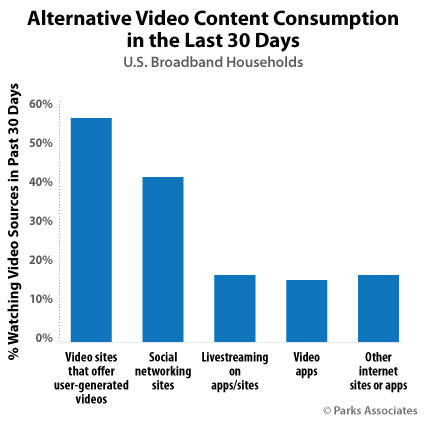
New video research from Parks Associates reveals US broadband households watch an average of two hours of alternative content on a computer each week from sources including Facebook, SnapChat, YouTube, Vimeo, and Dailymotion. 360 Deep Dive: Alternative Content Consumption examines alternative content such as livestreaming, user-generated content, short-form videos, and web video series that are available via social networking, video sharing, or similar apps or sites. Nearly one-half of US broadband households watch user-generated content on a monthly basis, and more than 10% watch livestreamed content.

Parks Associates: Alternative Video Content Consumption in the Last 30 Days
Brett Sappington
Brett Sappington

“Alternative video is an important part of the video landscape, and it competes with other video options for a share of consumer attention,” said Brett Sappington, Senior Director of Research, Parks Associates. “Approximately one-half of households with a TV watch video from YouTube and similar sites on their TV set. In fact, more households watch online video from an app such as YouTube than watch video from a TV channel app.”

Parks Associates data about alternative content consumption shows that adoption of pay TV declines as the frequency of user-generated content consumption increases. This correlation poses a future threat to pay-TV providers as younger respondents are far more likely to watch user-generated content, which could potentially impact their future pay-TV habits and perspectives.

Also Read: Parks Associates: More Than 85% of Millennials Subscribe to at Least One OTT Video Service

“Younger consumers are far more likely to create their own content as well as watch user-generated content,” Sappington said. “For these viewers, the creation of content is as much a part of the entertainment experience as is watching video. Increasingly, traditional content producers and service providers are leveraging alternative content in order to connect with audiences and draw viewers. Some are partnering with individual web celebrities and influencers who often have a disproportionately large influence on the user-generated side of the alternative content space.”

Additional data from the research reveals:

  • At present, only 7% of US broadband households watch sporting events via livestream.
  • Consumers who view user-generated content are much more likely than those who never watch it to have an OTT service.
  • Almost one-quarter of broadband households have posted videos to some type of content site or app within the last 30 days.
  • Alternative content compromises more than two hours of online video watched weekly on a computer.

Recommended Read: Over One-Third Of Households Live-Stream TV Shows Or Sports: Parks Associates

Konnect Digital Inks Global Mobile Distribution Deal With Euronews

0
Konnect Digital Inks Global Mobile Distribution Deal With Euronews

Konnect Digital, a global B2B marketplace for media and entertainment content, has signed a three-year deal to distribute news content from Euronews, a leading international news and media service.

The Euronews catalogue will be made available to Konnect Digital’s demand partners including mobile operators, OTT platforms, device manufacturers and publishers around the world, via its online content brokerage platform, DICE (Digital Content Exchange).

Sid Khemka
Sid Khemka

“Demand has never been greater for trusted news, factual analysis and unique perspectives on world events, than it is today,” said Sid Khemka, CEO of Konnect Digital. “We’re delighted to have partnered with Europe’s number one news and media service to distribute its world leading content globally to our mobile network, platform, device and publisher customers.”

Also Read: Smartsheet Launches Integration with Google’s Hangouts Chat

Kostas Oikonomou
Kostas Oikonomou

“Driven by uncompromising journalism, Euronews attracts a highly desirable audience, composed of curious, open minded leaders, and is a widely recognised global news brand leader,” said Kostas Oikonomou, VP Distribution & Partnerships for Euronews. “We are thrilled to be working with Konnect Digital and to leverage DICE to extend our reach to the screens of discerning consumers of news in the furthest corners of the world.”

Euronews has been delivering trusted news and information in a non-partisan and in-depth way to TV audiences and digital users across the world in their language for more than 25 years. It covers world news 24/7 in twelve languages and deploys more than 500 journalists reporting on relevant stories to serve a global audience.

Recommended Read: Salesforce Delivers the Next Generation of Service Cloud Einstein

Oro, Inc., Continues Expansion with Senior Appointment in Germany, Switzerland and Austria

0
Oro, Inc., Continues Expansion with Senior Appointment in Germany, Switzerland and Austria

Oro, Inc., the company behind OroCommerce, the No.1 B2B eCommerce platform, announced the appointment of Matthias Henrichs as the company’s new Regional Manager for the DACH region, which includes GermanySwitzerland and AustriaAlexander Shashin, who had initially been charged with building early awareness and partnerships in the region, will now be running sales and focusing on mid and  large enterprise opportunities.

Since Oro’s introduction into the DACH market, the company’s eCommerce platforms have generated widespread interest and accelerated adoption from some of the region’s largest and most prominent B2B merchants and manufacturers. Oro’s early adopters include Haneu Katalog GmbH, a German seller with 50 years of history providing quality transport, warehouse technology and operating equipment, and, more recently, Testrut, a German international trading house with more than 80 years of history selling kitchen wares, bath accessories, lawn supplies, and fireplace and furnace accessories.

Also Read: Cloud Migration Driving Market Dynamics Among SAP Providers, Says ISG

Henrichs is a seasoned B2B executive with almost two decades of experience working at some of the world’s largest and most successful business technology companies. Prior to joining Oro, he served as a business development executive at Capgemini, a multinational business consulting company with more than 200,000 employees in 40 countries and nearly $15 billion in annual revenue. Before Capgemini, Henrichs worked in sales and business development at companies including Hewlett-Packard, Ariba (acquired by SAP), Siemens Business Services, and Integrata (now part of CGI).

Yoav Kutner
Yoav Kutner

“The DACH Region is one of our fastest growing and most important markets,” said Yoav Kutner, CEO and co-founder of Oro, Inc. “With his unparalleled background and expertise in business- to- business technology, I’m confident that Matthias will take our German presence to a whole new level.”

In his new role as manager of DACH region, Henrichs will oversee all aspects of sales, partnerships, marketing, and operational activities, with the goal of driving continued adoption of the award-winning OroCommerce platform in this strategic market.

Recommended Read: Media Agencies Conquer Industry Transparency Issues with NetSuite

Fireside Chat with Adam Sirois

0
Adam Sirois

[easy-profiles profile_twitter=”https://twitter.com/AdamSirois” profile_linkedin=”https://www.linkedin.com/in/adamsirois/”]

Adam Sirois talks about the tools and strategies he uses to create effective B2B sales content at BounceX.

B2B Marketing Strategy and Customer Acquisition Models

Tell us about your role at BounceX and how you got here. What is the story behind the inception of BounceX?

I’m the VP of Sales and I’m responsible for new business. The majority of my team’s focus is working with the top ~500 online retailers (ecommerce).

Prior to BounceX, I had a pretty entrepreneurial background and my first foray into ecommerce was with my startup, Me & Goji, a custom cereal and granola company where anyone can design a cereal from 60+ ingredients, name it, upload a photo and have it shipped it direct-to-consumer.

In 2011, I co-founded another startup, Underground Eats, which was a curated marketplace for the top culinary experiences in NYC.

So, when I joined BounceX in 2013 as the first sales hire, I had a lot of ecommerce experience, but not as much traditional sales work under my belt—though as a founder, 90% of your time is spent selling in some capacity.

I think what attracted our co-founders to me what that I was able to use my experience in the industry—having actually built and grown ecommerce businesses—to understand marketers (our primary customers), what they cared about and the daily challenges they faced. I also had experienced what it was like to buy software and technology from a marketer’s perspective, and it was largely an awful experience.

Both of our founders also had a background in marketing and ecommerce, so this allowed us to approach the market with a ton of empathy from the Day One. In the early days of building a sales team, process and methodology, we were often driven more by what we knew we should NOT do rather than what we thought we should do.

The company is the brainchild of Ryan Urban, our CEO. He was a B2C marketer at the time who wanted to create another way for retailers to scale revenue outside of Google and Facebook. From there, he took what he knew from the consumer side and used it to help marketers scale their business through BounceX.

Tell us about your entrepreneurial experience?

I’m an entrepreneur at heart. In between the ages of 15 and 30, I started several businesses—with varying levels of failure—that ranged from driveway paving to custom cereal to rare sneakers to producing events like Vanity Fair’s one-hundredth Anniversary Dinner.

Truthfully, I only had one “real job” during that time, which was a two-year stint at Island Def Jam Music Group.

How often do you measure the performance of your marketing analytics and sales performance reporting?

We’re largely a quarterly business so, but we monitor performance on a weekly, if not daily, basis.

What are the dynamic elements driving your B2B sales revenue model?

We tend to focus more on our customer’s revenue than our own revenue.

The main metric we focus on is our median revenue contribution for clients, which is currently 7% of directly attributable revenue reported in the client’s own analytics platform. Last year it was 5%, and next year we want to get to 10%.

Every department at BounceX is laser-focused on how they directly impact that number, whether it’s how Customer Success can improve strategy and better leverage our technology to drive more revenue, or how Product can engineer new or enhanced products that contribute incrementally to that number.

We strongly believe if we continue to drive that number up, then our own customers will be our main customer acquisition channel and refer us business. Revenue will follow.

How important is a People-Based Marketing (PBM) Cloud stack for the modern business models?

I think the more important question here is: how important is the ability to identify your customers and prospects when they’re on your website to the modern business model?

Amazon is really good at personalizing the shopping experience to each individual. Why? Because 75% of people are logged in. For all other ecommerce websites, less than 5% of people log in.

If you don’t know who someone is, how can you effectively tailor your marketing messages to the individuals?

You can’t. That is why 95% of marketing is batch-and-blast, despite 90% of CMOs claiming “personalization” is a top-three priority.

Identification is the key to unlocking that. It’s a simple problem in theory but a massively complex problem technologically, which is why we’ve had about 100 of the top product and engineering talents in the world working on it the past few years.

Know My Team

How big is your team and what drives them to succeed in meeting small-term and long-term sales goals at BounceX?

Actually, our sales team is tiny by industry standards. In most SaaS companies, sales make up 50-75% of the headcount.

At BounceX, under 10% of the company is dedicated to sales.

We want to be known for having the smallest sales team while having the largest customer success teams in the industry. (But don’t tell our investors that).

The only way that model works, and we are able to hit our goals and scale the business, is if the sales team is extremely high output.

We’re relentless about constant improvement—both in terms of strategy and process as well as individual development. This requires having a team of very intelligent, very coachable and very agile salespeople in an environment that is collaborative instead of internally competitive—very rare in the industry.

How tech-savvy are your marketing and sales teams? How do you rate them on a scale of 1-10?

10 (no, really!!!).

In order for us to be successful in our roles and for us to position BounceX as the leading innovators in the MarTech space, each individual that represents us must be in the top 1% of adoption, understanding, and passion for where technology is today, where it’s going in the future and how that might impact our customers’ lives and careers.

How do you think young sales professionals should train themselves to master MarTech and sales automation skills?

Honestly, I probably wouldn’t encourage young sales professionals to spend too much time here.

Make sure you can operate at a level that your manager deems effective/acceptable, then spend all your spare time getting to know your industry, your customers and your products.

For new sales hires at BounceX, we don’t even talk about sales until around week three.

Focus first on developing the ability to have a deep-level, mutually beneficial conversation with the buyers of your industry.

Marketing and Sales Alignment: Social Media and Content Marketing Strategies

What are the tools and strategies you use to create effective B2B sales content at BounceX?

You need a really strong sales operations and enablement team.

Building strong sales content requires several different skill sets. You need people that know how to research and sort through data to pull out key insights; you need people who know how to turn those insights into an effective narrative that matches your buyer personas, and you need designers who can turn those narratives into visually compelling collateral.

What are the types of sales content you leverage? And, out of all marketing collateral, including white papers, brochures, e-books, playbooks, case studies, webinars, research reports, and infographics, which resonates the most with your customers?

We leverage all of the above and the most impactful is any content that includes genuine social proof from existing clients. We try to let our clients do the talking for us as much as possible.

Customer Success and Technology Insights

From a tactical standpoint, how often does your organization revisit the sales tech industry?

At this stage in the game, we don’t revisit our sales tech that often. In the early days, it required a lot of work to get an effective tech stack in place, but eventually, you reach a point of diminishing returns.

How do you see the technology you use impact the customer acquisition and success rate?

We’re targeting the Top 500 or 1000 retailers with an account-based approach and it’s a pretty nonlinear, complex sales process…so it’s hard to say how much any particular piece of technology impacts our win rates.

What is that one piece of advice you received that you would like to pass on to people in the MarTech industry?

Focus relentlessly on the value that you drive for your customers. Until it’s crystal clear what that is and how your customers measure it, you’re not ready to scale a sales team. All company resources should be dedicated to answering those questions first.

Thank You, Adam,  for answering all our questions. We hope to see you again at MTS, soon.

DocuSign to Welcome New Board Directors

1
DocuSign to Welcome New Board Directors

As part of its transition to a public company after a successful IPO in April this year, DocuSign announced that it will welcome three new members to its board of directors, and that five will in turn move off over the course of the year.

Joining effective August 29, 2018, are former GoDaddy CEO Blake Irving, Docker chairman and CEO Steve Singh, and IBM Watson business unit GM Inhi Cho Suh.

Dan Springer
Dan Springer

“We are thrilled to be welcoming Inhi, Blake and Steve into their new roles on our board,” said Dan Springer, the CEO of DocuSign. “We have worked with them all in various roles over the years. They bring a wealth of experience across the public and private sector. And they bring unique perspectives in the areas of SaaS, big data, artificial intelligence, and serving customers from the largest enterprises to the very smallest businesses. This will offer a vital contribution to our growth and evolution as a newly-public company.”

Also Read: Harte Hanks Appoints Veteran Jack Griffin as New Independent Director to its Board

Blake Irving
Blake Irving

With more than 25 years of leadership experience at public corporate and consumer technology companies—including Microsoft, Yahoo and GoDaddy—Irving will bring a breadth of knowledge to DocuSign’s board. “In the SaaS industry, it’s rare to see a company create a category from scratch, grow to lead that category, and then continue its innovation ark by extending to meet an even broader set of business challenges. That’s what we are seeing with DocuSign and its System of Agreement vision, and that’s why I am excited to join the board and help support the company for the future,” said Blake Irving.

Steve Singh
Steve Singh

Singh has been Docker’s chairman and CEO for just over a year, having spent much of his career prior to that at SAP and Concur Technologies—all of which ensures he offers public, private and enterprise SaaS expertise. “Joining DocuSign’s board is exciting for me both personally and professionally. I’ve worked across a spectrum of enterprise technologies, so I can appreciate the impact that DocuSign is already having in that space—and its vast potential for the future,” said Steve Singh.

Also Read: Seal Software Unveils Global Partnership with DocuSign, Announces $30 Million in Growth Capital from Toba

Inhi Suh
Inhi Suh

Suh is an industry veteran, with 20 years of experience driving innovation at IBM. She currently leads the company’s Watson Customer Engagement business unit and is no stranger to DocuSign, having appeared on the company’s Momentum conference stage as a customer and partner over the past few years. “DocuSign is a strong digital brand that engenders trust among people and businesses. The company offers incredible value to customers, demonstrates strong innovation, and is on a solid growth path—I look forward to supporting its success as a member of the board,” said Suh.

As part of this planned transition, DocuSign founder Tom Gonser and current chairman Keith Krach will leave their board roles at the end of the year. And directors Scott DarlingRory O’Driscoll and Jonathan Roberts will leave their board roles when the new members join on August 29, 2018.

“I know that I speak for the entire company when I offer my sincerest thanks to Tom, Keith, Scott, Rory and Jonathan,” added Springer. “Each have helped write important chapters of the DocuSign story. For this we are all grateful, and I know they will remain close to the company.”

Recommended Read: Tableau Executive Mark Nelson Joins Talend Board of Directors

New Capital Partners Announces LoyaltyExpress Investment in SoftVu

0
New Capital Partners Announces LoyaltyExpress Investment in SoftVu

Softvu Will Leverage This Partnership and Investment to Advance Its Prominent Position and Offer New and Expanded Services to Its Markets

LoyaltyExpress, a portfolio company of New Capital Partners, has acquired SoftVu, a leader in creation, management, distribution and tracking of automated marketing strategies for direct-to-consumer markets in the mortgage lending industry. The investment begins SoftVu’s partnership with LoyaltyExpress, a provider of marketing automation and cloud-based CRM solutions for mortgage companies and banks.

James Outland
James Outland

“SoftVu will fit very well into our LoyaltyExpress platform,” said James Outland, Managing Partner at NCP. “We’re excited to partner with Tim and SoftVu. He’s built an incredible company that will be a great complement to LoyaltyExpress in the mortgage tech space.”

Jeff Doyle
Jeff Doyle

“Partnering with SoftVu allows us to bring highly complementary solutions to our respective clients,” said Jeff Doyle, CEO of LoyaltyExpress.  “This will further enhance both companies’ abilities to provide innovative and market leading solutions. Since getting to know Tim and the SoftVu team, I’m highly confident that our partnership will yield tremendous value for our combined client base.”

Also Read: Domino Data Lab Partners With SAS to Accelerate Data Science Work in the Cloud

SoftVu, known in the market for its high degree of client focus and satisfaction, will leverage this partnership and investment to advance its prominent position and offer new and expanded services to its markets.

Tim Donnelly
Tim Donnelly

“Our desire to provide even higher levels of value and expand our marketing innovations to our clients is in perfect alignment with LoyaltyExpress’ mission and NCP’s investment strategy,” said Tim Donnelly, Founder and CEO of SoftVu.  “We are thrilled about this partnership with LoyaltyExpress, and with NCP’s deep experience and outstanding reputation, we’re excited to further enhance our ability to deliver even more value to our clients, plus expand our products and services through LoyaltyExpress’ platform.”

Adam Cranford
Adam Cranford

“We had heard about SoftVu’s reputation for delivering outstanding client focus and results, and through the due diligence process and getting to know the SoftVu team, we validated all of that and more,” said Adam Cranford, Managing Director at NCP.  “Providing additional capital to this highly regarded, profitable enterprise will allow the existing leadership team to continue to provide innovative advancements and build on their already sterling reputation.  We look forward to an exciting future with both entities.”

Recommended Read: 87seconds Joins Global Digital Marketing Group Datawords

Unify Square Announces New Microsoft Teams and Machine Learning Expansions for Market-Leading PowerSuite Software

0
Unify Square Announces New Microsoft Teams and Machine Learning Expansions for Market-Leading PowerSuite Software

Company Momentum Continues with Expanded Asia-Pacific Operations Center and New Operations Center in Lithuania to Serve Growing Global Customer Base

Unify Square, the leading provider of software and cloud managed services for Microsoft Teams and Skype for Business, announced the expansion of three existing PowerSuite solutions to add reporting and analytics for Microsoft Teams — Executive Dashboard, Usage & Adoption Dashboard, and Help Desk, as well as a new machine-learning-powered PowerSuite solution called Insights Center. This software launch was made in conjunction with the parallel announcement that Unify Square has already hired initial employees for a second Lithuania office and is also doubling the size of their existing Asia-Pacific office to accommodate up to 200 total global PowerSuite Network Operations Center (NOC) managed services technicians.

John Case
John Case

“These new releases for PowerSuite have put Unify Square at the bleeding edge of the unified communications ecosystem, particularly with Microsoft Teams-centric software solutions. This is just the beginning of our long-term strategy to continue to help improve the end-user experience for meetings, chats, and calls,” said John Case, CEO of Unify Square. “Simultaneously, growing our presence in Lithuania with the creation of our second NOC and escalating our Asia-Pacific operations will allow us to better service our expanding and wide-reaching customer base – we estimate we will double our footprint in the next year.”

Also Read: CleverTap Makes An Entry Into Psychographic Segmentation Using Machine Learning

PowerSuite for Microsoft Teams

This week, PowerSuite launched the first of many upcoming expansions to its repertoire of Microsoft Teams services with three important solutions. These expanded services have already been rolled out by several forward-looking companies that require a single pane of glass for simultaneously viewing both Microsoft Teams and Skype for Business performance. These offerings join PowerSuite Cloud Managed Services for Teams, Teams Transformation Services, and Teams User Adoption Services as IT teams around the globe begin to manage the transition of users from Skype for Business to Microsoft Teams:

  • PowerSuite’s Executive Dashboard is an easy place to visualize the progress of active, enabled, and targeted usage for Microsoft Teams and Skype for Business deployments.
  • The Usage & Adoption Dashboardmeasures active usage of clients, devices, and modalities (chats, meetings, calls, etc.) versus plan in order to help track adoption and ROI.
  • The Help Desk solution analyzes user and system behavior during meetings, chats, and calls to deliver diagnostic input and remediation guidance to end-user support professionals.

Also Read: Seal Software Unveils Global Partnership with DocuSign, Announces $30 Million in Growth Capital from Toba

PowerSuite Machine Learning Growth

In addition to the new Microsoft Teams solutions, PowerSuite has added a powerful net-new machine-learning-driven solution. Insights Center is a centralized hub for IT to view a prioritized list of technical and system-related problems in the environment requiring attention, along with a clear way to track progress towards resolution. Proprietary UC-Core Technology algorithms and continuous machine learning detect system anomalies and surface the key user-impacting “hot spots” in the environment, allowing IT to better optimize their remediation process and thereby reduce total cost ownership.

Managed Services Expansion in Europe

In order to respond to the growing demand for managed services for both Microsoft Teams and Skype for Business, Unify Square is building out a second PowerSuite Network Operations Center with room for up to 80 employees to open alongside the existing Unify Square developer office in Vilnius, Lithuania. According to the most recent European Innovation ScoreboardLithuania ranks as one of the fastest growing innovators in the European Union.

Also Read: Aurea Software Appoints Former IBM Executive Dan Beer as General Manager of Aurea SMB Solutions Division and Chief Customer Success Officer

Although located in Europe, the new NOC will carry the same 24×7 charter servicing global customers as the original Unify Square NOC in the Asia-Pacific region, which is planned to double in size this year. In addition to providing even higher levels of business continuity services, the combined locations will allow the company to expand the vitally important managed services and developer employee ranks.

Continued Momentum

Mike Fasciani
Mike Fasciani

In June, Unify Square announced it raised an additional $10 million in a Series C round. Led by global investment holding group PRIMEPULSE SE, the new funds have already kickstarted this company’s renewed go-to-market effort for managed services and accelerated the development of its industry-leading Unify Square PowerSuite software product line.

Earlier this year, Unify Square was designated as a 2018 “Cool Vendor,” based on the May 8, 2018 report titled, “Cool Vendors in Unified Communications and Collaboration,” by Christopher TruemanSteve Blood, Gyanee DewnarainVivek Bhalla, and Mike Fasciani at Gartner, Inc. The report recognizes the user experience’s primacy in the digital workplace.

Recommended Read: Machine Learning Company Soteria Intelligence Releases New Social Media Analytics Tools, Website

Mastering Customer Experience in the Era of the Empowered Consumer

0
Mastering Customer Experience in the Era of the Empowered Consumer

Visual IQ Nielsen LogoThanks to digital, consumers are more empowered, and their buying journeys are more complex than ever before. At any given moment, they expect highly relevant, friction-free brand experiences on the channels and devices that are right for them. In fact, more than half of consumers are prepared to walk away from a brand that doesn’t offer a personalized and relevant experience.

Meeting and even exceeding these expectations is possible, but not using the siloed, channel-specific strategies that marketers often resort to today. Marketers need to shake up their approach in order to optimize both the consumer experience and their marketing effectiveness, and people-based marketing is the fabric of that solution.

People-based marketing represents a fundamental shift from viewing consumer behavior in the context of individual channels to placing consumers at the center of marketing strategies. It enables marketers to track and measure consumer behavior across channels and devices, so they can understand how customers and prospects are interacting with their brand and which touchpoints are generating desired behaviors (such as an online conversion or in-store purchase, for example).

Also Read: How B2B Marketers Can Prove Their Effectiveness to the C-Suite

However, change is never easy, and adopting a people-based approach requires new processes and platforms. Here are three fundamental steps to get you started:

Consolidate marketing data across platforms

For a complete picture of customers and prospects, organizations must consolidate their audience and interaction data that are stored in disparate systems. Where possible, this should include data from both offline and online channels (web, mobile, call center, store, etc.), as well as demographic, intent, interest, and other audience attribute data from first- and third-party sources. By marrying and de-duplicating this disparate data in an anonymous and privacy-safe manner, marketers can gain a more holistic, people-based view of their customers and prospects, create high-value audience segments to target, and tailor content, offers and experiences to meet their unique needs and preferences.

Restructure marketing teams to be cross-functional

Optimizing the consumer experience requires marketing teams to be synchronized across every touchpoint. But just like marketing data is siloed by systems, marketing functions also tend to be siloed by brand, product or channel. Teams and/or individuals work independently, often with their own outside agencies, and use their own set of metrics to measure engagement, conversions, revenue, and return. These organizational silos not only promote duplication and waste but also create a disjointed experience for consumers.

To successfully adopt a people-based approach, companies must rethink their traditional, siloed structures and move toward cross-functional teams that can develop, test, measure, and optimize all of their marketing and advertising strategies and tactics against a common set of success metrics. By understanding what consumers value – and prioritizing metrics that reflect this value – marketers can create a cohesive consumer experience that feels like it’s being delivered by a single organization, rather than several different departments.

Measure all touchpoints, not just last click

Marketers recognize that different email offers, display placements, search keywords, and other tactics offer different kinds of value to customers and prospects based on where they are in their journey. However, most marketers are still resorting to last-touch attribution, which only gives credit to the last touchpoint and neglects the contribution of supporting channels and tactics that played a role in influencing the desired action.

Also Read: Eight Things That Matter from Gartner Digital Marketing Conference

To successfully deliver a people-based approach, marketers must move away from last-touch to an audience-centric, multi-touch attribution concept. When audience data is unified with multi-touch attribution, it produces people-based marketing performance insights. Marketers can see exactly which messages, content, creative, and offers are resonating with target audiences, and use this insight to make inter- and intra-channel budget optimizations, as well as optimizations to the consumer experience that translate into measurable increases in engagement, conversions, and ROI.

Optimizing the customer experience is a must in the era of the empowered consumer. Flawless interactions will drive desired outcomes and long-term customer loyalty, while disjointed experiences will send customers running to competitors. Taking a people-based marketing approach will allow marketers to deliver the relevant and personalized experiences that the empowered consumer expects.

Also Read:  Six Ways CMOs Can Keep Pace with Technology Innovation