Home Blog Page 4212

iResearch Data: Tencent Video App Led China Market with 600M MAU in May

0
Tencent and their breakthroughs in Web3.0

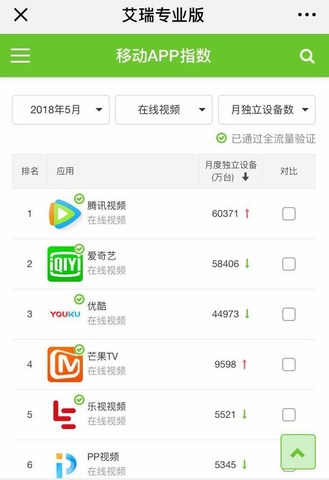
Tencent Video App was reported by iResearch to lead the Chinese online video market in three key criteria, including monthly active users (MAU), total monthly effective view time, and total daily effective view time.

According to iResearch, a leading third-party research company, in May 2018Tencent Video enhanced its leading position with about 604 million MAU, 19.65 million ahead of second place. Furthermore, Tencent Video has 6.313 billion hours monthly total effective view time for May. In terms of the total number of monthly active devices, the figure reflects user’s viewing behavior  on mobile networks, Tencent Video reached 731 million and the average daily active devices reached 123 million in May.

iResearch mUserTracker for May 2018

Tencent Video is leading the market with a substantial advantage and has steady performance in those three key factors.

Also Read: Five Inconvenient Truths of Multi-touch Attribution (MTA)

Zhonghuai Sun, Vice President of Tencent, said “We are very glad for the feedback from users and market, which is attributed to our continuous effort in providing high-quality content, including drama, variety shows, and other entertainment. Many of those programs hit the market and go viral rapidly.”

Supported by Guduo Media, a leading online video data and analysis platform in China, and Maoyan, a professional network video media data platform, Tencent’s original drama Moonshine and Valentine continued to be on the top of the list on both platforms, becoming the most popular original idol drama in Q2.

Also Read: Cannes Lions Witnesses World’s First Augmented Reality Video Ad Format

Original dramas like Suddenly This Summer and Secrets of Three Kingdoms also performed well, which effectively increased the viewership on the platform while further enhancing users’ loyalty. The original online variety show China Produce101made a perfect ending as it took overwhelmingly advantage and became a phenomenal program in Chinain Q2.

For this summer, there is more high-quality content coming to Tencent Video, including the exclusive drama Legend of FuYao which became a hit soon after its release, and other high-quality original dramas like Fights Break Sphere, Go Brother!,The Eternal Love II, and Sand Sea of Time Raiderswhich will be shown on Tencent Video exclusively. Additionally, animation dramas like Modao Zushi and variety shows such as The Coming One II, Chinese Restaurant II, Phanta City 2018, and The Trio of Happiness will keep up Tencent Video’s momentum .

The continuous and meticulous arrangement of diversified and comprehensive content as well as the massive amount of effort put into operations, will effectively support Tencent Video to further consolidate its leading position in the industry.

Recommended Read: Taboola Announces Global Self Service Business Has a Run Rate of Nearly $100 Million in Its First Year

Verasity and TRUTH Agency Wage War on Digital Ad-Fraud

0
Verasity and TRUTH Agency Wage War on Digital Ad-Fraud

Blockchain Technology Provides the Latest Weapon in the Fight Against Online Ad-Fraud

Verasity, a next-generation video platform enhanced with blockchain technology has partnered with TRUTH, a new media agency, to tackle ad-fraud.

Verasity’s proprietary, patent-pending, Proof-of-View (POV) technology prevents fake video views, eradicates bot interference, and reduces fraudulent activity wholesale across its video platform.

David Orman
David Orman

“Working with TRUTH, we’re going to provide advertisers with a far greater return on investment. Blockchain technology is already proving to be a total game changer for the way advertising is bought and sold across digital platforms,” said David Orman, Verasity Co-founder.

Mary Keane-Dawson
Mary Keane-Dawson

TRUTH’s blockchain technology ensures advertising can be traded and delivered with accountability. “Clearly Verasity’s Proof-of-View blockchain technology has a total affinity with our mantra here at TRUTH; to provide advertisers with fraudulent free media investment. By working with Verasity, we can provide our clients access to an accountable and 100% transparent media platform,” said Mary Keane Dawson, TRUTH’s Founder and CEO.

Also Read: CleverTap Makes An Entry Into Psychographic Segmentation Using Machine Learning

Why does this matter to your readers?

  • By 2021, 82% of all consumer internet traffic will be from video content. A market with an annual value of c.$312B. Streaming media is set for the largest increase in video ad-spend over the next five years.
  • Juniper Research estimates that advertisers will lose $19 billion in 2018 due to ad-fraud. Fraudsters are also ramping up their efforts. According to Pixalate, 20% of programmatically sold OTT ads in October 2017 were measured as suspect.
  • The utilization of transparent and immutable blockchain technology directly eradicates bot traffic and therefore ad-fraud.
  • Multinational companies such as Procter and Gamble, Unilever and the Royal Bank of Scotland are bringing marketing in-house as they are becoming more distrustful of external media buying.

Verasity is a suite of blockchain enhanced video platform technologies designed to supercharge the online video ecosystem by enabling a direct and transparent relationship between viewers, content creators and advertisers.

Recommended Read: NetScore Named NetSuite Vertical Alliance Partner of the Year

Tableau Executive Mark Nelson Joins Talend Board of Directors

0
Tableau Executive Mark Nelson Joins Talend Board of Directors

Cloud and Data Technology Veteran, Mark Nelson Brings Extensive Software-As-A-Service (SaaS) Expertise to Help Grow Talend’s Global Leadership Position in Cloud Market

Talend, a global leader in cloud integration solutions, announced that it has named Mark Nelson to its board of directors. Nelson has more than 25 years of experience in software development, engineering, and SaaS infrastructure at AT&T, Informix, Oracle, Concur, and most recently at Tableau, where he is currently Executive Vice President of Product Development.

Mike Tuchen
Mike Tuchen

“We’re thrilled to bring on a technology veteran like Mark with extensive expertise in cloud and new data technologies to bolster Talend’s board and help guide Talend through the next phase of its growth,” said Mike Tuchen, CEO, Talend. “This is a continuation over the last two years of our transition to a world-class, fully independent public company board. I am confident Mark will provide invaluable strategic advice to the company and I and the rest of the Board look forward to working with him.”

Also Read: Tableau Acquires AI Startup Empirical Systems

Mark T. Nelson
Mark Nelson

At Tableau, Nelson is responsible for leading the global engineering team, helping the company continue to broaden and deepen its industry-leading analytics platform to support customers globally. Previously he was CTO at Concur where he was responsible for all aspects of product development as well as hosting operations for their SaaS services and Concur’s internal IT function.  He also spent more than 16 years as Vice President and Architect at Oracle, where his last role was responsible for much of Oracle’s cloud infrastructure. Mr. Nelson’s extensive cloud computing expertise also affords him a role as an Advisory Board Member for SkyTap, a cloud provider focused on transforming traditional enterprise applications.

“Talend has architected a powerful single platform for data integration across cloud and on-premises environments, enabling greater collaboration between IT and business teams,” said Nelson. “As a passionate believer in the importance of data and the opportunities around it, I look forward to advising and supporting Talend and its innovations in cloud integration.”

Recommended Read: Tableau Appoints Mark Nelson as Executive Vice President of Product Development

Lifesize Appoints SaaS Marketing Leader Anirban Datta as Chief Marketing Officer

1
Lifesize Appoints SaaS Marketing Leader Anirban Datta as Chief Marketing Officer

Anirban Datta Brings Experience from Leading Technology Companies Such As eBay and Blue Martini Software to Lifesize

Lifesize, a global innovator of video collaboration and meeting productivity solutions, taps seasoned software-as-a-service (SaaS) marketing executive Anirban Datta to lead all aspects of the Lifesize global marketing strategy. As chief marketing officer, Datta will focus on elevating the Lifesize brand, growing the business globally and refining the go-to-market strategy.

Craig Malloy
Craig Malloy

“As Lifesize continues on its aggressive growth trajectory, we looked for a leader who could catapult our brand and business while remaining true to our core values of Customer Obsession and Make Every Day Matter,” said Craig Malloy, CEO of Lifesize. “We found that expertise and integrity in Anirban and are excited to have him join our team.”

Also Read: CMO Council Reveals How Big eCommerce Communities Are Advancing Digital Marketing Uptake By Brands

Anirban Datta
Anirban Datta

Previously as CMO at Boardvantage, a VC-backed technology company providing a SaaS application for meeting productivity and secure communication needs of leadership teams and boards, Datta led global marketing to propel profitable growth, earning more than half of the Fortune 500 companies as customers and culminating in a successful acquisition by Nasdaq. Datta also brings experience from leading technology companies such as eBay and Blue Martini Software. He earned an MBA from the Wharton School of the University of Pennsylvania and a bachelor’s degree in Computer Science and Engineering from Jadavpur University in India.

“I’m thrilled to join the Lifesize team at such a critical point in the company’s history,” said Datta. “We will use the strong foundation already set to further grow and scale Lifesize to enable even more customers worldwide to elevate their meeting productivity and how they collaborate.”

Recommended Read: Cloudwords Grows Enterprise Investment in Global Marketing Content by 112%; Surpasses 2 Billion Global Marketing Translated Segments

Infutor Launches ReachSmart Digital ID Audience Targeting

0
Infutor Launches ReachSmart Digital ID Audience Targeting

Adding Digital Identities Improves Quality of Custom First Party Audiences for Social and Programmatic Marketing

As social media and digital programmatic strategies evolve with a sometimes competing emphasis on targeting and scale, Infutor, the consumer identity management expert, introduced its ReachSmart Digital ID solution to help marketers target more of the exact consumers they most want to reach. ReachSmart Digital ID adds multiple email addresses (digital identity markers) to consumer identities, helping increase custom first-party audience match rates for both social and programmatic display campaigns.

Gary Walter
Gary Walter

“On average, today’s consumers have three email addresses they utilize for account registration and communicating online. With ReachSmart Digital ID, marketers can now use all of the email identity markers linked to each customer or prospect to reach a 10-30+ percent larger digital audience,” said Gary Walter, president and CEO of Infutor. “ReachSmart Digital ID eliminates the need to maximize campaign scale by adding less-qualified consumers, and instead empowers marketers to increase the reach-ability of specific customers and prospects with the greatest propensity to convert.”

Also Read:  Eight Things That Matter from Gartner Digital Marketing Conference

ReachSmart Digital ID adds up to 10 email addresses to each first party customer and prospect record in a marketer’s CRM or CDP database. These digital identity markers greatly increase match rates and, therefore, the likelihood of reaching the consumers they most want to target. It also minimizes wasteful marketing spend to attain campaign scale. With the solution, marketers improve sales, maximize digital ROI and enable more effective omnichannel attribution.

In addition to ReachSmart Digital ID, Infutor also offers self-selection lookalike audiences for social and programmatic through its predictive Identity Marketplaces solution for Auto, Property, New Mover, Demographic and Lifestyle. By selecting profiles built from predictive attributes – such as In-Market Auto utilizing Infutor’s 30 years of consumer auto ownership data along with rich demographic and lifestyle attributes – marketers can identify audiences likely already considering a purchase or service and quickly create custom prospect audiences using a wide range of multiple email addresses.

ReachSmart Digital ID is the latest addition to Infutor’s consumer identity solutions including ID Max, ID Ver, TCPA Premium, and Identity Marketplaces. Infutor is a rising star in a dynamic industry, having been named to the Inc. 5000 Fastest Growing Companies in America three of the last four years and named to the Crain’s Top Places to Work in Chicago in 2018.

Recommended Read: West Corporation to Acquire Flowroute

SITO Launches the SITO Channel Alliance

0
SITO Launches the SITO Channel Alliance

Partner Certification Program Expands Access to SITO’s Expansive Product Suite That Goes Beyond Location Data, Provides Omni-Channel Support for End-to-End Campaign Management

SITO Mobile, Ltd., the Consumer Behavior and Location Sciences company, launched the SITO Channel Alliance, a full-service extension of SITO’s location intelligence platform and managed media service offering through its certified re-seller partner program.

The SITO Channel Alliance (SCA) is a custom program purpose-built for creating strategic resellers of SITO’s real-time location data, consumer insights, and omnichannel media activation services.  SITO’s expertise in location data, combined with data verification, enrichment, modeling, and real-time measurement, provides SCA partners with an enhanced solution that goes beyond location data alone. This comprehensive industry solution removes unnecessary intermediaries from the modern-day media workflow and streamlines our partners’ ability to deliver data-informed personalized solutions to their clients.

Also Read: An Institute for Consumer Behavior and Location Sciences! SITO Does it…

Chet Petrow
Chet Petrow

“By providing our SCA partners access to real-time location data, we not only help to strengthen their market positioning, but we deepen our collective understanding of consumer behavior as it relates to actual engagement strategies live on the platform,” said Chet Petrow, Chief Revenue Officer at SITO. “SITO’s partners are the beneficiaries of a customizable, flexible, and accommodating program tailormade for their needs and laser-focused on positively influencing internal business imperatives.”

“We couldn’t be more pleased to partner with SITO. Together we offer an unparalleled marketing service for the medical and healthcare professional segments we serve,” said SITO Channel Alliance partner Ron Scalici, SVP, Digital Experiences, Haymarket. Additional Channel Alliance partners include GSTV, CHIVE TV and DDI Media.

The SITO Channel Alliance provides the opportunity for businesses to experience a seamless handoff of real-time location data and enriched consumer insights to an in-house media team capable of delivering standalone research, and/or full-service media activation. With dedicated account managers, ad ops, and creative teams, our managed service offering is capable of managing the entire media workflow (Program ideation to delivery to success measurement).  Instead of piecemealing vendors and managing data handoffs with the hopes that the findings will remain intact, the SITO Channel Alliance alleviates the need to involve multiple vendors who each support one element of the media campaign and do not create value as a single fluid interactive system.

Recommended Read:  Role of Fan Experience and Marketing Analytics in Influencing Global Sporting Trends

Nearly 700% Revenue Growth Drives New Hires to Leadership Team for Chatmeter

0
Chatmeter’s Nearly 700% Revenue Growth Drives New Hires to Leadership Team

Vice President of Marketing Cynthia Sener and Vice President of Finance Kurt Klitzner Join Executive Bench at Chatmeter

Chatmeter, the leader in local search marketing and reputation management, announced the appointment of Vice President of Marketing Cynthia Sener and Vice President of Finance Kurt Klitzner. Over the past three years, the company has experienced 692% revenue growth as major multi-location businesses turn to Chatmeter to improve online reputation, local SEO and sales. Under their leadership, Sener and Klitzner will help fuel Chatmeter’s next stage of growth and its strengthening foothold in industries beyond restaurants and retail, including real-estate, auto, hospitality, finance and healthcare.

Cynthia Sener
Cynthia Sener

Cynthia Sener, VP of Marketing, Chatmeter — Sener brings nearly 25 years of experience to Chatmeter with a background in local SEO, product development, strategic marketing, revenue generation and sales. Sener’s customer-centric approach to driving business value, growth and revenue will support Chatmeter’s expansion into new verticals. Sener joins Chatmeter from a previous role as VP of operations and product at Rio SEO and has held leadership roles at data-centric organizations such as Acxiom, Hanley Wood, and Constellation Software.

Also Read: Interview with Collin Holmes, Founder and CEO, Chatmeter

Kurt Klitzner
Kurt Klitzner

Kurt Klitzner, VP of Finance, Chatmeter — Klitzner holds over 18 years of management experience with extensive knowledge of high-growth startups and the software technology industry. Klitzner held previous tenures at multinational market leaders including  Verimatrix, Invensys Systems, Inc., and PricewaterhouseCoopers.

“Cynthia and Kurt are instrumental in taking our company through its next evolution and supporting new waves of innovation and expansion,” said Collin Holmes, CEO Chatmeter. “Their marketing and financial expertise and guidance are invaluable as we grow at record pace. We’ve had 692% revenue growth within the past few years, have increased our staff by 42% since January and are helping more than one million business locations and counting. We’re excited to have them on board and position Chatmeter for further success.”

Recommended Read: Empowering Consumers to Control their Personal Data, Freckle Launches Killi

Here’s What You Need To Do To Jump-Start Your Growth Marketing Efforts

0
Here's What You Need To Do To Jump-start Your Growth Marketing Efforts

The Global Growth Marketing Conference 2018 Scheduled for 11 and 12 December 2018, at Fairmont Hotel, San Francisco, California

Growth is everything for any business. However, the definition of growth is very different today than what it was at the start of the decade. Now, SaaS companies have a better understanding of their burn rate in the industry. They also know how fast they are losing their advantage over their competitors. If a traditional SaaS company loses 2-3% of its existing customers every month, the business must grow by 27-43% annually to maintain its current revenue. How do you maintain that growth rate?

The answer lies in adopting ‘Growth Marketing’.

How do you adopt Growth Marketing?

Follow the Growth Marketing Experts

Marketing teams have moved away from the philosophical approaches of delivering customer experiences only to get cash flow. Today, Growth Marketing exponents have removed the walls of regular marketing, innovating creative ideas to acquire and retain customers… A much of their grind involves a deeper understanding of their products, the values, and moving the needle faster than the competitor.

Also Read: FlipMyFunnel 2018 Conference to Return to Boston

Growth Marketing experts like Rand Fishkin, Scott Brinker, Mika Yamamoto, Julie Zhou and Guillaume Cabane (many more, as we lift the curtains, on the panel!) know the art of SaaS marketing, and marketing it well! The fun part is, they research, innovate, inspire, and contribute their insights at a far greater scale than traditional marketers do.

There has been a paradigm shift in the way modern businesses measure their marketing and sales effectiveness – largely thanks to the emergence of new-age analytics, insights, and account-based targeting models. They rely on learning, sharing and re-learning the art and science of marketing. No fluff, no fillers – pure, knowledge and engagement.

Attend Workshops

According to IDC, by 2019, companies would have spent $2.1 trillion on digital transformation. Yet, only 47% of these companies actually have a roadmap for their digital transformation. Which means that a majority of these businesses are staring at a certain revenue loss + customer loss?

Adopting growth marketing practices could help businesses get a clear picture of where their growth is heading and what innovations and technology could do to customer acquisition, retention, and engagement.

Attending workshops that explain the role of content marketing, story-telling, marketing and sales automation, and conversational marketing could make the difference to the entire digital transformation journeys.

Also Read: Tech Giants to Attend Morgan Stanley Technology, Media and Telecom (TMT) Conference 2018

Experience the AHA! Moments

At events, attendees are your customers. When speakers from the industry present valuable insights during their talks, attendees get to enjoy the learning process. Thus, successful marketing no longer relies on only top-of-the-funnel engagements.

Today, performance marketers are ready to sprint that extra mile to engage, acquire, and retain loyal customers. Customer experience and innovative, interactive content are at the core of performance marketing.

Hard to locate an institution where you can learn the art and science of Growth Marketing?

Not anymore… The Global Growth Marketing Conference 2018 agenda just went live!

It’s the only event dedicated to teaching what it actually takes to move your growth needle so you can start hitting the big numbers you know you deserve. Everything you need to be a Growth Marketer will be at this event. Top marketing professionals converge at the biggest, savviest event in the world – Global Growth Marketing Conference every year. This year’s edition is scheduled for 11 and 12 December 2018, at Fairmont Hotel, San Francisco, California.

Growth Marketing Conference is the leading growth marketing event in the industry. You’ll learn the latest and greatest ROI-driving growth strategies and tactics from the growth marketing legends who pioneered, practiced, and perfected them, while power-networking with Fortune 500 decision-makers, high-growth startup founders, and the most accomplished growth marketing thought leaders alive today.

Recommended Read: ThriveTracker Headed to Affiliate World Europe 2018 Conference

Exponential Unveils New Performance-Based Video Advertising Solution

0
Exponential Unveils New Performance-Based Video Advertising Solution

VDX Connect Includes Creative Features Developed for Key Industry Verticals

Exponential Interactive, one of the largest digital advertising companies reaching more than 700 million users monthly, has released a new video advertising solution that can be held accountable to performance metrics as measured by multi-touch, last-view or other performance attribution models.

VDX Connect allows brands to reach consumers with interactive video messaging at scale across various ad formats. The solution also includes features that are specifically designed for the needs of marketers in key vertical industries like travel, finance, fast-food and auto. These features include image galleries, menus, dynamic maps and reward programs that have been specifically designed to guide the consumer through the entire journey and assist in the decisioning process.

Also Read: Video Advertising Report Reveals Completion Rates at New Highs, Fraud Rates at New Lows

tyler greer
Tyler Greer

Exponential’s Director of Global Sales Strategy Tyler Greer noted, “We know from talking to our clients in Australia and New Zealand that there is a real appetite in the market for accountable video advertising solutions. VDX Connect addresses this by offering marketers a performance-driven solution at scale that is tied to verified performance metrics.” He continued, “The great news for marketers is that VDX Connect can be used to reach customers across the entire marketing funnel and takes viewability and reach to new levels.”

According to IAB Australia and PwC’s latest Online Expenditure Report for the first quarter of 2018, video advertising is up 38 percent year on year at $320 million for the Jan-March quarter; this represents a very significant 42 percent of total display advertising revenue.  With video advertising taking a larger share of online advertising, VDX Connect has been designed with flexibility and accountability.

The new solution includes a blend of in-frame and expandable video formats for mobile, desktop and in-stream, optimised to meet an advertiser’s campaign goals. Impressions for VDX Connect are sold on a Cost Per View (CPV) model and report time in-view based on an in-view standard of five seconds on mobile devices, 10 seconds on desktop and 15 seconds for in-stream. Whilst sold on a CPV basis, campaigns are optimised based on Cost Per Action performance goals.

Also Read: Early Adopters of LinkedIn Video Advertising Are Highlighted by Animoto

VDX Connect launches in Australia and New Zealand today, but has already been trialed in the United States by many advertisers including CDW, a provider of technology products and services for business, government and education.

Jeffrey Kahn
Jeff Kahn

According to CDW’s Manager of Digital Strategy, Jeff Kahn the solution has supported their sales efforts in the US market, “When it came to our digital marketing strategy, we needed an online video solution to reach highly qualified audiences who are ready to make a purchase, allowing us to measure sales success. When our agency and Exponential came to us with VDX Connect, we jumped at the opportunity to be forward thinking in the digital video industry and we are delighted with the ongoing sales outcomes they deliver.”

Other benefits of VDX Connect include:

  • Accountability to performance metrics as measured by last-view or other attribution models
  • Video messaging at scale and at all stages of the consumer journey
  • Seamless and consistent experiences across ad sizes, mediums and devices
  • Access to proprietary interest-based audiences
  • Real-time optimisation
  • Delivers upstream awareness with downstream ROI

Recommended Read: The Changing State of Mobile Video Advertising

Amazon Business Now Serves More Than One Million Business Customers in the US

0
Amazon Business Now Serves More Than One Million Business Customers in the US

Amazon Business Now Offers Business-Only Pricing on Millions of Products and Access to More Than 85,000 Business Sellers

Amazon Business today announced that it now has more than one million business customers since launching in April of 2015, offering business-only pricing on millions of products and access to more than 85,000 business sellers. Amazon Business serves businesses of all sizes and across industries, including hospitals, educational institutions, labs, daycares, government agencies, restaurants, Fortune 50 companies and sole proprietors. Amazon Business customers include Con Edison of NY, Gwinnett County Public Schools, Intermountain Healthcare, Johns Hopkins University, King County, Mayo Clinic, Siemens in the USA, and Stanford University, among others.

Prentis Wilson
Prentis Wilson

“We are grateful to our customers for helping us reach this significant milestone,” said Prentis Wilson, Vice President of Amazon Business. “Their feedback has been invaluable in helping us better serve businesses and organizations of various sizes – from local government agencies to global enterprises, we are constantly looking for ways to innovate on behalf of customers, and will continue to build out features that delight them. We are striving to set a new standard for B2B e-commerce with Amazon Business, and it’s still day one for us.”

Danielle Hinz
Danielle Hinz

“The transition to Amazon Business was a breeze,” said Danielle Hinz, Chief Procurement Officer, King County. “Setting up our users was simple and didn’t require any staff training. In addition, Amazon Business has helped us realize county-wide cost savings, such as providing access to business-only pricing with Quantity Discounts. We are also able to track purchases easily by department and user – we appreciate and value that transparency in our organization.”

Also Read: Amazon Leads Home Voice Control Assessment, Says Study by ABI Research

Drake Paben
Drake Paben

“Amazon Business is taking a lot of weight off of our shoulders,” said Drake Paben, Director of IT Procurement, Siemens Corporation (US). “Depending on the type of business, our teams may need tools delivered in a matter of hours, large amounts of office supplies, or big pieces of machinery for our factories. With Amazon Business, we’re able to automate a lot of orders and give our employees, divisions and factories the products they need to complete their jobs in a timely manner. They can find products easily on Amazon Business, and get them delivered in a very short amount of time. We are looking forward to expanding our procurement capabilities with Amazon Business.”

Stanford’s Chief Procurement Officer, Ben Moreno, has been leading a transformative initiative to reduce the University’s administrative burden while updating the procurement experience to consumer-like expectations. A decentralized structure, and the vast number of commodities purchased within a University environment, makes traditional procurement difficult to manage and lends itself to the more consumer-oriented buying experience of an open marketplace. To provide its campus consumers an open marketplace with increased visibility and seamless purchasing, Stanford University’s Procurement department selected Amazon Business.

Recommended Read: Aaptiv Closes Series C with $52 Million Raised to Date; Amazon Alexa Fund and Warner Music Group among new investors

Pegasystems Recognized As A ‘Top 100 Great Place To Work 2018’

0
Pegasystems Recognized As A ‘Top 100 Great Place To Work 2018’

Over Its 35-year History, Pegasystems Has Delivered Award-winning Capabilities in CRM and Digital Process Automation (DPA)

Pegasystems Inc., the software company empowering customer engagement at the world’s leading enterprises, was awarded ‘Top 100 Great Place to Work TM’ in India, a prestigious certification that ranks the best employers across multiple industries. This validates the company’s current recognition as a favorable employer, scoring an 84% in the overall trust index, demonstrating workplace attributes that delivers on commitment, supports employees, collaborates to evolve & innovate, and ensures a fair and respectful workplace.

Suman Reddy Eadunuri

Commenting on the award, Suman Reddy Eadunuri, Managing Director of Pegasystems India said, “The technology that meets the evolving business needs of the world’s leading enterprises are built out of Pega, by a class of developers who are proud of their work hinged on our culture that makes Pega a differentiated workplace. The talent is central to our success, and this ranking symbolizes their stellar work as we continue our efforts to offer them an ideal environment to grow, collaborate and excel across their entire journey with us. Our people practices reflect our organizational mantra to ‘Build For Change’, enabling us to continue pushing the boundaries of innovation and create a future-ready workplace.”

Also Read: Pegasystems Honors Partners at PegaWorld 2018 for Immaculate Growth and Customer Delight

Shanthi Sundar
Shanthi Sundar

“By taking our collaborative culture to the next level, we make talent management activities seamless, and put authority back in the hands of our colleagues, who now can choose how they want to grow their career or manage their performance. Such efforts in employee empowerment, collaboration & feedback, learning & development and diversity & inclusion have helped us improve ratings in multiple disciplines. The ranking by Great Place to Work signals that we are headed in the right direction, as we continue to position ourselves as a place to create game-changing software, and enjoy the journey as well.”, said Shanthi Sundar, Senior Director and Head, HR India at Pegasystems.

Recommended Read: Pegasystems Named a Leader in Gartner’s Magic Quadrant for CRM Customer Engagement Center

The Shift to Cloud Computing: A New Era for Rights Management in Media and Entertainment Businesses

1
The Shift to Cloud Computing: A New Era for Rights Management in Media and Entertainment Businesses

filmtrackWe live in an era in which consumers control the show. This is especially true when it comes to the media & entertainment sector, where the explosion of digital content and the rise of the Netflix distribution model have made business operations more complicated than ever before. From managing content rights and availabilities to royalty and intellectual property, the digital age has required companies to adapt at warp speed to keep pace. Fortunately, cloud solutions offer an attractive resolution to this dilemma as they’re able to help M&E businesses manage complex workflows and new revenue streams more efficiently.

But before we dive into the myriad benefits, let’s start with the basics.

What is Cloud Computing?

Simply put, cloud computing takes the heavy lifting off of hosting, storing, or processing data, applications, and other IT resources on locally managed hardware. Instead, the internet essentially acts as “the cloud” which means a user does not need to be in a specific location to gain access to the information stored in it.

According to Forrester, the cloud computing market is anticipated to reach $191 billion by the year 2020. And Gartner predicts that half of global enterprises currently operating in the cloud will have gone all-in on it by 2021.

Also Read: Six Tips for Winning With a Multi-Cloud Approach

Different Types of Cloud Computing

As cloud computing has grown in popularity over the years, three specific models have emerged to help meet the needs of different user bases.

  • Software as a Service (SaaS)
    SaaS is arguably the most familiar version of cloud computing. In this web-based model, software vendors host and maintain the servers, databases, and code that constitute an application; the software product is then delivered to users over the internet on a subscription basis. With SaaS, businesses don’t have to worry about upfront installation purchases or ongoing maintenance costs. Furthermore, its pay-as-you-go model provides fantastic flexibility and scalability.
  • Platform as a Service (PaaS)
    PaaS functions at a lower level than SaaS, but is also one of the most complex forms of cloud computing. In this model, a service provider delivers a platform to clients which enables them to develop, run, and manage business applications without the need to build and maintain the infrastructure on their own. One of the main benefits of PaaS is that businesses don’t have to manage the underlying infrastructure.
  • Infrastructure as a Service (IaaS)
    At the bottom of the cloud computing stack is IaaS. With infrastructure as a service, businesses can rent physical or virtual servers, storage, and networking from a cloud vendor. This model is especially attractive to vendors that want to build systems from the ground up and have complete control of nearly all IT elements.

Also Read: Ushering in a New Era of Automated Market Research

Cloud Computing and Rights Management for M&E Businesses

The proliferation of mobile devices, VOD, and social media platforms demand flexible business models to meet the needs of today’s digitally-driven consumer. By understanding the complexities of content rights management, and utilizing cloud-based technologies to solve for it, media & entertainment companies are able to keep pace with the ever-evolving landscape.

While there are myriad benefits to cloud computing, the following are some of the standout capabilities for media & entertainment businesses:

  1. Store content, documents, and related assets in a connected environment.
  2. Automate complex contract creation processes surrounding SVOD deals.
  3. Manage, process, and deliver massive amounts of data at lightning speed.
  4. Access real-time information on acquisitions, sales, and availability details from any device –– any time, anywhere.
  5. Safeguard information from internal mishaps and malicious external threats.
  6. Calculate granular details surrounding financial data, such as invoicing, revenue recognition, and cash application.
  7. Substantially reduce both capital expenditure and fixed costs.

Closing Thoughts

The shift to cloud computing is something that can no longer be ignored. In essence, by investing in the cloud, media & entertainment businesses have the ability to speed up manual legacy processes, ultimately saving time, money, and valuable resources.

Recommended Read: Visualizing Machine Learning: How Do We Humanize The Intelligence?

Conversable Now Empowers Brands to Easily Deploy Bots Across Voice and Messaging Channels

0
Conversable’s New Capabilities Empower Brands to Easily Deploy Bots Across Voice and Messaging Channels

New Voice Capabilities, Bot Kits, Outbound Center, and Deployment Center Launched by Conversable, Bring Conversational Intelligence to Automated Marketing Campaigns

Conversable announced the launch of a suite of omnichannel, easy deployment features, designed to let customers get their bot to market faster with little technical investment. Since the company launched in 2016, Conversable has deployed over 100 bots for major brands with millions of messages sent, solidifying its position as the leading enterprise provider of conversational intelligence solutions for the Global Fortune 500.

Conversational intelligence is no longer simply a nice-to-have for brands. Just as email marketing and paid advertising have become deeply integrated into customer engagement strategies, bots are now integral for building lasting and loyal relationships with customers. Yet according to the 2018 Gartner CIO Survey, only 4% of enterprises have deployed conversational interfaces, even as 30% are planning to or actively experimenting with the technology. According to another Gartner study, by 2020, the customer will manage 85% of the relationship with an enterprise without interacting with a human.

Also Read: Interview with Ben Lamm, Founder & CEO, Conversable

Ben Lamm
Ben Lamm

“Bots are taking over as the customer engagement method of choice, and brands are already behind if they don’t have a conversational intelligence strategy,” said Ben Lamm, CEO and co-founder of Conversable. “We are single-handedly helping brands integrate bots into their strategy without the hassle or investment required by other vendors. Our customers are able to experience what it’s like to be connected to their customers 24/7, across channels, from day one.”

Conversable was recently highlighted as one of the key platforms in the Gartner Market Guide for Conversational Platforms for “creating conversational experiences on any messaging or voice platform” and as a representative vendor offering “an extensible platform for a variety of use cases, that have capabilities above the average, and/or that have received the most client interest.”

Sherif Mityas
Sherif Mityas

“Conversable is an integral part of our AI strategy that has effectively doubled our off-premise sales in just the last year, responsible for about $150 million in revenue growth,” said Sherif Mityas, Chief Experience Officer of TGI Fridays. “This kind of technology has created the perfect bridge between innovation and business value, and the ability to be up and running quickly has been integral to testing out new messages and new channels. Conversable has been an incredible partner in helping us surprise, delight, and serve our guests with these new technologies.”

Conversable’s platform supports the greatest number of messaging and voice channels, including Messenger, Twitter, We, SMS, Alexa, Google Assistant, and even in cars with GM Onstar. According to a research report by Aberdeen Group, companies with extremely strong omnichannel customer engagement retain on average 89% of their customers, compared to 33% for companies with weak omnichannel customer engagement.

Also Read: Seven Email Marketing Automation Features You Should Consider to Drive Better Results

While most solutions rely on either voice or messaging, Conversable provides their customers the ability to compete on both. This is important in an era where 20 percent of mobile queries were made via voice in 2016, with accuracy now at about 95 percent.

“Voice is a transformative platform and an unprecedented opportunity. Businesses that get started early will have the most important advantage in the AI era: high-fidelity data to train machine learning models,” said Ben Lamm, co-founder and CEO of Conversable. “We are paving the way to intuitive and authentic brand conversations throughout the entire customer lifecycle, but the value doesn’t stop there. These conversations arm businesses with a new level of customer understanding.”

The company’s additional features supported on their platform including bot kits, message notifications with Outbound Center and easy bot management with their Deployment Center.

Also Read: Bots Are Failing And Here’s Why

Conversable’s new turnkey bot kits give brands access to pre-developed bots for messaging and voice built with the expertise and best practices of Conversable’s award-winning conversational intelligence platform for various industry verticals. Companies simply need to provide the appropriate content for interactions, and they can deploy customized chatbots in a matter of days. By lowering the barrier to entry for companies to begin exploring bot capabilities and experiencing the ROI of conversational intelligence, Conversable will lead an explosion of new bot experiences and interactions.

The Outbound Center unlocks a powerful marketing use-case in which customers can send and schedule notifications to users based on their interests in Messenger. Push notifications have driven stale marketing interactions for decades, but as the number of channels grows, those notifications can get lost in the mix. The Outbound Center is designed to make basic notifications useful again, engaging customers on the channel they want it most. The Deployment Center helps separate the pros from the amateurs. Customers are able to modify their bots in a test environment without affecting their live bot.

Conversable is delivering on the promise that customers can build best-in-class experiences on in one single solution so they don’t have to manage multiple integrations or vendors to extend their brand into each new chat and voice channel.

Recommended Read: Drift Named a “Cool Vendor” in Conversational Marketing by Gartner

Atomic Reach Announces $3.4 Million in Bridge Round to Accelerate Growth and Technological Innovation

0
Atomic Reach Announces $3.4 Million in Bridge Round to Accelerate Growth and Technological Innovation

Growing Content Optimization Platform Plans to Expand Its Strategic Partnerships and Market Reach as a Result of New Funding

Atomic Reach, an artificial intelligence-based content optimization platform, announced the completion of a $3.4 million bridge round. The funding included participation from existing shareholders, angel investors and certain funds managed by Fidelity Investments Canada ULC. The funds will be used to accelerate company growth, support continued technological innovation and expand strategic partnerships and market reach.

Atomic Reach drives content and communications efficacy for marketers, advertisers and agencies by analyzing and optimizing content for optimal lead conversions. By using a combination of artificial intelligence and data analytics, Atomic Reach provides scientifically backed insights and tools to improve the performance of content marketing, communications and digital advertising programs. While specializing in real-time text analysis using a combination of machine learning algorithms and artificial neural networks to provide feedback on the structure, style and language of content, Atomic Reach ’s technology enables its users to optimize their content in order to maximize conversions.

Also Read: Artificial Intelligence Learns and Builds Conversational AI Chatbots Autonomously

Bradley Silver
Bradley Silver

“When it comes to leveraging artificial intelligence in content and communications, we’ve only just begun tapping into the possibilities,” said Bradley Silver, CEO of Atomic Reach. “This round of funding will allow us to accelerate our partnership strategy and further develop our neural networks to empower marketers to increase the efficiency and effectiveness of their content, advertising and communications.”

“Atomic Reach was founded on the belief that artificial intelligence will bring an unprecedented level of automation and efficacy to the desk of the everyday marketer,” Silver said. “With this round of funding, Atomic Reach is positioned to integrate its technology with more platforms and make its content optimization AI broadly available.”

Recommended Read: Trustifi Announces Top 5 Tips to Protect Unsuspecting Summer Vacationers From Email Hacking

CrowdRiff Launches Media Hub, A Modern Way for Travel and Tourism Brands to Share Visual Content

0
CrowdRiff launches Media Hub, a modern way for travel and tourism brands to share visual content

The First-of-Its-Kind Platform Enables Brands to Share Visual Assets and Attribution Guidelines with Journalists, Influencers, and Other Partners

CrowdRiff, an AI-powered visual marketing platform, announced the launch of Media Hub, a simple, modern way for travel and tourism brands to share visual content with journalists, meeting planners and other content creators. Using Media Hub, CrowdRiff customers can share their visual content—user-generated and owned—in a central, mobile-friendly hub.

Soft-launched at the 2018 PRSA Travel and Tourism Conference in New Orleans, Media Hub brings together the functionality of both a user-generated content (UGC) and digital asset management platform to create an all-encompassing solution for any team that works with visuals. Media Hub provides customers with full control over branding and user access and includes analytics for all shared content, including the number of downloads on each asset.

Also Read: FlipMyFunnel 2018 Conference to Return to Boston

Dan Holowack
Dan Holowack

“The marketing landscape is changing, and visuals—user-generated content in particular—have arguably become the most important tools in a marketer’s arsenal, especially in the tourism industry where travelers choose what destinations to visit largely based on UGC,” said Dan Holowack, co-founder and CEO of CrowdRiff. “Visuals are also shown to vastly increase audience engagement, so it’s important for marketers, publishers, and other creators to learn how to integrate this content into their work seamlessly. To achieve this, we’ve re-imagined what a media hub experience could be, and developed an exciting solution.”

Media Hub is tailor-made for travel and tourism brands based on feedback from CrowdRiff’s 350+ customers in the industry about the shortcomings of their current workflows and solutions. The platform is fully customizable and is the first of its kind to offer social content sharing; enabling brands to make UGC a viable part of their media libraries.

According to a study from Elon University, 66 percent of consumers rely heavily on UGC when making purchasing decisions because it resonates as more genuine than branded content. Utilizing user-generated visuals is a simple way for brands, marketers and publishers to create authentic content for their target audiences and increase conversions, but uncertainty around copyrights has been a barrier to entry for many of these teams. Media Hub assets are shared with full information about rights and attribution, so using both UGC and owned content is more accessible to brands and partners alike.

Recommended Read: Inuvo’s Artificial Intelligence Technology, IntentKey, Increases Intent to Visit Destinations By as Much as 81%

CleverTap Makes An Entry Into Psychographic Segmentation Using Machine Learning

0
CleverTap Mobile Marketing Solution is the First to Market to Make an Entry into Psychographic Segmentation, Powered by Machine Learning

Clevertap’s Powerful Psychographic Segmentation Engine Is Transforming How Marketers Deliver on the Promise of Retaining Users for Life

The leading mobile marketing platform, CleverTap, announced its entry into the field of psychographic segmentation that sets a new standard for segmenting mobile app users. Psychographic segmentation is an industry-first machine learning capability that sits at the cornerstone of what CleverTap does – help growth marketers deliver on the promise of relationship marketing.

Despite the fact that we live in an age of abundant data, mobile users today expect to receive the right information with the right context. Existing mobile marketing tools help divide the audience by demographics, technographics, location, and app behavior. However, user actions are not always telling of what they are truly interested in. Their behaviors and interests change frequently, based on seasons, sporting events and current affairs. Actions can be one-off behaviors or occasional purchases.

Also Read: Fighting Fake News Content with AI, Sentiment Analysis Tech and Machine Learning

It is more critical than ever to identify micro-segments of users based on changing needs and pivot marketing efforts to bring timeliness, context and relevance. Of the numerous interactions that users have with a brand, marketers have to identify which ones characterize with their most dominating interests. For example, watching an action movie on one day does not indicate that they are action movie fans. The user’s predominant genre of interest may, in fact, be comedy and the content recommendations should be representative of these predominant interests.

This becomes even more challenging when you have hundreds or millions of users, making it impossible to accomplish contextual messaging at scale. By leveraging the power of machine learning, CleverTap leverages psychographic segmentation capabilities to process millions of data points across an entire user base to determine micro-segments of audiences. By determining a propensity or affinity towards one thing over all others, it helps establish an effective match between products and each user’s dominant interests.

Also Read: Io-Tahoe Webinar – Operationalized AI and Machine Learning: Challenges and Possible Solutions

With psychographic segmentation, marketers are able to anticipate user needs and predict what product or message will resonate the most with which micro-segment. They are able to find an accurate and a more intuitive way of understanding how users like to spend time on their app. It allows them to run targeted campaigns and significantly increase the chances of conversion.

Leading marketers are finding success with CleverTap’s psychographic segmentation to help them identify the most intelligent way to engage users along their customer journey. For instance, finding users most likely to purchase limited seats of a movie based on their genre of interest and viewing time preferences. With psychographic segmentation, marketers can now send the best offer to the user most likely to find value in it and ensure that their product inventory finds its most optimal buyers.

Sunil Thomas
Sunil Thomas

“Interest-based psychographic segmentation is a significant breakthrough that equips marketers to target much more relevant content to users based on their dominant or significant behavior. In early usage, the engagement rates are more than double as compared to engagement with behavior segments. The content and timing is just a whole lot better and users react to it more,” said Sunil Thomas, Chief Executive Officer at CleverTap.

Recommended Read: Box Announces Expansion of Box Skills Private Beta to Bring Advanced Machine Learning to Enterprise Content

The Third-Party Data Crisis: How the Facebook Data Breach Affects the Ad Tech

0
The Third-Party Data Crisis: How the Facebook Data Breach Affects the Ad Tech

smartyadsIn April all the media was on air with the Facebook data breach and the consequent third-party data crisis. Facebook’s biggest sin is, in fact, the case of Cambridge Analytica.

What is it for the ad tech world? The financial success of the most famous social network is advertising. That’s how Facebook made $16 billion in profit on revenues of $40.7 billion in 2017. And that’s how the whole digital advertising ecosystem works; it’s a $330 billion market worldwide.

Zuckerberg explains that Facebook doesn’t sell user data, but rather delivers the advertisement to the addressees by its own means. Although until recently Facebook let the developers collect this data by themselves.

The data breach scandal already has its consequences. The Mozilla browser’s blog says that the company refused to advertise on Facebook because of the recent user data leak. Mozilla highlighted that they “will consider the return” of advertising in social networks after Facebook “takes more decisive action” and improves the settings the default privacy for third-party applications.

Also Read: NFSM: Not-for-social-media: Live Video Thrives with Use Cases You Would Never See on the Social Platforms

2. Data protection regulations

Right now, Facebook is desperately trying to wash off the stain from its reputation and to strengthen the protection of the user personal data. Meanwhile, the public may start looking at the problem of collecting personal data and privacy threats from the different angle.

The Internet is loaded with such an incredible amount of data that traditional demographic lists or voter registries reside in the shadows. Much of this data is systematized in anonymous order, but not all of it. And few people are even aware how much personal data they actually give away out of a free will.

Engadget says that tougher regulation of Facebook is inevitable since the mistakes and a lack of transparency have left few other options.

Security breaches that have exposed personal data are ever more common – consider such companies as Saks, Lord & Taylor, Orbitz, Uber, and Equifax, to name just a few.  Lawmakers have introduced many privacy-oriented bills during the last decade, but they’ve all been narrowly focused and hardly any of them passed. Most of such bills apply only to a limited type of data, like social security numbers and health or financial information. After the Equifax hack in late 2017, which compromised the personal information of nearly 148 million people, lawmakers introduced bills that would give consumers more control over the data that credit reporting agencies can collect on them, require businesses to inform consumers of data breaches and impose fines. In the same year, the Browser Act was introduced which would require web-based services to let users opt in or out of having their data collected.

Also Read: Five Inconvenient Truths of Multi-touch Attribution (MTA)

As for now, there are a few data security standards (PCI DSS, ISO 27001, NIST). But the problem with them is that they are not universal, and all are designed for different purposes, industries or geographies.

  • The PCI DSS compliance standard outlines 12 data security regulations for organizations that process and store payment card details.
  • The ISO 27001 standard is a less technical, more risk management-based approach that provides practical recommendations for companies of all types and sizes in six defined phases.
  • NIST Special Publication 800-53, Revision 5 proposes a catalog of 20 different privacy and security control groups to help U.S. federal agencies and organizations better manage their risks.
  • The 20 CIS Critical Security Controls are independent of industry type and geography and provide a priority-based and a rather technical approach for immediate, high-impact results.

This year companies in EU have been actively preparing for the General Regulation of the EU on the protection of the personal data, so they are now calm about the data collection. Until recently, the General Data Protection Regulation (GDPR) appeared likely to have only limited benefits for people outside of Europe. Now, the law’s reach could be much bigger. Privacy experts say it’s becoming more likely that a new law would mark a change in the way the federal government approaches privacy regulations. Facebook CEO Mark Zuckerberg says Facebook already complies with parts of Europe’s GDPR, but it won’t comply with all of it worldwide.

Zuckerberg also highlighted his support for digital-advertising regulations like the Honest Ads Act, a bipartisan bill that proposes online advertising be regulated the same way print, radio and television ads are.

Much of advertising relies on programmatic behavioral targeting using customer data, so ongoing privacy revelations around Cambridge Analytica will surely impact the ad tech industry. In an interview with Bloomberg, Facebook’s Chief Operating Officer Sheryl Sandberg said that “a few” advertisers had already paused their ad spending.

Also Read: Facebook Viewed As Least Brand-Safe Platform, LinkedIn Most Safe, According to GumGum Research

The GDPR is also going to change how Facebook targets ads. The social network is drawing stricter boundaries around its work with certain advertisers and political campaigns. For the recent years, marketers used DMPs to store and analyze customer data and deploy it for highly targeted advertising. DMPs, or Data Management Platforms, work mostly on third-party data, which comes from various sources and is sold by a third party. DMPs collect, classify, and categorize data, then the segment and use it.

For now, processing third-party data through cookies without any consent is legal. However, The Cambridge Analytica scandal, together with the GDPR, is going to change that, together with the way marketers access the sales funnel. The GDPR classifies both cookies and IDs as personal data, which means that this restriction can extinguish most of the cookie data. By some estimates, GDPR will remove access to up to 75% of third-party data, and what is left will be more expensive. Those advertisers who use Facebook will face more limited audience reach and analytics tools. Without access to this data, targeting will be limited mostly to advertisers’ first-party data sets, in addition to context and demographics, which can still be provided by Facebook. Paid media posting and advertising will still work, but it could become much more expensive to run advertising campaigns on a social network like Facebook. It’s very likely there’ll be much less data inputs to work with.

Handling the third-party data is the DMPs’ biggest drawback with regard to GDPR, and promises to become more complex and problematic. But the good news is that it also has a potential to empower advertisers to take customer privacy seriously.

3. How to keep away from the privacy scandals? Transparency.

The business of online advertising is in combining first-party data with third-party data to create a detailed picture of the target audience. Online publishers and social platforms that sell advertising have to balance between the two – they need to monetize data about their customers, and at the same time to protect that data.

Today’s modern advertisers should probably take a closer look at Facebook and catch up with what they’re doing right now. Facebook is now making an effort to be transparent. While they won’t change the way data is accessed and curated by the organizations directly advertising through Facebook, their marketing partners and developers will need to adapt significantly to new measures. For any business trying to stay on top in an ad tech world, ensuring GDPR compliance becomes necessary. Consumers clearly need to rely on more than good faith to protect their interests. But while it isn’t required while you aren’t in the EU, doing so would set you on a right track regarding the growing concerns of your potential customers on their privacy. And in the ad tech, such trust is vital. Therefore, make sure that you comply with the GDPR requirements. Inform your customers of the kinds of data you’re collecting, what you’re doing with it, and who else will see it. Also, ensure that your privacy settings are on the highest level.

Business leaders can get ahead of compliance regulations, no matter which security compliant framework they choose. It’s a chance to build lasting trust with customers by targeting a higher standard for data protection. Data is a significant asset for organizations. It’s time to start acting like it because there’s a lot more than fines at stake.

Recommended Read: Facebook News Feed Update: Will the Revamp Add to your ‘Price of Opportunity’?

Interpublic Group to Acquire Acxiom Marketing Solutions

1
IPG Launches Creative Commerce Labs

Interpublic Group and Acxiom Marketing Solutions Bring Together Premier Media and Marketing Agencies with Leader in Data and Personalized Messaging

Interpublic Group (IPG) announced that it has entered into a definitive agreement with Acxiom Corporation under which IPG will acquire the Acxiom Marketing Solutions (AMS) business unit in a cash transaction valued at $2.3 billion, or net $2.0 billion after consideration of an acquisition-related benefit of the tax step-up. The agreement has been approved unanimously by the boards of directors of both companies.

The deal combines IPG’s media, creative, marketing services and analytics capabilities, global scale and consumer insights, with AMS’s unrivaled expertise in data management. With the acquisition, the Acxiom brand name will become part of the IPG portfolio; the transaction does not include the LiveRamp business of Acxiom Corporation.

Michael Roth
Michael Roth

“In a world where everything is becoming data-driven, Acxiom Marketing Solutions offers the deepest set of capabilities for helping companies navigate the complexity of creating personalized brand experiences across every consumer touchpoint,” said Michael Roth, IPG’s Chairman and CEO.

“Combining AMS with a range of IPG assets will help us shape the future of our industry. Acxiom’s leadership on data ethics is second to none, its business is solid and growing, and it has long played a foundational role in the marketing ecosystem. The company also boasts 2,100 associates with data and analytics skills that are at a premium in business today. Combined with IPG’s world-class client roster, as well as our talented 50,000-person global workforce across media, advertising and marketing services, and you have an unrivaled offering. Over the last year of working closely with AMS to power our AMP data platform, we’ve seen that our cultures are a great fit, and we’ve also seen that the combination creates value for our clients, as it will for our shareholders,” Roth continued.

Also Read: Acxiom and GSTV Partner to Measure Impact of Video Advertising

“Everyone knows how valuable data is, but for most businesses, it remains an under-leveraged asset. There also remains a great deal of uncertainty on how best to combine data with the creation and delivery of marketing messages. Our goal is to solve for those opportunities,” added Philippe Krakowsky, IPG’s Chief Strategy and Talent Officer and Chairman and CEO of IPG Mediabrands. “While marketing and information technology are increasingly converging within client organizations, service providers remain bifurcated. With the skills and capabilities that AMS brings to our portfolio of companies, we can offer clients end-to-end solutions that we believe will change the way in which we work for brands, and accelerate the onset of outcome-driven marketing.”

Scott Howe
Scott Howe

“This transaction is a great outcome for both Acxiom and our Acxiom Marketing Solutions business unit,” said Acxiom Corporation CEO, Scott Howe. “Acxiom Marketing Solutions is a strong business with deep expertise in data-driven marketing, talented associates and a client roster that includes many of the world’s leading companies. After careful consideration of a variety of options and potential partners, it became clear that a sale of AMS to IPG, with its scale and breadth of complementary services, represented the best possible path forward for our clients and associates.”

Also Read: Acxiom Global Data Navigator Tool Unveiled for Enhanced Visibility into Global Audiences

Dennis Self and Rick Erwin will continue to serve as co-presidents of AMS, which will remain a stand-alone division, aligned with IPG Mediabrands, reporting into Arun Kumar, Chief Data and Marketing Technology Officer, IPG.

AMS is the leading provider of data solutions for delivering real-time customer experiences and includes all of Acxiom’s data and data services. The company has 2,100 employees including 1,600 data specialists, over 2,000 world-class clients, access to hundreds of marketing databases, recognizes 2.2 billion connected consumers and manages over 20 billion customer records. Its capabilities allow brands, media and technology partners to harness data to improve every customer interaction, including:

  • Data Management Services – taking multiple marketing data and related technologies, including databases, data lakes, ad platforms, and combining them into a simple unified data layer with a complete omnichannel view of customers.
  • Data Strategy Services – providing clients with a prioritized roadmap for optimizing the use of data and marketing technology.
  • Analytics Services – delivering independent services for measuring marketing ROI, attributing impact, deepening consumer insights and predicting consumer behavior.
  • Audience Creation Services – creating ideal audiences through look-alike modeling, advanced scoring, custom segment creation and traditional packaged data offerings.

Recommended Read: Acxiom Launches Digital Transformation Services and New Adobe Experience Cloud Services to Power Omnichannel Personalization

TechBytes with Erin Murphy, Analytics Manager, Marchex

0
Erin Murphy

Erin Murphy
Analytics Manager, Marchex

Call analytics for sales is a powerful tool from a modern context. For companies looking to automate their sales cycle, call analytics and tracking could vastly improve how their sales reps engage with the customers and close more deals. We spoke to Erin Murphy, Analytics Manager at Marchex, to understand how the automotive and travel industries have embraced this emerging technology.

Html code here! Replace this with any non empty text and that's it.

Tell us about your role at Marchex and the team/technology you handle.

I’m a Data Analytics Manager for the Marchex Institute, a sector of the company that focuses on data insights. As an analyst, I identify impactful or interesting trends that occur on consumer phone calls to businesses and provide these results to our customers and various stakeholders within the company. I primarily work with our Speech Analytics product which captures actionable intelligence from over-the-phone interactions, along with our call recording technology and Call DNA which transcribes and visually maps every phone call. Recent analyses that my team has published include our report on America’s speech trends, a travel advertising conversion rate analysis, and a call handling insights report for the automotive industry.

What is the state of Call Analytics for Sales in 2018?

As people begin to realize the importance of phone calls, which was recently demonstrated in a Forrester report, they will begin to realize how important it is to measure and optimize them. There are so many ways that firms are losing business due to how they’re handling their phone calls. Without call analytics, you don’t realize how your agents are losing customers, let alone how the top performing agents are winning customers. We are starting to see many industries realize how valuable these insights can be, from ensuring brand consistency to understanding how to improve the process of making an appointment or dealing with an awkward sales situation. The automotive and travel industries in particular have been quick to embrace the emerging technology. During the first quarter of 2018, we added more than seven new clients, including several real estate and health customers. It is clear that call analytics are critical for businesses to stay competitive and drive customer loyalty.

How do you leverage data to improve your various analytics products?

Marchex has many different teams who leverage data to improve our products, from using AI and machine learning to custom analyses of large data sets. My team and I are in a unique position of being power users of all of Marchex’s products and have an opportunity to work directly with clients. We analyze calls to find trends and then surface insights directly to our customers. If we see similar trends across industries and clients then we work with engineering to add new features to surface these insights in a more scalable way. Since launching in April 2017, 100 million calls, more than 400 million minutes and nearly four billion utterances have been analyzed via Marchex Speech Analytics—that translates into a significant amount of data that continuously makes our technology more accurate, intelligent and scalable.

What are the key takeaways from your recently published report on the anonymized call conversations in the US?

We analyzed more than 6.8 million calls placed by consumers to businesses across the United States and uncovered some fascinating trends in conversation patterns across America. For instance, people from more rural states like Wyoming, Montana and North Dakota tend to be the most talkative and polite, and Pacific North Westerners tend to be the least patient as they hung up more quickly after being put on hold. We also found that cursing increases as the day progresses. On average, cursing is least likely before 4:00 p.m., but then the curse rate on calls doubles after 6:00 p.m., jumping from three percent to six percent. Visibility into these types of conversation trends empowers businesses to not only improve phone interactions with customers but also tap into these insights to optimize marketing and sales efforts.

How could sales teams utilize these findings to improve their customer conversions?

This study is fun in nature, but it reveals a lot about how people communicate over the phone and provides practical insights into how agents can best engage with different customers. For instance, residents in the Pacific Northwest hang up 1.48% faster when put on hold, so regional store managers could advise agents to limit hold times to under 20 seconds. The Marchex Institute also found that low-performing agents actually tend to apologize more often—saying “sorry” 50 percent more often than agents who facilitated positive outcomes with customers. The distinction here is that agents should be empathetic, yet focused on the solution. Explaining what you can do to help and focusing on positive solutions keeps customers engaged and more inclined to convert. We also found that it’s best to avoid negative phrases like “No, I don’t think I can” or “No, that’s not right.” Agents with lower sales rates said “no” twice as often as the top performing agents.

To what extent can analytics further boost sales automation and intelligence?

One area we’ll see speech technology play a key automation role is agent interactions. For example, speech technology can provide insight into common customer intent, such as booking an appointment, which involves a common set of inputs— the type of appointment, estimate of cost, date, time, etc. With speech recognition technology, businesses can analyze the top customer inquiries and provide marketers with chatbot solutions to automate these interactions, rather than having a live agent. They also can respond to inquiries not just during business hours but 24/7, increasing their ability to increase sales volume.

With GDPR incoming and disrupting data management practices, what change to your data strategy have you made? How would it benefit your employees and customers?

Currently, the vast majority of our clients are based in the US. However, we are committed to meeting compliance and data management standards with our customers that operate in EU markets. All of our customers’ data is securely managed in the US. Marchex does participate in and has certified compliance with the EU-US Privacy Shield program. In addition, we have a comprehensive privacy policy that outlines the information we collect, how we use that information, as well as the choices individuals have regarding our collection and use of their personal information including applicable out-opt procedures. GDPR has been a shift for the entire industry, and as an innovative technology company, we will continue to seek ways to improve and enhance how we operate, including the ways we manage our customers’ data. And as new requirements are introduced, the industry is beginning to understand the importance of transparency around data management. I do believe the level of privacy and personalization this regulation is driving will enable brands to earn trust and long-term customer loyalty.

How do you work with Data Science and AI/ML for better call analytics?

Marchex Speech Analytics leverages machine learning algorithms to analyze calls and predict the business impact of customer conversations in real time. It’s a technology that brings the intelligence of AI and big data analytics to organizations that rely on phone interactions with customers to drive revenue and strategic growth. In addition to accurate, real-time transcription, speech analytics needs to recognize colloquialisms of everyday speech, as well as detect tone and emotion. The more calls we analyze, the more intelligent data we have to teach our machines.

Thanks for chatting with us, Erin.
Stay tuned for more insights on marketing technologies. To participate in our Tech Bytes program, email us at news@martechseries-67ee47.ingress-bonde.easywp.com