Home Blog Page 4312

Branch Announces Universal Ads and Mobile Measurement Partnership with Facebook

0
Branch

Branch Universal Ads Offers Mobile Marketers Visibility into Web and App Campaign Performance Across Facebook and Other Top Advertising Networks

Branch, the mobile linking infrastructure for the world’s leading brands, announced the immediate availability of Universal Ads. With this launch, Branch is also entering into a partnership with Facebook as a Mobile Measurement Partner (MMP). Powered by Branch’s People-based Attribution engine, Universal Ads enables mobile advertisers and marketers to gain a unified view of their campaign performance across desktop web, mobile web, and native apps for the first time ever.

The advent of mobile has introduced critical challenges for marketers. Brands have struggled to engage consumers and measure performance across multiple channels, operating systems, and consumer destinations, such as websites and apps. For years, Branch has provided the industry’s leading deep linking platform to help businesses fix user experiences. With the release of Universal Ads, brands can finally measure the true impact of mobile advertising in a fragmented mobile ecosystem.

Also Read: Branch Secures $60M From Android Co-Founder Andy Rubin’s Venture Fund

Branch Announces Universal Ads and Mobile Measurement Partnership with Facebook
Alex Austin

“We’re incredibly excited about the introduction of Universal Ads and the MMP partnership — it will have a game-changing impact on the attribution market. With the explosive rise of native mobile apps, brands have struggled to bridge the divide across social media platforms, email clients, different mobile browsers, and native apps. Today is a historic day. Universal Ads brings the benefits of people-based measurement to advertising campaigns, giving marketers unparalleled insights into campaign performance,” said Alex Austin, CEO and co-founder of Branch.

Also Read: Navigating Facebook Advertising Landscape for the Holiday Season

The Facebook Mobile Measurement Partner program gives Branch access to cross-device performance data for app objective campaigns, resulting in more accurate, de-duplicated attribution for Facebook ads. With insights from Facebook, Universal Ads allows marketers to measure campaign results reported by Facebook against other ad networks and channels, ultimately providing actionable insights reflecting real consumer behavior.

HomeAway, LimeBike, and Nextdoor are among the many brands that have participated in the Branch Universal Ads beta over the past few months.

“We’re very excited about Branch’s partnership with Facebook’s MMP program and look forward to leveraging both platforms to continue fueling our mobile growth strategy. Our customers rely on the LimeBike app for their bike sharing experience with us. We want to make sure to provide them with the best possible mobile experiences while using accurate measurement data to continue to optimize our efforts,” said Noah Bond, Performance Marketing Manager at LimeBike.

Also Read: When it Comes to Ad Blocking, Personalization is the New Scale 

Customers using Universal Ads can expect to see up to 30% more in-app conversions attributed to their campaigns with People-based attribution versus fingerprinting-based attribution models. Rather than relying on a single cookie or device ID, Branch unifies multiple digital identifiers over time, capturing the true consumer journey through all marketing touches leading to a conversion. This approach enables marketing executives to build comprehensive and accurate portraits of campaign efficiency across all channels — only a people-based measurement approach can tell the whole story.

Recommended Read: Are Creative Marketplaces and Dynamic Creative Optimization the Future of Online Advertising?

Headway Joins Adjust Coalition Against Ad Fraud (CAAF)

0
Headway Joins Elite Mobile Ad Fraud Coalition CAAF

As a Member of CAAF, Headway Will Work Alongside Other Anti-Fraud Innovators to Develop Modern Solutions and Educate on the Dangers and Impact of Ad Fraud

Industry leading global media marketing firm Headway announced this week its acceptance as a member of the Adjust Coalition Against Ad Fraud (CAAF). Headway’s dedication to stemming the tide of mobile ad fraud has earned them this position with industry leaders and influencers.

Coalition membership is exclusive to companies who have passed a rigorous vetting process and agree to follow a set of guidelines, including performance and latency requirements. As a member of CAAF, Headway will work alongside other anti-fraud innovators to develop modern solutions and educate on the dangers and impact of ad fraud.

Headway Joins Elite Mobile Ad Fraud Coalition CAAF
Luis Barragué

Luis Barragué, COO, is thrilled with the membership and Headway’s future in fraud protection and management. “Since day one, quality and transparency has been a top priority for Headway. We invest heavily in internal technology development, aimed at analyzing more than 6,000 requests per second and detecting suspicious patterns. We feel proud being recognized by Adjust and look forward to taking an active role in the CAAF. We know that fighting fraud is not easy, but we’re confident that our long-term commitment will help mobile advertisers and disincentivize fraudsters.”

Also Read: The Three Types of Ad Fraud Marketers Should Know About – and How to Tackle Them

Headway Joins Elite Mobile Ad Fraud Coalition CAAF
Andreas Naumann

“CAAF creates a community to fight fraud in the mobile advertising industry. We work together to drive research, promote transparency, and create standards which educate marketers to protect themselves from fraud. We are pleased to see the supply side take on a more active role in this endeavor and welcome the newest members, like Headway, that are joining us.” Says Andreas Naumann, Senior Director of Fraud and Compliance at Adjust.

The Headway team will be at the upcoming Mobile World Congress in Barcelona from February 26th to March 1st, 2018. Those interested in finding out more about the company’s innovative solutions can stop by the booth, App Planet 8.1 H14, or email info@headwaydigital.com to make an appointment.

Recommended Read: Who’s Responsible for Solving the Billion-Dollar Ad Fraud Problem?

OpenText Acquires Creative Collaboration and File Sharing Solution Provider Hightail

0
OpenText Acquires Creative Collaboration and File Sharing Solution Provider Hightail

Creative Collaboration and File Sharing Solutions to Enhance Content Services

OpenText, a global leader in Enterprise Information Management (EIM), announced that it has acquired Hightail, Inc., formerly known as YouSendIt, a leading cloud service for file sharing and creative collaboration with approximately 5.5 million customers globally spanning enterprise accounts, paid subscribers, and individual consumers.

Mark J. Barrenechea
Mark J. Barrenechea

“The acquisition of Hightail underscores our commitment to delivering differentiated content solutions in the cloud that enable marketers and creative professionals to share, produce, and securely collaborate on digital content. We are pleased to welcome Hightail customers and employees to OpenText,” said Mark J. Barrenechea, OpenText Vice Chairman, CEO and CTO.

Also Read: OpenText Further Enables Enterprise Artificial Intelligence With Release 16 Enhancement Pack 3

Barrenechea added further, “I am excited about expanding Hightail capabilities as well as integrating Hightail into OpenText Content Suite, Documentum, Core, and Media Management, allowing our customers to seamlessly and securely collaborate with external trading partners and vendors.”

Hightail is not expected to contribute significant revenue to OpenText’s results for the fiscal third quarter ending March 31, 2018.

Also Read: OpenText Named As A Leader In Gartner Magic Quadrant For Content Services Platforms

Last month, OpenText announced its 2018 Innovation Tour conference series. This global series of events will be held in nine cities around the world from February to May 2018. OpenText executives, including Mark J. Barrenechea, Vice Chairman, CEO and CTO; and Muhi Majzoub, EVP Engineering, will keynote at the events taking place in Tokyo, Singapore, Sydney, Paris, Munich, Amsterdam, Stockholm, Johannesburg and London.

Talking about the tour, Barrenechea had said, “The world is changing at an incredible pace, and the opportunities for businesses to grow, differentiate, and compete through digital technology have never been more dramatic than today. At OpenText, we are helping our customers drive strategic transformation by harnessing the power of their information through extreme automation and insight. By combining enterprise information with applications, security, the Business Network, the Internet of Things, and artificial intelligence, we are defining the future of digital.”

Recommended Read: OpenText to Resell VisibleThread’s Language Analytics and AI Solutions

App Annie Announces Annual List of “Top 52” Highest Earning Publishers of 2017

0
App Annie Announces Annual List of "Top 52" Highest Earning Publishers of 2017

Asian-Pacific Publishers Represent a Majority of Top Earners; Google and Netflix Make Strides in US Rankings

App Annie, the most trusted mobile app data and insights company, announced their annual Top 52 Publishers list of 2017, which recognizes the top global earners across Google Play and the iOS App Store.

Newcomers to App Annie’s Top 52 in 2017 include: Google (United States), NCSoft (South Korea), Giant Interactive Group (China), FunPlus (China), Nintendo (Japan), 37Games (China), Youzu (China), Longtu Game (China) and Kakao Corp (South Korea).

Also Read: App Annie Strengthens Executive Team Amid Rapid Company Growth and Market Expansion

Additional notable ranking changes include: Netflix (United States) jumped ten spots to rank #25, InterActiveCorp (IAC, United States) rose to #20 from #24, Tencent (China) earned the top spot for the second consecutive year, Netmarble (South Korea) jumped six places to #3 and Sony (Japan) broke into the top ten in 2017, rising to #8 from #14 the previous year.

Several app publishers have demonstrated the long-lasting success of their app businesses in an increasingly competitive industry by consistently being featured in the top 10. These include Activision Blizzard, Supercell, BANDAI NAMCO, MZ and LINE.

Also Read: App Annie: Netflix and iQIYI Lead APAC Revenue Ranking in Online Video Apps in H1 2017

App Annie Announces Annual List of "Top 52" Highest Earning Publishers of 2017
Danielle Levitas

“A decade after Apple’s launch of its app store heralded a mobile revolution, apps continue to reshape entire industries on an unprecedented scale. As in previous years, gaming companies continue to dominate app store revenue. It’s also exciting to see media and entertainment companies experience exceptional app store revenue growth and this is demonstrated by the growing ranks for InterActiveCorp (IAC) and Netflix, and finally, Google entering the Top 52 on the strong performance by YouTube,” comments Danielle Levitas, SVP, Research at App Annie.

Also Read: App Annie Launches Comprehensive China Android App Metrics, Offers Rare Data Visibility Into the World’s Largest Mobile App Economy

App Annie Announces Annual List of "Top 52" Highest Earning Publishers of 2017
Bertrand Schmitt

Bertrand Schmitt, App Annie CEO and co-founder, added, “App Annie’s Top 52 Publishers list is the gold standard for global success in the mobile app market. Apps increasingly present growth opportunities for new and long-standing companies. As a result, having accurate data and actionable insights have become imperative for companies looking to transform their business through apps. Congratulations to all that ranked on the Global Top 52 Publishers list!”

Recommended Read: Consumers Want New Apps, Yet Mobile Marketers Fall Behind On Discoverability

Harvard Professor Stefan Thomke Joins Optimizely Advisory Board as Company Momentum Continues

0
Harvard Professor Joins Optimizely Advisory Board as Company Momentum Continues

Professor Stefan Thomke Will Serve as a Key Advisor, Ushering in a New Era of Accelerating Experimentation in the Enterprise

Optimizely, the world’s leader in customer experience optimization, announced that Harvard Professor Stefan Thomke is joining the company as a new member of the Optimizely Advisory Board. Thomke, the William Barclay Harding Professor of Business Administration at Harvard Business School and a contributor to Harvard Business Review, will advise the company on a variety of product, strategy and marketing initiatives. Thomke is a widely published author and a leading researcher on the process, economics and management of business experimentation in innovation.

Harvard Professor Joins Optimizely Advisory Board as Company Momentum Continues
Stefan Thomke

Thomke has been an active member of the Harvard faculty since joining in 1995, including leading numerous MBA and executive courses on innovation management, R&D strategy, product and service development, and operations. He is also the current chair of the Executive Education Program Leading Product Innovation, which helps business leaders in revamping their innovation systems for greater competitive advantage, and is on the core faculty of HBS’s General Management Program. He has authored and co-authored many publications on how companies can make better decisions through the power of business experimentation, including “The Surprising Power of Online Experiments” and “The Discipline of Business Experimentation” in the Harvard Business Review.

Also Read: Optimizely Hires Carl Tsukahara as Chief Marketing Officer to Lead the Next Phase of Growth

Harvard Professor Joins Optimizely Advisory Board as Company Momentum Continues
Jay Larson

“Professor Thomke is the leading authority on using experimentation for business innovation and we are thrilled to see him join Optimizely as an advisor. Stefan has spent over 20 years researching, educating business students, and training business executives on the power of experimentation systems. He is a big advocate of continuous testing of new features and user experiences to replace digital guesswork with evidence-based decision-making in business. His vision, academic work and business acumen are unparalleled and fit perfectly with our offerings and company philosophy. Stefan ‘wrote the book’ on experimentation. This relationship will create much value for our customers,” said Jay Larson, Optimizely CEO.

Also Read: Optimizely Launches Education Academy So Product, Marketing and Technical Employees Can Experiment

His appointment comes at a time when Optimizely has seen explosive demand for experimentation in the enterprise over the past year, leading to over $90 million in annual recurring revenue, global expansion and 26 of the Fortune 100 companies as customers. By empowering the world’s largest enterprises, including IBM, Microsoft and eBay, to test new ideas and push the limits of each customer experience while mitigating risk when rolling out new features, Optimizely is now the fastest growing experimentation platform in the world.

Thomke added, “I’ve been extremely impressed with Optimizely’s success at bringing the science of experimentation to the world of business. Businesses that want to compete online must build an experimentation capability and master the science of testing. Optimizely is dedicated to democratizing business experimentation and I am looking forward to advising the leadership team on how to accelerate that mission.”

Recommended Read: Optimizely Revolutionizes Sales Process and Boosts Productivity Using Skuid

The Most Effective Way to Sell, Backed by Science

0
The Most Effective Way to Sell, Backed by Science

affinity logoAccording to a recent survey by TOPO, it takes at least 18 touches to connect with a single buyer. With call back rates declining and consumers becoming increasingly wary of traditional sales tactics, it’s becoming more and more difficult for businesses to reach customers.

Thankfully, there’s one sure-fire way to effectively reach prospects and customers – personal referrals and introductions. From the top of the funnel to the bottom, personal referrals are the golden ticket to success in B2B sales.

1. Customer acquisition

Personal introductions are potent from a customer acquisition standpoint. When we hear about a company via a friend or a close connection, we are more likely to trust it as compared to other forms of advertising. This is why referrals convert at a 3-5x higher rate than average. We trust our close connections not to lead us astray.

Also Read: Talk to People, Not Numbers: How Email Personalization Can Turn a Cold Lead Warm

2. Customer retention

Not only do referrals increase customer acquisition, they also increase retention rates. Personal referrals and introductions are, in essence, a form of precision targeting. Existing customers know their networks well and tend only to make referrals to those individuals they believe are best suited towards a particular offering. Referred customers are thus more likely to stay with a brand for a longer time. They boast a 37% higher retention rate compared to non-referred customers.

3. Customer value

What’s more, referred customers also contribute most positively to the bottom line. Referrals, because they’ve been vetted by current customers as a good match for a particular offering, tend to have higher levels of engagement. They also tend to be more likely to upsell. A study by the Wharton School of Business found that a referred customer has a 16% higher lifetime value than a non-referred customer. Referrals are a direct route to increased revenue.

Also Read: How Natural Language Processing Is Shaping The Future of Communication

It’s important to make a concerted effort to leverage your existing customer base, investors, and advisors for new referrals. Referrals won’t magically appear at your doorstep. According to research by Texas Tech University, 83% of consumers are willing to refer after a positive experience — but only 29% actually do.

This is the problem that Affinity is set to solve. You can use Affinity to source and request these valuable connections from your internal team and extended network.

Affinity is a relationship intelligence platform built to expand and evolve the traditional CRM. Affinity instantly surfaces all of your team’s data and shows you who is best suited to make the crucial introductions you need to raise your next round of funding and close your next big deal. Using AI and natural language processing, Affinity helps teams curate and grow their networks by unlocking introductions to decision makers that they cannot easily tap into right now.

Recommended Read: IBM and Salesforce Strengthen Strategic Partnership

Payfone Raises $23 Million to Continue Expansion of Worldwide Digital Identity Authentication Network

0
Payfone Raises $23 Million to Continue Expansion of Worldwide Digital Identity Authentication Network

Synchrony Financial and MassMutual Ventures Throw Strength Behind Payfone’s Leading-edge Technology; Investment Will Bolster Payfone’s Initiatives in the Retail, Insurance, and Healthcare Sectors

Payfone, the world’s leading digital identity authentication network, announced that it has raised $23 million to expand its user experience-enhancing cybersecurity services in the retail, insurance, and healthcare sectors. The funding round was led by an institutional investor with participation by premier consumer financial services company Synchrony Financial; MassMutual Ventures, the venture fund of leading mutual life insurance company Massachusetts Mutual Life Insurance Company; Anil Aggarwal and Jonathan Weiner, the founders of Money20/20, Shoptalk and HLTH; and Andrew Prozes, the former global CEO of LexisNexis. The financing reinforces Payfone’s position as a new standard of digital identity authentication that enables enterprises to combat fraud, while enhancing the customer experience to accelerate revenue.

Payfone Raises $23 Million to Continue Expansion of Worldwide Digital Identity Authentication Network
Rodger Desai

“Our research shows that by 2020, 2/3 of e-commerce sales will be conducted by adults under 40. This next wave of customers will be mobile-first and will expect transactions to be both fast and secure. The days of using quizzes, questions and one-time codes to verify identity are numbered. Payfone is ushering in a new world where authentication is instant, passive and continuous using the most advanced cybersecurity. Our mission is to help clients across the financial, retail, insurance, healthcare, and technology industries use authentication to not only thwart fraud but drive revenue,” said Rodger Desai, Founder and CEO of Payfone.

Also Read: Customer Experience Pioneer TeleTech Announces Name Change to TTEC

Payfone Raises $23 Million to Continue Expansion of Worldwide Digital Identity Authentication Network
Michael Hensinger

“Synchrony is committed to exploring emerging technology to better serve our partners and customers. Our investment in Payfone enables Synchrony to deliver innovative mobile authentication solutions that will continue to improve the customer experience. We are excited to work with the Payfone team and continue our focus on eliminating friction from the authentication process for our customers,” said Michael Hensinger, SVP and Senior Managing Director, Synchrony Ventures.

Also Read: The Importance of Marketing and Sales Alignment

Payfone Raises $23 Million to Continue Expansion of Worldwide Digital Identity Authentication Network
Eric Emmons

Eric Emmons, managing director at MassMutual Ventures, added, “A positive customer experience doesn’t begin with a verbal identity challenge. Payfone enables service providers across the financial, retail, insurance, healthcare and technology sectors to offer a frictionless mobile and online experience to their customers, which substantially improves conversion rates and dramatically reduces the cost of call center operations.”

Payfone’s contrarian approach to delivering cybersecurity that enhances the customer experience instead of hindering it has been adopted by many of the world’s largest companies, including 6 of the top 10 banks in the United States. In November, Payfone was named the #72 fastest growing technology company in North America by Deloitte and its patented passive authentication platform is currently a Consumer Protection category finalist in the Edison Awards, which recognizes groundbreaking and innovative solutions and products in the spirit of inventor Thomas Edison.

Recommended Read: Lack of Data Integration and Exec Buy-In Is Risking CX ROI

Four New Partners Join NetSuite Partner Program to Drive Growth, Customer Success

0
Four New Partners Join NetSuite Partner Program to Drive Growth, Customer Success

ERA Consulting Group, Smartbridge, Softengine and Vibrant to Build Cloud ERP Practices with NetSuite

Oracle NetSuite, one of the world’s leading providers of cloud-based financials / ERP, HR, Professional Services Automation (PSA) and omnichannel commerce software suites, announced that four new partners have joined the NetSuite Solution Provider Program. ERA Consulting Group, Smartbridge, Softengine, and Vibrant Inc. have teamed with NetSuite to launch new cloud ERP practices to help clients accelerate growth while improving efficiency and insights into business operations. The new partner relationships come amid continued strong demand for cloud-based business management as organizations unshackle themselves from outdated legacy applications and costly in-house infrastructure to improve performance and profitability with the greater business agility of cloud systems. With consulting, implementation and optimization services spanning a range of industries, the new partners are positioned to rapidly expand their client base while enjoying the high margins and recurring revenue available through the NetSuite Solution Provider Program.

Four New Partners Join NetSuite Partner Program to Drive Growth, Customer Success
Craig West

“Our four new partners deliver deep industry-specific expertise and a proven track record of excellence in helping their clients meet and exceed business objectives. We’re delighted to welcome them aboard and look forward to long and prosperous relationships that help customers grow, realizing the transformative advantages that NetSuite offers,” said Craig West, Oracle NetSuite Vice President of Alliances and Channels.

Also Read: Oracle NetSuite Named a Leader Among B2B Commerce Suites for Midsize Organizations by Independent Research Firm

ERA Consulting Group Targets Growing Cloud Opportunities in Canada

ERA Consulting Group, an IT services firm based in Montreal, Quebec, is launching its NetSuite practice to address rising demand for cloud-based business management solutions among Canadian organizations. ERA Consulting, created in 2004, is expanding its long-term relationship with Oracle around the JD Edwards ERP system by adding NetSuite to its technology portfolio. The firm, with 100 clients, is focused on the manufacturing, distribution and services industries, making NetSuite an ideal fit for ERA’s target of small to midsized customers. ERA employs 40 ERP specialists with subject matter expertise in areas ranging from finance to HR, inventory, planning, manufacturing and logistics.

Four New Partners Join NetSuite Partner Program to Drive Growth, Customer Success
Benoit Gagnon

With NetSuite’s offerings for unified commerce, ERA Consulting also sees opportunities in the retail industry as it looks to build on its continued growth. “As a cloud solution, we’re able to implement NetSuite faster so that clients can focus on optimizing and growing their business. Canada has been traditionally a bit behind the U.S. in cloud adoption, but we have seen a shift as more organizations are rapidly embracing cloud solutions, and it will only go up from here,” said Benoit Gagnon, ERA Consulting CEO.

Also Read: Vonage for NetSuite SuiteApp Achieves ‘Built for NetSuite’ Status

Smartbridge Expands on Oracle JD Edwards Expertise by Adding NetSuite

Smartbridge, a Houston-based services firm that simplifies business transformation, is introducing cloud ERP into its broad portfolio through its NetSuite partner relationship. The 15-year-old company views NetSuite as aligning with its focus areas of ERP and supply chain, as well as systems integration, business intelligence, advanced analytics, enterprise mobility and digital transformation. In addition, NetSuite fits well with Smartbridge’s key industries of manufacturing, distribution, food service, oil and gas, and facility services. An Oracle JD Edwards partner, Smartbridge is expanding its Oracle relationship by offering NetSuite cloud ERP along with ongoing support and enhancements for JD Edwards. With NetSuite, Smartbridge will provide foodservice operators and Houston-based SMBs with the agile and flexible solutions they need to grow and innovate. Smartbridge’s core customer base, including some of the largest global restaurant chains and Fortune 500 facility services businesses, are also seeking the simplification of cloud ERP solutions for acquisitions, divestitures and managing franchises.

Four New Partners Join NetSuite Partner Program to Drive Growth, Customer Success
Sanat Nileshwar

“Our intention is to provide cloud-based enterprise solutions to help our customers succeed by growing our ERP practice around NetSuite with BI, integration and enterprise mobility as natural extensions. NetSuite’s single database and real-time information have generated a lot of interest in the market for modern, innovative companies that want to get out of managing infrastructure and application hairballs,” said Sanat Nileshwar, Director, Enterprise Systems at Smartbridge.

Also Read: Oracle NetSuite Expands Middle East Operations

Softengine Broadens Solutions Portfolio with NetSuite Cloud ERP

Softengine, an ERP and business process solutions provider based in Woodland Hills, Calif. has joined the NetSuite Solution Provider Program to broaden its portfolio and meet growing customer demand for cloud-based business management. Founded in 1996, Softengine is a longtime SAP Gold level partner. The company has expertise in a range of industries including wholesale distribution, manufacturing, food production, retail, apparel and nonprofits. Softengine will align that industry expertise with the NetSuite SuiteSuccess methodology and its tailored vertical offerings to deliver impactful industry-specific solutions.

Four New Partners Join NetSuite Partner Program to Drive Growth, Customer Success
Gil Lasman

With many fast-growing businesses among its hundreds of clients, Softengine views NetSuite as a good fit to help companies accelerate growth while improving business efficiency and visibility. The firm will focus on NetSuite cloud ERP, and offer implementation and optimization services in areas including CRM and ecommerce. “We’re continually looking at growing our business and we felt we could make even more progress by creating a NetSuite practice. We want to offer the best platforms as we see them on the market, and NetSuite is one of them,” said Gil Lasman, General Manager at Softengine.

Also Read: Oracle NetSuite Helps Shiftgig Make the Future of Work a Reality

Vibrant, Inc. Aims New NetSuite Practice at Fast-Growing Companies

Vibrant, Inc., a full-service IT provider based in Princeton, N.J., is focusing its new NetSuite practice on growing companies that need the scalability, agility and on-demand data access that cloud business management solutions deliver. Founded in 2000, Vibrant has extensive experience implementing such enterprise solutions as Oracle PeopleSoft, Oracle JD Edwards, Oracle eBusiness Suite and Microsoft Dynamics. The company, with operations across the U.S. and in India, chose to join the NetSuite Partner Program after evaluating other solutions including Workday and SAP Business ByDesign. Key targets for Vibrant’s NetSuite practice include fast-growing companies, and organizations in the life sciences, retail and manufacturing industries. Seeing strong market recognition of NetSuite’s leadership in cloud business management, Vibrant’s services will cover financials / ERP as well as ecommerce, CRM, and HR to deliver a complete end-to-end cloud environment.

“Looking at our target segment of growing companies, NetSuite is a perfect fit as a cloud solution with a low up-front investment that grows as the business grows. NetSuite’s multi-functional scope and tight integration mean a company could start with financials and scale into the supply chain, sales, marketing and HR as they grow,” said Pannala Suresh, Vibrant founder.

Also Read: Oracle’s Moat Receives ABC Certification for Video Viewability Measurement

Launched in 2002, the NetSuite Solution Provider Program is the industry’s leading cloud channel partner program. Since its inception, NetSuite has been a leader in partner success, breaking new ground in building and executing on the leading model to make the channel successful with NetSuite. A top choice for partners who are building new cloud ERP practices or for those expanding their existing practice to meet the demand for cloud ERP, NetSuite has enabled partners to transform their business model to fully capitalize on the revenue growth opportunity of the cloud. The NetSuite Solution Provider Program delivers unprecedented benefits that include highly attractive margins and range from business planning, sales, marketing and professional services enablement, to training and education.

Recommended Read: TechBytes with David Johnson, Director, Product Marketing, Oracle

Focus on ‘Data Centricity’ to Achieve Higher Sophistication by 2019

0
iab

Latest Research from IAB Data Center of Excellence and Data & Marketing Association Shows Talent Gap Remains Significant Obstacle

The Interactive Advertising Bureau (IAB), its Data Center of Excellence, and the Data & Marketing Association (DMA) have released “The Data-Centric Organization 2018,” the results of a survey showing that US marketers and publishers remain intensely focused on achieving “data centricity” across their organizations, with 90 percent responding that they either have or are developing an enterprise strategy centered on customer data. While only 9.8 percent of respondents described their organizations as “extremely” data-centric today, more than 44 percent said they expect to achieve that level of sophistication by 2019.

More than 44 percent of the US marketers and publishers said they expect to achieve a level of sophistication with data centricity by 2019.

Skilled, Well-Trained Professionals Can Deliver Data Centricity to The Brand Economy 

Orchid Richardson, Vice President and Managing Director, IAB Data Center of Excellence
Orchid Richardson

At the time of this announcement, Orchid Richardson, Vice President and Managing Director, IAB Data Center of Excellence, said, “Marketing strategies based on customer data have become table stakes not just a competitive advantage in today’s rapidly evolving marketing and retail environment. To drive success in a data-centric environment a well-trained, workforce is required.”

Orchid added, “The IAB Data Center of Excellence is working to address the talent gap with educational programs, insights, and guidance that will help expand the pool of qualified data professionals. This industry-wide need will only become more pressing as we navigate the new normal of the data-driven, consumer-centric, direct brand economy.”

Recommended Read: Outbrain Launches ‘Sphere’ for Unbiased Audience Development

Key Challenges to Data Centricity

The research, compiled by Winterberry Group to refresh a 2016 survey of U.S. marketers, publishers and other data users, shows that the majority of marketers are implementing strategies to support data centricity, but relatively few say they are driving results—with a greater number struggling to generate deliverables in 2017 than ever before.

These results may seem counter-intuitive given the significant investments many organizations are making in data and associated activation solutions, but executives shed light on the reasons, highlighting two key challenges –

  • The rigors associated with cross-channel data integration, management, and activation—especially within complex enterprises that may be otherwise slow to innovate
  • The threat of new imminent regulation, such as the European Union’s GDPR—redirecting resources from data-centric organizational transformation

Recommended Read: Top Insights on the CMO’s Best Allies, Content Marketing, and the Art of Story-Telling for Brands

Achieving Data Centricity Throws Up an Unprecedented Talent Gap

The study estimates that the most significant obstacle associated with achieving data centricity appears to be an industry-wide talent gap, particularly with respect to data analytics skills, management, and processing.

In contrast, having a technology/IT skill set has declined in priority.

Read More: How is The Location Data Landscape Shaping Up in 2018?

Data users also increasingly credit their supply chain partners with supporting their efforts to derive value from the use of data and optimizing the use of marketing technology. The survey results also reveal a growing interest in seeing partners provide training for internal functional managers and an increasing demand for case studies and best practices from within the industry and outside sectors.

“Marketers and their business partners are working together to manage an ever-increasing volume and velocity of data,” said Neil O’Keefe, Senior Vice President of Content and Marketing, Data & Marketing Association.

Neil added, “Solutions that bring together all parts of the data and marketing ecosystem – such as DMA’s Identity Council – help marketers become more informed and more adept at utilizing data to deliver relevant customer experiences. This is a win for all involved, from the businesses who save on their marketing spend to the customers who receive an improved product and better experience.”

Read More: Zaius Integrates with Zendesk for 360-Degree View on Customer Experience

“Data is presenting vast new opportunities for businesses to build insights, improve engagement and deliver better customer experiences,” said Jonathan Margulies, Managing Director, Winterberry Group.

Jonathan added, “For almost all organizations, though, achieving those tasks is difficult to work—and growing even more difficult as data and technology proliferate. Our research clearly reveals that industry is up for the challenge.”

“The Data-Centric Organization 2018” was released at the IAB Annual Leadership Meeting in Palm Desert, CA. Premiere sponsors of the research are Criteo, Deluxe, Epsilon, and Equifax; LinkedIn is a supporting sponsor.

Read Also: TechBytes with Tom Rassweiler, VP, Content Reinvention, Arkadium

Currently, The Interactive Advertising Bureau (IAB) empowers the media and marketing industries to thrive in the digital economy. Its membership is comprised of more than 650 leading media and technology companies that are responsible for selling, delivering, and optimizing digital advertising or marketing campaigns.

Native Ads Generate the Highest Engagement Metrics for Marketers

0
Native Ads Generate the Highest Engagement Metrics for Marketers

Though Recommendation Widgets Are the Most Popular Type of Native Ad Units and Generate the Greatest Revenue, Optimal Native Ad Performance on Both the Demand and Supply Side Is Achieved by Running the Range of Native Ad Units

The range of native ad units now available has powered native ad spending past all other forms of display advertising in 2017, according to analysis from Poynter. But are all native ads equal for marketers and publishers?
To answer this question and gain a greater understanding of the range of native ad units, the my6sense data analytics team analyzed billions of recommendation widget, in-feed and in-ad native ad units served via my6sense’s white label programmatic native ad platform in the last 6 months of 2017.

On the supply side, recommendation widgets are the most
profitable among the native ad units, followed closely by in-feed ad units,
which are 20% less profitable than recommendation widgets.

Recommendation widgets provide publishers with an effective way to recirculate organic content which increases publisher engagement metrics including time spent and pages viewed while also generating revenue from the additional ads viewed. In-feed ads earn the highest revenue per ad but generate a lower RPM (Revenue Per Thousand) for publishers since recommendation widgets include multiple ads in the same ad unit.

Also Read: AerServ Launches AerNative — Native Advertising for In-App Mobile Video and Banner Ads

In-feed units provide the supply side with a new revenue stream when they appear within content lists and articles. Among the three primary native ad units, in-ad units generate about one quarter of the revenue of recommendation widgets, yet are quick and easy to implement at scale on standard banner placements with no required layout changes, while they outperform traditional banner ads from both revenue and user experience perspectives.

On the demand side, in-feed ads generate the highest CTR and user engagement, 2.5 times greater than ads in recommendation widgets and about 10 times higher than ads within in-ad units. The ratio was similar when comparing effective CPMs for paid ad items across these three types of native ad units.

The strong performance of in-feed ads for brand campaigns is the result of the exclusive presence they receive as the only ad in view with larger images and longer texts, resulting in higher engagement rates. While in-feed ads dominate for branding campaigns, recommendation widgets and in-ad units, which are more cost-effective, perform better for direct response campaigns.

Also Read: TripleLift and AdRoll Partner to Help Brands Drive Successful Performance Through Native Ads

Though each of the three native ad units is unique, the best performing native ad campaigns for advertisers are those running with optimized A/B creatives in recommendation widgets, in-feed and in-ad units combined. And on the supply side, the combination of all three ad units results in the greatest revenue rates for publishers.

Native Ads Generate the Highest Engagement Metrics for Marketers
Avinoam Rubinstain

“In the same way Olympic champions utilize a broad range of training activities to achieve peak performance, my6sense marketers achieving the highest engagement rates and publishers generate the greatest revenue by running all three native ad units in parallel – recommendation widgets, in-feed and in-ad,” said Avinoam Rubinstain, CEO & founder, my6sense.

Also Read: Native Advertising Platform Adyoulike Expands to US with Launch of First AI-Driven Header Bidding Solution

Which native ad units are the most popular?

Native Ads Generate the Highest Engagement Metrics for Marketers


Recommendation widgets are the most popular form of native ad units (38%), followed by in-feed units (30%), in-ad units (25%) and finally textual and custom designs (7%).

Despite the smaller screen size, native ads on mobile devices generate twice the CTR of native ads on desktops, though the effective CPM is 30% lower on mobile because advertisers still pay more for desktop ads.

my6sense provides the only fully programmatic native exchange solution for multi-item native ad units combined with comprehensive organic content recirculation, enabling clients and partners to easily mix recommendation widgets, in-feed, in-ad units and any other custom native ad units with any number of ad items on the page.

Recommended Read: Native Ad Spend Increased by 600% Between 2014 and 2016; US Market to Touch $28 Billion in 2018

Adobe Unveils Next-Gen Content Intelligence to Transform Customer Experiences

0
Adobe Unveils Next-Gen Content Intelligence to Transform Customer Experiences

Adobe Promises to Deliver Content Intelligence That Will Play Key Role in Building Brand Loyalty, with Personalization, Authenticity, and Design Reigning Supreme

The latest Adobe survey of the US consumers has revealed that people spend on average 7.8 hours per day engaging with digital content—a figure that jumps to 11.1 hours per day among teenagers. According to the report, brands must produce, execute and iterate on compelling content at an ever-increasing velocity to engage with consumers, which is not an easy feat.

To solve these challenges, Adobe unveiled tighter integrations and seamless workflows between creatives, marketers and data analysts in Adobe Experience Manager, part of Adobe Marketing Cloud in Adobe Experience Cloud. These advances better enable brands to reach consumers across the full range of devices and channels. Adobe Sensei, the company’s AI and machine learning framework, further automate the delivery of personalized content, empowering marketers to work smarter and faster.

Aseem Chandra, Senior Vice President, Digital Experience Strategic Marketing at Adobe
Aseem Chandra

At the time of this announcement, Aseem Chandra, Senior Vice President, Digital Experience Strategic Marketing at Adobe, said, “Content will always play an integral role in building brand loyalty, with personalization, authenticity, and design reigning supreme.”

Recommended Read: MarTech RADAR 2018: Top 150 B2B Technology Companies You Should Follow

Aseem added, “The new content capabilities we are announcing today empower brands to deliver digital experiences that delight consumers and uniquely integrate content and data.”

New ways to pull creative content instantaneously from Adobe Creative Cloud into Marketing Cloud let brands integrate content and data more closely and deliver a seamlessly integrated experience.

Dynamic Content Intelligence Offer Fluid Cross-channel Experiences with Better Personalization

Experience Manager’s new intelligent content capabilities will be available next month and empower marketers to:

  • Intelligently discover images: Smart Tags helps marketers discover relevant images in an instant. The capability leverages an algorithm to automatically add metadata keywords that can be easily trained to recognize a company’s image attributes and add relevant tag values. As a brand’s library and taxonomy expand, Adobe Sensei continues to learn and recognize business-specific image features more quickly.
  • Automatically personalize content: Marketers can deliver content that intelligently adapts to individuals’ behavior and channels with new personalization capabilities. With Adobe Sensei, Smart Layout automatically generates the most effective layouts and assets for individuals. A restaurant can automatically serve up different images, menus and offers to someone who’s vegetarian or gluten intolerant, for instance. New fluid experiences combine Experience Manager’s ability to deliver content across marketing channels with Adobe Target for personalization and automatically adapts messages to specific situations. For example, a retailer can email customers to promote a store opening with personalized invitations to its launch party and targeted offers. That same content can be leveraged for Facebook and the retailer’s mobile app.
  • Intelligently tailor images for different screens: With intelligent Dynamic Media capabilities, marketers can automate tasks in bulk and deliver experiences faster. Smart Imaging detects the type of device and available bandwidth, minimizing the file size of images by as much as 70 percent to ensure smooth and quick loading without loss of visual fidelity. Smart Crop uses Adobe Sensei to detect and crop to the focal point in an image, capturing the intended focus regardless of screen size. Within Smart Crop, marketers can automatically locate and generate high-quality swatches from product imagery that show color or texture, for example.
  • Adapt forms for a better experience: Filling out forms for enrollment can make or break a customer’s experience. With Automated Forms Conversion, organizations can automatically identify and quickly change input fields from a traditional PDF into a great mobile experience, reducing customer frustration and abandonment.

Read More: Interview with Jaclyn Klein, Co-Founder, Product Designer, Growlabs

Adobe Content Automatically Aligns with Digital Asset Management Platform for Better Collaboration

New integrations between Marketing Cloud and Creative Cloud in 2018 will unify creative and marketer workflows:

  • More easily access assets stored in Experience Manager from within Creative Cloud apps: Finding, modifying and reviewing enterprise assets requires creatives and marketers today to toggle back and forth between different solutions. To streamline collaboration, Adobe is enabling creatives to find the digital assets they need in Experience Manager Assets natively from Adobe Photoshop CC, Adobe Illustrator CC and Adobe InDesign CC through powerful search. Creatives can also enjoy cloud-based collaboration without leaving their creative apps as they work on work-in-progress to production-ready assets. Through this native flow of content, only Adobe lets brands seamlessly bring assets into the industry’s leading content management solution.
  • Use 3D and source Adobe Stock content from Creative Cloud: To help marketers easily create and repurpose 3D models to bring new and engaging experiences to market faster, Adobe is integrating Experience Manager with Adobe Dimension CC. Marketers can seamlessly leverage 3D content designed in Creative Cloud and turn them into marketing assets. For example, a car manufacturer can upload a 3D model of a car in Experience Manager, make adjustments like changing the color and rendering the model into an image. Each rendered version can be saved as a marketing asset in minutes, bypassing costly photo shoots. Additionally, Experience Manager’s connection with Adobe Stock enables marketers to pull in Stock images and publish them across any channel.

Experience Manager, part of Adobe Experience Cloud, is leveraged by enterprise and mid-sized brands such as Hyatt, Mastercard, Nissan, Informatica, Philips, Manulife, Morningstar, Progrexion, UBS, Constellation Energy Group, Qantas Airlines and T-Mobile. Adobe’s leadership in content management is unrivaled.

Experience Manager integrates with Creative Cloud to seamlessly manage content and asset workflows at scale and Adobe Document Cloud to digitize document workflows. Integration with Adobe Analytics and Adobe Target provides deep insights into customer behavior and personalizes content.

Recommended Read: Top Insights on the CMO’s Best Allies, Content Marketing, and the Art of Story-Telling for Brands

Smaato Serves Record Mobile In-App and Video Impressions in 2017

0
Smaato

Smaato Mobile Platform Delivers 60% Overall Growth Q4 2017 Over Q4 2016

Smaato, a leading global real-time advertising platform for mobile publishers and app developers, has announced that the company delivered record advertising impressions in Q4 2017, posting a 60% increase over Q4 2016. The results were published in Smaato’s quarterly report, which offers key insights into the worldwide landscape based on in-depth analysis of the quarter’s ad impressions on the Smaato platform.

Smaato In-App Ad-Spending

The report also notes that Smaato delivered 87% ad spending growth in the Americas and 61% growth in EMEA, the two regions with the highest increases. In 2017, the company also observed several massive growth factors that have changed mobile advertising significantly in the past few years. Namely, a significant growth from mobile video and in-app advertising.

Read More: TechBytes with John Schnipkoweit, CTO, Choozle

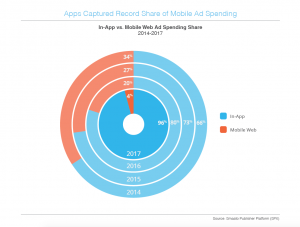
In-App Advertising Accounted for 96% of Global Ad Spending

In-app advertising has taken over the mobile advertising market, growing from 80% of total ad spending on the Smaato platform in 2016 to 96% in 2017. In-app’s domination of mobile ad spending last year was a global phenomenon, with in-app holding at least an 87% share of ad spending in each of the top 20 mobile advertising markets worldwide. Compared to mobile web, in-app ads also boasted much higher eCPMs, more user engagement and increased advertiser demand in Q4 2017.

Mobile Video Advertising Increased by 14X

Video, which can offer higher engagement advertising to a more captive audience, took off in popularity in 2017. Across all of the top 10 mobile advertising markets, mobile video ad spending has increased by at least 6X over the past year, with in-stream pre-roll showing the highest increase in demand. In addition to a huge volume increase, Smaato also measured a mobile video eCPM increase of 70% from 2016 to 2017.

Smaato Video-Ad-Requests

Smaato Reports a Fast Growing Asian Mobile Marketing Ecosystem 

Nearly 80% of the world’s internet users now access the web via mobile phones — totaling more than 2.7 billion people regularly using apps and the mobile web worldwide. Smaato, a global platform, observed record growth across many regions around the world in 2017. Black Friday was the largest spending day of the year in the US, showing a spending increase of 32% over the average for Q4. Much of 2017’s growth occurred in Asia.

Recommended Read: How is The Location Data Landscape Shaping Up in 2018?

Smaato saw year-over-year ad request growth in Japan (+147%), South Korea (+105%) and Singapore (+96%), while China, the world’s largest mobile market, posted eCPMs averaging 191% higher than APAC overall. On China’s Singles’ Day, the world’s largest shopping holiday, mobile ad impressions on the Smaato platform spiked +20% higher than the two-week average from November 5-17.

Currently, Smaato provides a real-time mobile advertising platform, connecting 10,000+ advertisers — including 91 of the Top 100 Ad Age brands — with over 90,000 app developers and mobile web publishers. Smaato manages up to 19 billion mobile ad impressions daily and reaches over 1 billion unique mobile users monthly.

Recommended Read: Interview with Eric Keating, VP, Marketing, Zaius

TechBytes with Tom Rassweiler, VP, Content Reinvention, Arkadium

0
Tom Rassweiler, Arkadium

Tom Rassweiler
VP, Content Reinvention,  Arkadium

The State of Content Marketing in 2018 revolves around real-time personalization and customer experiences. Content marketers are increasingly deploying strategies to build, distribute and repurpose interactive content that delivers engagement, traffic, and revenue, in addition to sustained brand visibility, across all marketing channels. Picking the right content marketing technologies can help identify traffic-boosting interactive content that keeps the audience on your site longer. To understand the core tenets of content marketing at Arkadium, we spoke to their VP, Content Reinvention, Tom Rassweiler.

Tell us about your role at Arkadium and the team you handle.

I’ve been with Arkadium for 14 years and run a ~20 person product development team that includes developers, designers and QA. We develop games and interactive content for consumers, publishers, and brands.

Explain to us “Content Reinvention”? How effective is it to recycle content, especially from B2B point-of-view?

Our team is developing new interactive content types all the time.  Our title of “re-invention” is aspirational. We are always trying to discover new engaging experiences for our users and partners that have never been done before.  At the same time, we are also looking for ways to evolve existing successful content types for new purposes and partners. The simplest example of re-using content is re-skinned games for new brands or partners. This is a good value because we know that the underlying game is engaging, but with new art, the game is able to match the needs of the partner. Interactive data visualizations can also be re-used based on the same strategy. We find a visualization and interaction mechanic that is fun and useful for end users, then we can update the visuals to match a brand, or change the data-back-end to tell a different data story. Re-use doesn’t remove the need to keep inventing and trying new things, it just allows us to multiply the value and returns from each successful piece of content we discover.

Also Read:  If A Picture’s Worth a Thousand Words, Then Visual, Interactive Content Is Priceless

What technologies are you looking at for producing cutting-edge content in 2018? Tell us about the core tenets of your content calendar or how you manage so much in real-time.

We have always focused primarily on a web and mobile-web technology stack. So, the core is some sort of javascript. However, our visualization engines are always changing because the space is moving very fast. We have been using WebGL and Pixi for the last year or so and have built some impressive templates for rapidly developing and releasing responsive interactives and games, but we’re actually starting to experiment with Adobe Animate for development of html5 content as well. Adobe has been steadily improving their tools since the death of Flash and we have seen some promising recent tests. This technology could empower our designers to do a lot more of the work without developer intermediation.

Managing the content calendar is challenging. We have a lot more ideas and opportunities than we have time, so the challenge is prioritization. Making great engaging content is not a conveyer-belt production process. It takes active engagement and creativity from everyone on the team throughout the process, as well as feedback from many different perspectives. We’ve found that having small teams focused on different content in simultaneous parallel is quite efficient. We’ve also invested in building our own higher-level frameworks so we can consistently create new content from a strong foundational base

What are the biggest challenges to creating great content experience on mobile?

There are a lot of challenges. Smaller visual dimensions for one we need to think about UI and UX from a mobile-first perspective to avoid getting derailed later in development. Load-speed on modern publisher web-pages is another challenge, primarily because of the large variety and density of network calls every page makes.  This can compound on mobile so we need to be very careful about both the size of the content and the number of calls we make before we can load. But we also see an upside.  Touch is a wonderful interaction mechanic so it opens a lot of opportunities. Also, mobile pages tend to be less visually cluttered so our content stands out and can get a lot of clicks and engagement.

How do you see interactive content market evolve with new-age guidelines for brand safety, transparency and data privacy?

I think that interactive content is going to continue to be an important and growing medium. Younger generations are growing up in a world where everything is interactive and if it’s not, it feels broken. So, I don’t think that’s going to change, but the new growth in brand safety, transparency and data privacy is going to shift the focus of the market shift towards premium methods for content delivery. Content needs to be contextually targeted, relevant and helpful to the users. Products like InHabit, which we released last year, are going to help with that because they use dynamic page analytics and machine learning to ensure the interactive data visualizations (we call them factives) it delivers fit natively in the article or information on the page. Users will appreciate and enjoy the content, brands will know that they are being served in the correct place, and we don’t need cookies to stalk specific users.

What are your thoughts on video marketing playing a bigger role in turning strangers to loyal customers?

We don’t work in video marketing much, so I don’t have a strong opinion here. Our specialty is interactive content and so I have a bias towards it and tend to think that interaction drives engagement better than video-only. Industry benchmarking proves this.

Do you think it’s right time for content marketers to leverage Artificial intelligence and machine learning for better customer engagement? How do you achieve that at Arkadium?

Absolutely. As with the question about challenges of privacy and brand safety, delivery mechanics that leverage machine learning and artificial intelligence can provide a ‘special-sauce’ that allows content to reach the correct audience at the correct time, in a scalable way. Arkadium’s InHabit product can ensure that a branded factive hits only the right contextual articles and users. It not only recognizes inappropriate articles or placements, but also finds the articles with the correct context and emotional tone to get the best engagement from readers on-site.

Thanks for chatting with us, Tom.
Stay tuned for more insights on marketing technologies. To participate in our Tech Bytes program, email us at news@martechseries-67ee47.ingress-bonde.easywp.com

Gartner Cites Newgen Software As A ‘Visionary’ In The 2017 Magic Quadrant

0
Gartner Cites Newgen Software As A 'Visionary' In The 2017 Magic Quadrant

Newgen Software, a provider of Business Process Management (BPM), Enterprise Content Management (ECM), Customer Communication Management (CCM) platforms, has been listed as a ‘Visionary’ in the ‘Gartner Magic Quadrant for Intelligent Business Process Management Suites 2017 by Rob Dunie, Van Baker, Marc Kerremans, Jason Wong, published on October 24, 2017’.

Newgen OmniFlow Intelligent Business Process Suite (OmniFlow iBPS) is a platform for business stakeholders to drive enterprise-wide digital transformation. The platform enables organizations to manage a complete range of business processes, leveraging its advanced tools for content integration, process orchestration, predictive and on-demand analytics, enterprise mobility, social collaboration and cloud deployment.

Also Read: CRM Magazine Named Bpm’online a Leader In Enterprise and Midmarket CRM Categories

Commenting on this recognition, Diwakar Nigam, MD & CEO, Newgen Software, said, “Being Cited a Visionary in the Gartner Magic Quadrant for Intelligent Business Process Management Suites validates our enormous efforts to provide a unique value proposition to our clients across verticals. The company has continuously strived to drive innovation across all of its products. Continuous process improvement, superior customer experience and accelerated business growth have become imperative for digital transformation within any organization.”

Newgen OmniFlow iBPS framework facilitates Digital Sensing for enhanced customer experience across different communication channels and Robotics Process Automation (RPA) enabling organizations to easily create, deploy, manage and monitor bots thus, enabling businesses across the globe with the competitive edge to improve efficiency, enhance productivity and accelerate revenue growth.

Also Read: Techwave and MosChip Take Home Inaugural bpm’online BPM Innovation Award

Recently, the company released OmniDocs 9.1 with enhanced data security, expandable Azure cloud storage and personalized document-centric workflows. The solution suite offers smart tools to capture content from multiple sources, manage it in a secure centralized repository and make the information accessible across content-centric processes. It enhances the productivity of workers and improves overall customer experience.

Key features offered by the solution include:

  • Enhanced Data Security: Prohibits unauthorized access to sensitive data with encrypted data storage (Advanced Encryption Standard 256 bit encryption) and provides restricted data view to users with rights-based access
  • Cloud Enhancements: Provides content storage on Azure Blob Cloud; Database management over MSSQL 2016 DB Server and User authentication on MS Azure Active Directory
  • Record Management: Efficiently perform basic Record Management operations, such as record request, generate transfer request, dispatch and reject directly within the solution
  • Personalized Document Workflows: Facilitates a highly personalized user experience with customizable document view. Users can configure and perform advanced document-centric workflow tasks such as Assign to File Plan (to initiate record filing) and Custom Actions (to auto-populate data or trigger actions)
  • Language Support: Offers Arabic language support

Newgen Software, is a provider of Business Process Management (BPM), Enterprise Content Management (ECM), Customer Communication Management (CCM) platforms with large, mission-critical solutions deployed at world’s leading banks, insurance firms, healthcare organizations, governments, BPO’s & telecom companies.

Recommended Read: CRM Magazine Named Bpm’online a Leader In Enterprise and Midmarket CRM Categories

Ad Blockers: Take a Page from Video Game Advertisers 

1
Ad Blockers: Take a Page from Video Game Advertisers 

The digital ad industry went into a collective meltdown over news that Safari, Apple, and Chrome were making moves to integrate ad-blocking technology. Indeed, ad blocking is already impacting companies throughout the ecosystem, with Criteo most recently forecasting a 9-13% negative impact on its 2018 revenue due to Apple’s changes.

To be sure, ad blocking isn’t some new phenomenon. Consumers aren’t thrilled to have ad tech companies track their moves and sell their data to advertisers. Globally, some 615 million devices installed ad blockers by the end of 2016, with 62% of those on mobile, according to a study by PageFair. Asia-Pacific is the largest geographical driver of mobile ad blockers, where 94% of ad blocking takes place.

Also Read:  What Does Google Chrome’s New “Auto-Annoying-AdBlocker” Mean For You?

Another study from Kantar Millward Brown found that 78% Asia-Pacific consumers are seeing more ads compared to three years ago with a further 61% saying that ads have become more intrusive.

In my view, ad blocking is a symptom of a larger problem that stems from poorly optimized ads, resulting in poor user experiences and irrelevant ads.  Far from being a solution, ad-blocking simply highlights the need to evolve the way ads are created, delivered and experienced by audiences. Both the studies reinforce this.

So, how do we tackle this complex reality?

Let’s go back to basics. The purpose of advertising has always been to reach the right person, at the right time, with the right message. Having said that, there’s a strong demand for innovation and experimentation, too.

In order to do this well, ad tech companies, agencies, and advertisers need to understand where people are spending their time and their broader motivations.

The video gaming industry has taken steps to address this and flipped the dynamic between the content provider and consumer. The concept revolves around rewarding consumers for their attention and making the experience more interactive by rewarding additional in-game currency or items for watching an ad or making ads an interactive mini-game while the main game loads.

The idea is gaining traction within the industry but is still far from being mainstream. In the meantime, there are other ways to better engage and interact with consumers.

Also Read:  4 Emerging Adtech Trends to Watch in 2018

The IAB Tech Lab has already taken the first step with the LEAN Ads Program. LEAN, an acronym for Light, Encrypted, AdChoices supported, Non-invasive ads, is a guideline for advertising standards that aim to boost user experiences around ads, regardless of platform.

The LEAN ads program looks to tackle some of the major issues that users are currently experiencing, addressing bloated ads that demand large amounts of data and invasiveness, which often leads to difficult or blocked access to content. Concerns about privacy and transparency are also being elevated through AdChoice support and encryption.

For the advertising industry to move forward, a concerted effort is required to fully adopt the guidelines suggested by the IAB. In the longer term, industry players need to take a leaf out of gaming industry and work together to develop, engaging, two-way interactions with consumers.

Also Read:  Forget Click-Through Rates, Focus on Emotional Engagement 

Interview with Jaclyn Klein, Co-Founder, Product Designer, Growlabs

0
Jaclyn Klein GrowLabs

[easy-profiles profile_twitter=”https://twitter.com/Jacmklein” profile_linkedin=”https://www.linkedin.com/in/jaclynmklein/”]
[mnky_testimonial_slider slide_speed=”3″][mnky_testimonial name=”” author_dec=”” position=”Designer”]“Chatbots have and will continue to have a huge impact in the online B2B space, making inbound sales teams so much more efficient and successful.”[/mnky_testimonial][/mnky_testimonial_slider]

Tell us a little bit about your role at Growlabs?

As a co-founder, my role spans various functions of the business; however, my core focus is designing the best possible software for our customers. I’ve used my past experience in sales and marketing roles, and the pain points I’ve felt trying to source data and engage leads, to inform a lot of design decisions for the Growlabs platform. In addition to my prior sales knowledge, I conduct interviews with sales teams, listen to sales calls, and work closely with our customer success team to determine our product roadmap. All the features we build are designed to solve problems for B2B companies looking to scale their growth. My role requires a lot of empathy and a deep understanding of current sales processes and best practices in order to innovate modern solutions.

My favorite aspect of my job is that I get to combine very powerful and complex features with a very simple and easy to use interface, which our customers have been extremely delighted and surprised by. I know how frustrating it can be to use a sales or marketing tool that has hundreds of settings, and an overwhelming set of features. I put forth a very conscious effort to make Growlabs easy to use and understand, and the feedback we’ve received has been extremely positive.

I’m proud of the work we’ve done so far, and I have to thank our incredible team of software engineers who have built our platform from the ground up, our customer success team who works around the clock to ensure all of our customers are happy and getting the most value from Growlabs, and of course to our team of sales champs for closing deals every day.

What draws you to the Revenue Summit 2018?

It’s a conference for forward-thinking sales and marketing professionals. When you attend Revenue Summit, you can expect to meet thought leaders, teams, and vendors from the next generation of revenue-generating strategies, tactics, and technologies. It’s inspiring and illuminating in many ways if you’re in the industry.

Which sessions at the Revenue Summit 2018 would you recommend and why?

Of course, I recommend my talk “Perfecting the SDR Playbook – How to Increase Sales with a Highly Targeted Outbound Process.” You’ll learn strategies for personalized engagement at scale, and I’m not talking about merge tags.

I’m also excited about the session “Inbound Lead Routing – Forms vs Chatbots – The Process of Routing, Timing, and Conversion Rate Optimization.” I think chatbots have and will continue to have a huge impact in the online B2B space, making inbound sales teams so much more efficient and successful.

How do you see the martech landscape evolving, in the years to come?

The rise of AI and Machine Learning will have a huge impact on the martech industry. We’re already seeing a lot of sales and marketing tools using automation, but this automation will become much more sophisticated and intelligent over the next few years. For sales teams, manual workflows and tasks will become very sparse, and the majority of their focus will be on selling to interested, qualified leads. I believe future tools will automatically execute and optimize the top half of the funnel.

What startups are you watching/keen on right now?

Guru is awesome. They make knowledge sharing look good! It’s such a useful tool for creating a searchable knowledge base for your entire company. I love it and hope it continues to see rapid adoption and growth.

What tools does your marketing stack currently consist of?

Growlabs, Intercom, AdRoll, Zapier, AdWords, LinkedIn, Salesforce, Dropbox, PandaDoc

Could you tell us about a standout digital campaign? 

Since launching our Zapier app, we’ve been able to push more dynamic multi-channel campaigns that span across both sales and marketing. When we add new leads in Growlabs and start engaging them, we’ve set up a trigger using Zapier that automatically adds those new leads to AdRoll to be targeted with ads. This allows us to build brand recognition as we start to send out cold emails to new prospects. We’ve seen a significant increase in reply rates for the groups of leads that have also been seeing our ads (we’ve been running A/B tests between leads who see our ads and leads who don’t). We’re excited about this new type of multi-channel campaign!)

How do you prepare for an AI-centric world as a business leader?

One way to prepare is by keeping an open mind when it comes to new tools. There are many areas where AI can increase accuracy and efficiency in a business. It’s worth testing these technologies as they arrive because ignoring them could cause your business to fall behind the competition. Moving faster and working smarter is a good thing. That being said, it’s also important to use a critical approach when evaluating these new solutions. There’s no doubt that some AI tools will claim to handle tasks that… frankly just can’t beat the effectiveness of human talents (at least not yet!). Be skeptical of far-fetched sounding solutions, and make sure to ask a lot of questions and do your research before transferring trust from a human to a machine. When in doubt, ask to speak with an existing customer.

One word that best describes how you work.

Evolving

What apps/software/tools can’t you live without?

Because I’m a designer, the number one tool I can’t live without is Sketch. After that, it’s Asana, Gmail, Slack, Dropbox. Our sales team would say they can’t live without Growlabs because it’s our most successful customer acquisition channel and the source of 65% of our deals/revenue.

What’s your smartest work related shortcut or productivity hack?

Our sales team has increased efficiency 5X by using Growlabs for outbound sales. They don’t spend any time manually sourcing new prospects or searching for their contact info (which could take hours a day). Growlabs finds the right decision makers for us, and puts them into an automated email sequence. The inbox filtering tool in Growlabs weeds out hundreds of “out-of-office” responses daily, and automatically re-schedules follow-up emails to send when the contacts indicated they would be back in the office. This allows our sales team to focus 100% of their time on replies from interested leads, rather than cleaning out their inbox every morning and manually sourcing data.

What are you currently reading? 

The content I read is either design, sales, or startup focused. I recently discovered a great article on LinkedIn (written by Justin Bauer for the Amplitude blog) called “Good Product Team / Bad Product Team”. It outlines the imperative qualities and processes that lead to a successful product and ultimately, a successful business. Good products (built by good product teams) will help your business succeed, will help your sales team sell, and will help your customer success managers retain clients and keep them happy.

Most of my content is found through a select handful of newsletters I subscribe to. For example, InVision’s newsletter is great for curated lists of design articles and blog posts, and for sales content, SalesHacker is one of the sources I rely on.

What’s the best advice you’ve ever received?

The best advice I’ve ever received was from one of my college professors. I was about to graduate and had the option to join a startup as the first business hire or to join an established agency as an entry-level associate. I knew the agency route would be a safe choice where I would learn from the senior, more experienced team members. I feared that I wouldn’t be qualified for the role at the startup and was very intimidated by it. My professor told me she believed in me and my abilities, and that I should take the risk. Joining that startup was one of the best decisions I’ve ever made. I’m thankful for her advice and encouragement.

Something you do better than others – the secret of your success?

My sense of curiosity and ability to learn fast has allowed me to rapidly move through various areas of responsibility within startups. I quickly became a “swiss army knife” for small businesses, finding success across various marketing, sales, creative, and product roles. I now focus mainly on product design, which I find the most rewarding and challenging.

My wide variety of business experience, and sense of empathy for the end-users allows me to design with various goals in mind, which makes me a strong asset to any design team.

Thank you Jaclyn! That was fun and hope to see you back on MarTech Series soon.

[vc_tta_tabs][vc_tta_section title=”About Jaclyn” tab_id=”1501785390157-b58e162d-0ae25a4b-c27aca64-108e51b0-80edaf37-bd3d357a-6c4694d6-eec8″]
Product marketer turned product designer. Open to ping-pong match challenges, if you’re brave enough. Words to live by: Be passionate and learn by doing.
[/vc_tta_section][vc_tta_section title=”About Growlabs” tab_id=”1501785390320-2d44fa50-740c5a4b-c27aca64-108e51b0-80edaf37-bd3d357a-6c4694d6-eec8″]

Growlabs
All-in-One Lead Generation & Sales Automation Growlabs combines lead generation with powerful email automation to help our clients grow their businesses, at scale.

[/vc_tta_section][/vc_tta_tabs]
[mnky_heading title=”MarTech Interview Series” link=”url:https%3A%2F%2Fmartechseries-67ee47.ingress-bonde.easywp.com%2Fcategory%2Fmts-insights%2Finterviews%2F|||”]

The MTS Martech Interview Series is a fun Q&A style chat which we really enjoy doing with martech leaders. With inspiration from Lifehacker’s How I work interviews, the MarTech Series Interviews follows a two part format On Marketing Technology, and This Is How I Work. The format was chosen because when we decided to start an interview series with the biggest and brightest minds in martech – we wanted to get insight into two areas … one – their ideas on marketing tech and two – insights into the philosophy and methods that make these leaders tick.

Outbrain Launches ‘Sphere’ for Unbiased Audience Development

1
Outbrain Launches 'Sphere' for Unbiased Audience Development

Sphere by Outbrain to Help Publishers Collaborate and Build Direct Connections with their Audiences

Leading premium discovery platform, Outbrain, has unveiled Sphere. Sphere by Outbrain is an innovative audience development platform that brings high-quality content to users and delivers new sources of revenue for digital publishers while reducing their reliance on Facebook. CNN, Meredith Corporation, Penske Media Corporation and Getty Images are among the premium publishers to have signed on with Sphere as founding members.

Read Also: TechBytes with John Schnipkoweit, CTO, Choozle

Sphere by Outbrain Would Provide Users with a Diverse Discovery Experience

Sphere by Outbrain is an invitation-only network of premium publishers that recommend and share each other’s high-quality, brand-safe content amongst the members of the closed group. The publishers within Sphere provide users with a diverse discovery experience by presenting the best editorial content from around the web alongside their own editorial content.

Recommended Read: How is The Location Data Landscape Shaping Up in 2018?

As a result, publishers have a cost-effective way to acquire loyal, high quality and highly engaged audiences that translate to more revenue and more long-term value.

Yaron Galai, Co-founder and CEO of Outbrain
Yaron Galai, Co-founder and CEO, Outbrain

At the time of this announcement, Yaron Galai, Co-founder and CEO of Outbrain, said, “We believe the future of publishing is a return to direct relationships between publishers and audience. Publishers need a better way to build owned audience growth, without relying on Facebook. With Sphere, we are paving a new path in the digital publisher business model to encourage high-quality content that delivers deeper engagement with users.”

Yaron added, “The Sphere experience takes into account the needs of both publishers and users, making it a necessary win-win for all parties.”

Read More: AdColony Announces Full Compatibility with IAS, Double Verify and MOAT

Sphere Rewards Engagement by Financially Incentivizing Longer Visits

A key differentiator with Sphere is in the product economics and revenue model, as the first tool to reward engagement by financially incentivizing longer visits. Via Sphere, Outbrain will be using a new algorithm to help publishers achieve Lifetime Value (LTV) per user by encouraging deeper engagement with content to drive higher-quality visits and increased page views.

Outbrain’s network of premium publishers is uniquely positioned to deliver high-quality audiences and content. Some of the world’s most well-recognized publishers utilize the Outbrain platform including CNN, ESPN, Meredith Corporation, Fox News, The Guardian, The Telegraph, New York Post, Sky News, TF1, Condé Nast, Bild, Orange, and L’Equipe.

Read More: Interview with Chris Lynde, CEO, SaleScout Data Solutions

Currently, Outbrain brings personalized, relevant online, mobile and video recommendations to audiences while helping publishers understand their audiences through data. Outbrain serves more than 275 billion personalized recommendations, reaching nearly one billion users every month across the globe.

The Great Gate Debate

0
Guest-post Gated Content

On24 Webinar WorldTo gate or not to gate, that is the question. It’s an argument as old as time. Or at least as old as digital marketing. For many years, the standard arrangement between companies and prospects was that companies would give you a valuable piece of content in exchange for some basic contact and/or demographic information. The “registration form” became an expected, and occasionally feared, part of the bargain. Once you filled out the form, you knew you were signing up for a bombardment of emails and phone calls. It was the price you paid.

Then something changed. The information age delivered on its promise and information was everywhere. If you didn’t want to fill out someone’s form, you could simply find what you needed from another source. New content types sprung from new channels. There were social sites, peer networks, forums, and wikis. Suddenly, you could easily access content on any subject. Unsurprisingly, conversion rates on gated forms plummeted.

This gets us to the heart of the debate. If we want people to consume our content, engage with our brands and hopefully consider our products or services, should we simply lose the gated form and let everyone view whatever they want? The logic being the more exposure the better, so let them have it all. That’s just what some companies did. You have all heard the stories of how “X” company bravely threw open their gates, gave away all their content and had amazing results. Yet for some reason, most marketing teams did not adopt this model. Why?

Also Read:  Context Is King: The Rise of Contextual Advertising in 2018

Well for one, if you examine these heroic companies, you realize what many of them did was simply ungate a lot of their written content. Higher level, engagement-driven content like webinars and live demos were still gated. That makes sense. The point is that different forms of content don’t  hold the same value or  play the same role.

What’s missing from this debate is the role of content engagement. Most content (like white papers, infographics and blog posts) are static. This means once someone downloads a piece of content, gated or not, there is no additional interaction with that person. They either read the white paper, don’t read it, read some of it; you simply don’t know. As they read your content, they may have thoughts, feelings and questions, but you can’t capture that feedback as there is no actual engagement. Even videos are passive content as the viewer can’t do anything except, well, watch the video. You are not learning anything about your prospect from the content experience.

Then there is dynamic content delivery. Let’s take the example of webinars: you have a piece of high-value content, perhaps a thought leadership presentation, but now your audience can engage with you throughout the experience. They can ask questions, respond to polls, download other content, tweet, post, link to free trials, demos or other key conversions. All that engagement (behavioral data)  helps you identify your best leads. But that doesn’t work unless you know who they are.

Also Read:  Why the Tug-of-War Will Continue in 2018 Social Marketing

Getting names is always good. “More leads” has been the longstanding marketing mantra. However, there is a shift taking place from more leads to better leads. Registration form data (the gate) only gives you the name and contact information. The real goal for marketers today should be the well qualified lead. Are they interested? What are their needs? What are their concerns? High-value content delivered through an engagement-driven experience helps us find those leads.

Perhaps the great gate debate is the wrong premise. As our marketing becomes more digital it also becomes more impersonal. Today, we should focus on delivering real human experiences where we can get beyond the gated form, interact with our prospects and learn more about them then simple demographic data. So, what does this mean in practice?

  1. Deliver your best high-value content through engagement-driven experiences; webinars, virtual environments, live demos, etg. This is the content you gate. Get the name and then measure the behavior.
  2. Offer up a lot of your static content, ungated, as teaser content to get people to a gated engagement.
  3. Once you have contact information on a prospect remove, or lessen, the gates and drive them towards additional engagement which will help you create connections that close.

The bargain we created long ago, where you get a great piece of content for some contact information, is now void. Both sides need more. Your audience wants to experience your content and engage with you in the process. In return, that conversation helps you learn more about them. In the digital world, human engagement may be our best chance to turn great content into happy customers.

Also Read: Are Creative Marketplaces and Dynamic Creative Optimization the Future of Online Advertising?

Zaius Integrates with Zendesk for 360-Degree View on Customer Experience

0
Zaius Integrates with Zendesk for 360-Degree View on Customer Experience

The Zaius-Zendesk Integration is the First B2C CRM-Customer Service Platform Integration for E-Commerce, Retail Marketers that Offers Data from Every Customer Engagement

Zaius, a leading B2C CRM that delivers real-time, cross-channel marketing automation and attribution built on a single customer view, has announced the immediate availability of its product integration with Zendesk.

Recommended Read: Interview with Jaimie Buss, VP Sales, Americas, Zendesk

By making customer support data available to marketers through this integration, Zaius is delivering on its promise of a complete view of every customer engagement, from marketing channels to support desk tickets.

B2C Marketers Can Create Effective Customer Experiences to Drive Better Sales

Eric Keating
Eric Keating, VP of Marketing, Zaius

At the time of this announcement, Eric Keating, Vice President of Marketing at Zaius said, “Marketers’ visibility into customer behavior has almost always been limited to marketing touchpoints, leaving them in the dark when it comes to some of the most important engagements customers have with brands.”

Eric added, “By integrating customer support data from Zendesk, we’re giving marketers the power to create campaigns based on the whole customer experience, so they can be more successful and drive more sales.”

Read More: Interview with Eric Keating, VP, Marketing, Zaius

Zaius’s product integration with Zendesk empowers B2C marketers with a centralized customer database and 360-degree visibility into all customer interactions with their brands. This one pane of glass streamlines the email, web, mobile, advertising and other data companies already collect, so they can better segment and target campaigns, and analyze relationships between ticket activity and customers’ average order value (AOV) or lifetime value (LTV).

Nicole Tabatabai, Senior Director of Digital Marketing at Optoro, said, “No single view of customer behavior is complete without support data, so the Zaius integration with Zendesk will give us critical feedback and insights that inform our entire marketing approach.”

Read More: Interview with Chris Lynde, CEO, SaleScout Data Solutions

Nicole added, “Leveraging this integration and the support data for segmentation and personalization lets us truly optimize our customers’ experiences with our brand.”

Optro currently offers Blinq.com as a leading overstock and returned product e-commerce business.

Zaius-Zendesk Integration Provides a Centralized Customer Base with Better Analytics 

By ingesting Zendesk customer support data and unifying it with a customer’s shopping behavior data, product data and more, Zaius provides-

A Centralized Customer Database

Marketers can augment their customer profiles with Zendesk data to include support tickets, satisfaction ratings and more in their view of customer interactions across marketing and support.

Segmentation and Campaign Targeting Capabilities

Users can exclude customers with open support tickets from promotional emails or review requests, segment customers based on the reasons why they opened support tickets, trigger satisfaction survey emails to customers after tickets have closed, nurture satisfied customers to create brand advocates and more.

Analytics

Retailers can understand the relationship between the number of tickets per customer and their satisfaction ratings, as well as metrics including AOV and LTV. They can further analyze how ticket activity and satisfaction ratings correlate to customer lifecycle stage.

Recommended Read: How is The Location Data Landscape Shaping Up in 2018?

Amplitude Expands Its Leadership Team to Meet Growing Demand for Product Analytics

0
Amplitude Expands Its Leadership Team to Meet Growing Demand for Product Analytics

Veteran Executives from Fastly and Google Join Rapidly Growing Company

Amplitude, the product analytics company, announced that it has hired former Google executive Erik de Muinck Keizer as General Manager of EMEA to lead the company’s first international office in Amsterdam. Amidst growing demand for its enterprise products, Amplitude has also hired Erik Watson, former Fastly executive, as VP of Enterprise Sales in North America.

Amplitude Expands Its Leadership Team to Meet Growing Demand for Product Analytics
Erik de Muinck Keizer

Before joining Amplitude, de Muinck Keizer spent 11 years at Google. While he was there, he was a founding member of Google’s Enterprise Division in EMEA, where he grew their Search Appliance product to become a profitable part of the business. He also founded and ran Google’s Cloud organization in Benelux, leading the division to become a sizable and profitable revenue driver.

Amplitude Expands Its Leadership Team to Meet Growing Demand for Product Analytics
Eric Watson

Meanwhile, Watson brings more than 20 years of enterprise sales experience to Amplitude. Most recently, Watson comes from content delivery platform company Fastly, where he helped scale their technology enterprise sales teams and grow the business threefold. In addition, Watson spent the majority of his career selling to and consulting with Fortune 500 companies.

Also Read: Amplitude Arms Product Teams with Analytics to Meet Growing Need For Rapid Innovation

As large companies compete to deliver the best product experiences, they are investing more in software that helps them to build, analyze and monetize great products. Over the past year, Amplitude has tripled its enterprise customer base in the U.S. and in Europe, adding new customers including Microsoft, Capital One, Hubspot, Dailymotion, and Booking.com.

Spenser Skates Amplitude“Product is today’s new competitive battleground. Successful companies need powerful product analytics to innovate faster and grow long-term revenue. We are excited to have Erik and Erik on board to help us meet the growing demand of our enterprise customers. They will be crucial to scaling Amplitude’s operations as we address the needs of large businesses that are competing to build the best products,” said Spenser Skates, co-founder and CEO of Amplitude.

Also Read: The Age of Choice : How Marketing & Business Will Change in 2018

In the past 12 months, Amplitude has achieved several important milestones:

  1. Released a new set of features designed for the enterprise: Taxonomy, Insight, Accounts and Scale
  2. Raised $30 Million in Series C funding led by IVP
  3. Doubled its headcount to 100, with plans to double again in the next year
  4. Opened an office in Amsterdam to serve increasing demand from product leaders in Europe
  5. Named as a best startup for new graduates

Erik De Muinck Keizer and Erik Watson will round out Amplitude’s experienced leadership team, which includes other recently hired executives such as Chief Financial Officer, Caitlin Haberberger, previously at Flite; Chief Revenue Officer, Matt Althauser, previously at Optimizely; Chief Development Officer, James Donelan, previously at MuleSoft; and VP of Marketing, Michelle Kim, previously at Okta.

Recommended Read: Know Thy Customer, Know Thy Market: Helping Startups Succeed