Home Blog Page 4213

Sizmek DSP Brings in Contemporary AI/Machine Learning Technology for Better Programmatic Control and Efficiency

4
Sizmek DSP Relaunched with Contemporary AI/Machine Learning Technology for Better Programmatic Control and Efficiency

AI-Enabled Sizmek DSP Provides Agencies and Brands with Improved Insights and Total Transparency to Optimize Campaigns in Real-Time

Today, Sizmek has announced a completely overhauled industry-leading DSP. The new DSP presents an evolved user experience, providing clients with new screens and workflows for added transparency, control, and efficiency when managing budgets and programmatic spend. These enhancements ensure agencies have greater insight into their advertising campaigns, enabling them to identify and optimize media strategies, gaining a clearer picture on what’s working, what’s not, and how to best take action in real-time.

At the time of this announcement, Dr. Mark Grether, CEO of Sizmek, said, “We heard our clients’ feedback, and worked with them hand-in-hand to design the new DSP. Agencies want more control and efficiency, and demand the offerings from technology partners strengthen their overall value proposition.”

Dr. Mark added, “More than that, we often hear the misconception in our industry that AI can replace people. Our DSP and products are all about enabling our clients to make smarter decisions and differentiate themselves in the market. Our success is rooted in how we bring data, creative and media together—all powered by AI.  The Sizmek DSP incorporates all of those offerings into one platform.”

Buyers experience improved usability and perspective with fewer clicks and reduced time-to-value, saving countless hours of tedious work and better optimizing their time.

Sizmek DSP Enables Buyer-Side to Retain Full Control over Campaign Execution and When to Use AI

The new DSP is powered by Sizmek’s industry-leading AI, providing agencies with an intuitive recommendation and optimization engine that improves the performance of media. In the past, advertisers and agencies did not trust the black box approach that AI and machine learning seemed to be based on and were wary of losing control over the decision making process.

The DSP provides:

  • An evolved user experience, giving clients new screens and workflows for added transparency, control, and efficiency when managing budgets and programmatic spend.
  • Improved usability and perspective with fewer clicks and reduced time-to-value, saving countless hours of tedious work and better optimizing their time.
  • Buyers retain full control over campaign execution and when to use AI. The DSP designs data for discovery and provides transparency into key learnings with data-visualization reports that show how attributes contributed to campaign success over time.

However, Sizmek ensures buyers retain full control over campaign execution and when to use AI (for instance whether to AI-optimize or manually allocate daily tactic budgets). The DSP designs data for discovery and provides transparency into key learnings with data-visualization reports that show how attributes contributed to campaign success over time.

Sizmek DSP and products are all about enabling the clients to make smarter decisions and differentiate themselves in the programmatic advertising market.

“The UI redesign was thoughtful, as all key features can be accessed quickly and let us edit and update specific items without additional clicks in sub-menus,” said Axel Jonuschies, Managing Partner, Global Trading – Programmatic at GroupM.

“The new UI gives us greater efficiencies, and reduces the frustration of a slow front-end; I’m sure it will be appreciated by all existing users of the Sizmek DSP.”

“Sizmek’s new DSP is the best I’ve seen—and I’ve seen most,” said Reeve Benaron, CEO and executive chairman of AudienceX.

Reeve added, “It ensures my teams have a better viewpoint and understanding of all our omnichannel campaigns. Ultimately we can better optimize our efforts to meet the needs and expectations of performance advertisers.”

Sizmek DSP Offers Clear Insight into Media, Delivery, Costs and Campaign Impact

Sizmek continues its tradition of transparency, as the enhanced DSP offers clear insight into media, delivery, costs and campaign impact. Agencies can make better-informed decisions about budgets and overall programmatic spend, strengthening their value as a brand partner by maximizing performance and minimizing human error.

Currently, Sizmek is the world’s largest independent buy-side advertising platform that creates impressions that inspire. In the digital world, creating impressions that inspire is vital to fostering relationships of trust with agencies and brand as well as building meaningful, long-lasting relationships with customers. Sizmek provides powerful, integrated solutions that enable data, creative, and media to work together for optimal campaign performance across the entire customer journey. Sizmek helps advertisers achieve these in real-time.

MTA Mythbusting: Reality Versus the Noise in the Marketplace

0
Multi-Touch-Attribution-Mythbusting

neustarMarketers are finally beginning to embrace multi-touch attribution (MTA) as a way to make in-flight optimization decisions in market, because they can learn which channels, platforms, publishers, formats, creatives, and audiences are influencing purchases, and how they all work together. MTA represents a major step forward for accountable marketing when it’s well understood, implemented correctly, and used in combination with other measurement methodologies like marketing mix modeling (MMM). In fact, CMOs across the world agree that customer experience, customer retention and growth, and customer analytics are crucial to support marketing outcomes over the next 18 months, according to Gartner. It is, therefore, no surprise that a study by the Data and Marketing Association (DMA) and the Winterberry Group concluded that two-thirds of US marketing professionals had increased their prioritization of marketing attribution in the past year.

But as valuable as MTA can be for marketers looking to improve their ROMI, many first-generation attribution solutions and general confusion in the marketplace have caused a series of myths to cloud the promise.

Here are six commonly misunderstood assertions about multi-touch attribution that every marketer should know about:

MTA fails to measure incremental impact

Some old school mix modelers have suggested that MTA is flawed because it is limited in scope and can’t take into account many of the key drivers influencing sales. They claim that MTA over-attributes marketing success to the channels/devices it reads and under-attributes the impact of everything else.

While that may be true for solutions that are limited in scope and explanatory power, best-in-class marketing analytics offerings take a unified approach, which brings together traditional non-addressable media, addressable media, and non-marketing drivers such as weather, economy, seasonality, competitor activity, etc.

This approach lets marketers measure the incremental impact of media. So not just the interaction between addressable channels, such as display, paid search, paid social but also channels like Out-of-Home (OOH), radio, print, TV, etc. If all advertisers look at is digital/addressable, at best all they can understand is their relative influence on each other. When considering “everything,” media, as well as non-media business drivers, advertisers can accurately determine the incremental impact that media has on their business. Marketers really need to think of this as business driver modeling and not just marketing mix analysis.

Also Read: Implementing Multi-Touch Attribution: 7 Best Practices

MTA fails at transparency and objectivity

Okay, this is fair with some media platforms that also provide their own measurement (and have a tendency to over-attribute their own influence and under-attribute other publishers).  But for the most part, advertisers have objected to these offerings and demanded neutral measurement providers. Marketers want and need an objective view into their performance and value the ability to look across all customer touchpoints.

They demand neutral, trusted partners that they can work with to ensure that they are getting an unbiased view of their media and are able to scale their advertising programs beyond one digital platform provider. With neutrality comes transparency and objectivity.

 MTA doesn’t measure at the customer level

The promise of MTA is understanding the impact of media at the customer level. Without this degree of granularity, MTA doesn’t work. While customer-level measurement is challenging – it is difficult to reconcile customer identity across devices, channels, platforms, browsers, etc. – some advanced measurement solutions available in the market today are able to join these disparate data sources into a single individual or household level view. It’s important to probe any potential provider about their view of identity and the scope of their graph. Strong MTA requires a broader aperture than merely a cross-device or cross-channel view.

Also Read: Five Inconvenient Truths of Multi-touch Attribution (MTA)

MTA has to be real-time to make a difference

The fallacy of real-time MTA is pernicious. The vision of real-time media allocation is attractive, but unrealistic. While there are certainly moments when it makes sense to quickly move money in or out of the market based on external factors, most advertising works on a slow build, cumulative basis. And even if a single ad were all it took for a consumer to buy; the purchase cycle is usually less than immediate. Worse, real-time attribution solutions are by definition last-touch, which is the antithesis of how advertising works (see above). By being able to better understand the whole journey, marketers will inevitably receive better outcomes, in the form of lower CPAs, higher ROI, etc.

Therefore, MTA can’t inform the media buy

Based on the argument above, the best MTA solution is not last-click and takes time to read.  True. But for MTA to be truly valuable—even though decisioning isn’t real-time off of media exposure—marketers do expect to be able to make in-flight optimizations. By measuring both media attributes (e.g., campaign, site, placement, creative), as well as audience attributes, advertisers can use them both as direct inputs into the buying process. For example, advertisers can identify an audience that works well in their MTA results and create a look-alike model for that audience segment. They can then push that segment into their favorite programmatic platform. Obviously, this requires that the MTA platform be connected directly with the media platform so that this customer analytics feeds customer experience flywheel can be successful.

Also Read: Cross-Channel Attribution and How to Cut Through the Noise

MTA is static and hasn’t evolved as new forms of data emerged

New forms of data and new rates of granularity have made previously opaque patterns of consumption and behavior transparent. Data lakes allow unstructured data to be used for analytics and MTA can use long-term longitudinal data but isn’t hostage to them. We’ve seen a lot of progress, especially with the leading digital platforms like Amazon, Facebook, Google, Snap and Pinterest – they’ve opened up access to their data sets so that advertisers can get that accurate, holistic view. The best providers are always looking at new data they can address and how much of the media mix can be included in the model.

MTA isn’t the holy grail, to be sure. And bad MTA is worse than no MTA at all. But with the right provider, a strong and holistic identity graph, integration with MMM, and a direct connection back to your media platform, MTA provides actionable analytics and intelligence that strengthens marketing returns for all consumers, not just those already down the funnel. Don’t let the fallacies get in the way of your strategy. MTA myths have already been busted.

Also Read: Everything You Wanted to Know About Marketing Attribution

Evergage Named a Leader in Gartner’s First-Ever Magic Quadrant for Personalization Engines

0
Evergage Named a Leader in Gartner’s First-Ever Magic Quadrant for Personalization Engines

Company Recognized for Completeness of Vision and Ability to Execute

Evergage, The 1-to-1 Platform company, announced it has been named a Leader in Gartner’s first-ever “Magic Quadrant for Personalization Engines”. Placement in the Magic Quadrant recognizes completeness of vision and ability to execute.

According to the Gartner report, “Leaders are vendors that demonstrate a solid understanding of the product capabilities and commitment to customer success that buyers demand in the current market. This is coupled with an easily understandable and attractive pricing model that supports proof of value, incremental purchases and enterprise scale. In the modern personalization engine market, purchase decision makers demand easy-to-use and easy-to-buy products. They require that these products deliver clear business value and deliver results with limited technical expertise and without the requirement for upfront involvement from IT. In a rapidly evolving market with constant innovation, a Leader must also demonstrate that it is not focused only on current execution. It must have a robust roadmap for solidifying its position as a future market leader, thus protecting the investment of today’s buyers.”

Also Read: Allant Group Expands Partnership with Sprinklr to Deliver Optimized Marketing Execution Across Owned, Earned and Paid Media

Gartner defines personalization as “a process that creates a relevant, individualized interaction between two parties designed to enhance the experience of the recipient. It uses insight based on the recipient’s personal data, as well as behavioral data about the actions of similar individuals, to deliver an experience to meet specific needs and preferences.” The report notes: “Personalization engines apply context about individual users and their circumstances to select, tailor and deliver messaging such as content, offers and other interactions through digital channels in support of three use cases – marketing, digital commerce and customer experience. These personalized interactions can increase conversion, marketing effectiveness and customer satisfaction, thereby improving business results.”

Evergage CEO and Co-Founder Karl Wirth said: “Gartner’s recognition of Evergage as a Leader, we believe, validates our strong and innovative offerings, and reflects our customers’ feedback and dramatic successes. We also believe this first-ever Magic Quadrant underscores why personalization is a critically important and strategic priority for companies across industries – impacting customer experience, loyalty and revenues. As organizations seek to better understand and respond to their visitors and customers across digital channels, we feel they are turning to Evergage’s 1-to-1 personalization and customer data platform (CDP), and we’re proud to be deemed a Leader in the space.”

Evergage enables B2C and B2B marketers to deliver individualized experiences in real time across websites, email, web and mobile apps, and onsite search – all from an easy-to-use platform that marketers can operate without IT intervention. Working with companies including Citrix, Lenovo, Publishers Clearing House, Walmart Mexico and many more, Evergage powers personalized experiences for more than 3 billion people across the world.

Evergage was also recently named “Best E-Commerce Solution” in the SIIA CODiE Awards and a gold (highest-level) Stevie Award winner in The 2018 American Business Awards. Evergage’s full-length book, “One-to-One Personalization in the Age of Machine Learning,” was recently dubbed a “Marketing Achievement of the Year” in the 2018 PR World Awards.

The news also comes amidst new product milestones and momentum for Evergage, including the recent launch of Evergage SmartSurveys, for targeted customer surveys that can trigger in-the-moment personalization. This year, Evergage also expanded operations to Europe, continued to innovate with advanced email personalization and announced it had doubled fiscal year revenues for the third consecutive year.

Recommended Read: Outbrain Acquires AdNgin to Further Enhance the Reader Experience


Invoca Announces Enhanced Integrations with Google Marketing Platform and AMP Support

0
Invoca Announces Enhanced Integrations with Google Marketing Platform and AMP Support

The Call Tracking & Analytics Platform’s Deeper Integrations with Google Make AI-Powered Call Intelligence Data More Valuable to Marketers

Leading call tracking software provider, Invoca has announced that it has launched enhanced integrations with Google Ads and Google Marketing Platform (formerly AdWords and DoubleClick, respectively). The company has also announced additional support for Google Accelerated Mobile Pages (AMP). The improved integrations with Google’s suite of ad tools allow users of Invoca’s AI-powered call analytics platform to improve campaign performance, optimize media across channels, enhance visibility and decision making, and boost organic search results.

Invoca’s improved integrations include:

Google Display and Video 360: Formerly known as DoubleClick Campaign Manager (and now part of Google Marketing Platform), Invoca’s improved integration with Google Display and Video 360 allows marketers to attribute conversions happening over the phone to digital display and video ads served by the world’s largest digital campaign management and ad server.

Google Ads Customer Match: With deepened integrations with Google Ads (formerly AdWords) and YouTube Advertising, marketers can improve ROI from their digital programs by suppressing, targeting, or creating lookalike audiences based on call conversions or non-conversions. This includes integration with YouTube TrueView for action, which gives marketers the ability to use call data to automate retargeting (and suppression) of customers on YouTube with direct response videos.

AMP Support: Invoca now offers full support for Google Accelerated Mobile Pages (AMP). Users can now drop an Invoca tag on AMP pages, enabling them to take full advantage of call intelligence data on AMP pages without sacrificing organic search result position.

“Google is not only dominating the US advertising market but has become an indispensable part of the martech stack,” said Nathan Ziv, VP of product management at Invoca.

Nathan added, “For call analytics to work for marketers, it absolutely has to work seamlessly with Google’s suite of products. Invoca’s unmatched depth of integration with Google maximizes the value of call intelligence data by making it available in the places that marketers care most about.”

Invoca’s full Google integration includes: Google Analytics, Google Ads, Google Display and Video 360, Google AMP support, and Google Search Ads 360 (formerly known as DoubleClick Search), and Google Attribution 360 (formerly known as Adometry). Invoca also offers seamless integrations with products from Adobe Analytics, Facebook, Instagram, Salesforce Marketing and Sales Clouds, and more.

Invoca now offers the most robust integrations with Google of any call tracking and analytics solution. What separates its offering is the accuracy of the attribution data that marketers rely on to optimize their campaigns within Google’s platforms. Unlike other vendors that use inaccurate proxy metrics like call duration or spoken keywords to measure call conversions, Invoca employs its award-winning Signal AI technology to automatically predict the likelihood that a particular call outcome was met, like a purchase or an appointment set. This results in a much higher level of attribution accuracy that marketers can be confident in.

Invoca customers like Healthcare Success are already taking advantage of these improved integrations to maximize the value of data derived from phone conversations with their customers.

Garrick Gaffney, Digital Account Supervisor at Healthcare Success, said, “The depth of Invoca’s integrations with Google Marketing Platform has made it seamless for us to attribute conversions happening over the phone to our search, display, and mobile campaigns.”

Currently, Invoca helps marketers drive more revenue and a better customer experience by bringing call data and conversation insights into the digital customer journey. With Invoca’s call tracking & analytics platform, marketers finally have attribution and analytics to measure call outcomes and tie offline conversions back to digital spend.

With an ecosystem of over 30 technology partners, marketers can inject call intelligence into their existing technology stack, enabling them to orchestrate a seamless customer journey. Invoca is backed by Morgan Stanley Alternative Investment Partners, Accel Partners, Upfront Ventures, Rincon Venture Partners, Salesforce Ventures, and Stepstone.


Gartner Says Customer Experience Pyramid Drives Loyalty, Satisfaction and Advocacy

0
Gartner Says Customer Experience Pyramid Drives Loyalty, Satisfaction and Advocacy

New Research Shows Organizations How to Discover Innovative Customer Experiences that Build Stronger Relationships

Eighty one percent of customer experience (CX) leaders report they will compete mostly or entirely on CX, but less than half have established the rationale for why CX drives business outcomes, according to Gartner, Inc. The goal of CX is to meet and exceed customer expectations, but while 48 percent say their CX efforts exceed management’s expectations, just 22 percent of CX leaders report their CX efforts exceed customers’ expectations.

Less than half of #CX leaders have established the rationale for why #CX drives #business outcomes.

To address this challenge, Gartner unveiled the CX Pyramid, a new methodology to test organizations’ customer journeys and forge more powerful experiences that deliver greater customer loyalty and brand advocacy.

“The fact that so many organizations understand the importance of CX to the brand, but are unable to deliver outcomes that meet or exceed customer expectations is indicative of the growing need for fresh approaches to delivering more positive outcomes for customers,” said Augie Ray, research director at Gartner. “Leading brands in CX start with a strong foundation in customer satisfaction. Getting this right and understanding how to build upon it to drive positive financial and business outcomes is what sets the best brands apart from the rest.”

Also Read: Ada and Zendesk Unite to Improve Chatbot Experience for Customer Service

The Gartner CX Pyramid (see Figure 1) is a framework to understand what separates the most powerful customer experiences from the rest. Each level, from bottom to top, defines an incrementally stronger way to forge relationships between an organization’s brand and their customers based on the way CX leaders listen for, understand, act on and solve customer needs.

The pyramid helps to identify the most powerful CX based on criteria including: (a) how the experiences are triggered, (b) the amount of effort required of the customer, (c) the completeness of the solution, and (d) the emotion and change in perception created by the experience. The CX pyramid goes beyond just solving today’s problems for today’s customers, by focusing on five key stages:

  • Stage 1: Communication Level – Furnish customers with the information they can use via the right channel at the right time.
  • Stage 2: Responsive Level – Solve the customer’s problem quickly and efficiently – meaning, balance both business and customer goals, measures and strategies.
  • Stage 3: Commitment Level – Listen for, understand and resolve customers’ unique needs.
  • Stage 4: Proactive Level – Provide experiences that resolve needs before customers ask.
  • Stage 5: Evolution Level – Make customers feel better, safer or more powerful.

Through these various levels, the CX pyramid should serve as a filter to review customer touchpoints and experiences throughout the entire buy, own and advocate journey.

CX leaders looking to drive more powerful, proactive and innovative solutions through the CX pyramid should follow three key steps:

  • Assess Your Capabilities – Ensure they’re capturing a thorough understanding of customer wants, needs and expectations, not just their perceptions of your existing initiatives.
  • Tailor Your Customer Journey Maps – Push experiences in the top of the CX pyramid at key touchpoints and drive customers deeper into the buy, own and advocate journey.
  • Measure Your More Innovative CX Efforts Differently – CX leaders must make sure to measure their more innovative customer experiences against adoption, perception and financial objectives.

Recommended Read: [24]7.ai Partners with Blue Prism to Deliver New AI-Enabled Automation Capabilities For Virtual Agents

Glue42 Extends Desktop User Experience via Open APIs

0
Glue42 Extends Desktop User Experience via Open APIs

Firm Contributes Proposal to FINOS FDC3  App Directory Working Group to Further Enterprise Desktop App Standardization

Glue42, the company bringing an entirely new desktop experience to capital markets, retail banks, and insurance firms, announced that developers can now acquire and deploy individual Glue42 services to augment their existing interop frameworks or containers. This new capability was largely made possible because of the emergence of platform agnostic standards, especially the Financial Desktop Connectivity and Collaboration Consortium (FDC3), a program of the Fintech Open Source Foundation (FINOS).

Glue42 extends desktop UX via open APIs. Contributes proposal to @FinosFoundation @FDC3_ App Directory Working Group to further enterprise desktop app standardization.

As a result, all Glue42 services will now be made available through Glue42 and through open APIs. These include app directory, advanced window management, notifications and multi-stack interop. The availability of these services will further streamline the user experience of fintech developers and their app consumers while delivering vital insight into users’ behavior, operational KPIs and compliance.

James Wooster, COO of Glue42, said, “Traders, wealth managers and knowledge workers in general have a large number of apps and not enough desktop real estate. It’s an all too common scenario in which users lose track of data and miss critical process steps.”

Wooster continued, “Currently, we are undertaking a global rollout of our next generation of fluid desktop with one of our clients. Users who were previously grappling with 25 plus applications are now presented with a fully integrated environment in which they appear to be using a single application. This will cut training effort, enable faster responses and improve business outcomes.”

Also Read: Facebook Introduces Five New Features in Ads Manager App

The decision to extend these services was a result of industry open source and standardization efforts. Chief among these was the standards work of the FINOS FDC3 collaboration which enables financial institutions to accelerate application development and deliver scalable applications across a wide range of technology stacks.

Glue42 CEO and member of the FINOS FDC3 App Directory Working Group, Leslie Spiro, recognized this opportunity to make a contribution, based on Glue42’s experience in supporting enterprise deployments that include hundreds of inhouse applications. His recommendation, which is under active discussion, has extended the Group’s discussions to ensure that large-scale, enterprise deployments using a variety of technologies can be supported on the FDC3 app directory servers.

Spiro said, “FDC3 is an excellent initiative and we look forward to continuing our work with them under the FINOS umbrella to ensure that the Group standards meet the needs of enterprises around the world. From our perspective, we are excited about the way in which FDC3 and FINOS give financial institutions more options regardless of their existing infrastructure or applications sets.”

Frank Tarsillo, co-chair of the FINOS FDC3 App Directory Working Group and a technologist heading architecture at IHS Markit, said, “As part of our effort to produce industry standards for app directories, we welcome the contribution of proposals that share the experience of companies and individuals in the community. FINOS provides a collaborative environment and neutral platform where constructive evaluation of these proposals can be discussed by all participants equally. As an active contributor, Glue42 recognizes both the importance of open collaboration and efforts to standardize interfaces that drive true value in our industry.”

In the next few months, Glue42 will make more services available via open APIs and plans to make further contributions to FINOS and its working groups.

Recommended Read: AGORA Images Closes 2 Million Euro Financing Round

Cisco’s Former CIO & SVP Of Operations Rebecca Jacoby Joins Apptio Board Of Directors

0
Cisco's Former CIO & SVP Of Operations Rebecca Jacoby Joins Apptio Board Of Directors

An Early Advisor and Customer, Jacoby Brings Experience and Vision to Apptio as it Drives Global Adoption of Technology Business Management

Apptio, Inc., the business management system of record for hybrid IT, announced the appointment of Rebecca Jacoby to the company’s Board of Directors, effective 27 July 2018. Jacoby will also serve on the Board’s Audit Committee. Previously, Jacoby served as senior vice president of Operations at Cisco and held the position of CIO for the 12 years prior.

“Today, every company is a technology company fighting for competitive advantage and new revenue streams. Apptio is the key to navigating this transformation amidst the change brought about by digital, cloud and Agile,” said CEO Sunny Gupta.

Sunny added, “Rebecca is a strategic leader and technology visionary, as well as an early Apptio customer, deeply respected by CIOs around the world. Her expertise lies in the unique combination of operations and technology with a strong growth mindset – an invaluable addition to our Board.”

Also Read: Upstream Works and ZOOM International Announce Cisco Solution Partnership

Jacoby retired from Cisco in May after more than 22 years of service. As SVP of Operations, she led Cisco’s global operations, driving profitable growth and enabling operational excellence. She also oversaw various functions including IT, supply chain, security and trust, global procurement, and renewals. During her tenure as CIO, Jacoby guided Cisco to adopt an early version of Apptio and influenced the evolution of its SaaS applications. In 2009, Jacoby was appointed as a strategic advisor to the Apptio’s Board and was a founding member of the nonprofit TBM Council. Jacoby also serves on the Board of Directors for S&P Global, a publicly traded financial and analytics company.

“The most progressive and successful IT and finance leaders in the world are automating their investment decision-making process with Apptio’s SaaS applications. Armed with data and analytics, these leaders are establishing a solid foundation of transparency, driving multi-year planning to fund innovation, managing their transformation to the cloud and application modernization, and driving shareholder value,” said Jacoby. “This is why I adopted Apptio at Cisco. Now, as a member of the Board, I’m honored and excited to continue shaping the value of Apptio for companies of all sizes, industries, and geographies.”

Also Read: IZEA Appoints Francesca Cruz as Vice President SaaS Customer Success

In addition to Jacoby’s appointment, Ravi Mohan, Managing Director and Co-founder at Shasta Ventures, will be stepping down from his role on the Board of Directors. Ravi has served on the Board since 2010.

“Ravi has been an extraordinary Board Member, partner and advisor for our business over the past eight years,” said Gupta. “His knowledge of technology value and his unparalleled leadership and insight has allowed us to grow Apptio to the organization we are today.”

Tom Bogan, CEO of Adaptive Insights, and Chair of the Board, will be coming off Apptio’s Audit Committee but will continue to serve the Board and Compensation Committee as he has since he joined in 2007.

Recommended Read: VenueNext Appoints Anthony Perez as New Chief Executive Officer

Simon Data Raises $20 Million to Take Big Data End-to-End for Marketers

0
Simon Data Raises $20 Million to Take Big Data End-to-End for Marketers

Simon Data, the first and only enterprise Customer Data Platform with a fully-integrated marketing cloud, announced the close of a $20 million Series B funding round to further develop its arsenal of solutions for marketers.

“The current crop of enterprise CDPs are falling short of their promise to deliver on personalization”

The financing was led by Polaris Partners, and follows a Series A funding round in 2015. The company was founded by Jason Davis, Josh Neckes, and Matt Walker, and has raised a total of $32 million to date.

“The current crop of enterprise CDPs are falling short of their promise to deliver on personalization,” said Josh Neckes, Co-Founder & President of Simon Data. “Like us, they have the capacity to join data from disparate sources to build a rich, unified view of the customer. Unlike us, they’re completely incapable of complex campaign orchestration. With more ways to engage customers than ever, marketers are demanding complex cross-channel workflows, deep insights and journey management. That’s where the value is and where we come in.”

Also Read: Zero Opt-Outs Is the New Holy Grail for Marketing Automation, This Year’s Nucleus Value Matrix Shows

Simon’s disruptive platform vision of blending the messaging and orchestration capabilities of a marketing cloud with the critical infrastructure offered by an enterprise-scale CDP quickly attracted major customers such as Airbnb, OpenTable, Blue Apron, TrueCar, and Rover. Simon enables these and other major brands to leverage all of their customer data to drive personalized, optimized communication in any end-channel.

“The value to any business of big data lies in the insights it provides and the business outcomes actioning it can deliver,” said Jason Davis, Co-Founder & CEO of Simon Data. “Companies everywhere have invested tremendously in their data infrastructure, but they’re unable to capture the value held within. Simon is a new type of platform designed specifically to unlock that value by using data to inform and orchestrate the customer experience.”

Dave Barrett, Managing Partner at Polaris Partners, joins Simon Data’s Board of Directors, alongside Maria Cirino from .406 Ventures. .406, F-Prime, and Commerce Ventures also participated in the round.

“Simon Data is solving the complex personalization puzzle that has long frustrated marketing executives & practitioners. Fine-grained performance measurement and campaign ROI is the holy grail for this next generation of marketing,” said Barrett. “Jason, Josh, and Matt have an incredible vision in this space, and have navigated colliding categories to produce a solution that is wholly unique. Their customer traction speaks for itself, and we’re thrilled to be their partner in their journey in building a transformative company.”

Recommended Read: SBDS Global Launches World’s First DataTech Services Company to ‘Cut Through the Data Clutter and Confusion’

Leveraging the Power of Social Media to Garner More Customer Reviews

0
Leveraging the Power of Social Media to Garner More Customer Reviews

The Importance of Online Reviews for Businesses Can Mean a Surge in Brand Awareness and an Overall Increase in Profit in the Long Run

An integral aspect of owning a business today would also mean the potential to garner online customer reviews for communication and positive participation.  Customer reviews on social media today play a huge role in bridging divides between a viral form of feedback and simple word-of-mouth technique.

According to a local consumer survey report, 85% of consumers trust online reviews as much as personal recommendations. Consumers also read at least an average of 7 reviews before trusting any business or buying a product.

So now if you’re sitting back leisurely in your chair and admiring these reviews, do know that you’re missing out on an incredible chance of creating more value for your business.

There are plenty of third-party sites that you can find reviews on, but there are possibilities of it being a vague and irregular number. Fortunately, there are methods on social media which can help an entrepreneur/business organically grow using only customer reviews for products/services.

What Should Social Media Platforms You Focus On?

Google Analytics notably mentions all the individual platforms that garner traffic. It also notes the platform that generates the most traffic.

For example, if Google Analytics points Facebook to be your key traffic generator- then focusing on the same social media platform and revamping it to have more social prowess is a good start. Though your company’s traffic may be coming in from Facebook, do not forget to count on other social media platforms as well.

Also Read: Integrating AI with Social Media Marketing to Persuade Profitable Markets

In this consumer-centric online marketing era, aligning your business with other social media platforms like Twitter, Snapchat, LinkedIn and Google Reviews is a smart step forward. Focusing on two or more social media platforms would mean a unified approach in harnessing more power on social media with added customer reviews.

  • Facebook

Facebook is a popular choice for customer reviews. It is a quick medium to give businesses credible information based on a consumer’s experience and evaluation of any service/product. Users can read reviews, add pictures or a rating besides the post, thus allowing users to quickly predict whether they want to opt for a service or not.

  • Twitter

Twitter is not always the most sought-after option for reviews. Despite that, Twitter is a great platform to generate a snippet based on customer reviews. A lot of businesses use Twitter as a platform for customer service and it effectively helps in strengthening the link between a customer and business.

  • Instagram

Instagram is a unique platform which has always outdone business expectations by harnessing the capability of doing more. Instagram’s review system is visually appealing and it cocoons an environment of detailed descriptions along with good-quality images. Most brands prefer using #hashtags and #reposts to generate a community vibe and develop brand awareness on social media.

  • Google +

Having an optimized Google + page business profile is one of the most standard mediums of zeroing down on local searches. Being present on Google + can give you an opportunity for users to find your business using local maps, find the opening and closing times and even read reviews all based on your search results. If properly utilized, Google + can increase the overall traffic being generated towards your business.

  • LinkedIn

LinkedIn recommendations for user reviews are extremely helpful for brand awareness and visibility in the online clutter. If you want your clients to trust you personally, then LinkedIn is the chosen platform. There are various plugins and tools that can help promote your LinkedIn on email and on the site. Since LinkedIn does not generate a lot of traffic as other social media platforms do, the key to connection is by packing more reviews in your bag. You can also request connections to review you from an entrepreneurial perspective to create a valuable profile.

As the social media expert, Brian Solis said, “Welcome to a new era of marketing and service in which your brand is defined by those who experience it.”

Extensive Ways of Leveraging Social Media for Customer Reviews

Billions of people around the world interact and engage with social media communities, which is why creating a profile for your brand is valuable. Social media is one of the easiest platforms for brands to interact with their customers and it is a constant channel of communication i.e if you do it right!

There are various ways to collect customer feedback, but what could actually be easier than a survey is the path paved for social media success.  It is important to know what customers speak of, especially in association with your brand.

Curated below are a few ways of understanding how to grasp a consumer’s attention and leverage social media to improve customer service for a brand.

  •  Social Media Listening

Monitoring mentions of your competitors and your brand is a good idea to get started. By overhearing mentions of your brand name on social media, the solution of customer feedback, support and customer reviews will be addressed. Monitoring competitors on your social media platform can also help you connect with customers who are unhappy with your services and resorting to other means. Try and learn why they may be dissatisfied, and how you could improve on measures to better serve them. At your best, you can learn by differentiating yourself apart from the competitors, nurture leads and convert them to happier customers!

  • Product Feedback

Collecting product feedback on a new product launch or changes to an existing product is important and efficient to keep your customer base in-the-loop. Leveraging your social network to be larger and constitute target customers, industry influencers and prospects is important as a communication medium for greater adoption rates post a new launch/feature changes.

Understanding the power of customer reviews is important because if unsatisfied, bad reviews coupled with a disgruntled person is a recipe for disaster for your brand. Product feedbacks are important since they act as reassurance towards the customer and your services.

  • Efficient Focus Groups

Effective focus group interviews also have a good deal of segmentation within them. To filter that, conduct your R&D efficiently and incorporate mediums like Google + to target your audience. Facebook’s live feature for a Q&A segment is also a well-planned idea. Focus groups tend to make a person feel special about the power of choice and are inherently contributive towards a more refined search on products/services.

  • The Power of the Poll

Conducting polls to understand the choices of your consumers is a fun, interactive method of garnering customer reviews and feedback. Asking people for their opinions on critical issues or lighter topics can gauge your customer’s opinions and preferences on a wider platform.

Also Read: Ten Content Marketing Ideas to Grow Your E-Commerce Brand

  • Industrial Influence

One of the major reasons social media exists is for networking. Taking advantage of gathering the best answers to the choosiest of your questions is a brilliant way of asking for help, interacting, inducing engagement and also opening up new doors of meeting somebody influential and strengthening relationships. Influencers in any industry are of great assistance to somebody who wants to step up their game. This is a good solution for brands that are looking for greater visibility and hoping to create more awareness.

  • Developing Personas for Greater Inbound Marketing Strategy

Do you know who your customers truly are? You may think it isn’t important in comparison to the product you sell but these are important characteristics that form customer- buying decisions. Having a well-defined persona can assist you with targeting marketing campaigns and narrowing down prospective customers. Personas put a face to a customer and drastically reduce confusion, thus better-placing products and identifying a user’s needs and wants. Developing personas is one of the most important aspects of your inbound marketing strategy since it paints a better picture for your marketing, sales and product teams.

As a marketer, adhering to common social media practices and community management guidelines include;

  • Keep your responses to customers light, helpful and short. Focusing on building brand stories around their questions is also a good start.
  • Responding to customers with unique statements instead of a copy-paste job is incredibly important.
  • Incentives are another good way of asking customers for reviews. Incentives engage consumers to be more proactive with their ideas and who doesn’t love a freebie occasionally?!
  • Avoid arguments with your customers online. Answering queries by being respectable is crucial. Ignore and disregard the use of hate language, profanities, and inflammatory statements. Those social-media wars are the worst and can tear a brand’s reputation down in just a few seconds.

Social media management software like Buffer, Sprout Social, Mention, Brandwatch among others are good bets on handling public forums, registering customer feedback, and assisting brands to develop their image with a brand identity attached to it.

Subscribing to Google Alerts is another good method of getting notifications as and when a customer posts a review or a comment.

Understanding the power of social media and various channels is important for a brand to show their customers that their opinions matter and that they care. Gathering insights from negative comments can be seen as an opportunity to accept failure, improve and expand the overall performance and growth of a brand.

Paytronix Research Reveals One to One Win-Back Campaigns Drive the Most Traffic

0
Paytronix Research Reveals One to One Win-Back Campaigns Drive the Most Traffic

Strategies for Successful ‘We-Miss-You’ Campaigns Help Drive Incremental Revenue from Easiest Segment of Guests to Get Back into Stores

Paytronix Systems, Inc., an innovator in mobile loyalty and online ordering applications, mobile payment, and digital communication tools, released a Data Insights research brief that identifies 80 to 90 days as the key average window for winning back lapsed guests. The report explains how “mitigating the impact of lapsed guests can have a high impact on traffic and same-store sales” and outlines key strategies for getting these guests back to drive incremental revenue.

“Be careful to only implement a win-back campaign after you’ve taken the time to separate truly lapsed guests, or you’ll be discounting loyal customers who already plan to return,” said Lee Barnes, head of Paytronix Data Insights. “This new brief explains how to separate out truly lapsed guests and identify the window where it’s most effective to engage with them—along with proven strategies to win the customer back.”

Also Read: Lattice Engines Accelerates Revenue and Customer Growth in First Half of 2018

The Paytronix research brief outlines the following steps to strategically determine when to send a “we miss you offer” to a guest:

  • Track and measure the variability in guest visit frequency;
  • Begin with a small offer first, then increase to more valuable offers as guest absences stretch 2-to-3 times their average visit frequency;
  • Keep a control group to measure the true impact of the campaign.

“Guest lapsing is a part of life and will happen no matter how great your concept and your loyalty program. Remember, a known lapsed guest is ALWAYS better than an unknown one. If the guest is unknown, you probably won’t even know that they’ve stopped coming in,” said Barnes. “Winning back lapsed guests can significantly impact your restaurant’s sales and traffic, but you can only do this if you know enough about the guest to A) be confident that they’ve lapsed and B) send an offer that resonates with them.”

Paytronix Data Insights

Paytronix embraces Big Data, bringing together POS, loyalty, social media, and other disparate data sources to discover new opportunities for compelling visits and spending, efficiently identifying and automating 1-1 guest engagement. This report from the Paytronix Data Insights research team is provided to help customers uncover actionable insights for more effective use of their marketing budget—which ultimately results in happier, more loyal guests.

Recommended Read: adsquare Implements Unacast’s Transparent Location Data to Build Cutting-Edge Mobile Marketing Measurement, Insights and Targeting Solutions with Unprecedented Clarity

The ADVERTISING Club of New York Enlists Top Industry Talent as New Board Directors

0
The ADVERTISING Club of New York Enlists Top Industry Talent as New Board Directors

Club Honors Standout Talent with 2018 President’s Award and Rising Star Accolade

The ADVERTISING Club of New York, the industry’s leading professional organization representing the advertising, media, marketing and ad-tech industries, announced the addition of seven new board members to new posts at its 122nd Annual Meeting of Members. The event took place at Horizon Media’s Headquarters in New York on July 18.

“All of the great momentum The AD Club has experienced recently is articulated by the recent changes to our board, with a new roster of talented, dedicated individuals at the core of our success,” said Gina Grillo, President and CEO of The ADVERTISING Club of New York and the International ANDY Awards. “The inclusion of some of advertising’s biggest and brightest stars will certainly help our organization continue to grow and make great strides that benefit not only Club members, but the industry at large.”

Also Read: SaaS and Technology Industry Revenue Acceleration Expert Jeff Loeb Joins Chief Outsiders’ Northeast Group

The list of Board Officers and Directors include:

Officers:

  • For Chairman: Mari Kim Novak, President, Stillwell Partners
  • For Senior Vice President: Lee NadlerLead Urban Growth & Transformation, MINI USA
  • For Vice PresidentRick SongChief Revenue Officer, Telaria
  • For Vice PresidentSandra Sims-Williams, Chief Diversity Officer, Publicis Groupe
  • For TreasurerMarie DevlinPartner, Brand Team Partners
  • For Chairman EmeritusCarl Fremont, President, Wavemaker Wunderman Alliance

Directors:

  • Devika Bulchandani, President, McCann New York
  • Sophie Kelly, SVP/NA Whiskeys Portfolio, Diageo
  • Nick Law, Global Chief Creative Officer, Publicis Groupe
  • Sandra Moerch, Site Manager of SAP Leonardo Center & Global Head of Branding, SAP Next-Gen
  • Michael Sallette, Global Marketing & Media, Nestle
  • Andrea Sullivan, Chief Client Officer, VaynerMedia
  • Lisa Valentino, EVP/Revenue Innovation, Univision Communications
  • Joseph Bihlmier, VP/Global Media, American Express
  • Colleen DeCourcy, Partner, Global Co-Executive Creative Director, W+K
  • Katrina Craigwell, Executive Director, Head of Marketing, Finn by Chase
  • Eliza Esquivel, CMO Consultant
  • Scott Falzone, Managing Director, Telecom at Google
  • Olivia Douglas, EVP, Senior Account Director, BBDO
  • Ron Fierman, Partner & President, Digital Pulp
  • Heide Gardner, SVP, Chief Diversity & Inclusion Officer, Interpublic Group
  • Jennifer Gardner, Senior Director, Media, Unilever North America
  • Jeremi Gorman, Head of North America Advertising Sales, Amazon
  • Elyssa Gray, VP/Branding, betterment.com
  • Brad Jakeman, Marketing Consultant
  • Andrew Keller, Global Creative Director, Facebook Creative Shop
  • Danielle Koffer, Chief Client Officer, Mindshare North America
  • Kris Magel, Media Executive, Denstu-Aegis Network
  • Lauren Newman, President/Beauty, Meredith
  • Tricia Nichols, SVP/Global Consumer Marketing, Estée Lauder
  • John Nitti, Chief Media Officer, Verizon
  • Barbara Pelham, Vice President of Global Agency Partnerships, Oath
  • Laurel Rossi, CMO, OMD
  • Bill Westcott, Executive Vice President, Medialink

Also Read: 2018 Content Marketing Awards Winners & Top Finalists Revealed

Young Pro President:

  • Michael Knopf, Director, Medialink

*Indicates new Directors

With Board Chairman Mari Kim Novak’s industry-wide reach, The Club has been able to expand its membership even further, particularly in the digital arena.

“I’m inspired by the talent and passion that sits on The AD Club’s board. This combination of directors will be empowered to make a real and positive difference to our business,” said Novak. “When it comes to training and education of talent in all aspects of the industry, The Club’s resources are unmatched and continue to play an instrumental role in shaping the future of advertising. Not to mention, the Foundation’s endless dedication to championing the power of diversity and promoting a platform that helps educate brands and agencies alike on how to do business better.”

The AD Club also recognized recipients of the 2018 President’s Award, which is granted to individuals and organizations who have demonstrated an outstanding volunteerism and commitment to The Club. They also honored a Rising Star, whose contributions have gone above and beyond. This year’s recipients include:

President’s Award

  • Rick Boyko, Retired, Co-President CCO Ogilvy North American / Director VCU Brandcenter
  • Adam Cohen-AslateiVice President of Marketing, Jun Group
  • Pete Favat, Chief Creative Officer, Deutsch
  • Jeremi Gorman, Head of US Advertising Sales and Global Accounts, Amazon Media Group
  • Harry Kargman, Founder and CEO, Kargo
  • Andrew Keller, Global Creative Director, Facebook Creative Shop
  • John Nitti, Chief Media Officer, Verizon
  • Lukeisha Paul, Senior Partner, Associate Director, Print
  • Barbara Pelham, Vice President of Global Agency Partnerships, Oath
  • Carly Zipp, Senior Director of Communications, Sponsorships, & Events, Outfront Media

Rising Star

  • Jordan Weinstein, Director of Business Development, Candid Worldwide

Recommended Read: Tableau Executive Mark Nelson Joins Talend Board of Directors

comScore Announces Campaign Ratings to Solve Cross-Platform Video Ad Measurement Challenge

1
comScore Announces Campaign Ratings to Solve Cross-Platform Video Ad Measurement Challenge

comscore’s New Product Will Offer Unduplicated Campaign Measurement Across Linear TV, Network OTT and Hulu on Desktop, Mobile, and Living Room Devices

comScore has announced a pilot program for its newest solution aimed to solve the industry’s need for sophisticated cross-platform video advertising measurement. The product, called Campaign Ratings, launches in beta this September with ABC, CBS, CNN, Disney, Fox, Freeform, GroupM, NBCUniversal, The CW Network, Turner, and Viacom, and will provide media buyers and sellers with trusted, unduplicated measurement of ad campaigns across linear TV, over-the-top (OTT), desktop, and mobile platforms, with streaming measurement powered by Hulu.

Currently, comScore is a trusted partner for planning, transacting, and evaluating media across platforms.

Bryan Wiener, CEO of comScore, said, “The measurement gap in advertising has hampered media brands from fully articulating the value of their audiences and advertisers from gaining an accurate understanding of campaign performance.”

Bryan added, “We heard from customers that cross-platform video measurement is a pain point that continues to magnify as audience viewership and engagement proliferates across screens. We’re excited to collaborate with these industry-leading partners on a product that will reduce friction and enable media buyers and sellers to drive business growth.”

The new solution will include an unduplicated view of total audiences across linear TV and digital platforms, person-level reach and co-viewing insights, and reliable audience demographics. comScore will incorporate feedback from beta partners to iterate on and optimize future releases of the product.

comScore’s recent “State of OTT” report highlighted that two-thirds of OTT audiences are also watching linear TV, demonstrating the convergence of digital and linear video consumption and a growing need for unduplicated, cross-platform measurement. In fact, another recent comScore study revealed that OTT alone increased the average number of linear TV viewers for a specific network program by 20 percent. When also combined with mobile and desktop, linear TV viewership for that same program increased by 42 percent, with audience reach increasing by 33 percent.

Given these trends, comScore is partnering with Hulu to power the product’s OTT measurement capability. The comScore “State of OTT” report found that Hulu viewers watched more hours of content per household than any other subscription service. Hulu has amassed more than 20 million U.S. subscribers as of May 2018.

This program is the first step in a broader company initiative to develop comprehensive and unduplicated measurement across all platforms and content types. As part of this initiative, comScore will continue to work with leading media buyers and sellers to create a true cross-platform solution made for the industry, by the industry.

What Customers are Saying

“The market is ripe for true cross-platform measurement that provides critical insight into unduplicated audience reach and co-viewing behavior,” said Radha Subramanyam, Chief Research and Analytics Officer, CBS.

Radha added, “We’re passionate about this initiative and look forward to partnering with comScore’s new leadership on a solution with the potential to move our entire industry forward.”

“CNN has a history of collaborating on new measurement solutions with comScore, notably as an Xmedia launch partner, in order to capture the full multi-platform scope of the CNN brand,” said Robin Garfield, SVP of research and scheduling, CNN.

Robin added, “This beta is another important step towards that goal and will ultimately help the entire industry accelerate investments in content experiences across a growing number of platforms and environments.”

“We continually work with partners and research companies to identify multiplatform measurement solutions that better serve our clients by providing them with a holistic understanding of their audiences and how they engage with brands,” said Elizabeth Sloan, SVP Consumer Insights, Disney|ABC Television Group.

“Supporting the development of a unified, third-party, audience metric covering all video platforms has been a priority for GroupM. A robust, comprehensive video currency is essential to maintaining a healthy video marketplace where agencies can productively trade clients’ budgets with media partners,” said Ed Gaffney, Head of Implementation Research and Marketplace Analysis, GroupM.

Ed added, “We look forward to the shared learning we’ll achieve with our clients by participating in the pilot of this new audience metric.”

“By powering comScore’s cross-platform measurement product for OTT, we’re giving marketers more options for measurement and a third-party validation of the incremental reach only Hulu provides at scale,” said Julie DeTraglia, Vice President and Head of Research at Hulu.

Julie added, “Our partnership with comScore is just another step towards achieving comprehensive measurement for the entire industry.”

“As NBCUniversal continues to seek out the best cross-platform measurement practices, and build on the momentum we’ve created with CFlight, we look forward to working with our measurement partners on new approaches,” said Kavita Vazirani, Executive Vice President, Insights and Measurement, NBCUniversal.

Kavita added, “Industry adoption of new measurement methodologies will be key in keeping up with the changes in consumption of our content.”

“Consumers are watching more video than ever, which underscores the importance of efforts by Turner and the industry as a whole to measure the impact of advertising across every screen, platform and environment,” said Beth Rockwood, vice president of portfolio research, Turner.

Beth added, “Providing measurement that can facilitate accurate planning, and fully value premium video is a priority for both buyers and sellers, and we look forward to expanding on our efforts with comScore through this beta to create measurement solutions that advance the industry.”

“This is a critical effort, not for the future of television, but for its present,” said Bryson Gordon, Executive Vice President of Advanced Advertising at Viacom.

Bryson added, “Closing the cross-platform measurement gap, that once intractable market challenge, with innovation across the industry like the comScore Campaign Ratings pilot and OpenAP’s platform for advanced advertising, will help to propel the industry’s transformation towards new currencies, products and consumer experiences.”

With a data footprint that combines digital, linear TV, over-the-top and theatrical viewership intelligence with advanced audience insights, comScore allows media buyers and sellers to quantify their multiscreen behavior and make business decisions with confidence. A proven leader in measuring digital and set-top box audiences and advertising at scale, comScore is the industry’s emerging, third-party source for reliable and comprehensive cross-platform measurement.

Chorus.ai Brings AI Technology at the Center of Business Conversation Analytics

0
Chorus.ai Brings AI Technology at the Center of Business Conversation Analytics

Chorus.ai Launches ‘Smart Themes’ AI Technology for Analyzing Business Conversations

Most clouds in a company, be it for sales, marketing or BI, have the power to deliver real-time values if they are driven by AI technology. Chorus.ai provides one such platform to leading businesses, where users can identify patterns and themes. Chorus.ai, the creator of the leading Enterprise Call Recording Conversation Cloud solution, announced the launch of its “Smart Themes” technology.

At the time of this announcement, Roy Raanani, CEO & Co-Founder of Chorus.ai, said, “When sales calls are analyzed, it’s hard to know what to look for, especially if executives are using traditional means, such as looking for manually categorized keywords.”

Roy added, “Our technology learns on its own and tells users exactly what they need to know. This process of unsupervised learning means we don’t need to manually input themes; Smart Themes identifies key themes and analyzes them for you.”

Smart Themes Makes Effective Analyses on Business Conversations After Just a Few Hundred Hours of Engagement

Smart Themes utilizes Chorus.ai’s sophisticated AI engine and through a process of unsupervised learning, proactively identifies patterns and themes within conversations and organizes them for easy access to insights. Identifying the use and placement of specific themes serves to bolster best practices, allowing the entire team to benefit from the work of the top performing sellers. Smart Themes begins to produce effective analyses after just a few hundred hours of conversations.

‘Smart Themes’ technology is an AI-powered solution that automatically analyzes business conversations, identifying common themes and topics for sales reps.

AI-powered solutions can significantly alter how day-to-day business conversations are conducted, by transforming them into meaningful data and identifying patterns that can improve the quality and impact of these conversations. While other AI technologies are limited by companies’ tagged data, Smart Themes automatically identifies common patterns, saving time and money by eliminating manual tagging and bypassing cumbersome research.

“Smart Themes automatically learns and highlights important moments in our calls without any configuration from an Admin or Sales Manager,” said Jennifer Yelton, Director of Sales Operations at Recurly.

Jennifer added, “It saves time and setup, but more importantly can tell us things about our sales process that we didn’t know impacted our win and renewal rates.”

Chorus.ai Has Changed How Sales Reps Conduct Sales

Top-revenue teams continue to choose Chorus.ai’s solutions to increase efficiency in business conversations. Marketing companies such as EverString and Engagio, and software companies like Procore, have used Chorus.ai’s technology to shorten ramp times and close more deals. Chorus.ai has changed how sales reps conduct sales and Smart Themes is the latest step in this process.

Currently, Chorus.ai provides its market-leading platform for transforming conversations into data and insights. It is ensuring more effective communication between companies and their customers. Chorus.ai’s technology transcribes and analyzes business conversations in real time. The proprietary algorithms detect High-Value Moments that serve as the foundations of an effective strategy for sales and customer success teams, thus freeing sales representatives to focus on building relationships.

Taoping Alliance Receives $17.6 Million Ad Distribution Order from Ju’an Home

0
TAOP Launches Taoping G Cloud Data Center

Taoping, Inc., a leading provider of internet-based ad distribution and ad display terminal sharing systems in China, announced that Taoping Alliance, a new media operating organization founded by TAOP and Shenzhen Taoping New-Media Limited, have entered into a contract with Ju’an Home, a nation-wide in-home care and service platform. The contract is expected to generate $17.6 million revenues for Taoping Alliance within the next twelve months.

According to the contract, Ju’an Home’s real-time ads, including brand promotions, lock hardware products announcements, and in-home care and service announcements, can be distributed on the selected cloud-based ad terminals respectively owned by local members of Taoping Alliance throughout 22 cities in China. As the developer and technology/ service provider of the Taoping new-media eco-system and the founder of Taoping Alliance, TAOP is expected to receive approximately 15% of the total revenue generated from the contract.

“We are pleased to partner with Ju’an Home,” said Mr. Jianghuai Lin, the Chairman and CEO of TAOP, “By utilizing its nation-wide networks and TAOP’s sophisticated new-media distribution and sharing platform , Taoping Alliance provides local communities the convenience service and adds value to the consumers.”

Taoping Alliance is a nationwide advertising resource sharing platform jointly founded by TAOP and Shenzhen Taoping New-Media Limited. Since its establishment in May 2017, the members of Taoping Alliance have increased to fifty-six members with the coverage of over twenty-five provinces and provincial cities throughout China.

Recommended Read: VenueNext Appoints Anthony Perez as New Chief Executive Officer

Connected Planning: The Key to Customer Engagement

0
Engagement

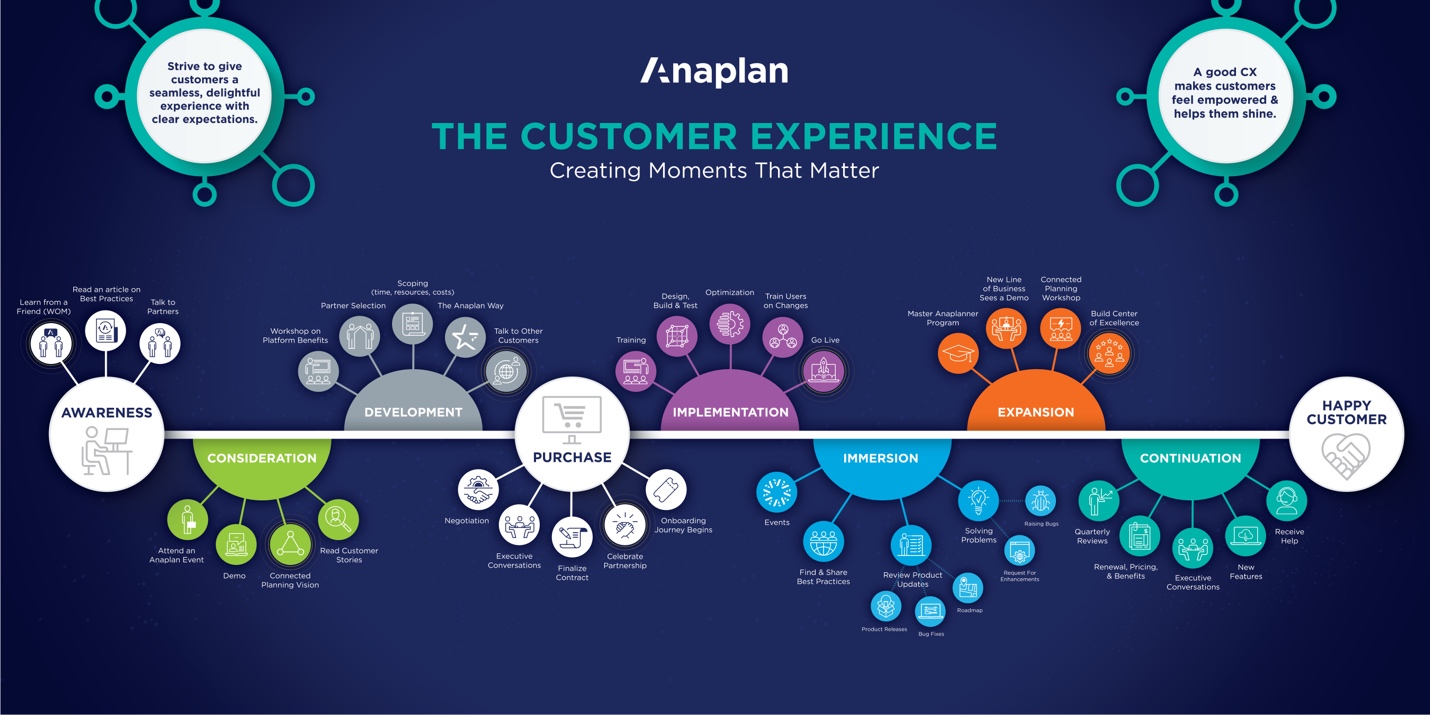
anaplanEngagement is the heart and soul of the customer relationship. Engaged customers are happy customers—they not only share their opinions and experiences, but also trust the vendor to respond in ways that deepen the buyer/seller relationship, increasing loyalty (not to mention repeat purchases) over time.

Customer EngagementAt Anaplan, we believe the essential prerequisite to engagement is a “Customer First” approach. Easy to say—most companies believe in focusing on the customer—but in practice, challenging to implement. Customer First, in order to succeed, must be cultural. It has to permeate the entire organization so that every employee sees her or his job through the lens of the customer experience.

Thanks to Anaplan’s senior management, Customer First has that kind of priority in our company. But for the marketing function in particular, it’s important to view Customer First as a customer lifecycle question. It’s not enough to focus on lead generation; marketers must consider the entire spectrum of touchpoints including relationship management, retention, and customer value creation.

Customer Engagement

At every turn, customer interests must be prioritized in order to achieve the engagement marketers look for. When establishing customer communities online, for example, it makes sense to appropriately open those communities to one’s own employees and business partners. Doing so allows those individuals to see customer concerns, share experiences and tips, and answer questions.

Also Read: Mastering Customer Experience in the Era of the Empowered Consumer

Survey Fatigue

Account-based marketing is another way to gain insight into the complex interests of key accounts (care should be taken, however, to not overlook smaller, yet still loyal customers). Even surveys—a prime source of customer learning—need to be handled carefully. Survey requests from multiple departments should be combined in order to minimize survey fatigue. Incentives also help, to show customers that their time is valued.

At Anaplan we use our own product, the Anaplan Connected Planning platform, to improve our marketing efforts. Connected Planning allows people, data, and plans to seamlessly interact across an enterprise to better manage virtually any and all organizational planning. Working from a single platform, managers can draw from, and inform, all relevant areas of the business.

Connected Planning offers multiple benefits to marketers focused on engagement. Because it allows other departments to see the potential impact of upcoming campaigns, it builds support for marketing efforts and enables those departments to plan better. For marketing executives, Connected Planning provides a more holistic view of the customer, drawing in more data faster and from more sources. As data is rolled up and analyzed collaboratively and across functions, new insights are generated.

Also Read: Lessons B2B Brands Can Learn from Direct-To-Consumer Disruption

Reduces Lag

Finally, Connected Planning reduces lag time for campaign iteration, allowing marketing teams to adjust to customer priorities. Not only do customer feel they are being heard, but teams are better able to shift dollars as needed to places where campaigns are working well—or to places that need help.

The single source of truth that Connected Planning provides is a big advantage for maximizing customer engagement. Used effectively, it promotes a culture that continually puts the customer first—ensuring the success not only of the customer, but the business as well.

Zoho One Achieving Rapid Market Adoption; New Apps, AI, Analytics and Zia Search Further Extend Power of the Integrated Software Suite

0
Zoho

Business-wide AI, Analytics and Search Demonstrate the Power of Building Services on a Pre-Integrated Operating System

Today Zoho announced major updates to Zoho One, its flagship suite of applications designed to put businesses completely in the cloud. Launched in July 2017, this all-in-one solution includes apps that run sales and marketing, finance and HR, operations and business intelligence. One year later, Zoho One is enabling a new set of capabilities that bridge the gap between different departments and roles within an organization: Zia—Zoho’s AI—can now respond to user queries by combining information from multiple apps; Zoho One’s new Analytics delivers a deeper, more contextual picture of business operations by blending data from apps across the suite; and a new unified Search feature can execute across multiple applications, bringing back richer results that significantly reduce the time and effort needed to find the right data.

The company also announced Zoho One adoption numbers for its first year on the market: more than 12,000 business worldwide—with 40 percent from the US—have become Zoho One customers. The average Zoho One customer enables 16 applications for their business, often replacing software from different vendors, preferring instead to run their business from a single cloud platform. The company has added four new apps to Zoho One in the past year—CliqZoho SprintsZoho PageSense and Zoho Flow—and today, they are introducing Zoho Backstage (link), an end-to-end event management software, which is being added to the suite at no additional cost.

“The adoption of Zoho One has exceeded our expectations, and we hope to continue this momentum into its second year. The stats clearly show that customers will use multiple apps from a single suite, if those apps work together more deeply than a patchwork of products from different vendors,” said Raju Vegesna, chief evangelist at Zoho. “We see customers combining data from different Zoho and third-party apps—like email campaigns, CRM, customer support, and invoicing—to generate new insights and make better decisions. Zoho One has already replaced more than 600 different products, and that number will only grow as we release even more new apps.”

New Capabilities Added to Zoho One 

Analytics: The new Zoho One Analytics tab provides analytics across Zoho’s suite of transactional business apps. Business owners, CXOs and managers can now track KPIs and trends all from one place, helping them to make more informed decisions. Users can create their own custom reports and dashboards to blend data from different business apps and do cross-functional analytics. For example, a marketer could combine data from Zoho CRM and Zoho Campaigns to see how many leads were created from a particular campaign and how much they cost. Currently, there are over 500 pre-built reports and dashboards available across applications. Users can also import data stored in third-party applications and analyze it along with the data from Zoho’s internal apps.

Zia for Zoho One: Zia, the AI-powered assistant first introduced by Zoho CRM in 2016, is being extended to Zoho One. Zia for Zoho One functions across various applications, pulling data from different departments to provide the right contextual information. Using simple commands, Zia can handle complex queries. Pulling information from Zoho CRM and Zoho Desk, Zia can tell users how many customers in the sales pipeline have an open support ticket. Similarly, Zia can generate a chart that displays revenue-per-employee trends for the last five years by fetching figures from the accounting app and the human resource management app. Zoho also plans to open up the Zia Voice Platform for Zoho One users, allowing them to extend Zia with custom skill sets built to address their unique needs.

Zia Search: On average, knowledge workers spend 30% of their workday searching for information, according to an IDC research paper. The new Zia Search lets users search across all their Zoho apps instantly, dramatically improving information access within the organization. Zia Search was built from the ground up with an understanding of each application’s domain, design and authorization rules, making it possible to display a more relevant, richer set of results. Zia Search also offers a results preview as well as contextual actions so users can utilize their results without having to leave the search window.

Mobile app: The Zoho One mobile app—for both iOS and Android devices—allows organization administrators and service administrators to onboard new employees, provision applications, manage permissions, set security policies, create groups and more, all from their mobile devices. With this app, admins can even take care of time-sensitive requests, like resetting a password, when they are away from their computers.

Zoho Concierge: Launched last year along with Zoho One, the Zoho Concierge is a free service available exclusively to Zoho One customers. Since its inception, this dedicated 24/7 team has helped more than 6,500 customers by mapping their business processes and advising them on how best to optimize Zoho One for their particular needs.

“Zia for Zoho One, the new Analytics tab, and Zia Search are organization-wide tools designed to give our customers deeper understanding of their businesses,” said Vegesna, “This kind of unified data ecosystem is only possible because all of Zoho’s 40+ applications have been built from scratch, over the last two decades, on the same technology base.”

Statements 

“Zoho One has brought our company closer together. What started out as a North America implementation for 50 users and ended up being a global roll-out for more than 500 employees. Not only do we rely on Zoho One for all intra-company communications, we find ourselves executing more efficiently due to the shared data and analytics we now have across departments and offices. Whether it is through Projects, CRM, Reports, or Connect, all of us have one single source of customer data and work more effectively as one team to serve our distributors and end-users. We’ll continue to explore applications on Zoho One—this is just the beginning of further system expansion we can achieve as a Zoho customer.” – Amanda Dolan, Head of CRM, Purolite

“Businesses are now looking for more integration and automation to simplify workloads for users, make quicker and more informed decisions, and deliver better experiences to customers. And they are gravitating towards vendors who can deliver that combination. To already have more than 12,000 businesses using Zoho One within its first year, ranging from one to 20,000 users, proves the value proposition of Zoho’s integrated platform appeals to companies of all sizes. With so many apps integrated together, Zoho One not only makes it easier for businesses to work more efficiently, but having this integrated data structure allows Zoho to leverage its AI and machine learning technologies to provide users a more diverse and complete data set. This has the potential to combine productivity gains with more impactful customer insights, giving businesses a competitive advantage.” – Brent Leary, Partner, CRM Essentials

“The retail landscape is evolving rapidly and has increasingly become dominated by major online players. As the largest retailer in New Zealand, with more than 200 locations across the globe, it is crucial for us to stay ahead of the landscape changes and be as agile as possible. The breadth of apps within Zoho One has allowed our more than 12,000 employees to work more seamlessly as one team and gives us the ability to communicate real-time across teams and offices. Having data on one platform has also streamlined how we service customers and has unleashed incredible energy within our company. Our response times have been reduced significantly, from days to where we are now able to resolve customer issues in real-time. Zoho One is truly the Operating System for any business!” – Timothy Kasbe, Chief Information and Digital Office, The Warehouse Group

“As a fast-growing solar company in the Northeast, we needed a comprehensive but consolidated solution that not only suited our current needs but our future requirements as well.  Customer satisfaction is our priority, thus it is critical for both sales and operations to access real-time customer status within a single platform. From lead acquisition to installation management, through the final billing, having all our platforms joined in Zoho One helps us track every interaction throughout the customer journey. This has allowed us to work with our customers more efficiently. Having various operational departments all able to work within a single platform has also saved us significant time as Zoho One makes information sharing across apps and channels seamless. We weren’t able to accomplish this prior to Zoho One due to disconnected platforms and the many redundancies that were present with different users, logins, and basic credentials. Our business has grown rapidly, and the ability to scale our operations and adapt to industry changes as efficiently as we have would not have been possible without Zoho One.” – Ben Sopczyk, Director of Marketing, Apex Solar Company

Pricing and Availability

Zoho One is available for $30 per employee per month. Businesses must purchase a license for every employee in their organization to get this pricing. Zoho One is currently available worldwide, in multiple languages. Users can sign up for a 30-day trial version of Zoho One at zoho.com/one.

Zia for Zoho One and the mobile app are not currently available. The Analytics feature will be rolled out in phases, whereas Zia Search is available immediately at search.zoho.com.

Zoho Innovates Event Management Space with New Zoho Backstage

0
Zoho

Comprehensive end-to-end event management platform touts intuitive website builder, seamless marketing campaign integration and event mobile app for attendee engagement

Today, Zoho announced its newest product offering: Backstage, an end-to-end event management tool that allows organizers, corporations, and non-profit agencies to plan, promote, and run enterprise events ranging from large-scale meetings to conferences and trade shows. Zoho Backstage comes equipped with a broad range of features, including a multi-language website builder, agenda planner, attendee mobile app, sponsor management, detailed analytics and more. Backstage adds a completely new marketing channel to Zoho’s integrated suite of apps, Zoho One.

“Planning and running an event is a complex operation that has traditionally required different tools for each stage of the process—a website builder, a mass emailing solution, scanners for checking in attendees, and a stand-alone app for audience engagement,” said Raju Vegesna, Chief Evangelist, Zoho Corp. “Backstage embraces event management from start to finish by offering a unified online platform that allows you to market your event, fill your seats, and engage your audience all from within one product. Rather than getting bogged down in the complexities of the tools being used, this holistic event management system lets organizers focus on what matters: putting on a great event.”

Highlights of Zoho Backstage:

Before the Event

Dynamic event website builder: Zoho Backstage enables organizers to create a dynamic event website from scratch within minutes. The website builder includes multi-language support, an agenda planner, sponsor promotion, direct registration (for free and paid tickets), photo gallery, speaker management, and customizable labels and sections.

Intuitive agenda planner: 

With Backstage’s agenda builder, organizers can create unique schedules for each event, choosing from different session types and organizing presentations into multiple tracks. They can simply drag-and-drop the time blocks to build the perfect event for their attendees.

Sponsor and speaker management:

To get the most out of an event, external partners—such as speakers and sponsors—need to be highlighted prominently on the event website. Important speakers can be featured on the homepage to boost interest, and the dedicated sponsor page gives credit to the outside companies that made the event possible. Backstage also allows organizers to define sponsorship categories to maximize revenue.

Promotion tool: Event planners can use the built-in promotion tools to spread the word and increase event reach. Backstage also offers the option of embedding promotional banners on third-party websites and blogs. It equips event marketers with customizable email templates directed at attendees and sponsors, both for promotional and instructional purposes. In addition to this, Backstage can also be integrated with Zoho Campaigns via Zoho Flow to run email marketing campaigns.

Monitor ticket sales:

Backstage integrates with Eventbrite allowing organizers to watch in real-time as attendance grows in the days and weeks before the event. In the next couple of months, Backstage will also be releasing an in-house ticketing solution that will bring the entire ticketing process onto one platform.

Custom branded mobile app:

Event organizers can provide attendees an engaging experience with a completely custom branded event mobile app. This can be hosted on the app store and is available for both iOS and Android devices.

During the Event

Content Library: Presentations are an integral part of any corporate event. With its native integration with Zoho Docs and Show, Backstage offers a centralized content library to create and manage slide decks, files, images, and more. This ensures that on event day all the presentations are pre-loaded and the sessions run smoothly, without any disruptions.

Agenda personalization:

Personalized agendas allow attendees to keep track of all the sessions they are most interested in. This self-selected schedule makes it easy to check presentation times, speaker bios, and assigned locations on the go.

Audience Engagement:

Backstage also integrates with Zoho’s internal presentation delivery tool, ShowTime. Designed to encourage interaction during presentations, this tool allows attendees to provide speakers with feedback through virtual Q&As, slide likes, and instant ratings, all from within their mobile devices.

Community building:

Event organizers can create an online community even before the event starts. Discussion forums provide a good opportunity for participants to not just interact with the organizers, but also keep conversations going with other participants.

Attendee convenience: Large events can be impersonal and overwhelming if attendee experience is not taken into consideration. In an effort to reduce long lines on the opening day of the event, Zoho Backstage allows staff to check in attendees with the click of a button on the web dashboard or the mobile app, rather than using an external scanning device.

After the Event

Comprehensive analytics: Zoho Backstage gives organizers insight into the key performance indicators for each event, from engagement statistics for individual sessions to attendance metrics for the entire event. Speakers can be evaluated by reviewing the number of likes and comments each session receives, and reading through post-presentation attendee feedback.

Post-event feedback:

Organizers can use Zoho Flow to integrate Backstage with Zoho Survey, making it possible to gather information on how the event resonated with attendees.

Other Integrations: Zoho Backstage is integrated with Eventbrite for ticketing, and will soon have its own ticketing solution. It also work with Zoho Flow, an extensive integration platform that connects Backstage with over 100 third-party applications.

Customer Statements:

“Our Zoho Backstage experience has been very positive.  In less than an hour and a half, Backstage helped me build a two-day event with all the bells and whistles. The ability to have multiple solutions in one place that saved 5 to 6 hours of my time is just wonderful. I highly recommend Zoho Backstage.”

Josh Wagner – Director of Marketing. Fluitec International, New Jersey, United States.

“Zoho Backstage can be best described as convenient, advanced, and smart. We saved a lot of time—and time is money. This solution is definitely worth the investment.” – Quốc Vinh – Group Chairman and CEO. Le Bros, Vietnam

“With Backstage, we were able to save time and money. All it took was a few clicks to get our event website up and running. We were also able to provide our attendees with an engaging and memorable event experience through a custom branded mobile app. Backstage will surely be part of our future events.” – Ramesh C Pathak – PMP, VP Technology. PMI Bangalore, India.

Pricing and availability: 

Zoho Backstage is available immediately, both as a web app and as mobile apps for iOS and Android. Zoho Backstage offers four subscription plans: the Free plan, the Professional plan ($99 per month), the Professional+ plan ($199 per month), and the Single Event plan ($299 per event) with a custom branding add-on at $1000 per year. Custom branding includes a custom domain and mobile app. The Zoho Backstage Professional+ plan is included as a part of Zoho One.

Swrve 3.0 Can Win You More Moments of Multi-Channel Engagement

0
Swrve 3.0 Can Win You More Moments of Multi-Channel Engagement

Swrve 3.0 Is a Powerful Microtargeting Tool Integrating with Multi-Channel Campaign Workflows to Extend Reach Across Mobile, Web, Email and Streaming TV Apps

The rules of engagement have changed. Marketing is shifting from broadcast-based monolithic experiences to contextual, personal experiences served to individuals right in their moments of need.  Leading Mobile Marketing Automation company, Swrve has announced the release of Swrve 3.0. Swrve 3.0 is an entirely new platform that reimagines how marketers know and communicate with their customers across the broad range of mobile, web and TV apps modern consumers use today.

According to Accenture estimates, over $1 trillion is lost to competitors because business messaging is not relevant in the moment. Swrve 3.0 enables marketers to win more customer engagement moments by delivering relevance at scale across the broad range of channels modern consumers use.

This month, the Swrve platform was recognized by Gartner as a Leader in its inaugural “2018 Magic Quadrant for Mobile Marketing Platforms” based on Swrve’s completeness of vision and ability to execute.

At the time of this announcement, Christopher Dean, CEO at Swrve, said, “Eighty-four percent of consumers say the communications sent to them from businesses are irrelevant. Fifty-two percent say they switch brands because of this.”

Christopher added, “Some of the world’s largest organizations are already deploying the new Swrve 3.0 platform, which unites powerful microtargeting capabilities with multi-channel campaign workflows to enable them to win more moments of customer engagement across mobile, web, email and streaming TV apps.”

Swrve 3.0 is a Real-Time Engagement Platform to Reach Customers in Relevant Micro-Moments

Unlike stand-alone analytics tools, Swrve processes real-time behavioral data from multiple sources, builds audiences, and triggers messaging based on user behavior. Presently, the platform process 14 billion events daily. Real-time data eliminates the need to construct elaborate workflows to guess which steps users will take and in which order.

With Swrve 3.0, interactions fire automatically — on any channel — the instant targeting and triggering conditions are met. Uniquely, the platform sees beyond the events a user has taken (e.g. flight purchase), into event “payloads” to unlock individual customer need (e.g. details of the event like LAX/JFK return, no seat purchased, purchased a window seat four times in last five flights).

With an all-new user interface, marketers can build their own segments and audiences on their own and not rely on their business intelligence teams.

Clients Benefit From a Unified, Multi-Channel Campaign Workflow

Swrve 3.0 enables marketers to connect and unify customer data across multiple channels; unify multi-channel campaigns with shared targeting, triggering, personalization and workflow; and finally, reach customers across all the channels modern consumers prefer. These include mobile in-app and push messaging, web messaging, email messaging and messaging through over-the-top (OTT) video streaming platforms like Apple TV, Android TV, and Roku.

Artificial Intelligence Helps Retain and Grow Customer Relationships

Artificial intelligence (AI) technology pervades the Swrve 3.0 platform. It enables marketers to predict individuals whose behavior shows a strong propensity to churn, as well as to optimize mobile experiences with A/B resource testing.

The Autopilot AI feature delivers messaging at each customer’s optimal time of day. Swrve clients entrust Autopilot optimal time delivery to handle 70 percent of all scheduled messages. Using this feature, most clients achieve double or triple response rates compared to “broadcast” approaches.

Currently, Swrve provides SaaS-based, real-time marketing automation software to increase customer engagement through dynamic campaigns across mobile, email, web, TV and emerging digital channels.

Digital marketing and product teams use the Swrve platform’s real-time behavioral analysis and machine learning engines to micro-target messages to millions of segments-of-one at scale while triggering those interactions in micro-moments that matter. Swrve collects customer behavior and attributes from its own SDKs and through flexible integration to virtually any external system or data service.

With the Swrve platform and expert marketing and technical services, brands win more customer engagement moments so they can onboard, retain, convert and monetize for lower customer acquisition cost (CAC) and higher customer lifetime value (CLV).

Branded Cities and NinthDecimal Integrate Out-of-Home and Mobile Advertising for Cross-Channel Brand Engagement

0
Branded Cities and NinthDecimal Integrate Out-of-Home and Mobile Advertising for Cross-Channel Brand Engagement

New Partnership Will Drive Brand Messaging from OOH Locations to Mobile Devices, Delivering Meaningful and Measurable ROI

Branded Cities (BC), a premier Out-of-Home (OOH) and iconic media company in North America and NinthDecimal, the leading omni-channel marketing platform, announced a partnership that will empower brands to amplify their OOH campaigns with mobile advertising. Marketers will have the ability to create one-to-one conversations at Branded Cities’ OOH locations, continue engagement at influential moments and receive actionable audience insights.

ninthdecimal-_-brandedcities

“We are happy to partner with NinthDecimal,” said Steven Ellman, Chairman & Chief Executive Officer of BC. “For us, this is the natural progression of Out-of-Home’s drive towards extending reach, delivering measurable engagement and receiving more reliable analytics. By combining the ubiquity of smartphones and the influential nature of OOH, we will be able to magnify campaigns, connect brands to their target audience, and demonstrate how advertising on our OOH signage can drive in-store visitation.”

Also Read: 5 Pinterest Hacks That Can Be Used For B2B Marketing

The partnership will allow advertisers to elevate the effectiveness of their OOH campaigns through NinthDecimal’s digital media extension to deliver actionable touch points to desired audiences across mobile and desktop. Additionally, NinthDecimal’s campaign measurement attribution solution, Location Conversion Index (LCI), gives advertisers a better understanding of who is being reached by their OOH campaigns and the resulting business impact. By quantifying the incremental lift in visits, brands receive valuable insights into their OOH campaign including its ability to drive customers to stores. This precise attribution can further be used to optimize future marketing spend and maximize effectiveness across metrics that matter most to the brand.

“We are thrilled to be partnering with the leaders in iconic Out-of-Home advertising,” said Michael Fordyce, CEO of NinthDecimal. “Marketers can now leverage NinthDecimal’s real-time engine of consumer behavior to help with their OOH planning, mobile media amplification, and attribution. Together we are unlocking the full potential of OOH campaigns to focus on driving visits and sales for true business growth.”

Recommended Read: Malicious Bots And Bad Apps: Why The Twitter Purge Matters?

Interview with Randy Wootton, CEO, Percolate

0
Randy Wootton
Interview with Randy Wootton, CEO at Percolate

[vc_wp_text]“If your content marketing solution is not designed to anticipate future demand, you may be forced to sacrifice quality and accuracy in the interest of speed and simplicity.”[/vc_wp_text]
[easy-profiles profile_twitter=”https://twitter.com/randy_wootton” profile_linkedin=”https://www.linkedin.com/in/randy-wootton-910″]

Tell us about your role at Percolate and how you got here. What inspired you to join a marketing technology company?

In 1995, Don Peppers and Martha Rogers wrote a book titled, The One to One Future, and in it, they outlined the promise of 1:1 marketing — essentially getting the right message to the right person at the right time. Fast forward 25 years, and we’re still wrestling with the challenge of delivering audience-centric experiences. I’ve been grappling with making the promise of personalization real since 1999 when I started as the Customer Targeting product manager at Avenue A (one of the first all-digital agencies).

Since the beginning of my career, we’ve seen had an explosion of channels, markets and devices — all of which needed more personalized content. However, we have been limited by the cost of creative — specifically the cost to produce the content in terms of people and dollars.

That’s what brought me to Percolate. Percolate is the Content Marketing Platform, and I’m excited at the power our platform can have to solve The Content Bottleneck by helping businesses deliver on The One to One Future’s promise of personalized marketing.

What’s the most fascinating aspect of leading a content analytics team in an AI-driven era?

Over the past two years, we’ve seen advancements in applied AI in the marketing industry, with IBM pushing its Watson AI more aggressively and Salesforce launching Einstein as Marc Benioff touts an “AI-first world.” There are many things driving this, but principal among them is that “Big Data” has now become Immense Data and the challenges of collecting, processing and acting have multiplied exponentially.

In this world, the perceived value of compelling content could become marketing’s biggest and safest opportunity. But if your content marketing solution is not designed to anticipate future demand, you may be forced to sacrifice quality and accuracy in the interest of speed and simplicity.

Predictive marketers who want to take advantage of this data, to create meaningful experiences in the moments that matter, need the computing power to augment both their ability to understand, act and respond in real-time — what we call Applied AI. To tie all the pieces together, marketers need the ability to learn from the data and improve the specificity of a campaign — getting the right creative to the right audience at the right time. With the amount of data being assembled and put to use, an amount that is beyond human scale, artificial intelligence provides the most effective way to process the data and make informed decisions.

Given the changing dynamic of user-generated content and influencers, where do you see Percolate fitting into a CMO’s tech stack?

The growing proliferation of internet-enabled devices is changing the way we work and live. We awaken to a smart device connected to a smart home, our smart cars can back themselves out of the driveway. And while as consumers we delight in these connected experiences, as business people who must meet the heightened expectations these experiences create, there is real pressure for our businesses to transform at the pace of expectation.

Going forward, content marketing will be how brands will communicate their responsiveness to changing expectations.

In this world, the perceived value of compelling content could become marketing’s biggest and safest opportunity. But if your content marketing solution is not designed to anticipate future demand, you may be forced to sacrifice quality and accuracy in the interest of speed and simplicity. This is the crux of the content bottleneck.

Percolate has the only system that is purpose-built to address these problems and is now the only company recognized as a leader in the CMP category by the top three analysts: Gartner, Forrester and SiriusDecisions.

What does your ‘ideal customer’ profile look like? Which new geographies are you currently targeting?

IBM released a CMO study recently that we have been referencing quite a bit lately. They identify key archetypes within an organization and the ‘mindset’ that each exhibit.

In this report, they identify three marketing archetypes: Reinventors, Practitioners and Aspirationals. Reinventors — representing about 30% of the total — are the standouts. IBM reports that these folks outperform their peers in both revenue growth and profitability, and lead as well in innovation.

In every successful implementation of Percolate, we find there is a “reinventor” who is the executive sponsor of radical change — the person who gets the problem has defined a strategy and is confident in their ability to see what others don’t. This is our ideal customer. Beyond that, we look to specific job roles in enterprise companies who understand the need for a platform like ours: ops/IT/leadership (CMO/CIO)/ content/marketing).

What are your thoughts on the future of ‘AR/VR/video’ in full-funnel content marketing campaigns?

Much like 3D printing, AR/VR for marketing feels like a promising technology — but one that is still looking for a problem to solve. From what I can tell, AR/VR is showing up in marketing for retailers and brands who are looking for a way to survive in an Amazon world. Amazon won and will continue to win the efficiency war in terms of supply chain optimization. Today, the existential question facing all “brick and mortar” retailers is how can they win with in-store experience? The transformational opportunity for retailers is if they can convert inefficient (in terms of money spent vs. money made) retail space by creating a cool VR/AR-augmented experience to pull shoppers in

For example, I was just in the AT&T store in Union Square in San Francisco where they had launched a co-promotion with Westworld (the HBO TV show about dystopia in the not-too-distant future). From a brand-building/ROI perspective what is really interesting is that they had converted the entire second floor of some of the most expensive real estate in San Francisco into a branded Westworld museum/experience.

This type of augmented experience is the harbinger of things to come and we will see more retailers using AR/VR to lure folks into experiences rather than try and compete with Amazon’s efficiency dominance. Moreover, I think it is a brilliant “brand” building opportunity when trying to engage millennials in particular who–all the research shows are spending less on goods and more on experiences.

What startups in the technology industry are you watching keenly right now?

I tend to notice those startups that are disrupting a category or solving a specific “pain point” in a unique way through technology. At Percolate, we are relentlessly focused on how marketers unlock the potential of their teams to deliver the highest quality content to their customers. Solving the pain of the “content bottleneck” influences almost every decision we make. The companies below are also solving pain points, and changing the way people work. It will be interesting to see their journeys.

I’ve been hearing buzz around Superhuman and I think what they are trying to do is interesting. I don’t know one person who says their inbox is under control. They are trying to disrupt with their product and make managing your email more feasible. Over 50,000 people are on the waitlist to try it and experience a set of really compelling features. The key will be adoption and if people can break their current email habits.

Another startup that is interesting to watch is BetterUp. Staying with the disruption theme, they are taking 1:1 coaching and making it accessible for companies who don’t have the time or money to coach employees at scale. It’s a way for employees to have mentorship in a fast-paced world where we never have enough time to connect.

The last company is Gusto. I really like their mission and vision for one of the hardest pieces to build in a startup. Being able to spin up a solid HR function is not easy and this product might help companies like ours be more efficient.

What marketing and sales automation tools and technologies do you currently use?

Over the last two years, Percolate has moved from a high volume, point solution GTM motion focused on the mid-market to one that focuses on selling a platform solution to the marketing decision makers at the world’s largest enterprise companies. We have evolved our marketing model to be more of an account-based marketing motion as part of this shift in strategy. As many of your readers will know, embracing an ABM motion is a huge commitment and requires a deliberate strategy supported by specific technology. You won’t be surprised to learn we actually use Percolate to plan and run our omnichannel marketing. We have built integrations with the usual suspects including: Marketo, Salesforce, GoToWebinar, Pendo, LinkedIn to enable us to close the loop on what campaigns-and content — is working for which personas in our target list. We are actually in the throes of evaluating several vendors to deliver more capabilities in line with the strategy outlined above so check back with me in 6 months for where we ended up.

How do you prepare for an AI-centric world as a business leader?

All business leaders are overwhelmed by optionality — i.e., there are infinite problems to consider and options to choose from. The key is understanding what broader trends and/or threats are ones that you need to prepare for today, next year or in the next 5 years. To paraphrase Andy Grove — the long-time CEO of Intel: “Market share is often gained in moments of transition.” And I think we are in the middle of one of those epic moments of transition. It was the reason I left Salesforce to join RocketFuel. I thought the volume and velocity of data had outstripped our ability to process it and the only way forward was in an AI-augmented world. I think the first step in preparing for an AI-centric world is understanding the reality of AI. AI today, for marketers, sits in three areas: natural language processing (for chatbots), deep learning (analytics) for insights, and real-time interaction.

The second step with regards to preparing for an AI world is to think deeply about what processes should be automated and which could be augmented by AI — i.e., which ones could benefit from applying machine learning to massive data sets. There will certainly be some manual tasks — and by extension entire jobs (e.g., pulling data and creating excel reports) — that will be replaced by AI-powered processes.  But some companies, like Salesforce, use AI to turn employees into superheroes, instead of replacing them.

The third step requires creating clean training data. Large companies today have lots and lots of data stored in many — siloed databases, but if it’s not structured in specific ways it may not be useful for certain machine learning approaches. Marketers can make tremendous steps forward by creating a coordinated tech strategy & data taxonomy such that you create access to enough features to enable AI-powered algorithms to learn.

Finally, you have to hire data scientists who have the time and capacity to dedicate to looking for insights and helping to teach the AI v/s just generating reports. Unfortunately, everyone is looking to hire data scientists and they are really expensive. In this case, you may want to look for a consultancy to help you get your AI program up and running. Once you build the model, the idea is that machines will learn over time.

How do you inspire your people to work with technology?

I have been working in the technology industry — specifically the internet tech space — for almost 20 years. And while I continue to be amazed by the potential of tech to change our lives, I — as a business leader — am most interested in how technology can make teams and organizations more effective. I encourage my teams to work with technology by providing them with resources that help them organize and work more efficiently.

What is one word that best describes how you work?

Engaged — fully.

What apps/software/tools can’t you live without?

I’m probably pretty boring in that most of my must-have applications are the standard work/life productivity tools (email, calendar, maps). I do really like having an app for my car that helps me find it in the parking lot and turn on the climate control before I show up on hot days. It will be better when the car does this on its own — i.e., it knows when I have landed and sends me a map to my car and turns on the climate control to get it to my preferred temp.

What’s your smartest work-related shortcut or productivity hack?

I have become a convert to GDocs. I find the ability to develop content and comment on presentations and documents asynchronously extremely valuable. I tend to get up very early in the morning so I am able to consume, process and provide feedback on a lot of information before most people are up and before I lose myself to a day full  of meetings

What are you currently reading?

I just finished re-reading Play Bigger; the idea of creating a category is directly relevant to Percolate as we continue our pivot out of Social Media Monitoring and into Content Marketing. I would say that is often how I determine what I will read for business. Define what is the problem I am wrestling with, find the one or two best books on the topic and then explore the bibliography for other materials. I also read Harvard Business Review every month and consume an inordinate amount of analyst reports from Forrester and Gartner in particular. Our industry is changing so fast, it is almost too fast for book publishers to keep up.

What’s the best advice you’ve ever received?

When I was a young Ensign in the Navy, I had an Admiral tell me to keep a “leadership notebook” and to jot down examples of leaders’ behavior that I admired and wanted to aspire to AND examples of leaders’ behaviors I found off-putting and would want to avoid. Throughout my career, I have continued to watch and learn from both the positive and negative examples as I have continued to develop my own leadership muscle.

What is something you do better than others – the secret of your success?

I am still working that out. But what I do know is I am inherently curious and passionate about all facets of the business and am always operating at the edge of my own ignorance. To me, to be a successful CEO, you have to fall in love with all functions of an organization and grow beyond your individual superpower. And the best part of being a CEO is the opportunity to learn about all facets of a business and a category.

Tag the one person in the industry whose answers to these questions you would love to read:

Elon Musk

Thank you, Randy! That was fun and hope to see you back on MarTech Series soon.

[vc_tta_tabs][vc_tta_section title=”About Randy” tab_id=”1501785390157-b58e162d-0ae25a4b-c27aca64-108e51b0-80edaf37-bd3d357a-6c46d712-3b68db8f-23cbffa7-f690″]

Randy began his career helping Microsoft and Salesforce achieve triple-digit revenue growth rates by focusing on our customers’ thorniest problems. He has brought this same approach to RocketFuel & now Percolate where he continue to focus on strategies that will help make marketing more meaningful for both consumers and brands.

[/vc_tta_section][vc_tta_section title=”About Percolate” tab_id=”1501785390320-2d44fa50-740c5a4b-c27aca64-108e51b0-80edaf37-bd3d357a-6c46d712-3b68db8f-23cbffa7-f690″]

Percolate
Percolate’s complete web and mobile software platform helps the world’s leading brands and agencies deliver unified, inspired customer experiences across all marketing channels. By automating repetitive work, improving team collaboration and delivering unique brand insights, Percolate is The System of Record for Marketing that helps businesses reduce marketing costs and capture widespread efficiency gains.

[/vc_tta_section][/vc_tta_tabs]
[mnky_heading title=”MarTech Interview Series” link=”url:https%3A%2F%2Fmartechseries-67ee47.ingress-bonde.easywp.com%2Fcategory%2Fmts-insights%2Finterviews%2F|||”]

The MTS Martech Interview Series is a fun Q&A style chat which we really enjoy doing with martech leaders. With inspiration from Lifehacker’s How I work interviews, the MarTech Series Interviews follows a two part format On Marketing Technology, and This Is How I Work. The format was chosen because when we decided to start an interview series with the biggest and brightest minds in martech – we wanted to get insight into two areas … one – their ideas on marketing tech and two – insights into the philosophy and methods that make these leaders tick.