announced the enhancement of its localization enablement platform with the inclusion of Amazon Translate, a neural Machine Translation (MT) service developed by Amazon Web Services (AWS).
Amazon Presents Recent Project Success That Highlights Fast, High-Quality Language Translation to Market Through Neural MT Technology
Lionbridge Technologies, one of the world’s leading global digital communications company that helps brands to deliver seamless, cross-cultural experiences, announced the enhancement of its localization enablement platform with the inclusion of Amazon Translate, a neural Machine Translation (MT) service developed by Amazon Web Services (AWS). Amazon Translate was made publicly available during AWS Summit San Francisco. Lionbridge CTO Ken Watson and VMware provided insight into a recently completed project where Lionbridge used Amazon Translate to augment the production of multilingual content.
Lionbridge was selected by AWS to collaborate on its new service to help their customers localize their core content efficiently and cost-effectively. Amazon Translate delivers fast, high-quality and affordable language translation through a form of automation that uses deep learning and neural networks. The result is more accurate and natural-sounding translation compared to traditional statistical and rule-based translation algorithms.
John Fennelly
“Being selected by AWS to be a part of its Amazon Translate launch is truly an honor. AWS has a strategy of continuous evolution, and the announcement of Amazon Translate is no different. Neural MT is changing the game for multilingual communication. For more than 15 years, the team at Lionbridge has been the leader in arming human translators with new tools to produce better communications. We are always looking to provide our customers with innovative, new ways to produce higher quality content. We’re excited to be a part of this program and look forward to many joint successes,” said John Fennelly, CEO, Lionbridge.
As global businesses continue to find ways to provide immediate, relevant content to meet changing customer demands, neural MT provides a solution that performs faster and more accurately than ever before. Through this work with Amazon Translate, Lionbridge is helping lead the way for new translation technology that can deliver high-quality, relevant and cost-effective content.
Swami Sivasubramanian
“Lionbridge offers its customers a convenient and effective solution for the localization of assets that call for the creativity and experience of highly skilled translators. Creating and disseminating trusted content in a timely fashion is key for global businesses today. Lionbridge is uniquely positioned in the translation and localization market, and we look forward to helping more businesses around the world reach their audiences in their native language together,” said Swami Sivasubramanian, Vice President, Machine Learning, Amazon Web Services.
LMS Embraces Hyper-Personalization & Doubles Business
Data-Driven Consulting Firm Expands Revenue and Adds 11 New Employees in Past Year
LMS Inc., a leading data-driven consumer experience consulting firm, has evolved in their approach to courting customers, and they’ve boosted business by 200 percent as a result.
In the past, marketing companies were reactive, using client lists to reach potential customers through electronic and paper mail. However, advances in data collection presented a new opportunity, one LMS has strategically embraced to offer a more personal glimpse of consumers for their client partners.
Steve Cohen
“Take, for example, our partnership with a well-known cruise company,” said Steve Cohen, Chief Executive Officer and founder of LMS. “We helped them utilize data science to identify individual cruiser preferences for a personalized concierge experience, so if a guest enjoys lobster, or has a specific drink they prefer, a cruise restaurant may stock more lobster and offer them their favorite cocktail, all to enhance the guest’s experience.”
The enhanced cruise experience has become a model for other clients, as LMS uses data and marketing insights to partner with clients to get a more intimate understanding of current and potential customers, and then apply it in a practical way to achieve their business goals.
The difference has been profound for LMS. They’ve grown more than by 200 percent, made strategic appointments, and hired 11 new employees in the last year. They doubled their office space as well. LMS moved into their new Orlando headquarters in August and already reconfigured the space to accommodate their continued growth.
“LMS isn’t just hiring more people,” Cohen said. “We’re focused on hiring strategic, high-level professionals who understand the tailored, data-driven landscape.”
LMS Inc., is a data-driven consulting firm that offers sophisticated consumer solutions for their client partners. For more than 20 years, LMS has evolved their methodologies beyond the traditional use of both digital and offline channel marketing. Their data-optimized strategies and consumer insights serve as a base for establishing lasting relationships between partnering clients and their target audience. From customized direct and digital campaigns to comprehensive customer relationship strategies, LMS is positioned to serve as a long-term data solutions partner.
Unless you’ve been traveling in outer space, you have heard of cryptocurrency and blockchain. Stories about cryptocurrency and blockchain, the technology that foments digital currencies (or tokens), dominate the news as newly minted millionaires seem to get younger every story. However, they are two separate entities when it comes to future applications.
Certainly, cryptocurrency is disrupting the financial world in many ways. However, blockchain will massively impact how we do business, communicate and transact. Its capabilities reach beyond the financial sector and will change many industries, including law enforcement, healthcare, intellectual property rights to name a few. And soon marketing in new and profound ways.
In basic terms, blockchain is a kind of ledger. Imagine a huge spreadsheet where massive amounts of data can be seen, stored, amended and shared securely. Years ago Napster created the first peer-to-peer network; today blockchain is the evolutionary result of those early platforms that allows information to be stored and distributed but not copied. “Every section of the peer-to-peer network verifies every incoming transaction,” says Martech’s Barry Levine, “which becomes a new block of data that gets added to the ‘blockchain,’ so the recorded value is available to everyone on the network.”
In a recent Forbes article, Ahmal Williams states, “No one can alter or destroy a blockchain. That kind of inviolability creates a single point of truth, which will be highly valuable to businesses and marketers. It’s possible that a second currency resulting from blockchain initiatives will be trust. The truth about products and claims is easily verified via blockchain technology, and marketers will be able to capitalize on that like never before.”
And it’s the marketer’s job to build trust with a product to pull it through the marketing funnel.
How Will It Impact Digital Marketing?
Brand storytelling, which relies on interaction with consumers and users of a product or service will benefit from blockchain. Brands can share verifiable information to their target audience, on a one-to-one basis who will instantly have access to the product’s journey and the full story of that product. This moves us from a one-to-many model to a one-to-one connection with the consumer that does not appear as marketing, but a unique experience between a brand and consumer.
Ad delivery, where it’s almost impossible to know if stats are accurate, will benefit from this trust currency. On a blockchain platform, there can be no discrepancy in confirming that a targeted person saw the ad and for how long. As a transparent record of each activity or transaction is made on the blockchain, ad performance is verified for the optimal frequency with limits set on overserving.
Further, publishers will be able to bypass the media buyers (middlemen). Forrester estimated that removing the middleman could improve CPM from $1-$5. It’s conceivable that blockchain could allow publishers to skip the ad buy all together and pay audiences to view their ads, receive instant feedback, launch loyalty programs and develop a dialogue. In other words, prove they have their targets audience’s attention before any exchange of currency. Currently, the Basic Attention Token (BAT) allows advertisers to pay based on an effort and engagement by the person viewing the ad.
The opportunities for blockchain to transform marketing and business are profound. The day where advertisers will pay consumers for their information is not far off. And we can only imagine the impact blockchain will have on corporate accountability, social responsibility and the enormous efficiencies it will bring for marketers to speak with their target audiences.
The future will be here sooner than we think and it will be for the better.
The Ultimate Guide on Instagram Marketing for B2B CMOs
Instagram continues to add followers, not in thousands, but in millions every year! Yet, you may not find your Chief Marketing Officer on Instagram, or worse, with a minuscule fan-following and posts that reflect limited brand-savvy. While marketers and advertisers look to build their marketing channels with an eye on Instagram audiences in 2018, missing out on a CMO account could count as an impediment, especially when you are targeting millennials.
Here’s a quick guide on how B2B CMOs can grow their brand value on Instagram.
The State of Instagram Marketing
The Top Trending Instagram Tech Accounts
Google: With 6.1 million followers, Google leverages Instagram by running a theme with spotlights on the letter – ‘G’, from its logo. The company shares various pictures that show ‘G’ in many usances ranging from food to slime. Colorful streets and skylines are also a part of Google’s posts.
Adobe: Adobe makes the most of Instagram to showcase its creativity via pictures of clouds or lakes. The posts would never let anyone guess that Adobe makes software but they’re impactful. 652K followers speak volumes about the impact.
IBM: The IBM Instagram account boasts of 211K followers and is all about the company’s history and its data centers. One such example is a post where it shared how the programmers at IBM contributed to the famous Apollo 13 in 1970.
HubSpot: The leading sales and inbound marketing company has a totally different Instagram strategy than others. No skylines, lakes or rainbows. All of its posts are digital marketing themed. From infographics to quotes on the best practices to memes, HubSpot shares content that marketers can relate to. 97.3K is its follower count.
Salesforce: Fairly new to the Instagram space, Salesforce has 47.1K followers. The company puts the slideshow feature of Instagram to great use by uploading multiple images which followers can swipe over. Events and outdoor spaces are the primary focus of a majority of Salesforce posts.
There is no doubt that LinkedIn is a dedicated professional network for business and offers a great platform for B2B marketers. However, when it comes to customer reach and advertising, Instagram marketing offers a more personalized and hands-on approach in terms of customer interactions and engagement.
LinkedIn is great to connect with fellow professionals and share knowledge and information but Instagram helps in establishing a stronger brand image and resonance. The reason is fairly simple – Visual stories have a deeper impact than text updates.
Popularity, and Why CMOs Should Build Their Account
The Facebook-owned photo-sharing platform reached 800 million monthly active users (MAU) last September. This marks an incredible increase of approximately 1500% from 2012 when it had 50 million MAU. And, with the surge of inbound marketing activities, Instagram can’t be overlooked anymore, and, the reasons are simple:
It’s an app exclusively for mobile (a majority of the audience)
It’s visual content (more viral)
No language barriers (effective engagement)
Simply put, Instagram can help brands cut the noise of a crowded marketplace and be heard. Contrary to some of the preconceived notions, this is not just true for B2C but holds equally true for B2B as well. In 2017, 70.7% businesses in the US were leveraging Instagram compared to 48.8% in 2016.
Instagram Marketing Myths
Resistance to change is often based on excuses or myths. Let’s bust some critical ones that have, over the years, stopped B2Bs from ‘Instagramming’.
Our target audience is not on Instagram – With 800 million MAU and counting, this is one myth that B2B marketers need to bust immediately and get on with it.
Instagram is for kids – According to Statista, 40% of Instagram users are of the 30-49 year age demographic and 64% are in the 18-29 age group. The former is the fastest growing segment on Instagram. So, it’s time to move out of the ‘for kids only’ frame of mind.
Our business content won’t sync with Instagram – Perhaps the most negative of them all. If as a B2B marketer, you feel you don’t have resonating visual content, it’s time to overhaul your entire marketing strategy.
Instagram is for CPG, FMCG, and lifestyle brands only – More than 40 million photos get posted on Instagram every day. To think that all of them are selfies, food, and B2C products is a clear error in judgment.
Once these myths have been busted, to succeed with Instagram marketing, like any other type, is all about a clearly defined strategy. And, with predictions that 1 billion MAU are not far flung, Instagram deserves the attention of B2Bs.
Here’re some elements that are pivotal to a successful B2B marketing strategy on Instagram.
Real-Time, Genuine UGC
Your leads and prospects using Instagram seek content that is authentic and provides a sneak peek into your products or offerings and your culture. Therefore, it’s time to get real. Real-time User Generated Content(UGC) like live streaming or videos ensures high brand resonance and recognition. UGC ensures a human element is added to B2B marketing and helps marketers establish a genuine connection with potential customers. Unlocking the true potential of hashtags is what makes your UGC discoverable.
According to Croudtap, “Advertisements with UGC content get 4x higher click-through rates. Plus, user-generated content is 35% more memorable than other media.”
For instance, Buffer leveraged UGCs from global customers featuring how they work, play and live. Calling itself #digitalnomads, the company has used simple, effective hashtags like #bufferstories, #buffercommunity, #bufferlove, and #bufferspaces.
For Metrics, It’s Sanity over Vanity
B2B marketers on Instagram must be wary that they don’t gauge their performances based solely on vanity metrics. Increased likes and clicks are good. However, they won’t reveal the relevance of your reach which is critical to a B2B marketer. Metrics such as comments on posts and new followers are better indicators of how much exposure your business is garnering on Instagram.
Instagram for Business was introduced in 2016, and has an inbuilt analytics tool allowing marketers to view metrics in real-time on the performance of posts and stories. It also helps in getting deeper insights into followers and their respective interactions with marketer’s content. This, in turn, helps in identifying the right leads.
For advanced analytics, platforms like Iconosquare, Hootsuite (which itself is very active on Instagram), Sprout Social, and others can offer you metrics such as churn rates of followers. In essence, your ABM funneling can actually begin here.
Consistency in Messaging
Instagram, being a very user-friendly app in terms of posting content, is also very dynamic. It’s a fun space and B2B marketing need not be boring. Keeping your posts dynamic, fun, but relevant, helps you appeal to the audience while showcasing different shades of your business.
For instance, a small video snippet on how your CRM software works can be followed by animated cat video depicting customer retention or a humorous GIF. How’s the latter relevant? It shows that your brand has a work and play culture. And, that’s a great thing for enhancing brand image.
Engagement Is The Foundation To Carve Your Niche
B2B marketers need to understand that brand content posted on Instagram is just half the job done. The idea is to get into conversations and engage. Like any other social space, your Instagram presence needs to be optimized for listening and responding. Your leads and prospects will take the time to engage with you only if you find the time to engage with them. That’s the symbiosis and that’s how B2B brands can carve a niche for themselves on Instagram.
Tell Tales that Grip Audiences
Brands that have succeeded on Instagram have one thing in common. They’ve been great visual storytellers and that is the gateway to develop a large set of followers. For this, Instagram Stories is a fabulous opportunity to build videos, slideshows, montages, collages, and much more. And, it’s far more engaging and you can string a series together based on your individual audience interactions. Now, that is personalization which any lead or prospect would vouch for. Another great example is PayPal – a P2P cash transaction firm, that has 87.1K followers on Instagram. PayPal uses #paypalit, allowing users to tell their own stories by submitting their own content.
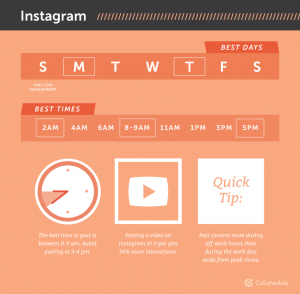
Finally, to get the timings of your Instagram post spot-on, below is quick hack by CoSchedule.
A common misconception about B2B content is that it’s mundane. Not quite! Whether you are already on the Instagram bandwagon or just about to hop into it, the focus should be on generating authentic interest and not just grabbing momentary eyeballs. Be it infographics, video, or just plain images, determining a visual voice of your own is important to make it resonate. Even your UGC must be brand-specific and echo that same visual voice as yours.
Sometimes, B2B marketers might think that their service or product can’t be brought to life through visuals. In that case, keep it simple and tell the stories of your customers.
A Proactive Approach Helps
After all, Instagram is a social app. Your customers are not bots. Keep the human touch going by interacting with them as people and not as business entities. Being grateful is a proven way to develop strong customer relations on any social platform, and, Instagram is no exception.
It’s time for B2B marketers to get out of the ‘Instagram is for B2C’ syndrome. While it may seem daunting at the beginning, if you can strike the right visual chord that resonates with your leads, prospects, and customers, Instagram can become the most prominent cog in your B2B social and content marketing wheel.
Workato Partners With Apttus As First to Bring Intelligent Automation To Apttus Middle Office Platform
The New Workato/Apttus Partnership Enables Businesses to Streamline Their Customer and Revenue Operations Using Artificial Intelligence
Workato, a leading intelligent automation and integration platform, and Apttus, the global leader in Quote-to-Cash and Contract Lifecycle Management solutions utilizing Artificial Intelligence (AI), announced that they are a partnering to bring intelligent automation to quote-to-cash and contract management workflows.
Ben Allen
“Apttus and Workato have a great synergy as both the companies are focused on using Artificial Intelligence to streamline business processes like Quote-to-Cash and Contract lifecycle management,” said Ben Allen, Chief Marketing Officer, Apttus. “We are excited to partner with Workato to bring their Intelligent Automation Platform to all our customers globally. Its business-user-friendly capabilities will provide our customers with speedy revenue outcomes.”
The partnership between Apttus and Workato enables customers to achieve scalable growth by maximizing their efficiencies in their revenue operations processes as follows:
Faster quote-to-cash: Automate and use AI-enhanced workflows across the entire quote-to-cash process by integrating Apttus with CRM (e.g. Salesforce, MS Dynamics), and ERP/Financial applications (e.g. SAP, Oracle, Netsuite, Workday).
Contract cycle time reduction: Automate workflows across the entire contract lifecycle for all types of contracts including sales, service, and procurement by integrating Apttus with Service apps, (e.g. ServiceNow, JIRA ServiceDesk), Procurement apps (e.g. Coupa, Ariba), and ERP/Financial apps (e.g. SAP, Oracle, Workday, Netsuite).
Reduce approval times: Reduce the time required to get approvals and contract signatures by enabling intelligent approval workflows through Workbot, a platform bot that works with messaging apps like Slack, MS Teams, Email, and SMS.
Empowered Ops: Workato’s robust, business-user friendly UI enables sales ops, revenue ops teams and more to build and operate automation while ensuring corporate governance.
“Managing the overall quote-to-cash process and contract lifecycle can be extremely complex and disjointed,” said Markus Zirn, VP Business Development at Workato. “We are excited to be the first partner to integrate with the Apttus Middle Office Platform, enabling their customers to automate their customer and revenue operations end-to-end with our AI-enhanced Intelligent Automation Platform.”
Getty Images And Cortex Partner On Artificial Intelligence Platform For Creatives
Cortex Uses Artificial Intelligence to Analyze Large Sets of Data and Then Recommends the Best Getty Images Content
Getty Images, a worldwide leader in visual communication, announced a partnership with Cortex, an artificial intelligence platform for creatives that recommends the best Getty Images content for social media campaigns.
Cortex’s artificial intelligence analyzes several years’ worth of data from over 33,0000 brands to predict and recommend which color schemes, imagery, and keywords perform best on social media – that can be automated by time, frequency, and subject. Beginning today, April 4th, the recommendations will also include specific images drawn from Getty Images expansive collection of creative content.
Brennan White
“Cortex’s models are now learning from the largest set of professional image performance data ever created,” said CEO of Cortex Brennan White. “Partnering with Getty Images will provide our customers with access to the highest quality visuals available and give them the tools they need to effectively engage any target audience.”
Cortex currently has a lengthy list of customers across several industries including Heineken, Hulu, Jack Daniels and Marriott. According to data compiled by Cortex, marketers using the tool to create content outperform their industry benchmarks by up to 300 percent and save an average of 8.5 hours per user per week.
Andrew Hamilton
“Having an abundance of content is amazing for choice, but without the data to understand it, it can also be overwhelming,” said Getty Images Senior Vice President of Data and Insights Andrew Hamilton. “Getty Images’ highly annotated visual content paired with Cortex’s AI platform will give marketers a tremendous advantage in selecting the best visual content for their brand.”
This announcement follows a series of partnerships as the company drives forward its Getty Images Everywhere strategy – delivering the company’s world-class content to everyone. Under the leadership of Hamilton, Getty Images has developed a growing Data and Insights team that reflects the company’s commitment to innovation and experimentation with the latest technology to drive value for customers and partners.
TwentyThree Unveils In-Depth Analytics and Distribution Support for LinkedIn Video
Video Marketing Platform, TwentyThree, Announced the Launch of LinkedIn Support For Their Platform
A video is the best way to tell stories and connect with your customers. The world’s best marketers need a video marketing platform to make better-informed decisions about video across the entire marketing funnel. LinkedIn recently unlocked the potential of B2B videos for advertisers on its platform. In an important announcement, TwentyThree, a leading video marketing platform, would start to support the LinkedIn Video, allowing marketers to easily run and distribute their videos on LinkedIn. Through TwentyThree, marketers can post LinkedIn Video to their company page and customize the visibility; such as posting a video for only connections, to logged-in LinkedIn users, a public audience, or designed for ad-promotion.
The announcement comes barely days after LinkedIn’s recent update for B2B video advertisers and publishers. Last week, LinkedIn announced the launch of their Videos for B2B Ads.
Twenty Three Committed to Improving Marketing Analytics for LinkedIn Video
Thousands of marketers are using TwentyThree to significantly increase their results and gain the missing 50% of website data through video marketing.
Thomas Madsen Mygdal
Thomas Madsen-Mygdal, CEO and founder of TwentyThree, spoke to us about this announcement.
Thomas said, “We’ve seen incredible demand for LinkedIn support. By adding LinkedIn to our platform, marketers can now run all of their videos from one platform, where they can easily distribute video content and get in-depth analytics across channels.”
Thomas added, “The TwentyThree video marketing platform allows marketers to view all of their video marketing analytics in one central location. Whether that’s a website, Facebook, YouTube, or Twitter.”
He added, “Now, we’re the first to support LinkedIn publishing from our platform and we’re currently waiting for LinkedIn to add their analytics API to allow us to pull that data in addition to our already existing channels. This helps marketers to segment by channel and see which video content is performing the best, allowing them to test and optimize each and every video.”
The Best Way to Include TwentyThree for LinkedIn Video Marketing
Thomas provided deeper insights into how TwentyThree makes LinkedIn video marketing One of our product approaches at TwentyThree is to allow marketers to “Run Video Everywhere.” That means using video across every possible platform to get FullMetrics™ on all of their videos. Through our platform, they can create short snippets for LinkedIn which can be published directly on a company page and can direct the viewers to a longer video on the company website where the cross-channel performance of individual video content can be measured. These tools help marketers measure and move users down the funnel or buyer’s journey.”
At the time of this announcement, Casper Emil Rouchmann, Traffic Manager at Templafy, said, “LinkedIn is one of our most important channels for user acquisition, so we’re excited that TwentyThree’s LinkedIn support allows us to run all of our social and website video from a single platform.”
Currently, TwentyThree allows marketers to run video on Facebook, Twitter, YouTube, and now, LinkedIn. This is part of the TwentyThree product approach to “Run Your Video Everywhere” and to have FullMetrics™ for video performance across all channels. Additionally, TwentyThree’s video marketing platform empowers marketers to integrate and add video to their marketing stack and successfully run video with inbound and demand generation.
TwentyThree and LinkedIn are available immediately for the thousands of marketers, with millions of videos, already using TwentyThree’s video marketing platform. At TwentyThree, the focus lies on empowering the marketing teams to finally integrate and add video to their marketing stack to successfully run video with inbound, social, and demand generation.
Frost & Sullivan Names IBM A Leader In Customer Value Within Integrated Commerce Order Management Space
IBM Watson Commerce Order Management Helps Retailers Deliver Outstanding Customer Experience by Optimizing Order Management and Fulfillment
Based on its recent analysis of the integrated commerce order management space, Frost & Sullivan recognizes IBM with the 2017 Global Customer Value Leadership Award for its order management solution, part of IBM’s Watson Customer Engagement portfolio.
Martin Hoff ter Heide
“IBM Watson Commerce order management brings together capabilities, such as inventory visibility, distributed order management, order promising, delivery service scheduling, and reverse logistics. It collects orders from online, call centers, and stores, and it provides transparency through a single view of inventory and demand across channels and throughout the supply chain,” said Martin Hoff ter Heide, Lead Consultant, Integrated Commerce, Frost & Sullivan.
IBM Watson Commerce order management allows retailers to offer accurate promised delivery dates to customers by taking differences in selling channels into account—such as store, Web, and marketplace—and by closely monitoring inventories. IBM Watson Commerce order management is also capable of proactively providing suggestions of alternative ways of fulfilling an order in case of challenges. It supports a variety of B2B sales models, including direct, through distributors, through a robust partner network, and through a chain of enterprises.
Another differentiator of IBM Watson Commerce order management is its purposeful and user-centric design. This is increasingly characteristic of IBM’s solutions portfolio and is reflected, for example, by user interfaces that provide a consistent user experience across solutions. From a user role perspective, for instance, it empowers store associates through mobile tools with new sources of insight and efficient processing, enabling them to provide better customer service. Store managers can obtain real-time visibility of inventory and a wide range of other store metrics beyond the scope of order management, such as operational efficiency and customer satisfaction. It also empowers fulfillment directors and analysts with analytics, data-driven insight, and recommendations that support their quest to maximize profitability and deliver the best possible customer experience.
IBM maintains continuous investment in innovation to further enhance scalability and reinforce the use of AI and predictive analytics. As a category-defining leader with a well-honed, best-in-class ability to execute, IBM is well suited to provide outstanding customer value in integrated commerce order management solutions.
Each year, Frost & Sullivan presents this award to the company that has demonstrated excellence in implementing strategies that proactively create value for its customers with a focus on improving the return on the investment that customers make in its services or products. The award recognizes the company’s unique focus on augmenting the value that its customers receive, beyond simply good customer service, leading to improved customer retention and customer base expansion.
Frost & Sullivan Best Practices awards recognize companies in a variety of regional and global markets for demonstrating outstanding achievement and superior performance in areas such as leadership, technological innovation, customer service, and strategic product development. Industry analysts compare market participants and measure performance through in-depth interviews, analysis, and extensive secondary research to identify best practices in the industry.
Fincons Group Supports Mediaset’s Publitalia ’80 for the Launch of Pioneering Addressable Smart TV Advertising
Fincons Group, a leading global IT business consulting firm, has been a key enabler behind the launch of Publitalia 80’s new advertising products ADD+Plus. Publitalia ’80 is now able to offer addressable advertising capabilities as well as a broad and engaging digital platform to advertisers by leveraging Smart TV capabilities and broadband-broadcast convergence across all Mediaset’s portfolio. Mediaset is Italy’s largest commercial broadcaster and wholly owns Publitalia ’80, its advertising sales business.
Making Broadcast-Broadband Convergence a Reality with Smart TV Advertising!
Michele Moretti
At the time of this announcement, Michele Moretti, CEO Fincons Group, commented, “Our long-standing relationship with Mediaset has been extremely fruitful, enabling us to develop our solution from R&D right through to commercialization.”
Michele added, “We are delighted to have enabled Mediaset with this pioneering advantage that enables them to offer addressable advertising and extensive content capabilities to their customers. We are proud to be making broadcast-broadband convergence a reality together.”
Fincons Group was awarded funding by the EU along with a broader consortium to take part in a co-development initiative, known as MPAT (Multi-platform application toolkit), to research and scope-out the potential of the HbbTV standard. Having developed those capabilities, Fincons Group was selected by Mediaset to implement the Enabler platform which is at the heart of ADD+Plus. Mediaset’s new Smart TV advertising products consist of two key features: ADD+Inside and ADD+Over.
What is ADD+Over?
ADD+Over is an ad-hoc format overlayed on a TV containing a call to action by simply clicking the “OK” button on a television remote control. ADD+Inside is an “L-shaped” frame, a high-impact format displayed inside editorial TV content, thus ensuring the greatest visibility. The frame becomes interactive by simply clicking the “OK” button on a remote control.
The interaction with ADD+OVER and ADD+OVER leads to an informative mini-site containing additional materials (video, text, images) about products and services.
Both formats are “addressable” ad solutions enabling the delivery of a customized message that enhances the advertiser’s communication and the value of the viewer thanks to data and targeting variables.
How Volkswagen Leverage ADD+over to Scoop Opportunities in Smart TV Advertising?
The German car manufacturer, Volkswagen, was the first company to take advantage of the addressability linked to these new formats. They use the ADD+ products to advertise 2 new models of car – Golf and Golf TGI. The company wanted to geolocalise the communication in two different areas and differentiate the creativity of the ADD+INSIDE formats to deliver two different messages on the linear TV Mediaset channels.
Paola Colombo
Paola Colombo, General Manager Adtech & Business Development at Publitalia ’80 said, “The collaboration with Fincons allowed Publitalia to offer advertisers a revolutionary and successful proposition which has been delivering real tangible results. We are currently working with Fincons to further develop the ADD+ family of products and we will soon be able to put on the market new video formats, bringing new exciting opportunities.”
Francesco Moretti, Deputy CEO Fincons Group and CEO Fincons US and Paola Colombo, General Manager Adtech & Business Development at Publitalia ’80 would describe this pioneering project in detail at NAB 2018 in Las Vegas on Monday 9 April at 4 PM local time.
Medallia Appoints Susan Lovegren As The Chief People Officer
Former AppDynamics Exec Joins Medallia to Support Global Employee Growth
Medallia the leader in customer experience management software, has appointed Susan Lovegren as the Chief People Officer. She will lead the People and Culture function and serve on Medallia’s executive team. Her focus will be leveraging the company’s human capital capability to support continued global expansion. Due to strong business growth driving massive global hiring, Medallia now has more than 1,250 employees in more than 15 offices around the world.
“With more than 25 years in leadership at technology companies, Susan is passionate about developing great working environments. Her track record of working for high-growth companies with values-driven cultures speaks for itself. Susan brings the right combination of skills, experience, and passion to help us tackle our biggest challenge: maintaining our strong culture while rapidly growing our global workforce,” said Borge Hald, CEO, Medallia.
Prior to joining Medallia, Lovegren served in Chief People Officer roles at AppDynamics, (acquired by Cisco), Juniper Networks, and Plantronics. Under Lovegren’s leadership, both Juniper Networks and Plantronics were named to Fortune’s 100 Best Companies to Work For list. She also held human resources roles at Hewlett Packard and Agilent Technologies. Throughout her career, Lovegren has supported women in technology by partnering with the Anita Borg Institute, Grace Hopper Women in Computing, Catalyst Inc., and Watermark, where she received their 2016 Advocacy Award.
“I am excited to be joining Medallia during a time of growth and success, as it scales from a large start-up to a major enterprise software player. Plus Medallia Experience Cloud, which makes companies significantly more customer-centric, has the added benefit of driving both faster revenue growth and positive culture change at client companies. Employees get more motivated when they know how their work impacts customers.
Many of the companies we work with talk about how implementing Medallia significantly improved their employee engagement, and that is personally very inspiring to me,” added Lovegren.
Lovegren earned a BA degree from San Jose State University and an MS degree in Human Resources Management from Golden Gate University. She currently is a member of the HR Industry Council for Betterworks and previously served on the Board of Trustees for Second Harvest Food Bank of Santa Cruz County.
iWave Announces Salesforce Integration Available on the Salesforce AppExchange
iWave Integration Enriches Salesforce Database with Powerful Fundraising Intelligence
iWave, one of the top-rated fundraising intelligence platforms on the market, announced the release of a new, more feature-rich version of iWave for the Salesforce platform.
Development and fundraising professionals depend on comprehensive donor information to make informed gift asks. iWave for Salesforce brings this information directly into a nonprofit’s Salesforce database. Enriching nonprofits’ internal data in Salesforce with iWave’s one billion wealth and philanthropic records, the upgraded app enables users to focus time and effort on the best major gift prospects.
“We are happy to see iWave further enhance the iWave for Salesforce app on the AppExchange, as they provide customers with an exciting new way to learn more about their donors and better understand their capacity and inclination to give,” said Mike Wolff, SVP, ISV Sales, Salesforce. “The exponential growth of the AppExchange underscores the enormous opportunity the entire Salesforce ecosystem has in creating cutting-edge solutions and driving customer success.”
The latest version of iWave for Salesforce enables more functionality than ever before. Features include:
Batch scoring: Users can segment and score many contacts with one click.
Access to Profiles: Within the app, users can generate a new, custom profile for their prospect or link to an existing profile that details comprehensive donor records.
Tailored User Preferences: Customize individual settings so users can score and filter prospective donors based on fundraising goals.
Trent Beattie
“Our goal with iWave for Salesforce is to help our clients fundraise with confidence,” said Trent Beattie, VP of Channel Partners for iWave. “The latest version continues to enrich our clients’ Salesforce database with valuable intelligence and it brings a new level of customization and transparency that enables clients to align the solution with their unique fundraising goals.”
TechBytes with Tuomo Riekki, Founder, CTO at Smartly.io
Tuomo Riekki Founder, CTO, Smartly.io
Marketing teams are spending more time and dollars to optimize their Facebook + Instagram marketing performance in 2018. Lack of automation and control in campaign management workflow prevents marketing teams from fully delivering ad campaigns at their highest performance. There is a clear need to differentiate between optimization and automation technologies for Facebook + Instagram Advertising. To throw credible light on Facebook + Instagram Marketing Performance, we spoke to the CTO of Smartly.io, Tuomo Riekki.
Html code here! Replace this with any non empty text and that's it.
Tell us about your role at Smartly.io and the team/ technology you handle.
I am co-founder and CTO at Smartly.io. I spend a majority of my time traveling around the globe to meet with Smartly.io customers and learn about their biggest challenges. I then develop new product initiatives to solve those biggest pain points – sometimes coding new functionalities for them in-person, during my meetings with them. At Smartly.io, working closely with our customers and partners is just as important as working closely with our colleagues – that consistent communication between these groups and our teams yields better results in product and more innovative ideas.
The core foundation of the Smartly.io technology is to help advertisers scale their advertising on Facebook and Instagram. One of the most popular product features is Dynamic Image Templates, which grants advertisers the ability to scale their creatives; it automatically couples product elements like images, price, and product names with a pre-designed template to standardize the design across thousands of ads. You can, for instance, pull best-selling items from product catalogs and create ads that showcase those products.
We work to constantly put customer feedback into action in our offerings. A great example of this is when we realized our customers wanted to have the same scalable options and automation for video advertising that we’ve given them with the image templates. We’re currently developing a video templates feature on our platform to meet those expectations.
How do you differentiate between optimization and automation technologies for Facebook + Instagram Advertising?
Automation is a means of reducing manual work and can be applied to anything from campaign to ad creation and reporting, whereas optimization is a specific task aimed at improving campaign performance.
Our Predictive Budget Allocation is an AI-based feature that helps users to make smarter decisions when it comes to shifting campaign budgets and spend. While it’s an optimization tool, there is also an element of automation in this feature. It automatically works to maximize campaign performance – but it’s done through optimization of budget allocation. All that marketers need to worry about is setting their goal – the technology does the rest, with more insight and smarter allocations than could ever be done manually by a single marketer.
On our platform, we provide marketers with the ability to automate a variety of manual tasks, with the most crucial being creatives through Dynamic Image Templates, as I mentioned previously. That doesn’t mean we take the humans out of the process, we just help marketers scale their work, giving them the ability to hit a larger audience with more relevant advertising. Creative automation capabilities are central to so many of the successes our customers have seen with their Facebook advertising campaigns.
What are the biggest challenges for marketers on Facebook? How does Smartly.io enable marketers on Facebook to beat these challenges?
The biggest challenges tend to be scaling ad campaigns (ie. ramping up spend and advertising volume whilst maintaining performance), targeting the right consumers at the right time, with the right content, of course. There are so many tools via Facebook that can help brands offer more engaging consumer experiences – but targeted advertising at scale is difficult to accomplish without automation capabilities. Manually, it would be challenging to achieve sustainable performance if the bulk of your time is spent on ad and campaign creation and management. FB has a massive user base and many brands have many products or campaigns they want to advertise. Between the two that’s a lot of volume.
At Smartly.io, we have created tools that are able to manage prospecting and retargeting campaigns, end-to-end, while enabling advertisers to scale their creative output. The Smartly.io platform does the work of what might take a really large team – and it does it more efficiently. Our e-commerce and travel customers find our creative automation tools particularly helpful as their product inventory is constantly changing and creatives need to be adjusted accordingly (flight deals adjustment, sold out clothing inventory removed from product ads automatically).
What do the changing algorithms on Facebook mean for marketers and influencers?
With the recent News Feed change, marketers are going to see less organic reach with their branding and advertising on Facebook. Their posts and ad content will not be prioritized, and, as a result, the premium inventory on Facebook will become more expensive and the advertising landscape on Facebook will be more competitive than ever. Having said that, marketers will diversify their ad format portfolio and venture into various placements outside the News Feed: Messenger, Instagram, and Instagram Stories to name a few.
In order to make sure ads stand out, it really comes down to both thoughtful and interactive creative as well as the ability to relay a smart, digital narrative across all stages of the marketing funnel – from brand background to product information. Luckily, Facebook has tools that help advertisers accomplish exactly that. And one of them is a tool that’s actually been around for a while but is not as widely used: the Canvas ad format.
What are the opportunities on Canvas Ads?
Canvas gives advertisers the opportunity to implement legitimate storytelling into their advertising. The format allows for so much flexibility in both the presentation of the ad imagery and in the order of the messaging within it. The Canvas ad can incorporate both higher level branding to direct response messaging about specific products – almost acting like a mobile landing page. It has the ability to scroll vertically and incorporate an abundance of information that we typically can’t fit inside a single ad unit. Compelling brand narratives are going to be the major differentiator between successful and unsuccessful brands. Canvas is definitely a huge stepping stone for that on Facebook.
What are the core tenets of your ‘Digital Transformation’ strategy? How does Smartly.io deliver contemporary Customer Experiences?
The core tenet of our strategy gets right back to that idea I mentioned of keeping our customers close to every step of the process. Their pain points are a consistent source of our latest innovations. So many of our ideas and solutions stem from our customers’ experiences.
Our company structure helps us with our product development speed. That structure includes, of course, that close relationship to the customer, but also lets our employees take direct ownership of their projects. We’re a flat organization structure so it gives everyone more autonomy – which is so critical in the innovation process, giving ideas room to grow and expand.
At Smartly.io, we’re also all consumers, ourselves, so we can literally put ourselves into consumers’ shoes when in the product development stages to understand exactly how our ideas will play out across the digital customer journey – will they create a more seamless and relevant experience for the consumer? That’s always an end goal, in addition to solving our own customers’ specific pain points.
What are your predictions about Social Media intelligence technologies playing a bigger role in 2018? How much of this would be influenced by AI/ML adoption?
Creative automation, particularly around video creatives, will be one of the central technologies in 2018 as personalization and scale are key to succeeding in digital marketing. As for AI, it should not be regarded as a must-have just for the sake of having AI – it only becomes meaningful when it creates value to the marketer by helping them take smarter decisions, faster. Ultimately, AI and machine learning should have the goal of making advertising less of a disruption and more of a value to consumers: seeing what they want, when they want it. In 2018 we’ll continue to develop the machine learning algorithms behind our automated optimization solutions, as well as developing new features that reduce manual work for advertisers and drive ad performance.
Talkdesk Delivers ROI Exceeding 300 Percent According To Independent Consulting Study
Independent Research Shows Talkdesk Customer Realized More Than $7 Million in Savings After Switching from a First-Generation Cloud Contact Center Application
Talkdesk, the leading enterprise contact center platform, announced the findings of a Total Economic Impact (TEI) study performed by a leading industry analyst firm, Forrester Consulting. Talkdesk commissioned Forrester to examine the potential return on investment (ROI) enterprises can realize by deploying Talkdesk Enterprise Contact Center Platform. Forrester’s final analysis found benefits in excess of $7 million over three years with a net present value (NPV) of more than $5 million, an ROI of 346% and an increase 19 points in Net Promoter Score (NPS).
To determine Talkdesk’s economic impact, benefits, costs and risks, Forrester interviewed a Talkdesk customer, a leading internet services provider with thousands of customers and millions of end users with over 250 customer support agents. Based on the data gathered, Forrester found the company realized overall benefits of $7 million comprised of the following:
$5.6 million saved through improved agent occupancy rates, which eliminated the need for additional contact center agents. Occupancy rate increase was directly attributed to the Talkdesk Enterprise Contact Center Platform improving application reliability and support.
$1.2 million saved in research and development costs by implementing Talkdesk’s easy-to-use, out-of-the-box solution.
Lowered customer acquisition costs by nearly $500,000 through improved customer satisfaction and retention rates.
“Forrester has done a remarkable job quantifying the acute benefits that Talkdesk delivers to our current customers as well as any company looking to improve their customer experience. In this study, Forrester found an astonishing 346% ROI and three-month payback period after a large enterprise customer made the transition to Talkdesk from another contact center platform. We’re excited to share the results of this study so that other companies can quantify the tangible value of improving their customer experience,” said Tiago Paiva, CEO, Talkdesk.
Before moving to Talkdesk, the surveyed company was using a first-generation cloud contact center application. The system was unreliable and plagued with numerous outages, leading to low NPS scores, low agent occupancy and lost revenue. After an extensive vendor search and technology review, the company selected Talkdesk to provide a reliable communications platform, which seamlessly integrated to their CRM system and provided the flexibility to quickly adapt as their customer service needs evolve.
Have Facebook and Google Done Enough to Restore Advertiser Trust?
Amid mounting concerns surrounding brand safety, transparency in advertising, and the responsible use of consumer data, marketers are rethinking the field’s larger strategic framework. Nine in ten CMOs at large US brands overhauled their digital strategy in 2017, according to a Teads survey. Amid this strategic pivot, Facebook and Google have been at the forefront of the debate over how to effectively combat ad fraud, protect the brand safety, promote transparency, and ensure the appropriate use of user data.
Among the most encouraging outcomes of this discussion have been improved ad solutions designed to optimize campaign effectiveness and equip brands with the tools needed to acquire and retain quality customers.
Evaluating Campaign Effectiveness
Since taking the helm at the world’s fastest growing performance marketing company in 2014, I’ve witnessed a sea change in how the industry evaluates campaign effectiveness. Today, an effective campaign is not one that reaches an extremely high volume of users, out of which only a small subset will actually convert. Instead, an effective campaign targets high-quality users who are genuinely interested in your business – high-intent users who are ready to perform meaningful actions.
For advertisers to mount successful campaigns, they need the ability to accurately identify their audiences; present targeted audiences with the right messages, be it content or creative; and lead them to the ideal proposition. Publishers, meanwhile, must deliver engaging content, thus attracting real user traffic at high-volume and in a scalable manner.
That’s the fundamental reality driving the strategic changes being implemented in marketing departments worldwide. Google’s universal app campaigns (UAC) is an instructive case study.
Metrics Drive Targetting
In touting UAC’s value proposition, Google has some impressive metrics at its disposal. UAC has driven 140 percent more conversions per dollar than Google’s standard app campaigns, and the company reported in August that it had delivered app developers more than 6 billion installs, compared to 2 billion in 2016. Google’s algorithms are able to distinguish high-quality users from others, enabling brands to optimize ad placements and reach users with the strongest conversion potential. UAC’s brand safety filters – not yet labeled, mature audience, tragedy and conflict, and sensitive social issues – bring an added layer of brand safety.
Meanwhile, amid the recent Cambridge Analytica revelations, Facebook has moved to take full responsibility for its users’ privacy, with executives displaying a deep understanding of the potency of data and external technology. Moving forward, Facebook should remain committed to its promises to secure the privacy of its users’ data. Such a promise lies at the heart of Facebook’s existence – which is precisely why we are likely to see the implementation of robust and meaningful safeguards.
All stakeholders – marketers included – have a vested interest in the restoration of user trust. As an executive with a fifteen-year track record in the marketing industry, I firmly believe that user value should be the North Star of the advertising ecosystem. Millions of redundant eyeballs on content won’t deliver businesses the quality leads and converts they seek. That outmoded approach spawned significant shortcomings in brand safety, culminating in the great strategic pivot of 2017. Facebook and Google’s recent moves, then, will go a long way toward reorienting the ad industry and better serving businesses’ bottom lines – putting the behemoths on a path to regaining the industry’s trust.
Email Marketers Are Confident Machine Learning Can Personalize Content To Individual Interests, New Study By The Relevancy Group And OneSpot
Seventy Percent Of Marketers Would Reallocate Over 36 Hours A Week To Strategic Initiatives If They Eliminated Manual Processes By Using Machine Learning
An overwhelming majority of email marketers (97 percent) are confident that machine learning can be used to personalize email content to an individual’s specific interests and improve the customer experience, according to “The Email Individualization Imperative,” a new study released today by market research firm The Relevancy Group in collaboration with OneSpot, a content individualization and intelligence platform. The survey of executive marketers examined their understanding of, sentiments towards and usage of machine learning for email personalization, across industry sectors.
Damian Borichevsky
“Machine learning — a powerful subset of AI — is advancing personalization beyond broad segmentation to turn every email subscriber into a segment of one. With machine learning, every person interacting with a brand should have their own unique content experience, a practice we call individualization,” said Damian Borichevsky, senior vice president of Customer Success and Business Development for OneSpot. “This research underscores the tangible sea change underway being driven by the proven ease and reliability of machine learning, consumer intolerance for content outside their individual interests, and marketers’ imperative to gain a measurable return on that individualization.”
“At The Relevancy Group we believe that the proliferation of AI and machine learning represents a watershed moment for email senders and we are extremely excited by the growing opportunities for brands and publishers to create individually relevant and valuable customer experiences,” said Nicholas Einstein, vice president of Research and Principal Analyst at The Relevancy Group.
Email response rates are on a three-year upward trend due to senders implementing more personalized and relevant email campaigns
97% of marketers are confident machine learning — a powerful subset of artificial intelligence — can personalize content to individual interests and improve the customer experience
70% of marketers would reallocate over 36 hours a week to strategic initiatives if they eliminated manual processes by using machine learning
Top concerns about implementing machine learning to drive individualized content in emails include implementation/training and switching/adding a new platform
Time Saved by Using Machine Learning Lets Email Marketers be More Strategic, Eliminate Manual Processes
Among the study’s findings is that on a weekly basis, most marketers’ teams spend over 36 hours or the equivalent of that entire work week of time on manual email segmentation processes such as content selection and proofing, in an attempt to personalize content. But 70 percent of marketers say if they used machine learning and eliminated manual processes, the time saved would be reallocated to program planning, expansion and strategy. More than half of marketers (51 percent) would instead allocate the time saved to data analysis, while subject line optimization (44 percent) and segment refinement and list cleansing (35 percent) are other activities to which marketers would shift their time reserve.
CPG and Retail Marketers Have Even Greater Opportunity to Benefit from Machine Learning Time Savings
To personalize email content, marketers in the Retail and Consumer Products sectors are spending a weekly average of 46 hours and 40 hours, respectively. As such, for retailers, there is an opportunity to garner an even greater business return on individualizing content by using machine learning in transactional emails e.g. communications regarding purchase, cart abandonment or returns. CPG marketers could use machine learning to increase email frequency to build even deeper relationships with audiences through individualized content.
Despite Proven Personalization and Operational Benefits of Machine Learning, Implementation, Training, Switching or Adding Platforms Among Top Concerns
Implementation and training are key issues for marketers currently using machine learning for email personalization as well as those thinking about doing so. For 44 percent of marketers, implementation time took an average of 3.5 months, while 25 percent of marketers cited that it took as much as 7.5 months to implement a personalization solution. Only 16 percent experienced implementation times of 45 days, and it took less than 30 days for 3.5 percent of marketers.
“At OneSpot we are actively facilitating an industry transformation in partnership with Fortune 2000 companies, many of which operate newly established content studios,” added Borichevsky. “These brands and publishers have an ‘always on’ approach to content marketing, so spending months on complicated email implementations is highly detrimental to success. In just weeks, OneSpot seamlessly launches customers, easily integrating with their existing email service providers, collaborating on strategy and providing straightforward training every step of the way.”
Bytedance Partners With BAIR Lab To Foster Future AI Innovators And Entrepreneurs
Bytedance to Sponsor First and Second-Year Students at the Berkeley’s Artificial Intelligence Research (BAIR) Lab
Bytedance, a leading technology company operating content platforms that enable people to connect with, consume, and create content through machine learning technology, announced that it will collaborate with the University of California, Berkeley to support academic programs at its Artificial Intelligence Research (BAIR) Lab. The Bytedance AI Lab and BAIR will also look to further explore joint research projects and academic exchanges.
The Berkeley Artificial Intelligence Research Lab brings together UC Berkeley researchers across the disciplines of computer vision, machine learning, natural language processing, and robotics. BAIR includes over twenty faculty members and more than a hundred graduate students pursuing research on fundamental advances in AI technologies, including multi-modal deep learning, human-compatible AI, and connecting AI with other scientific disciplines and the humanities.
Bytedance has been dedicated to enhancing the content experience through AI technology, offering a global portfolio of content discovery platforms and interactive entertainment services. The Bytedance AI Lab is innovating and advancing state-of-the-art technology that enhances the entire lifecycle of the content experience – from creation to moderation to interaction. Staffed by world-class scientists and researchers, the Bytedance AI Lab focuses on basic research as well as product development, by placing lab team members side by side with product teams for direct experience with users and real-life product applications.
Wei-Ying Ma
“Bytedance looks for opportunities to support and engage with the best minds in the world, and the prestigious BAIR Lab is a center of gravity for young AI talent and internationally recognized leaders in their fields. We appreciate the opportunity to foster new scientists, ambitious inventors and future entrepreneurs dedicated to solving challenges,” said, Wei-Ying Ma, Head AI Lab, Bytedance.
“We appreciate the resources provided by Bytedance as an industry affiliate. It is valuable for BAIR Lab’s students and researchers to have the support of businesses applying AI technologies in changing and challenging real-world scenarios,” said Trevor Darrell, Professor & Co-Director, BAIR Lab.
Bytedance actively promotes cooperation between industries, universities, and research institutions to further basic research and transformational scientific development. The company is participating in several ongoing joint programs with prestigious institutions, including UC Berkeley, Stanford University, Tsinghua University, Peking University, Hong Kong University of Science and Technology, the China Computer Federation(CCF), and the Institute of Electrical and Electronics Engineers (IEEE).
Harmonic Sets The Benchmark For OTT Delivery And Next-Gen TV At 2018 NAB Show
Harmonic Will Showcase Its Video Delivery Innovations at the 2018 NAB Show in Las Vegas From 9-12th April
Harmonic will showcase its market-leading innovations in OTT and broadcast video delivery. As broadcasters and service providers strive to deliver better-quality video and drive new revenue streams, agility and flexibility are critical. Harmonic’s software-centric solutions in UHD, ATSC 3.0, IP video and content-aware encoding technologies set the benchmark for the future of OTT and broadcast delivery. These solutions are offered as appliances or SaaS for business agility and provide exceptional quality of experience (QoE) on every screen at a low total-cost-of-ownership.
Tim Warren
“Global video consumption is at an all-time high, and broadcasters, content owners and service providers are under pressure to respond to the surge in OTT video, launch new services with fast time-to-market, and migrate to new media environments like IP video and ATSC 3.0. With a portfolio of agile and innovative solutions deployed by a global base of satisfied customers, Harmonic is committed to solving real-world challenges. Our expertise in media processing, playout and cloud uniquely position us to partner with our customers, enabling them to seamlessly adapt to a changing industry landscape,” said Tim Warren, Senior Vice President & Chief Technology Officer, Video Business, Harmonic.
Harmonic will address the challenges in OTT video delivery with targeted innovations:
Harmonic will highlight its award-winning VOS media processing family including the new VOS SW Cluster media processing software and VOS 360 media processing SaaS. VOS SW Cluster embeds market-leading media processing capabilities with support for cloud and bare metal compute environments enabling operators to launch OTT services quickly.
Harmonic offers streamlined OTT video delivery through cloud-based channel origination on VOS 360 SaaS, enabling operators to swiftly migrate channels from playout to end-user delivery for greater flexibility and a lower cost-per-channel.
Harmonic will also showcase live sports for OTT, delivered with reduced latency matching that of a live broadcast, in stunning UHD and HDR using VOS 360 SaaS.
With the VOS family, operators can deploy EyeQcontent-aware encoding to reduce bandwidth requirements for OTT delivery, decrease CDN costs and improve QoE. At the 2018 NAB Show Harmonic will premiere EyeQ support for HEVC.
Get the Most Out of ATSC 3.0 With Advanced Statmux and Hybrid OTA/OTT services
Harmonic’s expertise in statistical multiplexing will play a key role in providing high-quality ATSC 3.0 streams at low bitrates. At the 2018 NAB Show, Harmonic will showcase its software-based Electra X ATSC 3.0 media processor and statistical multiplexing solution to deliver high-quality HEVC programs over DASH. For OTT services to complement over-the-air (OTA) transmissions, Electra X connects to Harmonic’s VOS 360 SaaS to enable hybrid OTA/OTT services.
In the IP Showcase, sponsored by AIMS, in booth C12634, Harmonic will highlight the Spectrum X media server as part of an end-to-end IP video workflow from contribution to delivery, using the SMPTE ST 2110 suite of standards, SMPTE 2022-7 seamless protection switching and AWMA IS-04 and IS-05 specifications. The Electra media processor and Spectrum X server fill the final gap for uncompressed workflows and control with support for uncompressed and compressed streams, enabling a smooth transition for live broadcast and OTT.
Looking Ahead at Next-Gen Video Codecs and Content-Aware Encoding
Artificial intelligence (AI) technologies have become a key innovation factor to optimize the video encoding process. Leveraging AI in the development of next-generation video codecs and content-aware encoding (CEA), Harmonic is leading the charge toward delivering better video quality at low bitrates. The company will provide a valuable side-by-side comparison of codec efficiency between HEVC, AVC with Harmonic EyeQ CAE technology, AV-1, and JVET.
Tell us about your professional journey as a tech entrepreneur. What inspired you to set up a digital marketing firm?
I somewhat accidentally got involved in online marketing at the very beginning, way back in 1993. I was the spokesperson for a government agency and hated it. My friends from college had started the very first Internet company in Arizona, and I was looking to do ANYTHING else. I fell in love with digital (although dial-up modem speeds weren’t that sexy). My current firm, Convince & Convert, is the fifth digital marketing firm I’ve run. Our 10th anniversary is this July.
How can business firms leverage content marketing for social media promotions to drive marketing ROI?
Increasingly, content and social work closely together, with social as an amplification engine that brings new viewers to content executions. Done well, they work in concert to drive awareness, leads, and sales.
How is the B2B marketing world evolving with newer tools and technologies? Which technologies are you keenly following?
A recent paper from Demand Gen Report found five technologies that B2B marketers are using to drive relevancy and results. The three that I work with the most for my own consulting clients are interactive content, repurposing and atomizing content, and video content. All three are skyrocketing in popularity because they break through the clutter.
What would be the best way to succeed in content marketing in 2018?
Whichever way works best for your audience is the real answer. But if I had to pick a horse to ride this year, I’d probably choose video, provided it’s hyper-relevant, useful, and entertaining.
Between Search and Social, which would drive higher ROMI in 2018 and how?
What startups in the tech industry are you watching/keen on right now?
I’m bullish on several companies and am a proud investor in several strong martech startups including Terminus in the ABM space, Uberflip in the content hub space, Co-schedule in the marketing operations space, and Buffer in the social publishing space.
What tools does your marketing stack consist of?
Sooooo many. Because we work with dozens of SaaS Martech companies as sponsors, partners, advisors, and mentors, I couldn’t even begin to list them all. We counted recently, and we have something like 80 SaaS licenses.
Would you tell us about a standout digital campaign? (Who was your target audience and how did you measure success?)
As an analyst and strategy firm, we don’t think much in terms of campaigns, but more in terms of how our recommendations tie back to overall business objectives. That said, I’m really proud of our work on behalf of many, many organizations, including The United Nations, Grand Ole Opry, David Weekley Homes, Cisco, and even Oracle!
How do you prepare for an AI-centric world as a tech leader?
I can’t wait for the AI-centric world. When robots are in charge of the blocking and tackling and the drudgery of marketing, the strategist becomes king. Bring It On.
What’s your smartest work related shortcut or productivity hack?
I use lots of 1:1 and small group video to help provide direction. Very helpful in a company that is all virtual.
What are you currently reading?
I read tons of periodicals. Not as many books as I would like. And right now, I’m finishing the new book I’m publishing this Fall with my co-author Daniel Lemin. It’s called Talk Triggers: The Complete Guide to Creating Customers with Word of Mouth. So, that’s taken up a lot of my recent reading time!
What’s the best advice you’ve ever received?
Some days you’re the pigeon, and some days you’re the statue.
Something you do better than others – the secret of your success?
I’m only good at two things, really: pattern recognition, and judging talent.
Tag the one person (from the Martech space) whose answers to these questions you would love to read:
Internet pioneer Jay Baer helps companies clone their customers. He’s created five multi-million dollar companies of his own and is obsessed with helping businesses turn their customers into volunteer marketers. A New York Times best-seller of five books, Jay brings 25 years of marketing experience and has worked with more than 700 companies, including 35 of the FORTUNE 500.
Recently inducted into the Word of Mouth Marketing Hall of Fame, Jay is also an avid tequila collector, and certified BBQ judge. In his keynote presentations, Jay teaches how to gain more customers and keep more of the customers you’ve already earned by motivating and mobilizing today’s fickle, distracted consumer. Jay is the host of the Social Pros podcast, named best marketing podcast. He is also an active angel investor and startup advisor.
One of America’s fastest growing private companies, per Inc. Magazine, the Convince & Convert Consulting group provides digital marketing and customer experience strategic counsel to the world’s most important brands. The Convince & Convert Media Group produces award-winning digital magazines, email, podcasts, webinars, workshops and other content assets that educate advanced marketing and customer experience professionals.
The MTS Martech Interview Series is a fun Q&A style chat which we really enjoy doing with martech leaders. With inspiration from Lifehacker’s How I work interviews, the MarTech Series Interviews follows a two part format On Marketing Technology, and This Is How I Work. The format was chosen because when we decided to start an interview series with the biggest and brightest minds in martech – we wanted to get insight into two areas … one – their ideas on marketing tech and two – insights into the philosophy and methods that make these leaders tick.
Netcore Is Emerging as Asia’s Largest Email Delivery Platform
Netcore Solutions, a leading marketing technology company formed over 20 years ago, has expanded its international presence with offices in the US, located in the New York metropolitan area.
This is a strategic move for the company, serving 3,000+ companies including international brands such as Dominos, KFC, Vodafone, Airtel, Facebook, Cox & Kings, Myntra, Access Bank, Bibli, Malindo Airline, Standard Chartered Bank, Tokopedia, and Traveloka among others. Netcore is emerging as Asia’s largest email delivery platform, sending over 6 billion emails a month.
With comprehensive offerings, the company will be looking to rapidly expand into the United States. Offerings include Pepipost, their transactional API-based email delivery service; and Netcore Smartech, a full stack marketing automation suite, powered by Artificial Intelligence, coupled with analytics and consulting services.
Abithab Bhaskar, CEO, International Business, has helped Netcore Solutions grow over the past 16 years. Located in Mumbai, Bhaskar is an accomplished senior leader with a progressive career spanning two decades. In his current role, he has been instrumental in strategizing processes to expand the global footprint with indirect presence in over 20 countries and the direct presence in the US, Malaysia, Indonesia, Nigeria, Philippines, and UAE. Bhaskar said, “I believe that Netcore’s core strengths and commitment to our product development will provide US marketers a new and better option for email services. We focus on customer satisfaction – for both our clients and their customers.”
Sankalp Bajpai, VP – US Business & Strategic Initiatives, International Business, will spearhead the initiative by expanding the team and customer footprint in the market in the US. Bajpai, located in the New York area, has been instrumental in expanding Netcore’s presence in APAC and MENA and consolidating the growth strategy in APAC. “We are coming into the US market with a deep understanding of email deliverability, along with core email marketing services that transform our client’s marketing capabilities,” added Bajpai.
“I am very excited to be part of Netcore’s launch into US markets. I believe their products will resonate with many US marketers, who are looking for reliable email services and the expertise to get their email executed and delivered along with their customer’s journey,” added Jeannette Kocsis, SVP, Marketing & Business Development. She will manage marketing and business development efforts in the US. Kocsis, located in New York, was previously Global Head of Strategy at Harte Hanks, Inc. and led digital strategy and operations teams over her 17 years with the company. She has a technical background coupled with a digital marketing focus.
Netcore is a gold sponsor of the Email Evolution Conference, being held in New Orleans, LA on April 4-6, 2018.
Phil Fraher Will Lead Zilliant’s Financial Operations and Will Report Directly to Greg Peters
Zilliant, a company helping B2B enterprises turn data into actionable intelligence to accelerate profitable growth, announced that Phil Fraher has joined the company as Chief Financial Officer (CFO). Fraher joins Zilliant from Bask Technologies, where he was President and CFO and helped re-energize the consumer technology firm.
“Phil has an excellent track record advising fast-growth organizations and we’re excited to welcome him to the company. I’m confident his extensive experience in private equity, venture capital, M&A and international business expansion will provide tremendous value to Zilliant,” said Greg Peters, CEO, Zilliant.
“It’s an exciting time to join Zilliant. Zilliant is helping B2B organizations transform their traditional and digital channels to maximize the immediate value of every transaction. In today’s hyper-competitive B2B market, the company is helping their customers create a significant competitive advantage. I look forward to helping the company optimize its financial operations,” said Fraher.
Fraher’s experience includes serving as CEO, COO, and CFO for FuelQuest, a fuel supply chain software company, which he guided to a series of successful exits. Other roles include President and CEO of Visual Numerics, Inc., COO and CFO of Brightmail, Inc., and financial management positions at Cahners Business Information Electronic Media Division, Pilot Software, and Dun & Bradstreet. Fraher previously served as an Executive in Residence at the Houston Technology Center and holds an MBA from the Simon School of Business at the University of Rochester and a BS in computing engineering from Auburn University.
Zilliant helps B2B enterprises turn data into actionable intelligence that accelerates profitable growth. The Zilliant IQ Platform uses AI to deliver actionable, real-time sales and pricing intelligence for traditional and digital channels, so you can maximize the immediate value of every transaction – and the lifetime value of every customer.


















 What is ADD+Over?














 “Phil has an excellent track record advising fast-growth organizations and we’re excited to welcome him to the company. I’m confident his extensive experience in private equity, venture capital, M&A and international business expansion will provide tremendous value to Zilliant,” said