Home Blog Page 4301

FISION Appoints Global CFO, John Bode, To Board Of Directors

0
fisiononline

Appointment of Independent Director, John Bode, Advances Company Toward NASDAQ Uplisting Qualification

FISION Corporation, a leading provider of cloud-based digital asset management, sales enablement, and agile marketing technologies, has appointed John Bode, as a Company director and Chairman of Its Audit Committee, effective March 1, 2018.

Recommended Read: Interview with Mike Brown, CEO, FISION

John Bode
John Bode

Bode formerly served as Chief Financial Officer of the Tribune Publishing Company (now tronc, Inc., ). He is currently the Managing Director of Aerie Investments, working on strategic initiatives with companies ranging from legacy media enterprises to digital start-ups. Recent engagements include serving on the board of directors and audit committee of a leading payments firm as it successfully completed a significant recapitalization.

Prior to leading Tribune Publishing’s successful listing on the NYSE following its separation from Tribune Media, Bode served as the CFO of Source Interlink Companies, one of the largest enthusiast media companies in the U.S. and a leading distributor of periodicals. After graduating from the accounting program at Notre Dame, Bode began his auditing career as a CPA at BDO Seidman.

Read MoreWebinar World TechBytes with Fred Isbell, Senior Marketing Director, SAP

At the time of this announcement,  FISION CEO, Mike Brown, said, “John brings to our board extensive entrepreneurial and senior management experience, particularly as a CFO of several global enterprises.”

Mike added, “Given his success in guiding several large enterprise organizations, we expect John’s insights and guidance to play an important role as we continue to pursue large enterprise customers with our agile marketing solutions.”

“John’s appointment as our first independent director also enhances our corporate governance as a public company, and advances us toward meeting the qualification for listing on a major exchange, like the Nasdaq Stock Market,” added Brown.

Bode commented: “I’m excited to join the board and work alongside Mike and his talented team as they enable enterprises with a patented technology that solves major pain points in the creation and management of digital content.”

Read MoreTechBytes with Wesley MacLaggan, Head of Marketing, Marin Software

“FISION has developed an extremely valuable suite of tools that are just now starting to be recognized in the market,” continued Bode. “However, their progress and success over the past year have been phenomenal, from winning major enterprise customers and rolling out global deployments, to completing a strategic acquisition, receiving its first US patent, and becoming a public company. I feel fortunate to join the company at such a pivot time in its growth and development.”

Several large enterprises across a range of industries have deployed FISION’s sales enablement solutions, including a national financial services company, a global provider of aerospace and building systems, a top provider of online higher education, an operator of the world’s largest business network, and a Super Bowl-winning National Football League team.

Founded in 2011, Minneapolis-based FISION is the nation’s leading provider of agile marketing software that simplifies collaboration across global organizations, and more effectively manages brand and marketing content.

Recommended ReadTechBytes with Kathryn Loheide, Vice President, Marketing, Octiv

Looker Debuts in Gartner Magic Quadrant for Analytics and BI Platforms

0
Looker Debuts in Gartner Magic Quadrant for Analytics and BI Platforms

At the Gartner Peer Insights Website, Looker Was Rated 4.6 out of 5 in the BI and Analytics Platforms Market, Based on 51 Ratings as of 26 February 2018

Looker, a leading marketing data platform company, has made an entry into the 2018 Gartner Magic Quadrant for Analytics and Business Intelligence Platforms. This is the first year Looker has appeared in this Gartner Magic Quadrant, which evaluates vendors based on their completeness of vision and ability to execute.

Currently, Looker is recognized as a complete data platform that offers data analytics and business insights to every department and easily integrates into applications to deliver data directly into the decision-making process. 

Recommended Read: Interview with Jennifer Grant, Chief Marketing Officer at Looker

Frank Bien, CEO of Looker, said, “We rethought the modern analytics platform from the ground up, creating an integrated, flexible and scalable solution that delivers actionable insights to anyone in an organization. Our rapid growth underscores the value Looker brings to organizations of all sizes in helping everyday users better understand and use the information that drives their business.”

Frank added, “We’re pleased that Gartner has recognized Looker and are honored to be included in this year’s Magic Quadrant.”

On the end user review Gartner Peer Insights site, Looker was rated 4.6 out of 5 in the BI and Analytics Platforms market, based on 51 ratings as of 26 Feb. 2018.

Read More: Qubit and Looker Forge Partnership to Empower Data-Driven Personalization for E-Commerce

In 2017, Looker grew revenue over 85% while adding over 500 new customers, including Amazon’s Retail Group, Fox Networks Group, Square, trivago, CrossFit and Five Guys.

Looker now powers data-driven cultures at more than 1200 industry-leading and innovative companies such as Sony, Amazon, The Economist, IBM, Spotify, Etsy, Lyft and Kickstarter.

Recommended Read: ListenFirst’s Report for Media Publishing Industry Reveals Social Branded Content Nearly Doubled

RedPoint Global Takes The Lead As The Most Comprehensive Customer Data Platform In CDP Institute Vendor Comparison Report

0
RedPoint Global Takes The Lead As The Most Comprehensive Customer Data Platform In CDP Institute Vendor Comparison Report

Company Leads Top 24 Customer Data Platform (CDP) Vendors as the Only Platform to Provide All Features and Capabilities Measured by the CDP Institute

RedPoint Global, a top provider of customer data platform and customer engagement technology, announced that it has been positioned as the most comprehensive customer data platform in the CDP Institute Vendor Comparison Report. The Customer Data Platform (CDP) Institute is a vendor-neutral organization dedicated to helping marketers manage customer data. Their CDP Vendor Comparison Report presents a side-by-side comparison of key features that differentiate customer data platform vendors. In this report, RedPoint Global was revealed to have the most extensive offering—outperforming all other 23 vendors evaluated. Of the companies assessed by the CDP Institute, RedPoint Global was the only vendor that met the criteria for every single capability and feature measured in the report.

Redpoint Global Launches Data Management 8.0, A Platform For Optimizing Customer Engagement
Dale Renner

“Some of the world’s best-known brands have been using the RedPoint Customer Data Platform long before ‘customer data platform’ was in vogue. The unique flexibility and single point of control we give enterprises of their data is the result of years of careful design to help brands meet the needs of the always-on consumer. We believe that our position as the most comprehensive customer data platform in this report underscores our mission to enable brands to transform their customer experience by offering contextually-relevant, personalized experiences across all touchpoints,” said Dale Renner, Chief Executive Officer at RedPoint Global.

Also Read: RedPoint Global Launches Data Management 8.0, A Platform For Optimizing Customer Engagement

In today’s always-on world, brands need to provide superior customer experiences to compete and succeed. Customer data platforms underpin the customer experience transformation and have seen a surge of interest in the market as a result. The number of CDP vendors more than doubled in 2017, and the industry has attracted $270 million in new funding in just the past year according to the CDP Institute Industry Report.

To transform the customer experience, brands must have a customer data platform that provides accurate data at the speed and scale required across all enterprise touchpoints, so that the best information is available to make the best decisions at the point of customer engagement. The RedPoint Customer Data Platform provides the most powerful set of advanced data ingestion, integration, data quality, identity resolution, matching, and master data management (MDM) capabilities available on the market today. Using RedPoint’s probabilistic and deterministic matching algorithms, brands can create a RedPoint Golden Record: a singular, accurate, and continuously updated enterprise view of each customer that is maintained with a persistent key.

Also Read: Allant Group Announces Strategic Retail Solution Powered by RedPoint Global

In sharp contrast, a majority of customer data platform vendors are unable to process all data, including batch and streaming data, along with 1st-, 2nd- and 3rd-party, structured, semi-structured, and unstructured data. Most CDP vendors simply provide data assembly, or a combination of data assembly and analytics functions, and are not built for the performance and scale required to operationalize data across the enterprise.

RedPoint’s data-first customer engagement solution is far more comprehensive, rigorous, and flexible than anything else on the market. With RedPoint, enterprises realize higher revenue productivity with an outstanding marketing program and campaign performance, lower customer interaction costs, and improved customer retention and loyalty.

RedPoint Global is a founding member and gold sponsor in the Customer Data Platform Institute’s 2016 launch and is a founding member and gold sponsor of the Customer Data Platform Institute Europe launch set to take place next month.

Recommended Read: MarTech Conference 2018 Comes to the West Coast This April

Simplaex Raises New Capital in Follow-On Round to Strengthen Its AI Technology Efforts in the Programmatic Ecosystem

0
Simplaex Raises New Capital in Follow-On Round to Strengthen Its AI Technology Efforts in the Programmatic Ecosystem

New Funding to Fuel Simplaex AI Product Development That Will Help SSPs and Programmatic

Simplaex, the company behind the world’s most advanced Artificial Intelligence-powered user classification technology for the programmatic advertising ecosystem, recently announced that it has closed a follow-on investment, bringing the company’s total funding to date to $6 million. The round was led by Harbert Management Corporation. The new funds will be used to accelerate development of Simplaex’s product offerings and expand the team of developers and data scientists according to Co-Founder and CEO Jeffry van Ede.

The addition of capital comes after a momentous 2017 for Simplaex, which saw revenues increase 3x over 2016 and strong market share worldwide. The company was founded in 2015 by van Ede and Co-Founder & CTO Moti Tal.

Simplaex’s AI Fuels 3X Revenue Growth in 2017
Jeffry van Ede

“This influx of capital will help us accelerate our goal of being the premier solution in the post-GDPR programmatic world,” said van Ede, adding, “For Simplaex, GDPR represents a huge opportunity – akin to Tesla with regard to environmental regulations. We intend to take advantage of this new landscape, and lead the charge in this direction.”

Also Read: Simplaex’s AI Fuels 3X Revenue Growth in 2017

“Simplaex has demonstrated that their solution is equipped to solve the programmatic consent question in a GDPR world. We are therefore pleased to provide capital in support of the Simplaex team’s broader goals as they aim to solve the programmatic problem with their AI technology,” said David Bateman, Senior Managing Director, Harbert Management Corporation.

Becoming effective starting May 25, 2018, GDPR is designed to give control back to citizens and residents over their personal data and to simplify the regulatory environment for international businesses by unifying the regulation within the EU. In 2018, brands handling vast amounts of customer data will need to ensure adequate permissions are in place for future marketing contact and removal of such data when requested by the consumer. Recently, Simplaex was certified to be GDPR compliant.

Also Read: Demandbase’s ABM Innovation Summit 2018 to Feature Sessions by Billie Jean King, Aasif Mandvi, Adam Blitzer, And Chris Golec

One would argue that in a GDPR world, given that publishers and advertisers need to get consent from each user to employ their personal data to target ads, that this will have wide ramifications across the programmatic ecosystem. Thus far, technology stacks have only helped either publishers or advertisers to ‘win’ in terms of monetary benefits. But, unless all players that depend on one another win, including the consumer, the programmatic ecosystem will not reach its full potential to be able to compete with Facebook and Google.

Due to these converging factors, Simplaex is developing a proprietary solution for opening up the black box and giving the demand side (advertisers/DSP) and the supply side (SSP and publishers) the same view and deep insight into their audiences. With this new proprietary solution, the supply-side can value its inventory correctly by understanding the relevance of its own audiences while the demand side can now have far more meaningful interactions with these relevant audiences.

van Ede added, “There has been much speculation about the sweeping changes GDPR will bring to the programmatic industry, however, Simplaex is optimistic that GDPR will expedite greater levels of relevance in campaigns. To this end, we believe that through our AI-powered solution we will provide increased relevance to an engaged database, improving the strength of advertising results.”

Recommended Read: MarTech Conference 2018 Comes to the West Coast This April

The Death Of Cash Back And Loyalty Programs – The Burgeoning Impact Of Influencer Marketers  

0
CashbackLoyaltyMarkeing-Guest-Post

More Merchants Leaving Traditional Affiliate Channels As Influencers Prove Their Worth

Pepperjam LogoA tectonic shift is occurring in performance marketing, traditional traffic is under a microscope as advertisers grow to understand the value influencers bring to their brand. As building brand advocacy through content gains momentum, influencer marketing is quickly becoming the predominant channel for merchants, from both a sponsorship and pay for performance perspective.

Social media increased its contribution to e-commerce referrals by 200% between Q12014 and Q1-2015, according to MarketLive. Now, about 2% of all e-commerce traffic in the US stems from social networks such as Facebook, Pinterest, and Twitter. Not only is social media driving more transactions, but the ROI it produces is strong. Another report by BurstMedia states that consumer brands earned $11.33 for every $1 spent on influencer marketing programs in 2015 and apparel brands earned $10.48 for every $1 spent.

Also Read: The Data & Measurement Behind Successful InfluencerMarketing

Influencer Marketing Has Come Into Its Own

With success metrics like these, it’s no surprise then that influencer marketing has come into its own as a primary method of marketing for advertisers, affiliate networks,and the entire performance marketing ecosystem.

These influencers, celebrity or otherwise, have built up huge followings—acting a modern-day word of mouth, on their social channels becoming an important piece of the puzzle for merchants looking to move product.

Recently, Nordstrom decided to pull its cash back program from Ebates— a significant move within the performance marketing industry. According to recent research, the decision is not as outrageous as some within the channel would assume.

While coupons, cash back, and loyalty programs still play a role in performance marketing, increasingly influencer marketing is laying down a bigger footprint.

SimilarWeb estimates that 74% of Nordstrom’s August mobile traffic came from referrals with influencer platformRewardStyle bringing in 79% of that total. For context, 42.6% of all Nordstrom traffic arrives via mobile.

On desktop 38% of Nordstrom traffic comes from RewardStyle and its 20,000 influencers. As an illustration of the
shifting tides of performance marketing, Dealmoon (daily deal site) and Lyst (fashion shopping comparison engine) accounted for5.78% and 5.44%, respectively, of referrals.

SimilarWeb provided some additional digging for a WWD article taking a deep dive into RewardStyle referrals rates for Addidas. It was discovered that influencers drove 7% of referrals, far ahead of the 4% driven by direct traffic and 2% from organic search.

Also Read:  Influencer Marketing is the Fastest-Growing Online Customer Acquisition Strategy

Influencers Are Entering The Performance Marketing Landscape

These stats are especially noteworthy as the research also revealed that referrals were the third largest source of traffic after direct and search.

Influencer networks are entering the performance marketing landscape as an unstoppable force– think Amazon’sinfluencer program, Snapchat’s Snap to Store tech and influencer networks like RewardStyle and MagicLinks as evidence.With the results they are producing, there’s no sign they’ll slow down anytime soon.

In the face of the influencer takeover, an increasing number of advertisers are shifting their allegiance — and their marketing budget — from traditional publishers to influencers. But, just as the radio spot and the old school ad banner still exist, so do coupon, deal and loyalty sites.

They’ll always play a role and have a place in a well-rounded performance marketing strategy. With that said, it is becoming impossible to bury one’s head in the sand and pretend influencer marketing isn’t an increasingly important element in the marketing mix. As a result, expect to see the continuance of this shift in performance marketing.

Also Read:  How NOT to Handle a Collaboration Request When it Comes to Influencer Marketing

TechBytes with Guillaume Marcerou, Global Privacy Director, Criteo

0
Guillaume Marcerou
TechBytes with Guillaume Marcerou, Global Privacy Director – Criteo

Guillaume Marcerou
Global Privacy Director, Criteo

Recently, Criteo released its GDPR Checklist for the upcoming disruption that is seen as one of the biggest challenges for data marketers in 2018. To understand the deeper aspects of GDPR and its impact on the ‘Sensitive’ and ‘Non-sensitive’ data, we spoke to Criteo’s Global Privacy Director, Guillaume Marcerou.

Html code here! Replace this with any non empty text and that's it.

Tell us about your role in Criteo and the team you handle.

My role is to manage the risks and business impact of privacy laws and regulation, thus protecting users’ privacy. I lead Criteo’s Privacy Team, which implements and oversees privacy practices and policies. We employ Privacy-by-Design, a long-standing practice that promotes transparency and user choice to ensure an industry-leading level of privacy, security, and safety for consumers and marketers.

How would GDPR modernize the legal system to protect personal data in an era of globalization and technological innovation?

GDPR will modernize the current regulatory environment by harmonizing the various data privacy laws across all 28 EU member states, including the UK. Once GDPR goes into effect, all EU member states must treat cookies and other technical identifiers as “personal data.” This will hopefully meet the challenges resulting from globalization and the new use of technologies. It will also bring more coherence and clarity to the EU rules for personal data protection across Europe, which is very important for companies like Criteo that are active in more than 80 countries.

Apart from helping to evolve the legal framework, the new regulation will also strengthen and reinforce an individual’s right and will reduce administrative formalities to ensure a free flow of personal data. We anticipate that overall GDPR will have a positive, trickle-down effect: it will re-establish confidence and trust among consumers, which in turn will benefit businesses that value and prioritize transparency and consumer choice.

What are the differences between ‘Sensitive’ and ‘Non-sensitive’ data that GDPR intends to target? Are these terms related to unambiguous consent at the time of sign-in?

Sensitive data is any data that reveals the following: race or ethnic origin, religious or philosophical beliefs, sexual orientation, political affiliation or opinions, health status, genetic or biometric data and trade union membership. Data controllers must obtain explicit consent, meaning the user must opt-in, in order for the data to become accessible.

Non-sensitive personal data refers notably to online identifiers, such as cookies, and other pseudonymized information that does not allow data controllers to directly identify individuals’ personal data. The use of non-sensitive personal data is incentivized by the GDPR, as the GDPR considers it is an efficient way for data controllers to meet their legal obligations. In this case, an explicit opt-in from the user is not required.

The distinction between sensitive and non-sensitive data is important. In the era of GDPR, brand and agency marketers will need to differentiate between unambiguous and explicit consent. The GDPR requires companies to obtain unambiguous consent from users. This includes a user continuing to browse a website. As online identifiers (e.g., cookies) alone are categorized as non-sensitive personal data, explicit content (i.e., opt-in) is not required.

What would be the biggest impact of GDPR on the tech industry, especially the ones dealing with B2B Marketing and Advertising?

When it comes to e-commerce and online advertising, protecting consumers’ privacy and being forthright with them about business practices is a matter of respect. When customers understand exactly how their information is being used, and when they are given control over their personal browsing information, it strengthens their trust in a company. The more a customer trusts a brand, the fiercer their loyalty will be to that brand long-term. Because of this premise, Criteo has historically demonstrated a strong track record of being transparent on the data we collect, and giving consumers control; this business practice pre-dates GDPR-era regulations.

Furthermore, since 2008, we have made it easy for consumers to immediately opt-out from our services. As a result, Criteo is well-positioned for GDPR compliance; we already have a strong foundation and legacy of following several industry best practices, standards and regulations – including but not limited to GDPR – and applying the highest levels of security and data privacy across our portfolio of products, technologies, and services.

At the end of the day, my hope is GDPR will help bring back trust in our industry by making transparency and choice table stakes for any business.

Would GDPR negatively impact customer experience? How does Criteo plan to solve these challenges?

Quite the opposite, in fact. GDPR will likely enhance the customer experience, as it will give them more control over what ads they are or aren’t being served. This includes an opt-out choice that is easy to use and access to language that explains how it will affect a browser’s ad exposure. Consequently, marketers should theoretically have much better data and targeting capabilities.

Since our inception in 2005, Criteo has been chiefly concerned with customer privacy. Before the greater industry began talking about GDPR, Criteo established itself as an early thought leader by clearly stating the rights that consumers have to access their data, what data is collected, how it is used and how they can opt-out.

Beginning in 2008, we committed to the Ad Choices program which allows consumers to see exactly where Criteo is using their data, and how we protect their privacy in a single click. When a consumer chooses to opt-out, we immediately stop tracking and retargeting and remove all identifiers from their browser, making it impossible to target them in the future.

Additionally, we’ve also created an internal program that I oversee, Privacy-by-Design, that is our own long-standing practice and commitment to ensuring industry-leading privacy, security, and safety for both consumers and marketers.

How does Criteo intend to leverage data science and AI/ML capabilities to better leverage data management within the GDPR boundaries?

Criteo’s Commerce Marketing Ecosystem (CME) is a network of tens of thousands of retailers, brands, publishers, centered on integrated marketing technology, powered by machine learning, built and optimized to drive commerce results, i.e., sales and profits.

We expect a very limited impact, if any, on our clients’ and partners’ ability to work with us in the wake of GDPR. We expect we will continue to work together to harness commerce data at scale in order to drive commerce results, i.e., profitable sales.

Criteo is already in compliance with key elements of GDPR and we are well-positioned to rapidly implement any additional requirements throughout Criteo’s entire CME.

Thanks for chatting with us, Guillaume.
Stay tuned for more insights on marketing technologies. To participate in our Tech Bytes program, email us at news@martechseries-67ee47.ingress-bonde.easywp.com

Also Read:  TechBytes with Jonathan Opdyke, President, Brand Solutions, Criteo

ProsperWorks Deepens Collaboration with G Suite, Announces New Hangouts Chat Integration

1
ProsperWorks Deepens Collaboration with G Suite, Announces New Hangouts Chat Integration

ProsperWorks and G Suite Hangouts Will Allow Relationship-Makers to Have Direct Messages and Group Conversations

ProsperWorks, one of the leaders in the CRM market, announced a new evolution in the CRM industry for its customers.

This coincides with G Suite revealing Hangouts Chat, an intelligent and secure collaboration tool designed to bring amazing teams together no matter where they work from. With the proliferation of digital tools in the workplace and omnichannel communication, this integration will arm teams with the tools they need to get their jobs done efficiently.

ProsperWorks Deepens Collaboration with G Suite, Announces New Hangouts Chat Integration
ProsperWorks G Suite Hangouts Chat

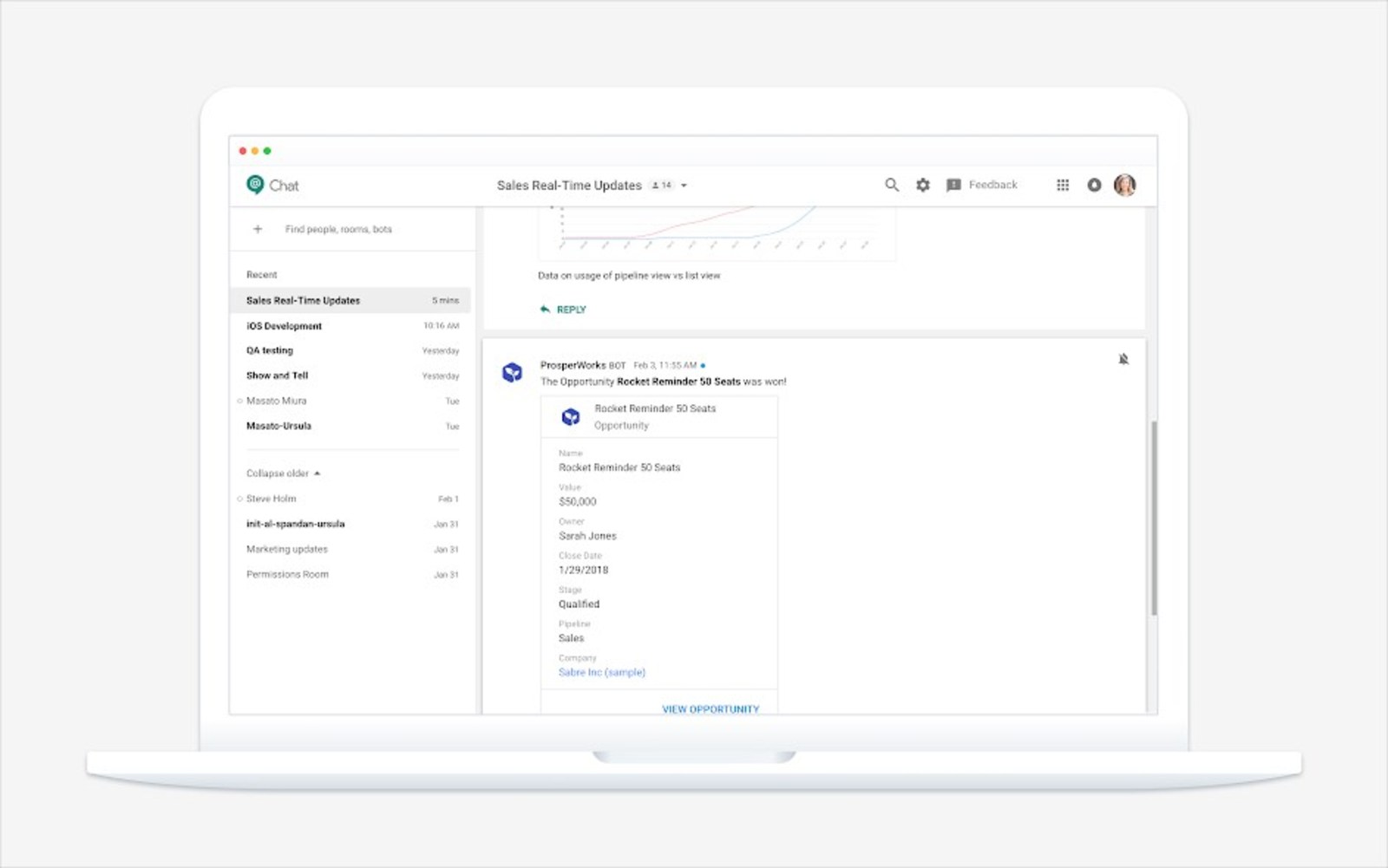
ProsperWorks and Chat will allow relationship-makers (sellers, marketers, service professionals) to have direct messages and group conversations while providing a centralized, integrated experience that makes team collaboration easy and efficient from anywhere in the world.

Also Read: Why Your CRM Is Lying to You

ProsperWorks Deepens Collaboration with G Suite, Announces New Hangouts Chat Integration
Jon Lee

“Today’s relationship-makers require more collaboration than ever before. They don’t have time to toggle between apps, they want to work in the systems they’re most used to in G Suite. As a longstanding Google Cloud partner, we’re proud to reinforce our existing G Suite integration and continue to provide more functionality to new and existing users. By eliminating the need to switch between apps, we’re helping sales teams save valuable time and focus on what matters most – closing deals,” said Jon Lee, ProsperWorks co-founder and CEO.

ProsperWorks has been a go-to launch partner with Google Cloud since the early days of its Chrome extension in 2014. This first partnership gave users the ability to access critical CRM data directly through Gmail. With today’s deeper integration announcement, users can now access that same data in Chat, providing the collaboration and flexibility required to form strong relationships.

Also Read: How to Pick the Right CRM: 3 Key Ingredients

Chat with ProsperWorks will allow any G Suite company to create rooms for relationship-specific messaging, conversations, or private meeting rooms for business relationship conversations. Chat is a free service that is included in every G Suite subscription and at no additional cost.

ProsperWorks has built a relationship bot designed to give alerts to any new business relationship triggers, from new users, new deal activity, updates, lead status changed, opportunities created, won, or even lost, and all status updates in the relationship lifecycle.

ProsperWorks Deepens Collaboration with G Suite, Announces New Hangouts Chat Integration
Jon Aniano

“Building cloud-first offerings with native integration provides a limitless future with the ability to leverage all of GCPs (Google Cloud Platforms) and G Suite technology. This is a critical component of empowering companies to work better and smarter to gain new and maintain existing relationships,” said Jon Aniano, ProsperWorks Chief Product Officer.

Recommended Read: How Marketers Can Optimize $682 Billion in Expected Spend in 2018

EventMobi Wins Back-To-Back Silver Stevie Award in 2018 Stevie Awards for Sales & Customer Service

0
EventMobi wins back-to-back Silver Stevie Award in 2018 Stevie Awards for Sales & Customer Service

EventMobi Provides Technology That Empowers Event Marketers and Planners to Create Incredible Event Experiences

For the second year in a row, EventMobi has received the Silver Stevie Award in the Customer Service & Call Centre Awards Team category at the 12th annual Stevie Awards for Sales & Customer Service.

Following Apple's Updated Guidelines, EventMobi Gives Event Planners More Options
Bob Vaez

“EventMobi is delighted to be recognized as a leader in customer service. Creating a customer-first and customer-centric support experience is a top priority for our team and an area where we will continually strive to improve. We are committed to having a full understanding of our clients’ needs to ensure the best overall customer experience possible,” says EventMobi’s CEO Bob Vaez.

Also Read: Following Apple’s Updated Guidelines, EventMobi Gives Event Planners More Options

The Stevie Awards for Sales & Customer Service are the world’s top honors for customer service, contact center, business development and sales professionals. More than 2,500 organizations of all sizes were nominated and evaluated across all industries in this year’s competition. Winners were determined by an average of more than 150 scores given across seven specialized judging committees.

EventMobi wins back-to-back Silver Stevie Award in 2018 Stevie Awards for Sales & Customer Service
EventMobi’s award-winning support team recognized with a 2018 Silver Stevie Award for Sales & Customer Service 
EventMobi wins back-to-back Silver Stevie Award in 2018 Stevie Awards for Sales & Customer Service
Rebecca McDougall

“Since winning last year’s Silver Stevie Award for Best Contact Centre of the Year, the Customer Support team at EventMobi has regularly incorporated client feedback to improve our customer service processes. We’ve been able to reduce our response time by 50 percent, and incorporated additional communication channels to service and support our customers in delivering incredible events for their attendees,” says EventMobi’s Manager of Customer Support, Rebecca McDougall.

Also Read: CMO of Extreme Reach, Wins Gold Stevie Award in 2017 Stevie Awards for Women in Business

Providing the best possible customer service at each stage of the event planning lifecycle is a pillar of EventMobi’s mission. The level of satisfaction and value perceived by clients is demonstrated through outstanding Customer Satisfaction Scores (CSAT) year after year, which is now at 98 percent. EventMobi’s constant drive for customer excellence and delighting clients will continue to pave the way for product innovation and value creation for event professionals worldwide.

Recommended Read: How to Stay on Customers’ Radar – Without Bugging Them

Interview with Field Garthwaite, Co-Founder and CEO, IRIS.TV

0
Field Garthwaite
Interview with Field Garthwaite, Co-Founder and CEO - IRIS.TV

[easy-profiles profile_twitter=”https://twitter.com/FieldJG” profile_linkedin=”https://www.linkedin.com/in/fieldgarthwaite/”]
[mnky_testimonial_slider slide_speed=”3″][mnky_testimonial name=”” author_dec=”” position=”Designer”]“The future of media and marketing is building large loyal audiences and building first-party data to inform your strategies across all departments.”[/mnky_testimonial][/mnky_testimonial_slider]

Tell us about your role and how you got here. What inspired you to launch your second video technology company after Jukebox TV?

Jukebox TV was originally created to make a better viewing experience for discovering and watching video content on the web. The first “Pandora for Video” product on the web. This was a straight B2C experience.

IRIS.TV is a video personalization and programming platform for broadcasters, publishers, and now — brands. The platform enables premium publishers like FOX, CBS, Time Inc., Gannett, and Rolling Stone to increase revenue by automating the creation of custom video feeds or playlists to users on a one-to-one level. This is the tip of the spear, as we are also providing our clients with valuable data enrichment, programming controls, and prescriptive insights that they can use to optimize their content strategy.

This technology is more important now than ever. Major media companies’ business models are changing rapidly and they need to own their distribution channels. Publishers and all media companies have become too reliant on walled gardens like Facebook and YouTube for distribution. The future of media and marketing is building large loyal audiences and building first-party data to inform your strategies across all departments.

As a video technology company, how would you define “Digital Transformation’ and “Digital Innovation”, respectively?

Within five years, we’re going to stop using the term digital to define part of the ecosystem. There won’t be many Chief Digital Officers—instead every department will need to be savvy about how digital fits into their business, regardless of the industry. Whether it ’s organizational or automating processes all of these things play an integral role in the current transformation of the digital space.

Innovation is leveraging emerging technology and knowledge to yield better results or simplify and automate a process. For example, the rise of voice and NLP technologies will help simplify the way we access information — from weather to sports scores to data in our business.

Doug Rozen, Chief Innovation Officer at OMD is someone who shares this view. And if you look at the way TV spending is changing, and the rise of digital, it’s hard to look away from that and continue thinking that digital is this small part of the ecosystem we can separate from the “real business.” It is becoming the business.

How do personalized video deliverables match up to the modern-day customer experience standards?

Platforms like YouTube and Facebook have built habits with users. For major media companies to compete, it’s essential to create a great user experience and curate messaging specifically for subsets of your audience. The most effective way to do this is through data science and machine learning, which allow you to constantly improve performance and take advantage of network effects so you can show the most relevant content to users.

For example, if you have a video on your homepage about the Super Bowl and you published it on Sunday, obviously it is still relevant on Monday. But if the most trending asset and best performing one is about the market drop on 2/5/2018, it’s no longer relevant the next day. If you don’t use machine learning, you may never serve the most valuable content to your audience. A playlist assumes they may want to watch sports, but everyone wants to see breaking news that affects them. Machine Learning can take advantage of that.

What are the major pain points for businesses (users as well as non-users of video personalization tech) when they deal with the multi-touch video engagements?
Video infrastructure is very complex. You need a CMS, transcoding/encoding tech, a video player, an ad server, a CDN, and some way of programming videos. Programming can be done through playlists, but you lose a lot of valuable data and in our opinion, it is essential to use machine learning and understand your Stream Yield in order to build great user experiences for your audience. The challenges are understanding how to place ads that are contextually relevant or don’t repeat too often and end up driving users away and learning from the data locked up in all those different parts of your infrastructure to learn ways to build large and loyal audiences.

What are the key business video-centric CRM metrics that modern marketers should have at their fingertips?

Content category-level data paired with new, returning, and loyal user data, and device data will be critical to understanding what content is resonating with different audience types and in what context. It is important to develop methods for building habits with users and your brands — whether that is promoting content on social or sending out content that drives viewers to a video experience through email targeting. The industry has good tools to track page performance and content marketing campaigns, but the insight on how they interact with editorial video content is not widely adopted nor incorporated into their operations This is one area where IRIS.TV provides value to our clients today. We create a feedback loop to help inform monthly and quarterly video strategies.

What are your predictions for the video industry in 2018? How does IRIS.TV prepare for these?

We can definitely expect a continued focus on brand safety, which has grown increasingly difficult due to the current news cycle as well as some challenges with distributed platforms such as YouTube. In addition, you have some fundamental changes to things that publishers had long taken for granted such as the Facebook newsfeed, Chrome, and Safari browser updates around autoplay. The good news is that publishers who have not been too heavily focused on distribution on third parties will see their audiences continue to grow.

At IRIS.TV our focus is on maximizing engagement from new and loyal audiences, so we welcome the change. Out of the box, our tech has enabled our clients to increase the return from audiences on their owned and operated properties that have intent.

Another big shift that is happening is viewers are watching less live TV and more viewing is being done in catch-up and online through OTT. Because there are potentially fewer people coming in from social, publishers have to be more strategic about how they use tools to drive users to their destinations. That’s where our prescriptive data helps. We can identify video assets that have led to increased follow-on video views and therefore more pre-roll completions. Pubs have used this data to finetune their audience acquisition strategy to drive users to content that drives the highest revenue.

In 2018, users are being even more selective with their time. We’ve found that repetitive pre-roll leads to high drop off rates in the video streams.  This is part of the reason we created IRIS.TV for Brands, to place branded video content into the video stream as content, not pre-roll. With branded content, we are able to serve branded video alongside editorial content in a playlist. This enables brands to get to the right premium audiences and helps publishers more than compensate for losses due to a depression in initial video starts. What’s exciting about this new format is users are completing these videos at a higher frequency than video ads on social, out-stream, and pre-roll so we expect that this format will grow this year.

What startups in the martech/adtech industry are you watching/keen on right now?

There are a number of startups that are leading the evolution of DMPs and emergence of CDPs as a market segment. This is a very exciting area that we are watching closely.

What tools does your marketing stack consist of in 2018? 

We use Salesforce, Pardot, WordPress, Vimeo, Buffer, Canva, Adobe Creative Cloud, Infogram.

Would you tell us about your standout digital campaign at IRIS.TV

One campaign that comes to mind is with our publishing partner Rodale, who leverages the IRIS.TV platform across video players across their owned-and-operated site. Christian O’Toole, the director of video custom content for Rodale, said that IRIS.TV, “Almost overnight increased views by 100 percent across the board, on all of our platforms.”

Rodale also found extensive value in being able to customize the AI with programming controls, which allows you to set rules for the automation balances while maintaining scale, editorial standards and brand safety. We also use metadata enrichment and data structuring to get better insights from content categories.

How do you prepare for an AI-centric world as a marketing leader? How do you leverage AI capabilities at IRIS.TV?

At IRIS.TV, we understand the essential role AI will play in the future of consumer experience.

As we are creating hundreds of millions of unique user experiences, you can imagine we have to process a lot of data. We use AI and machine learning across our entire workflow to determine the right piece of content to serve to the right person. We are still in early days of this technology but creating custom user experiences will become an essential part of building a loyal base of users. This application will become increasingly important for brands and marketers when it comes to ensuring proper placement of ads alongside relevant, brand-safe content.

How do you bring together people and technology at one place?

We are a data-driven company. Something that we have done is built out prescriptive analytics and alerts into our workflows. This can be done through email and Slack alerts so that any member of the team can subscribe to a data-set that pertains to their role. It is a great way to move people from dashboards and give them signals to take action — instead of just poring over data and trying to determine which action to take.

We believe this is where analytics are headed and we’re big on prescriptive data as a result. We also believe that there is a pathway forward in business where we’re less reliant on dashboards or reports, and that data and information can be packaged in such a way that it lends itself more towards action and reduces time wasted. In the same way, “voice” has begun to take over screen time with Alexa and Google Home—we believe in business there will be more dashboard less intelligence incorporated into day to day work.

What’s your smartest work related shortcut or productivity hack?

Fewer meetings. When you have clearly stated agendas, clear expectations of participants and a window of time that is finite and well defined then everyone comes in much more prepared and knows what needs to be accomplished and it reduces drag in your organization dramatically. This is very difficult to do and when it is done correctly it is incredible.

What are you currently reading? (What do you read, and how do you consume information?)

No matter the topic, getting a wide array of sources is essential. New York Times, Wall Street Journal, The Atlantic, The New Yorker, Business Insider, The Information, eMarketer, MarTech, Digiday, and right now I love the new publications Polygraph and The Outline.

What’s the best advice you’ve ever received?

John Landgraf (Chief Executive Officer of FX Network and FX Productions) once gave we some incredible advice when I was telling him what we were up to in the video ecosystem. He sat down and showed me the numbers that FX has everyday, and from minutes spent watching content and ads how it dwarves the scale even of YouTube. You could distill it down to “it’s hard to compete with scale.”

We’re seeing that today with YouTube and Facebook. The reach is so big and there’s so much data to learn from, it’s hard to keep up. Years after this conversation, IRIS.TV is helping companies like FX’s parent company Fox to grow video. Our focus is taking advantage of our data network, like the walled gardens, and using it to provide technology back to media companies and marketers directly.

Tag the one person in the industry whose answers to these questions you would love to read:

Martin Baron, executive editor of the Washington Post

Thank you Field! That was fun and hope to see you back on MarTech Series soon.

[vc_tta_tabs][vc_tta_section title=”About Field” tab_id=”1501785390157-b58e162d-0ae25a4b-c27aca64-108e51b0-80edaf37-bd3d357a-6c46282b-3838″]

Six years ago, Field was lucky enough to work with some brilliant engineers and data scientists where they built the first in-stream video recommendation engine-Jukebox TV—think “Pandora for Video.” By focusing on building better data sets and adaptive machine learning—They built an early iteration of the tech that is now IRIS.TV. Field has been designing machine learning systems and programming products to power the future of video and TV since graduating at Pomona College.

Throughout his professional career Field has worked with artists, creators, media companies and studios with a focus on distribution and product. Ensuring that content distribution is profitable for artists and content owners is his credo and They built IRIS.TV to ensure that content owners and brands can own their distribution and make online video a profitable distribution.

[/vc_tta_section][vc_tta_section title=”About IRIS.TV” tab_id=”1501785390320-2d44fa50-740c5a4b-c27aca64-108e51b0-80edaf37-bd3d357a-6c46282b-3838″]

iris.tvIRIS.TV is a cloud-based personalized video programming system that allows publishers and content owners to generate more video views and engage users across all devices. The company’s product suite is designed to increase video consumption and simplify operations for web, mobile, and OTT video distribution. The software integrates with existing video players using artificial intelligence and adaptive machine learning to automate streaming of personalized content based on audience preferences, user interaction, and behavioral segmentation. IRIS.TV has hundreds of customers across the world that rely on the company’s video programming platform to keep their audiences watching. Based in Los Angeles, IRIS TV’s investors include Sierra Wasatch, BDMI, Progress Ventures and individual backers including Machinima founder Allen DeBevoise, Lions Gate CFO James Barge as well as senior executives with Nielsen and AEG.


[/vc_tta_section][/vc_tta_tabs]
[mnky_heading title=”MarTech Interview Series” link=”url:https%3A%2F%2Fmartechseries-67ee47.ingress-bonde.easywp.com%2Fcategory%2Fmts-insights%2Finterviews%2F|||”]

The MTS Martech Interview Series is a fun Q&A style chat which we really enjoy doing with martech leaders. With inspiration from Lifehacker’s How I work interviews, the MarTech Series Interviews follows a two part format On Marketing Technology, and This Is How I Work. The format was chosen because when we decided to start an interview series with the biggest and brightest minds in martech – we wanted to get insight into two areas … one – their ideas on marketing tech and two – insights into the philosophy and methods that make these leaders tick.

Seismic Wins Gold For Sales & Customer Service At The 2018 Stevie Awards

0
Seismic Wins Gold Stevie® Awards In 2018 Stevie Award For Sales & Customer Service

The Stevie Awards are the World’s Top Honors for Customer Service, Contact Center, Business Development and Sales Professionals

Seismic, the leading global sales and marketing enablement solution, has announced that they have been presented with the Gold Stevie® Award in the Sales Enablement – New Version category at the 12th annual Stevie Awards for Sales & Customer Service.

Read More: Fireside Chat with Shawn Schwegman

At the time of this announcement, Doug Winter, Seismic co-founder and CEO, said, “Seismic continues to invest heavily in ensuring that we offer the best, most innovative sales enablement solution on the market for the customer.”

Doug added, “Considering the tremendous amount of work our team puts into delivering a product that generates true sales productivity and revenue-driving results, we are incredibly honored to once again be presented with a Gold in the Stevie Awards for Sales and Customer Service.”

Stevie Awards are conferred in seven programs: the Asia-Pacific Stevie Awards, the German Stevie Awards, The American Business Awards, The International Business Awards®, the Stevie Awards for Great Employers, the Stevie Awards for Women in Business and the Stevie Awards for Sales & Customer Service. 

The Stevie Awards for Sales & Customer Service are the world’s top honors for customer service, contact center, business development and sales professionals. The Stevie Awards organizes seven of the world’s leading business awards programs, also including the prestigious American Business Awards and International Business Awards.

Read More: Latest Katabat Customer Experience Management Releases Target Customer Centricity

This is the second consecutive year in which Seismic has been presented with a Gold Stevie Award. Last year, the company won Best Collaboration Solution for their WorkSpace product feature.

More than 2,500 nominations from organizations of all sizes and in virtually every industry were evaluated in this year’s competition. Winners were determined by the average scores of more than 150 professionals worldwide in seven specialized judging committees.

Read More: Outbrain Launches ‘Sphere’ for Unbiased Audience Development

2017 saw a host of product innovations across the Seismic solution, including:

  • Seismic NewsCenter is a sales communications feature that allows enterprises to communicate relevant pieces of the company, competitive, and industry news to the right sales rep at the right time, so that they remain fully informed in real-time, wherever they are through Seismic’s mobile apps. With NewsCenter, Seismic expanded their offering into sales communications to redefine a truly complete sales enablement solution.
  • Seismic’s new Salesforce.com app with predictive content functionality allows sellers to discover inline, context-perfect content recommendations for their specific buyer and sales stage. Recommendations become more precise as the platform gets to know each seller better.
  • WorkSpace for CRM allows sales and marketing teams to power content collaboration with CRM opportunity data, automating the content collection, revisions, and feedback for optimal sales productivity.
  • Seismic announced technology integrations with marketing automation providers Marketo and Oracle Eloqua, helping marketers to further directly tie their efforts to the bottom line.
  • Seismic LiveInsights is a dynamic dashboard of analytics of sales content inventory, content adoption, engagement by buyers, and revenue data, allowing sellers to see in real-time what is truly effective in the field and marketers to have the intelligence they need to make impactful content improvements.
  • Seismic’s revamped mobile apps, available for Apple, Windows, and Android devices brings the full power of Seismic to the fingertips of every seller, regardless of where they are.

In 2017, Seismic’s platform also won Best Document Management Tool in the WealthManagement.com Industry Awards, Best Cloud Solutions Provider in the Mutual Fund Service and Technology Awards was named to Pharma Marketer 360’s annual Innovators list, and won Enterprise Technology Company of the Year in Business Intelligence Group’s BIG Award for Business.

“All of our Stevie Award winners should be proud of their achievements. Independent professionals around the world have agreed that their accomplishments are worthy of our public recognition,” said Stevie Awards president Michael Gallagher.

Currently, Seismic is the leading global sales and marketing enablement solution, improving close rates and delivering larger deals for sales while increasing marketing’s impact on the bottom line. Large enterprises use Seismic to increase sales productivity through the automatic distribution of relevant information and personalized content to reps for any buyer interaction. Powerful content controls and visibility into usage ensures brand integrity and reduces risk.

Recommended Read: TechBytes with Tom Rassweiler, VP, Content Reinvention, Arkadium

Periscope Data to Showcase End-to-End Analytics Platform at Gartner Data & Analytics Summit 2018

0
Periscope Data to Showcase End-to-End Analytics Platform at Gartner Data & Analytics Summit 2018

Platform is the First to Bring SQL, Python and R Together in One Solution

Periscope Data, the world’s first software platform built to address the complete analytics lifecycle, will showcase its latest innovations focused on helping data teams drive measurable results for their businesses at Gartner’s Data & Analytics Summit 2018 in Grapevine, Texas, from March 5 to 8, 2018.

Earlier this month, Periscope Data introduced new features enabling data professionals to work with Python, R and SQL together all on a single platform. With this new functionality, data teams are able to complete far more analysis in less time by transforming data in SQL, performing complex statistical analyses in Python or R, then visualizing, collaborating and reporting on the results — all without leaving Periscope Data. Live demos of Periscope Data’s Python and R functionality will be on display at the Summit.

Also Read: Automation Anywhere Plus Unveiled as Industry’s Most Comprehensive Global Customer Success Program

For data teams looking to ingest, store, analyze, visualize and report on data, Periscope’s Unified Data Platform provides a single source of truth throughout the data lifecycle, from data ingestion to analysis and reporting. With Periscope’s industry-leading analytics product and a secure, managed data warehouse, data teams can unify their data sources and streamline their analytics workflow while maintaining complete control.

At the summit, Periscope Data will be located at booth #529, with experts ready to discuss how to empower your team to go deeper with data.

Periscope Data builds software that turns data teams into superheroes. Its Unified Data Platform is the industry’s first to address the complete analytics lifecycle, allowing data teams to ingest, store, analyze, visualize and report on data all from one connected platform. This empowers them to collaborate and drive faster insight while allowing businesses to foster a data-driven culture around a single source of truth. Periscope Data serves 975+ customers globally, including Adobe, Crunchbase, EY, Flexport, New Relic, Supercell, Tinder and ZipRecruiter.

Recommended Read: 5 Things You Gain by Closing the Marketing Operations Gap


Outreach Expands Management Team With New COO Anna Baird And SVP Of Customer Success Mike Zinne

0
Outreach Expands Management Team With New COO And SVP Of Customer Success

Forbes “Next Billion-Dollar Startup” Continues Rapid Growth Trajectory with New Hires, New Marquee Customers, and Triple Digit Revenue Growth

Outreach, the leading sales engagement platform, has hired Anna Baird as COO and Mike Zinne as Senior Vice President of Customer Success, rounding out the company’s management team and positioning Outreach to continue the rapid growth trajectory it has been on since its founding in 2014.

In just two years (FY2015-2017), Outreach, which late last year was recognized by Forbes as one of its “Next Billion Dollar Startups”, went from zero to a $10 million run rate and just closed FY2018 up another 100+ percent. The company has also seen significant increases in headcount, doubling the number of employees from FY2018 to FY2019. Headcount growth for FY2019 will focus on investments in engineering, sales and customer success.

Outreach Expands Management Team With New COO And SVP Of Customer Success
Anna Baird

Anna brings a wealth of financial and operational leadership experience to her new role as Outreach COO. Before joining Outreach, Baird was responsible for providing financial and strategic leadership as CFO of Livongo Health, a consumer digital health company. Prior to her tenure at Livongo, she served as President and CFO of RadiumOne, a data-driven marketing platform that was recently acquired by RhythmOne. She has also held senior-level financial and operational positions at Say Media, McAfee and KPMG. As COO of Outreach, Baird will lead the company’s Finance, Business Intelligence, Sales Operations, Security and IT efforts.

Also Read: Outreach Joins LinkedIn’s Sales Navigator Application Platform (SNAP)

Outreach Expands Management Team With New COO And SVP Of Customer Success
Mike Zinne

Mike, Outreach’s new SVP of Customer Success, will be a key part of future growth, providing services and training to existing customers and the Outreach employees that support them. Zinne has deep experience building and optimizing customer delivery teams for SaaS companies. Prior to joining Outreach, Zinne spent several years as Vice President of Customer Experience for Zendesk as well as in sales and support roles at Kyriba, Oracle and RightNow.

Also Read: $30 Million in Series C Funding Ushers Outreach into the Era of Sales Excellence

Outreach Expands Management Team With New COO And SVP Of Customer Success
Manny Medina

“Like most startups, a major key to our success has been – and continues to be – finding the right people to join our team, challenge us and ultimately propel us forward. These hires represent the best of the best in terms of experience, skill set and a deep understanding of what it takes to strategically grow. We are excited to welcome Anna and Mike to Outreach,” said Manny Medina, CEO of Outreach.

In the recent months, Outreach has secured numerous new marquee customers, including MINDBODY, Splunk, and The San Francisco Chronicle. What’s more, the company has successfully expanded into new verticals, building on its base of technology customers. In Q4 FY2018 alone, more than half of Outreach’s new accounts came from verticals outside of technology, primarily financial services, telecom and healthcare.

Recommended Read: Outreach Meetings Simplifies Scheduling Workflow With Prospects

Most Consumers Fill Out At Least One Online Form a Week, But Businesses Struggle to Design Consumer-Friendly Forms

0
Most Consumers Fill Out At Least One Online Form a Week, But Businesses Struggle to Design Consumer-Friendly Forms

Businesses Risk Losing Customers and Hurting Their Reputation with Poorly Crafted Online Forms. A New Survey Offers Data and Advice for Businesses on Designing Better Web Forms

Nearly 90% of consumers fill out at least one online form per week on average, according to a new survey from Clutch, a B2B research firm.

However, consumers tend to abandon poorly designed online forms, putting small businesses at risk of losing conversions for lead generation or e-commerce sales.

Clutch surveyed 502 consumers that filled out a web form in the past month to understand how small businesses can improve their web forms’ design.

Also Read: Clutch Announces Leading Web Designers in Seattle and Portland

The survey found that ineffective online forms can harm a business’s reputation by suggesting that the business is untrustworthy or out of touch with technology.

Most Consumers Fill Out At Least One Online Form a Week, But Businesses Struggle to Design Consumer-Friendly Forms
Graph showing how often people fill out web forms
Most Consumers Fill Out At Least One Online Form a Week, But Businesses Struggle to Design Consumer-Friendly Forms
Mark Baldino

“It says to a potential customer that you don’t understand technology and you care less about them. It tells a story of attention to detail that a company can provide,” says Mark Baldino, co-founder of Fuzzy Math, a Chicago-based user experience firm.

Experts recommend that small businesses apply user experience best practices that make it faster and easier to complete an online form. These best practices can also help ensure the data collected is accurate.

Also Read: Small Businesses Use Social Media Instead of a Website: Survey By Clutch

Almost half of the online form users (44%) say that the average web form takes 2 minutes or more to complete. However, small businesses should create short and efficient web forms that do not ask for extraneous information.

Most Consumers Fill Out At Least One Online Form a Week, But Businesses Struggle to Design Consumer-Friendly Forms
Graph showing the average time it takes people to complete a web form

Features that autofill addresses or pull data from uploaded documents are popular, and can make a web form more concise. Applying conditional logic can ensure users aren’t asked irrelevant questions.

Most Consumers Fill Out At Least One Online Form a Week, But Businesses Struggle to Design Consumer-Friendly Forms
Leeyen Rogers

“For instance, if a form first asks for an age range, whatever that user answers, the subsequent questions should relate back to that. If someone says they’re 30-years old, the questions shouldn’t ask anything pertaining to a different age range,” said Leeyen Rogers, vice president of marketing at JotForm, a web form builder tool.

Also Read: JotForm Introduces JotForm Cards to Increase Form Conversions and Ease Data Collection

Online form features such as a status bar indicating progress, inline validation, or a password strength checker can help deliver a better user experience and are preferred by 90% of online form users, the survey found.

Finally, consumers indicate that they prefer to scroll through all the form’s questions on one page rather than clicking through multiple pages of questions. This stands in opposition to current design trends, which promote forms with multiple pages.

Clutch surveyed 502 consumers who filled out an online form within the past month; 67% of those surveyed had filled out an online form within the past week.

Recommended Read: How to Boost Push Notification Engagement with Mobile App Deep Linking

Confirmit Promotes Claire Sporton to SVP, Customer Experience Innovation

0
Confirmit Promotes Claire Sporton to SVP, Customer Experience Innovation

Industry Expert Claire Sporton Expands Role to Drive the Discipline of Customer Experience Management

Confirmit has announced the promotion of Claire Sporton to the role of SVP, Customer Experience Innovation. In this newly-created position, Sporton will be responsible for ensuring that the company continues to deliver the market-leading expertise and technology that businesses need to support their CX programs.

Confirmit Promotes Claire Sporton to SVP, Customer Experience Innovation
Claire Sporton

Sporton has worked closely with Confirmit’s clients since she joined the company in 2011, helping to define and deliver Voice of the Customer programs that empower employees to do the right thing for customers, and drive improved performance, based on clear business insights.

Also Read: Confirmit Launches New Survey Designer to Improve Customer Engagement Campaigns

Sporton said: “I’m thrilled to be taking this new position. I am passionate about helping our clients to build truly customer-centric business cultures that inspire change and deliver measurable business improvement. This is a really exciting opportunity to help drive the discipline of CX Management at a global level, supporting CX professionals around the world by giving them the tools they need to build customer experience programs that deliver significant business improvement.”

Also Read: Confirmit’s Shelly Chandler Recognized as 2017 CX Impact Award Winner

In addition to driving new strategies in CX methodologies, Sporton will work hand-in-hand with Confirmit’s R&D and Product Management teams to ensure that the company’s solutions meet the ever-evolving needs of organizations committed to driving change. She will also take on responsibility for Confirmit Empower, Confirmit’s own Voice of the Customer program, based on cutting-edge best practices and Confirmit’s latest product enhancements.

Confirmit Promotes Claire Sporton to SVP, Customer Experience Innovation
Michael Wooh

Michael Wooh, Chief Marketing Officer at Confirmit said: “Claire’s promotion to this new role is a significant development for Confirmit. We have always provided world-class software and consulting services, and Claire will now take a core role in helping us to meet our plans for significant growth. Her unparalleled experience in delivering CX programs to clients, particularly those in B2B markets, will stand her in good stead to lead our CX innovations and address a rapidly-evolving market.”

Also Read: Confirmit Supports Youth Market Research at Ungdomsbarometern

“Customer Experience is currently at a crossroads. CX professionals can either view CX measures as just one of many organizational KPIs or can position their work as a true catalyst for change – enabling everyone to make better decisions. This is a very exciting year for Confirmit with the fruition of some ground-breaking capabilities that will enable companies to predict and track the change in real time. The world of CX is changing, and Confirmit is perfectly positioned to be a significant driving force in that change,” explained Sporton.

Recommended Read: Need for Data Orchestration for Contextualizing Customer Experience

YouAppi’s Second Annual CMO Mobile Marketing Guide Survey Reveals Significant Increase in Video Investment for 2018

1
YouAppi's Second Annual CMO Mobile Marketing Guide Survey Reveals Significant Increase in Video Investment for 2018

Year-over-Year Results Show Video Usage on the Rise Across Every Channel

YouAppi, a leading growth marketing platform for premium mobile brands, recently announced the results of its second annual CMO Mobile Marketing Guide, which highlights opportunities for mobile marketers over the next 12 months.

YouAppi's Second Annual CMO Mobile Marketing Guide Survey Reveals Significant Increase in Video Investment for 2018
YouAppi CMO Mobile Marketing Guide – Journey

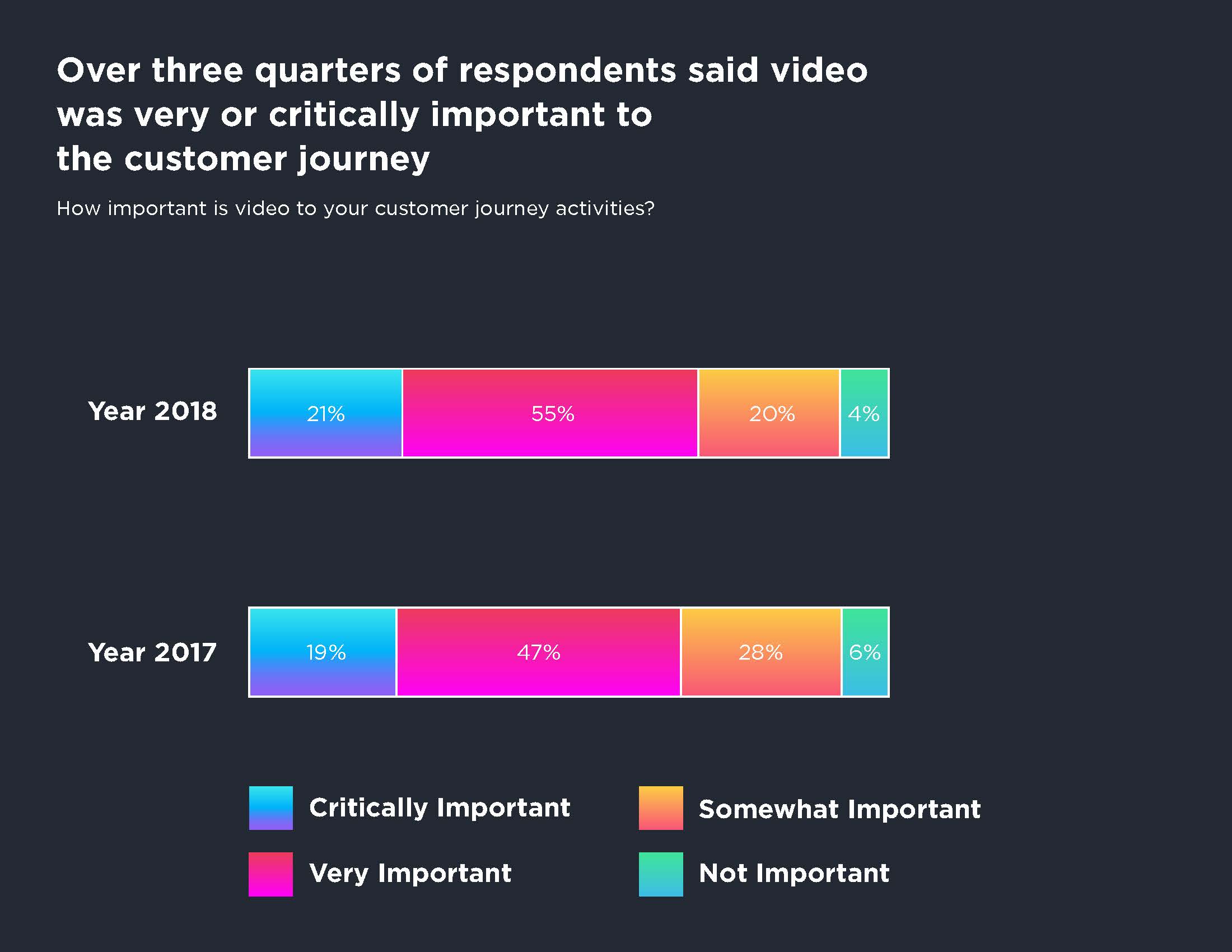
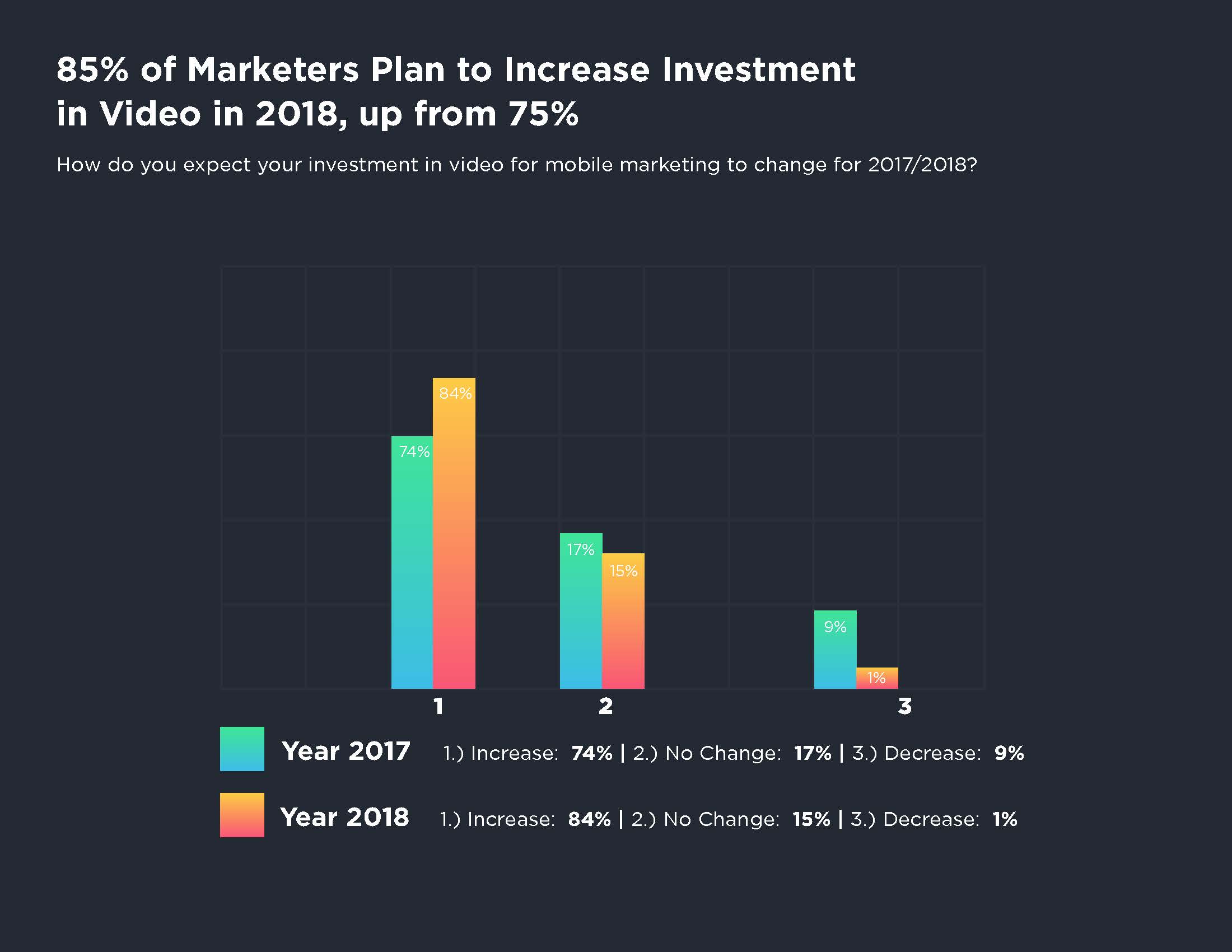
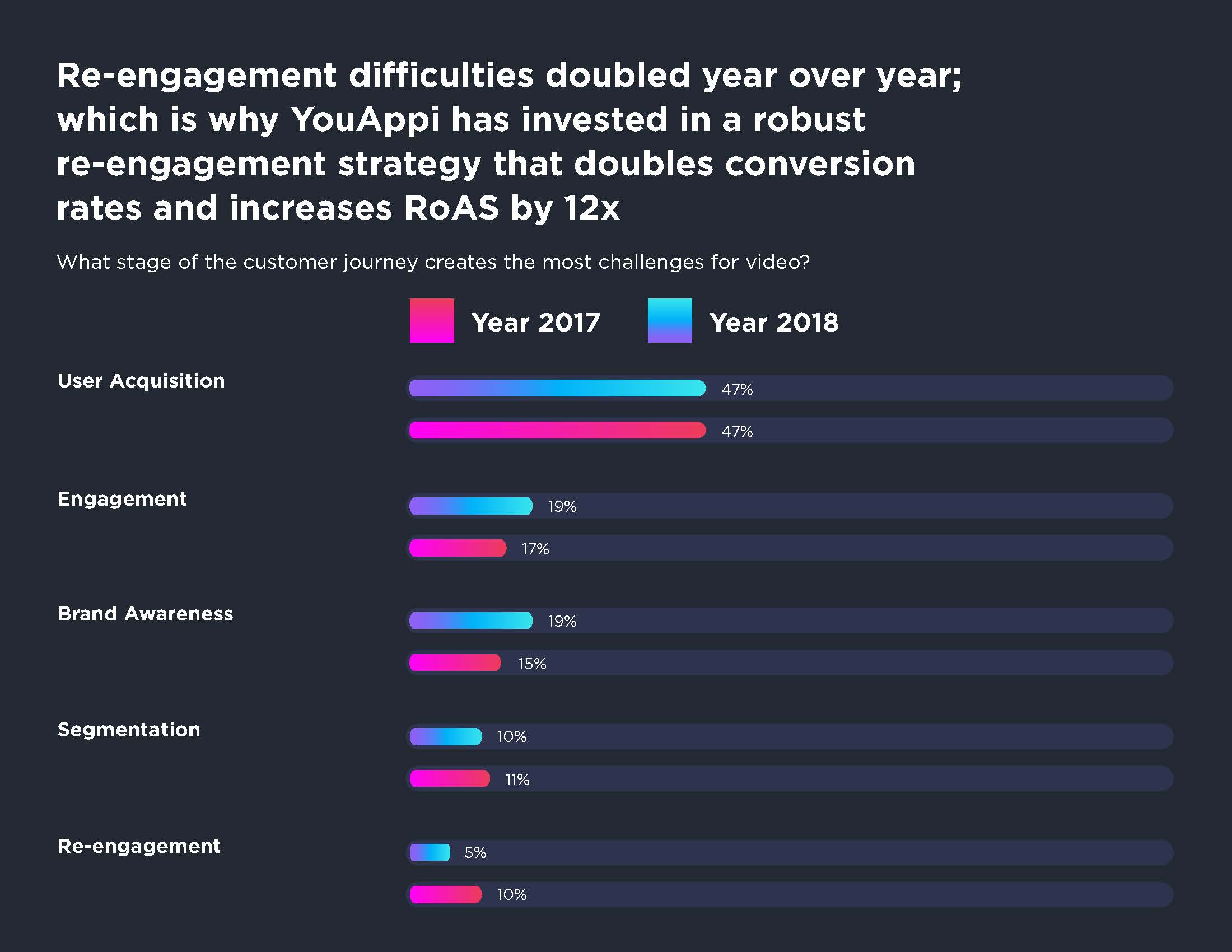
Video emerged the clear winner, with 85 percent of marketers planning to increase their investment in video during 2018, up a full 10 percent from 2017. Over three-quarters of respondents cited video as very or critically important to the customer journey, with marketers saying they use video for acquisition (71 percent), awareness (65 percent), engagement (56 percent), re-engagement (40 percent) and segmentation (31 percent).

Also Read: YouAppi Delivers The Most Comprehensive Mobile Fraud Protection Suite, Powered By Dedicated Fraud Analytics Team

YouAppi's Second Annual CMO Mobile Marketing Guide Survey Reveals Significant Increase in Video Investment for 2018
YouAppi CMO Mobile Marketing Guide – Video

YouAppi's Second Annual CMO Mobile Marketing Guide Survey Reveals Significant Increase in Video Investment for 2018

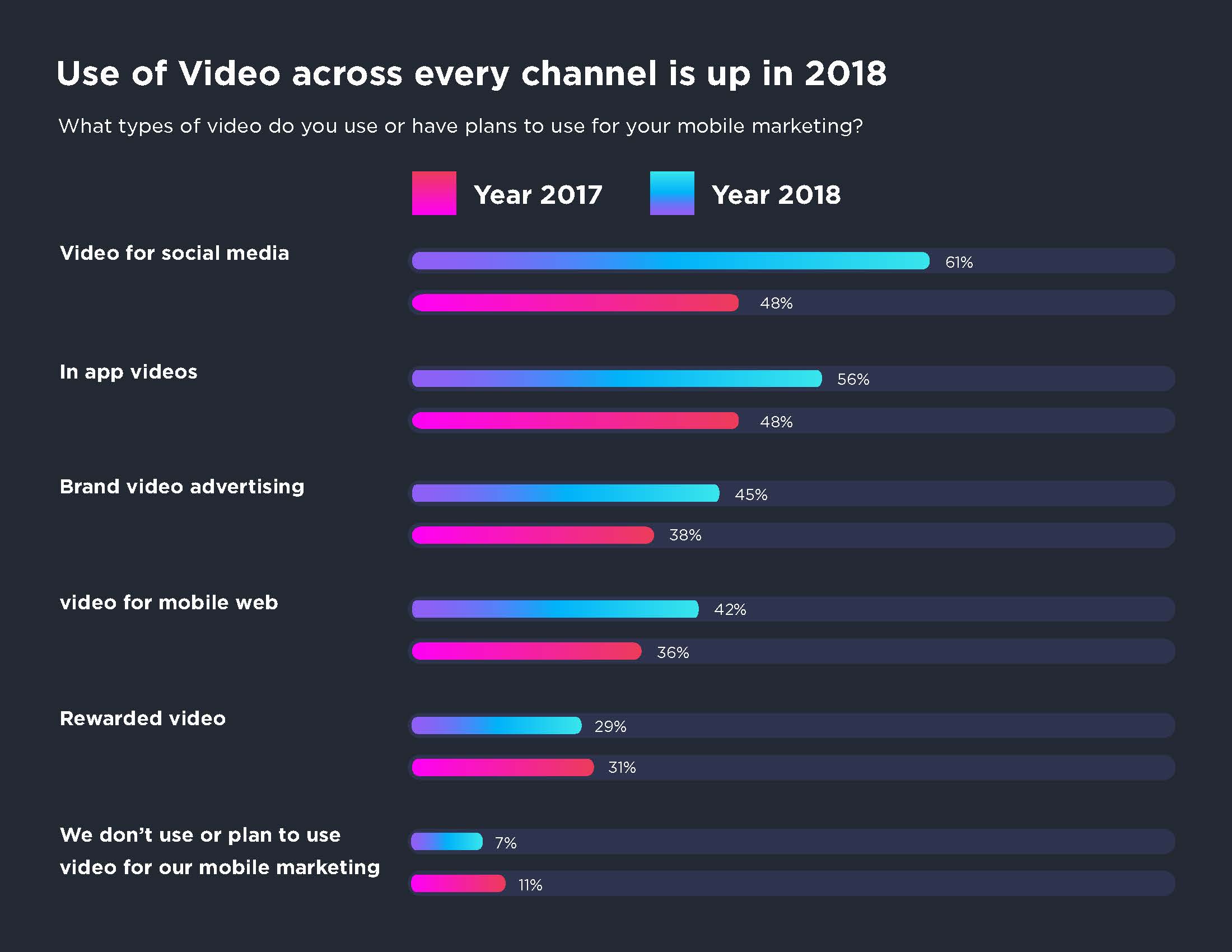
The use of video across every channel is also on the rise. Social media topped the list at 61 percent, an increase of 13 points year over year, while other channels also saw increases in 2018 including in-app video (56 percent), brand video advertising (45 percent) and video for mobile web (42 percent). Rewarded video remained steady, with about one-third of respondents planning to use it in the coming year. Conversely, the number of respondents who said they had no plans to use video in their 2018 mobile marketing programs decreased by four points, to only seven percent.

Also Read: YouAppi Launches 360 Degree Growth Marketing Platform For Mobile Marketers

YouAppi's Second Annual CMO Mobile Marketing Guide Survey Reveals Significant Increase in Video Investment for 2018
YouAppi CMO Mobile Marketing Guide – New Tech
YouAppi's Second Annual CMO Mobile Marketing Guide Survey Reveals Significant Increase in Video Investment for 2018
Moshe Vaknin

“The results of our annual survey highlight a growing trend for marketers to meet consumers where they are, and that is with video. What is particularly exciting is the impact of video in every part of the customer journey – from user acquisition to engagement, segmentation, awareness and re-engagement. Marketers cited user acquisition and re-engagement as top priorities in the coming year, and video is one of the most effective resources for attracting the right customers and keeping them engaged,” said Moshe Vaknin, CEO of YouAppi.

Also Read: YouAppi Doubles Mobile User Conversion Rates With Powerful Re-Engagement Solution

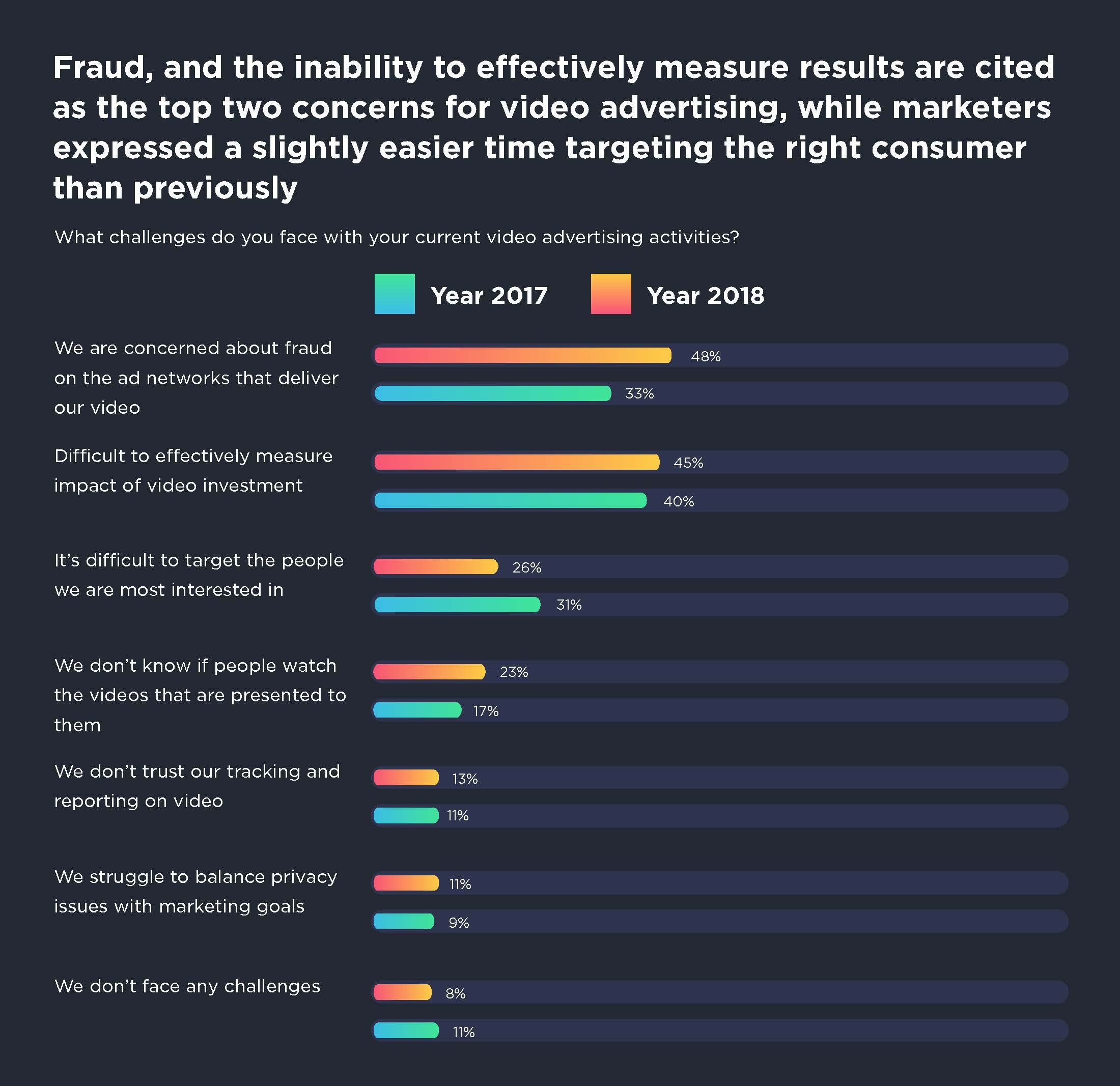
Mobile marketers did reference certain challenges with video advertising as well. Fraud topped the list, with 48 percent of respondents citing it as their main concern, a 15 point jump from 2017. Additional issues included difficulty in effective measurement (45 percent), difficulty in targeting (26 percent), and lack of visibility into whether videos are being watched (23 percent).

YouAppi's Second Annual CMO Mobile Marketing Guide Survey Reveals Significant Increase in Video Investment for 2018
YouAppi CMO Mobile Marketing Guide – Measurement

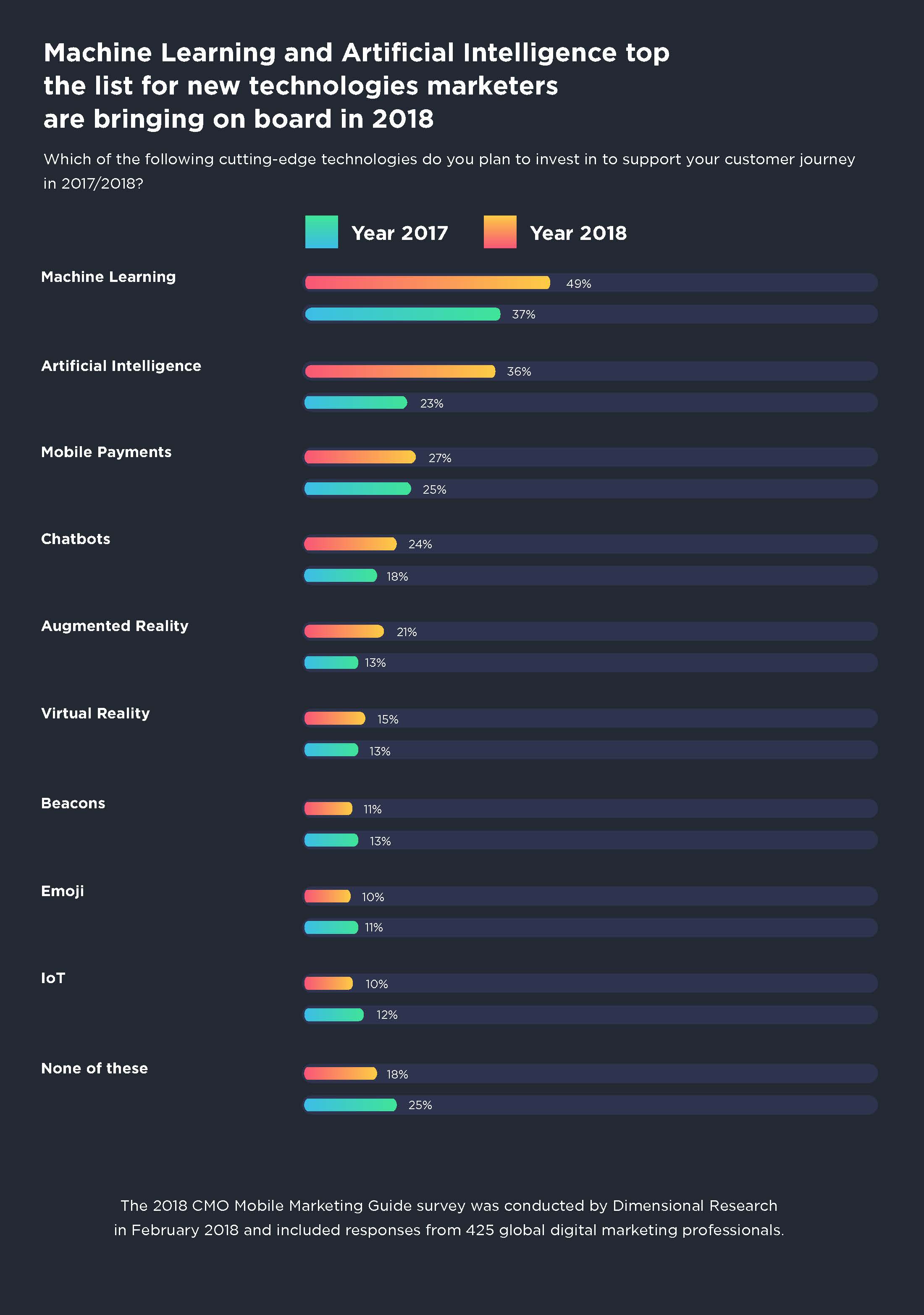
Mobile marketers are eager to incorporate emerging technology, with 49 percent saying machine learning will become a part of their customer journey in 2018 and 36 percent using artificial intelligence. Additional technologies marketers will use in the coming year include mobile payments (27 percent), chatbots (24 percent), augmented reality (21 percent) and virtual reality (15 percent).

YouAppi's Second Annual CMO Mobile Marketing Guide Survey Reveals Significant Increase in Video Investment for 2018
YouAppi CMO Mobile Marketing Guide – Re-engagement

The 2018 CMO Mobile Marketing Guide survey was conducted by Dimensional Research in February 2018 and included responses from 425 global digital marketing professionals.

Recommended Read: Customer Data Is the Next Competitive Battleground Shaping the Future of Digital Marketing

How To Interpret And Measure KPIs In The New Age Of Marketing

0
KPI Metrics

Merkle LogoAs a marketer, your goal for most campaigns is to create value for your brand’s top line by increasing things like orders and revenue. Historically, this choice was made because there was a lack of additional viable KPIs to choose from. There used to be questions like, “Did we see more revenue after we shipped out a bunch of catalogs? Were we selling three times as much in market B after we setup billboards in and out of the city center?” However, marketers didn’t have an accurate way of determining just how good their brand was doing at supporting its main goals. Sure, there were ways to “track” the performance of tactics, but they were far from perfect. How often does the customer remember its special 25-character alpha-numeric brochure code? Did he or she dial that special phone number or was it simply easy enough to dial the corporate 1-800 number and place the order?

Start Leveraging Primary KPIs

Today, despite being in the time of pixels, cookies, DSPs, DMPs, web analytics packages, media platforms, and a whole host of third-party data providers and tools, some marketers are still stuck in thinking in the black and white views. For a company to stay in business, it needs to fundamentally support the key marketing objectives of measuring orders and revenues. With the explosion of metrics that range from basic market sizing and demand all the way to intimate details of how individual cookies are interacting with your website, marketers need to start leveraging these as primary KPIs when they make sense to do so to measure campaign success.

Also Read: Customer Data Is the Next Competitive Battleground Shaping the Future of Digital Marketing

Choosing the Right Metric

To make things even more complicated, it isn’t about selecting different metrics, but about understanding what those metrics represent given the context of what you’re trying to accomplish. The same metric may be the right KPI for campaign 1, but be completely irrelevant for campaign 2, despite them having similar overall objectives. For example, clicks may make sense as the end goal for an awareness campaign — you got someone to interact with your ad and now they are on the website and you assume they did something. Huge win, right? But what happens if the bounce rate is at 90 percent or the visitor spends less than 10 seconds on the page? Do you still feel the same way? If there are various video play opportunities, downloadable content and various tools/calculators for your prospect to interact with and that visitor didn’t use any of it, do you still think this campaign was a success?

On the other hand, what if you are simply driving awareness to your site so that you can engage users later via remarketing? In this instance, clicks may be fine to call out how many visits you’ve made to the website has seen that you can build a retargeting campaign around. You could certainly make the case that there are better metrics than clicks for this example (like cookie pool size and unique visitors), but you can see how two basic awareness campaigns would fork into two different sets of KPIs.

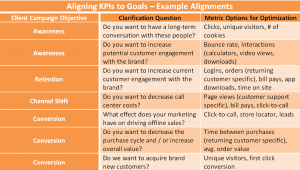
For additional food for thought, see the below table that lists a few of the more common marketing objectives, a list of questions, and the metrics that can be used to help answer those questions.

How To Interpret And Measure KPIs In The New Age Of Marketing


We can now start to see see how poor KPI selection impacts campaign management, bidding and budgeting, and marketing message. It is a snowball effect that gets bigger and bigger as it goes downhill and ends up crashing through your door. Irrelevant keywords with poor messages are prioritized over keywords that are actually driving individuals to get to know your brand. Budget is prioritized in this direction too, and the only thing you have to show for it is clicks — a metric that can be easily manipulated by bidding into first position or doing total page takeovers or using dynamic overlay display ads.

Also Read: Marketing Strategy In 2018: How To Deliver Savvy, Sleek and Integrated Campaigns Amidst Digital Transformation

Interpreting The Metrics

There are certainly a lot more metrics out there than ever before, and the interpretation of those metrics can be drastically different depending on what audience segment you are looking at or which filter you have on or even which campaign it is being run out of. The key is to take a step back, ask the right questions, and think through what the goal/objective is and then choose the metrics that make the most sense to determine success or failure. It may still all go back to how much revenue was brought in or how many orders were placed, but you can make more informed decisions and feel confident in doing so by making sure you align the right KPIs for the job at hand.

Kenscio Partners With eDataSource to Launch ‘Email Analyst’ for Competitive Intelligence

0
Kenscio Partners With eDataSource to Launch ‘Email Analyst’ for Competitive Intelligence

‘Email Analyst’  is The New Game Changer in Email Marketing Competitive Intelligence and Inbox Tracking

Kenscio Digital and eDataSource have partnered to launch a revolutionary competitive intelligence and inbox product called the ‘Email Analyst’, which will enable organizations to monitor their email marketing campaigns and keep up-to-date on competitor strategy. The companies will collaborate to deliver advance intelligence and inbox deliverability to email marketers, with Kenscio being the exclusive partner for ‘Email Analyst’ product suite in India and the APAC.

kenscio_edatasource

Read More: Adobe Unveils Next-Gen Content Intelligence to Transform Customer Experiences

While eDataSource is a leading global provider of performance insights and analytics for email marketers, inbox delivery, and customer activity, Kenscio has created a niche for itself as the market leader in email marketing in India.

The Email Analyst suite includes four powerful components known as —

  1. Competitive Tracker
  2. Inbox Tracker
  3. Design Tracker
  4. Analytics Tracker

These play an important function in increasing customer engagement metrics and managing email market intelligence.

Read More: Zaius Integrates with Zendesk for 360-Degree View on Customer Experience

The Email Analyst changes the rules of email-centric customer engagement by offering the following features —

  • Tracks email marketing intelligence and provide a stream of accurate data in real-time
  • Detects issues and optimizes email delivery into inbox
  • Gives live alerts and notifications to keep marketers up-to-date on Deliverability Status
  • Monitors important metrics such as Engagement Levels, Read Rates, and Deletion Rates
  • Pretests email marketing campaigns for any technical issues or broken links
  • Helps to compare brand’s email marketing performance with direct competitors
  • Conducts speedy pretests across all format – desktop, mobile, and web
  • Increases brand message engagement by gauging keyword performance and sender metrics

Read More: How is The Location Data Landscape Shaping Up in 2018?

Kenscio’s Email Analyst suite is the perfect tool for the modern email marketer that will help organizations remain a step ahead of their competitors. Competitive Intelligence applications are the future of marketing. It has been proven that marketers who harness the power of market intelligence instruments generate three times the revenue of those who don’t, highlighting the need to make sure that customer data is available quickly, accurately, and in the real-time.

Currently, Kenscio offers innovative marketing technology solutions to brands and enterprises by enabling personalization and one-to-one communication through Digital Marketing, Big Data, Analytics and creative based solutions and services.

Recommended Read: TechBytes with Tom Rassweiler, VP, Content Reinvention, Arkadium

ListenFirst’s Report for Media Publishing Industry Reveals Social Branded Content Nearly Doubled in 2017

0
ListenFirst Named As Member Of The Twitter Official Partner Program

Social Branded Content up 98%, Fatherly with New York Life Insurance Lands #1 Branded Post

ListenFirst, the most comprehensive social analytics solution for the enterprise, today released its Media Publishing: Social Branded Content Report with key insights into the adoption, effectiveness, and strength of social branded content as a new advertising opportunity. ListenFirst’s report reveals social branded content on Facebook grew by 98 percent in 2017 and outperformed all other posts published by the media publishing industry by 5 percent.

Also Read: Want To Combat Facebook’s News Feed Changes? Read ListenFirst’s State of Social TV Report

ListenFirst's Report for Media Publishing Industry Reveals Social Branded Content Nearly Doubled in 2017
Mike Rothman

“As the most recent Facebook algorithm update has demonstrated, it’s increasingly difficult for brands to achieve escape velocity for the distribution of their content marketing programs on their own. Working with publishers gives marketers an edge as they’re leveraging the media property’s credibility, not just with consumers, but with platforms as well. ListenFirst is the only measurement partner Fatherly has worked with that can contextualize the value of branded content in a marketer’s media mix while also helping publishers understand how their performance in a distributed environment stacks up against the competition,” said Mike Rothman, CEO and Co-Founder, Fatherly.

Also Read: 45% Enterprise Marketers Clueless About How B2B Organizations Measure Content Marketing Success!

“The return advertisers are getting by partnering with publishers on social branded content illustrates the value of partnering with a great media brand that creates engaging content and has a loyal following. While Facebook’s news-feed algorithm change might cause uncertainty across the media and advertising industries, advertisers who partner with premium media companies still stand to benefit from their combination of scale, targeting, and ability to create meaningful interactions with passionate communities,” says Jason Klein, Co-Founder and Co-CEO, ListenFirst.

Also Read: Over Half of Millennials Check Snapchat Daily, Much More Than Boomers and Gen Xers

Key takeaways from the report include:

  1. Branded content represent less than one percent of all media publishing posts: The number of publishers posting branded content grew by 34 percent in 2017, yet only 20 publishers account for more than half of the social branded content posted by media publishers on Facebook
  2. Social branded content is the most effective post-type in media publishing: Media publishing’s social branded content began outpacing non-branded content in average post responses in Q2 by 23 percent, with the trend continuing through Q4 2017
  3. Fatherly and Buzzfeed’s Tasty grab top posts: Fatherly’s partnership with New York Life Insurance Company was the #1 branded post in 2017 with 853M responses and 46.6M views, followed by Tasty’s partnerships with Frank’s RedHot with 651M responses at #2, and Kraft Natural Cheese with 601M responses at #3
  4. Automotive and CPG are top advertisers: Automotive was the #1 advertiser category led by Toyota USA, Ford Motor Company, and Ford Trucks, followed by CPG-Food at #2 led by Pringles, and Alcoholic Beverages at #3 with Coors Light and Miller Lite taking the lead

Recommended Read: Can Publishers And Agencies Survive In A World Led By The Duopoly?