Home Blog Page 4282

Cellular One Launches New TV & VoD Search and Discovery App, Called “Chill VoD” Powered by Vennetics

0
Cellular One Launches New TV & VoD Search and Discovery App, Called "Chill VoD" Powered by Vennetics

Chill VoD App Enables Users to Search and Discover Movies and TV Shows Across All Their Favorite Online Video on Demand Services Simultaneously

Vennetics, an innovator in telecommunications, media, and IT applications has announced the deployment of its Mobile Video Platform (MVP) with US mobile carrier, Cellular One.

Vennetics MVP provides an aggregated search capability that spans all of the leading Video on Demand (VoD) services. It uniquely curates content into one easy-to-use App, allowing users to search and discover movies and TV shows across multiple VoD services simultaneously. This innovative approach of leveraging existing OTT content removes the enormous costs associated with launching a VoD service. More importantly, it delivers a new, lucrative revenue stream to mobile carriers, from generous commissions earned through Vennetic’s agreements with content providers. These commissions help mobile carriers monetize the significant and increasing volumes of OTT video traffic across their networks.

Also Read: Endeavor to Acquire NeuLion Inc in $250 Million All-Cash Deal

“Consumers have been eagerly looking for an aggregated service that can bring all of their VoD content into one experience. Working with the team at Vennetics we’ve responded to this consumer need by introducing the groundbreaking Chill VoD App. The Chill VoD App allows users to browse all of the major VoD services simultaneously, with immediate price comparisons ensuring that none of our users ever pay too much for a movie ever again. We’ll even take you directly to the movie or TV show on the content service provider’s App. That’s the genius of Chill VoD – it lets you spend more time enjoying your favorite movies than trying to find them,” said Drew Logsdon, Marketing Manager, Cellular One.

Also Read: OTT Explosion Provides Safe Platform For Marketers

“We’re delighted to be working with the team at Cellular One. The Chill VoD App has been designed to meet the evolving entertainment needs of US viewers. We work closely with service providers to ensure that their content is delivered to the end user precisely as they intended. We’re delighted with the user experience that the team at Cellular One has created and we’re certain that users will love it!” said Kieran Dalton, Chairman, Vennetics.

Recommended Read: The Rise of Outstream Video: From Fraud to Darling

The Wrong Way to Buy MarTech

0
Guest-Post-WrongBuyMartech

Pedowitz GroupI remember the very first time I met with a director of a marketing operations (MO) group. It was in 2009 and I was blown away that there was an entire department dedicated to running and optimizing technology for the purposes of marketing. In this case, the MO group was in a B2C environment.  I certainly had never seen anything like this in the B2B world. Fast forward to 2018 when a dedicated MO team is fundamental to the transformation of B2B marketing from a cost center to a profit center. Technology plays a huge role in the ability to successfully make this transformation. That said, there is a right way and a wrong way to buy technology and too many marketers are doing it the wrong way. This article looks at the why, how and who of buying marketing technology to facilitate a successful marketing transformation.

Also Read: Core Organizational Ingredients of the Ever-Expanding Marketing Operations Function

Why

As I reflect on why marketers buy technology, I see two types of marketers who display wrong reasons for buying technology. The first is “I have to have the bright and shiny toy.” While it is very important to keep up with technological changes, buying technology because it’s the “latest thing” creates a cluttered, under-utilized environment. Another kind of marketer is the technology hoarder. They will pick up random software, bring it to work and never let it go, although it serves no purpose except for taking up space. Clearly, these marketers exemplify the wrong way to buy technology.

The right reasons to buy martech always support the business strategy. CMOs must ask how does this technology enable my organization to change, improve or do something new?  The need to change something might be the ability for marketing to be accountable for revenue. The need to improve something might be producing higher quality MQLs that convert to opportunities at a higher rate. The need to do something new might be adding inbound and social as part of your omnichannel program.  In every case, the reason to buy a new piece of technology fits into the business strategy.

Also Read: How Marketing Ops Runs Marketing Like a Business

How

Given a clear business reason to buy a new piece of marketing technology, let’s now look at the elements of “how” including problem definition and participation. The purpose of the technology solution is to solve a business problem that you have. By clearly defining the problem, you can develop a use case for what the technology needs to accomplish. I built my first set of technology use cases in 1990 when I bought my first CRM. I have used this technique for every software purchase I have ever made. Why? Because I need to see how a piece of technology will solve my business problem. An out-of-the-box demo is not going to impress me. I’ve seen marketers use a similar process with great results. By taking the time to understand what the technology does and specifically how it will help you do something new, better or change something, you stand a better chance of buying a solution that you will actually use and from which your department will benefit.

The average number of technologies in a marketing group today is 19. I’ve seen MO groups with close to 60 (once optimized). If you do the calculation on time and effort required to build a use case for every piece of technology, you might throw up your hands and exclaim, “I don’t have the time!”  You do have the time.  You must make the time now or you will need to make the time later. Figuring out how a piece of technology will improve an element of your business is a sunk cost. Doing it early ensures you buy the right technology the first time.

Participation is a frequently overlooked element in buying martech. If you are not involving all the key stakeholders in the buying process, you are doing it wrong. I cannot state this strongly enough. Too many times I arrive at a client site and in discussions with the marketing team hear that they have technology that they are resistant to using because they were not involved in the buying decision. In some cases, this included the people who are using the technology on a daily basis.

Participation in the buying process ensures improvement in two areas. First, participation gets everyone on the same page and gains commitment to the technology. Commitment means your team will work for a flawless implementation and will also work to optimize the use of the technology.  Second, participation will secure a higher probability that you are buying the right technology. Other stakeholders add valuable insights to how the technology may be used, enabling you to make the best decision for the entire organization.

Also Read: How Marketing Operations Affects Marketing Accountability

Who

I have referenced working with key stakeholders during the buying process. The other “who” refers to the people engaging in the unfettered buying of marketing technology across the organization. One of the first things we do when we engage with a customer on defining, mapping and building a martech architecture, is to begin the hunt to discover the various technologies used throughout the marketing organization, by whom and for what. Doing this audit takes time and effort, but is critical.

The accidental marketing technology landscape in a company is often a legacy hangover that is resolved with a documented martech map. With a documented current and future architecture, the “who” of the buying process becomes corralled and defined. The buying of all marketing technologies now becomes a centralized effort rather than occurring randomly. Defining a buying process and a team to lead the process ensures purchasing the right technology at the right time to solve the right business problems.

In the history of digital technology, there have been volumes written on the right way and the wrong way to buy technology. 99% of what has been written has been written for the IT department.  Marketing is now a major buyer of technology and in some companies the CMO has a larger technology spend than IT. It is time for marketing to develop a comprehensive and agile process for buying marketing technology. We are in a fast-growth market and being able to responsibly source marketing technology is a key skill for marketing operations both today and for the foreseeable future.

Also Read: The Right Time for the Millennial Marketer

Atento’s End to End Digital Sales Solution Improves Sales Conversion and Drives Customer Experience While Lowering Cost of Sales

0
Atento's End to End Digital Sales Solution Improves Sales Conversion and Drives Customer Experience While Lowering Cost of Sales

The Use of Analytics and Automation Increases Sales Conversion While Reducing Costs

Atento, the leading provider of customer relationship management and business process outsourcing services (CRM/BPO) in Latin America, and one of the top five providers worldwide, has expanded the capabilities of its sales service to offer a 100% digital end to end sales solution designed to increase sales conversion and customer satisfaction while reducing costs.

Also Read: DialogTech Deepens Integration with Adobe Experience Cloud

The solution combines digital marketing tools with Atento’s multiclient sales portal and omnichannel platform allowing completion of the sales cycle, from attraction to sales conversion, for any type of product or service. Thanks to its sales portal and analytics capabilities, Atento helps companies define the best digital marketing and sales strategies to generate qualified leads. Acting upon these leads, through automation and its omnichannel platform, Atento engages with customers at every touch point of the sales cycle via chat, bots, apps, email or SMS with or without the intervention of human agents. The results are an increase in the sales conversion levels, enhanced customer experience and a significant reduction in the process’s total cost.

Also Read: Can Publishers And Agencies Survive In A World Led By The Duopoly?

Atento’s end to end digital sales solution can also integrate retargeting strategies and actions focusing on customers who initiated a buying process but did not complete the operation. Retargeting actions for these customers can deliver up to 70% sales conversion for clients of Atento’s digital sales solution. The solution can also incorporate an anti-fraud module that allows for integration with anti-fraud and credit agencies to complete the sales cycle with total security.

Atento Digital’s mainstream offering encompasses a wide range of digital capabilities that enhance customer experience and increase efficiency across the customer lifecycle, from acquiring to managing and retaining customers. Atento Digital’s proposal incorporates the use of digital marketing tools, automation, artificial intelligence, cognitive technology based on Keepcon’s semantic engine and analytics to deliver a new level of customer experience and process efficiency for Atento’s core service such as sales, customer care, technical support, collections or back office.

Recommended Read: Salesforce Is #1 in Fortune’s List Of ‘100 Best Companies to Work For’

The Next Generation of Global OTT Platforms Has Been Unveiled Offering Cutting-Edge Streaming Technology – and It’s for Sale

0
The Next Generation of Global OTT Platforms Has Been Unveiled Offering Cutting-Edge Streaming Technology - and It's for Sale

Similar to Amazon, Global OTT Solutions Claims to Have Revolutionized the Global Streaming Space

Global OTT Solutions LLC announced that it has developed and is offering for sale its first fully tested, operational and proven global OTT streaming network.

Similar to what Amazon has done for shopping, the company claims to have revolutionized the global streaming space by having fully tested and operating global platforms purpose-built and at the ready for anyone wishing to distribute their content immediately and efficiently on a platform they actually own and control. Whether it be live broadcasts, streaming video on demand or almost any other possible content scenario, it will no longer take years to develop your own platform at great risk, time and expense.

Also Read: Harmonic and Veygo Team Up to Deliver End-to-End OTT Solution, Successfully Deployed by Indonesia’s AMTV

Uniquely, the company showcases this accomplishment with www.TheDigitalTicket.com, a free app which the company created to provide free first-run films to any smart device in the world. Utilizing its library of over 9,000 films with users in 256 countries and territories, its streaming platform has been in continuous operation since launch. This first-in-industry methodology combined with cutting-edge streaming technology removes all doubt regarding the platform’s performance and capabilities.

“We saw an opportunity to provide the metaphorical railroad tracks to those with content trains still sitting at the station and encumbered with governmental oversight or old and uncertain technology. We’ve done all the work and removed all the risk thereby allowing a beneficiary to focus on what they do best – content provision, marketing, and profitability,” said Bert Bedrosian, chairman, Global OTT Solutions.

Also Read: OTT Explosion Provides Safe Platform For Marketers

“It takes years to develop a proper streaming platform with the requisite testing to prove functionality and ensure real-world performance and reliability. By utilizing our purpose-built, currently running a network, we have cut the time, risk and expense of development and platform ownership by unprecedented multiples,” said Tim Page, Chief Technology Officer, Global OTT Solutions

“Our developers have been at the forefront of streaming from the very beginning. This technology is tricky and riddled with naive developers, over-optimistic CEOs, and stories of woe. Our networks are pristine, proven and built to be specifically inheritable, customizable and infinitely expandable. We have now made cutting the cord seamless, expedient and pain-free,” added Page.

 Recommended Read: The Remaining Barriers to OTT Advertising’s Boom

TechBytes with John Hurley, Senior Director, Product Marketing, Radius Intelligence

0
John Hurley, Radius Intelligence- ABM Innovation Summit 2018

John Hurley
Senior Director, Product Marketing, Radius Intelligence

Account-Based Marketing is exploding! In 2018, B2B marketers are eager to learn the ‘how’ of ABM from real people who are practicing it every day. Connecting these real people to B2B marketers, Demandbase’s ABM Innovation Summit 2018 is focused on bringing the real-life ABM examples from thought leaders and hands-on practitioners. In this TechByte, we spoke to the seasoned ABM practitioner at Radius Intelligence, John Hurley.

Html code here! Replace this with any non empty text and that's it.

Tell us about your role and how you got here?

My role is to help define a new category of enterprise software. There has long been a major gap in marketing automation and CRM that requires a new backbone technology that delivers more accurate, integrated data and deeper audience intelligence to revenue teams. My job is to act as the voice of the customer and the market, and to syndicate that voice internally in our product development and sales enablement, and externally through thought leadership, go-to-market strategies, and integrated campaigns. I’ve been fortunate enough to see this market form over my six years at Radius. As a lifelong marketer, I knew that the powerful data sets that were forming could form the tools for a new generation of data-driven marketers.

What is the biggest driver for you to attend the ABM Innovation Summit 2018? What sessions are you most interested in attending?

I continue to learn from the brilliant practitioners out there that are experimenting and setting the course for the new standard of B2B marketing. My hope is to take those new learnings back to Radius and our customers so we can continue building products that enable great account-based use cases, and to re-tell the stories to instill best practices with our customers. And if I can help those attendees eager to get off the ground running with ABM by answering some of their most critical questions:

  • How can we arrive at the best target account list?
  • What data do we need to effectively scale ABM?
  • How do we use data, intelligence, and integrations to create an omnichannel experience that accelerates the enterprise deal?

Billy Jean King is such an inspirational figure for women and all pioneers. Finding success in ABM is going to take pioneers–people willing to work hard and take risks–so finding that inspiration is going to be key. Steven Casey from Forrester is also one of the top experts on how to use technology to progress the ABM mission. He gets a really unique, dual-sided, and unbiased point of view from the market in engagements from both the vendors and the users.

How can Product Marketing teams truly benefit from attending the ABM Innovation Summit 2018?

Account-based marketing is reshaping go-to-market strategy for B2B teams. We’re moving from personas to buying groups. Sharpening the focus on the definition of the ideal customer profile. Evolving thought leadership into hyper-personalized content. Adopting new channels to engage B2B buyers in their B2C channels.  All of these go-to-market motions are fundamental to the role of product marketing. Aligning the product marketing playbooks to the specific revenue operations of an account-based approach will be critical to the success of ABM as a whole.

What are your predictions on the state of B2B Data and Analytics platforms in 2018-2022?

The Harvard Business Review recently found that the three top challenges experienced by B2B go-to-market leaders in growing revenue were data silos, inaccurate data, and lack of data analytics resources. Companies with advanced data strategies are not just surpassing others, they’re exponentially better at achieving their top goal – more revenue. Yet too few companies are advanced, which is why investing in data and intelligence is their #1 priority for reaching their goals. It’s clear company leaders recognize the opportunity and what they need to do. They can no longer ignore the importance of having reliable data and a smart data strategy.

For the next 2-3 years, these challenges will continue to be the primary roadblocks for a majority of organizations. A primary reason for this will be organization will be unable to manage the many emerging technology vendors required to solve these challenges.

Consolidation and further innovation in the data, martech, and adtech industries are inevitable and necessary. We will see a tech buying spree from large platforms, as well as strategic partnerships and mergers across leading players, to create end-to-end solutions that can be adopted by the masses.

Second, network-effects will take hold of B2B data to finally solve the data quality crisis that’s stalling progress in AI, omnichannel marketing, and data management. The most disruptive platforms (Facebook, Amazon, Uber, Google) are not technology companies, they’re data companies, and network-effect driven data sets are the foundation for their defensible positions. A few companies will create this advantage in B2B data and pass along the benefits to their customer base.

By 2022, a new data intelligence cloud will be fully adopted by most modern enterprises. It will surpass marketing automation in market size and importance and become only secondary to CRM as the most important technology in go-to-market operations.

What are the major challenges to better manage Data Orchestration for accurate audience segmentation? How do you achieve this segmentation at Radius?

Knowing what to do with the data available. “Getting insights out of the data.”  This phrase has become a cliché, and I actually believe it’s becoming less and less true. Many organizations have a treasure trove of insights, but their ability to mobilize those insights is the primary barrier.

First, revenue teams must be able to abstract the meaning from the insights–be able to answer what a data point on your customers can actually tell you about their motivations, behaviors, and likelihood to buy. Those that graduate from basic manual firmographic segmentation to segmentation that incorporates real intelligence like first and third-party behavioral data (aka intent), technographics, contact coverage, and reach will stand out amongst their competition.

Second, great insights are academic if you can’t reach buyers. Sourcing and managing accurate data in your engagement channels is an ongoing battle. And increasingly, having the required data that allows you to pursue actual people, not just their businesses, in digital channels is a gap in almost all organizations. Data orchestration will be vital for people-based marketing in B2B.

At Radius, providing real intelligence on real buyers has always been a strength of our platform. Our customer success teams and idea sharing from successful customers is the second ingredient that tells us and the rest of our customers what to do with that platform.

Tag the one person at the ABM Innovation Summit 2018, whose answers to these questions you would love to read:

Steven Casey

Thanks for chatting with us, John.
Stay tuned for more insights on marketing technologies. To participate in our Tech Bytes program, email us at news@martechseries-67ee47.ingress-bonde.easywp.com

PremiumMedia360 Names Adtech Executive Sam Bhaumik as Chief Solutions Officer

0
PremiumMedia360 Names Adtech Executive Sam Bhaumik as Chief Solutions Officer

Sam Bhaumik Will Lead PremiumMedia360’s Effort to Connect Networks and Media Publishers to the Company’s Data Hub

PremiumMedia360, the advertising data automation company, named Sam Bhaumik as chief solutions officer. Bhaumik will lead PremiumMedia360’s effort to connect networks and media publishers to the company’s data hub, which in turn creates a two-way seamless connectivity that automates the workflow to advertising agencies.

Also Read: 6 Simple Ways To Drive ROI On Your Landing Pages

Sam Bhaumik

“I am looking forward to working with PremiumMedia360 and their clients as linear TV advertising is transforming fast in the digital age and data connectivity between buyers and sellers is becoming increasingly important to stay competitive in the space. Current communication between agencies and the inventory owners, or programmatic vendors, is very manual and fragmented. PremiumMedia360’s real-time, two-way connectivity streamlines the process and increases the efficiency by multiple folds. With this connectivity and new blockchain-enabled technology, both buyers and the sellers can take many of the advantages that digital advertising brings to the linear TV advertising marketplace,” said Bhaumik.

Bhaumik previously acted as vice president, product management for SintecMedia (now Operative). In this previous post, he focused on delivering ad sales and content data from global media companies across digital, linear, advanced TV and other channels. He was instrumental in adding a number of new strategic products and driving significant additional revenue for the company.

Also Read: Why Contact Centers Are Critical to Omnichannel Marketing Strategies

Prior to SintecMedia, Bhaumik served as director of product manager at Broadway Systems, a major provider of traffic, billing and advertising management software for national cable networks. While at Broadway Systems, Bhaumik spearheaded product strategy as well as the development and implementation of new products.

“Sam has been at the forefront of the trend toward automation and our vision of two-way connectivity between agencies and networks. With his extensive background in the TV industry, and knowledge of network trafficking software, we know he will be a valuable addition to our team,” added John Bowser, CEO, PremiumMedia360.

Recommended Read: Need for Data Orchestration for Contextualizing Customer Experience

United Nations Establishes Tableau as Visual Analytics Standard, Streamlines Global Adoption of Platform

0
United Nations Establishes Tableau as Visual Analytics Standard, Streamlines Global Adoption of Platform

United Nation and Tableau’s Partnership to Enable Timely Access to Easily Understood Information in a Crisis Situation

The United Nations and Tableau Software have announced an unprecedented agreement that provides access to Tableaworld-class visual analytics to professionals working in 193 Member States across the United Nations system.

United Nations Secretary-General António Guterres, speaking at the launch of the Centre for Humanitarian Data in The Hague in December 2017, highlighted the growing importance placed on data systems for disaster response. The event showcased the role of data-informed decision-making applied to addressing social development issues and crisis response, including several innovations.

“Accurate data is the lifeblood of good policy and decision-making. Obtaining it, and sharing it across hundreds of organizations, in the middle of a humanitarian emergency, is complicated and time‑consuming, but it is absolutely crucial,” said António Guterres, Secretary-General, United Nations.

Also Read: Digital Marketers Will Devote More Resources to Online Reputation Management in 2018

Atti Riazi

This partnership enables timely access to easily understood information in a crisis. “Effective use of data can help us expand our knowledge of fundamental issues, such as social and political instability, natural disasters and climate change, to improve decision-making and enhance our ability to predict, and even pre-empt, the next crisis,” said Atti Riazi, Assistant Secretary-General, Chief Information Technology Officer, United Nations.

Atti Riazi also highlighted that “strategic partnerships allow us to embrace data by making world-class visual analytics available to United Nations offices globally. The United Nations is the guardian of an unparalleled database of the world’s socioeconomic and political history. Opening this data to the public and collaborating with partners will help us make better decisions that support the work of the United Nations.”

Also Read: DialogTech Deepens Integration with Adobe Experience Cloud

Tableau is the first United States-based enterprise software company to sign a master global agreement with the United Nations. The agreement establishes Tableau as a global visual analytics standard across the United Nations system and simplifies the acquisition of the technology for all United Nations-affiliated entities.

Adam Selipsky

“The scope, complexity and life-changing importance of the work being done across the United Nations has made easily understood data and insights more important than ever. Promoting peace and justice, ending poverty and ensuring all people have the opportunity to be seen and understood are values we share. We’ve seen how data helps bridge divides and advance those efforts. We are honored to be a strategic partner in that process and help United Nations staff worldwide shape a better future for us all,” said Adam Selipsky, Chief Executive Officer, Tableau.

Tableau’s establishment as a global visual analytics standard followed a comprehensive and exhaustive examination of Tableau’s technical capabilities and corporate standing. The agreement builds on the work of multiple United Nations agencies already using Tableau to find insights and take on some of the world’s most pressing challenges. The Office of the United Nations High Commissioner for Refugees (UNHCR), World Health Organization (WHO) and the International Atomic Energy Agency (IAEA) are some of the many agencies that have deployed Tableau to help improve the lives and livelihoods of people regionally. This first-of-its-kind agreement allows agencies in the United Nations system — at Headquarters, in regional offices, or in-country missions — to easily access Tableau’s industry-leading software.

Also Read: Remesh Secures $10 Million in Series A Funding Led by General Catalyst

Since 2015, the Tableau Foundation, the philanthropic arm of Tableau Software, has also partnered with United Nations agencies to foster data innovation and support people in the world’s most vulnerable communities. Working through the United Nations Sustainable Development Goals framework, the Tableau Foundation partnered with the World Food Programme (WFP) to deliver real-time food security monitoring insights to decision-makers in the field who are alleviating hunger and suffering in more than 80 countries.

Tableau Foundation also partnered with the United Nations Office for the Coordination of Humanitarian Affairs’ Humanitarian Data Exchange on efforts to improve access to data in disaster preparedness and response.

“I am proud of the role the United Nations is taking in the global data revolution and am excited to see what we can accomplish when we bring our partners to the table, wherever they may be in the world. Tableau looks forward to creating a strategic partnership with the United Nations and the broader technology community to help the United Nations achieve its important goals,” added Riazi.

Recommended Read: Why Contact Centers Are Critical to Omnichannel Marketing Strategies

NeverBounce Commits to GDPR Compliance for Customers

0
NeverBounce Commits to GDPR Compliance for Customers

Upholding and Honoring Our Clients’ Trust with Their Sensitive Data Is NeverBounce’s Top Priority

NeverBounce, the industry-leading email verification, and list cleaning service have announced that it is in compliance with the General Data Protection Regulation (GDPR) ahead of the May 25, 2018, deadline.

NeverBounce Releases New White Paper on Email Attrition
Brad Owen

“The security, privacy, and availability of user data are critically important to our organization. Our internal systems and procedures are routinely evaluated and internally scrutinized to ensure that they function as efficiently as possible,” said Brad Owen, CEO, Founder of NeverBounce, adding, “Upholding and honoring our clients’ trust with their sensitive data is our top priority. Not only is NeverBounce proud to offer clients effective and reliable email deliverability services, we are also committed to the security of our clients’ personal data. Our operational and data processing systems are maintained in a secure environment, with appropriate administrative, technical, and physical safeguards to protect the personal data we maintain from unauthorized access.”

Also Read: Is GDPR Really Changing Ad Tech?

In anticipation of the GDPR deadline, internal procedures and third-party relationships were proactively reviewed. NeverBounce has developed comprehensive policies to address data security, encryption, and transfers. Internal processes have been developed to facilitate the communication of inquiries we may receive from EU data subjects to the appropriate client so the request may be handled in a timely manner. To promote seamless integration of the GDPR compliance program, our employees have been trained on these new requirements and informed of the GDPR’s impact on their areas of responsibility.

Also Read: NeverBounce Releases New White Paper on Email Attrition

Along with GDPR, NeverBounce complies with the EU-U.S. Privacy Shield Framework and the Swiss-U.S. Privacy Shield Framework as set forth by the U.S. Department of Commerce regarding the collection, use, and retention of personal data transferred to the United States from the European Union and Switzerland, respectively. With respect to EU and Swiss personal data, NeverBounce has certified that it adheres to the Privacy Shield Principles.

Recommended Read: GDPR: Take a Long, Hard Look at Yourselves in 2018

Tinyclues Launches Spring Release Their AI-First Campaign Intelligence Solution at Major Retail Events

0
Tinyclues Launches Spring Release Their AI-First Campaign Intelligence Solution at Major Retail Events

Tinyclues to Expand Its Operations in North America and EMEA

Tinyclues, a provider of leading AI-first marketing campaign intelligence solution, will unveil the Spring release of Tinyclues Action simultaneously at Shoptalk in Las Vegas and E-commerce One to One France in Monaco. Following a successful $18M Series B funding announcement in February of this year, Tinyclues is swiftly expanding its operations in North America and EMEA. This round also reinforces the company’s aggressive roadmap for their solution, helping B2C marketers further reinvent their campaign strategies and optimize their marketing agendas to deliver intelligent marketing campaigns.

Also Read: Performics Launches Caiman, a Proprietary Amazon Marketing Platform

David Bessis

“Artificial Intelligence is the driving force that will reshape marketing for years to come. With this funding, we will continue to massively invest in R&D in order to achieve this vision. We will expand our product with more analytics, better support for omnichannel, more automation and more prescriptive capabilities. Eventually, AI will enable marketers to simply focus on strategy and business goals, without worrying about quantitative micro-decisions,” explains David Bessis, founder, CEO, Tinyclues.

Tinyclues Action’s Spring release is in response to the growing demand for intelligent marketing campaigns across all B2C industries, as email reactivity wanes and new digital channels continue to emerge. Tinyclues is expanding the support of even more channels for CRM campaigns, allowing marketers to plan complex campaigns for, among others, e-mail, push notifications, SMS, call-center, direct mail and Facebook Ads. A new monthly calendar view allows marketers to better manage their intricate omnichannel marketing agenda and optimize multiple campaigns across days and weeks.

Also Read:  Top 5 Cloud Services Predictions 2018

In order to monitor and optimize the growing number of omnichannel campaigns, Tinyclues has introduced a new Campaign Dashboard to help users and managers easily analyze their campaign KPIs, customer database reach and better assess campaign results and trends.

As Tinyclues’ customer base grows to include major B2C enterprise players such as Air France, Arcadia, Cdiscount, Charles Tyrwhitt, Club Med, Fnac Darty, Lacoste, Manor, OUI.sncf and Vente-privee.com, Tinyclues has introduced user management and permission administration features to help better manage large and international teams.

Recommended Read: AI, Big Data And Digital Transformation – And The Potential ‘Buzzword Backlash’

Interview with Seth Besmertnik, CEO and Founder, Conductor

0
Seth Besmertnik
Interview with Seth Besmertnik, CEO & Founder - Conductor

[vc_wp_text]“Technologies need to help marketers understand the entire picture – from a customer’s perspective.”[/vc_wp_text]
[easy-profiles profile_twitter=”https://twitter.com/Besmertnik” profile_linkedin=”https://www.linkedin.com/in/besmertnik/”]

Tell us about your role and how you got here? What galvanized you to start an organic marketing company?

It started out over ten years ago as a side project. I was working on launching an online therapy business, and a friend and I helped companies with SEO for a few extra thousand bucks a month. Then one morning I got a call from Vonage, the phone company, saying they wanted to spend $50k a month with us. I was still working from my home, and it was a request for services way beyond anything we were scaled to provide.

That got my attention, and I realized it was the start of something big. The writing was on the wall. Consumers were changing from passive to active. People were making choices about what content they wanted to engage with. They could skip ads, stream content, and effectively block out unwanted messages. And they started turning more and more to organic channels to ask questions, find solutions, and make decisions. Marketers had to start creating valuable, visible content. I wanted to be a part of that change, so we started Conductor.

How has the New York tech scene changed since you first started?

Aside from growing, I’d say it’s changed in the way that all tech scenes are changing. People are talking less and less about how they can wrangle venture capital or hit hockey stick growth, and more and more about how they can actually improve their customers’ lives, and provide real value to people.

What would you say is the biggest driver for the change in the content marketing technologies?

Consumer power. Modern customers are infinitely savvy. You can’t fool them anymore. And that means that content marketing has to be so entertaining or useful that consumers seek it out. If you’re not providing what people want, then the market will ignore you.

How do you see digital experience platforms evolving with the maturity of AI/ML and voice? What challenges do you foresee marketers will face?

AI is going to bring more changes of degree than changes of type. Google still wants to provide the best user experience possible. The only thing that’s changed is that now the raw computing power they leverage to do that is exponentially greater. All Google cares about is quality. AI is going to be deployed in pursuit of that. We should stop trying to win at search marketing and start playing to win customers.

How do you see the content marketing technology evolving around omnichannel analytics experience and customer data management in the coming years?

Customers think in omnichannel terms. We should too. Technologies need to help marketers understand the entire picture – from a customer’s perspective.

Tell us about the new standards of B2B content and their idea of optimizing customer journeys?

You have to serve your customer before they’re your customer. Research shows that educational, helpful content makes people 131% more likely to purchase. So it can’t just be product pages or Q&As for people who have already bought what you’re selling. You need to provide content for the entirety of the customer journey, before they’re even considering your solution, and then provide support indefinitely post-purchase.

What has been your best digital transformation campaign?

One of our customers is WeWork – the global leader in co-working spaces and bringing energy back to the workplace. While they are far and above the market leader, they were hard to find digitally in some of the core markets. In record time, we worked with their team to grow their online presence by 400%, helping tens of thousands of qualified people connect with WeWork who may not have otherwise been exposed to them. The result was incredible and we’ve never seen a team move as quickly as theirs.

At Conductor, how do you help companies can transform customer relationships through the digital landscape?

The first interaction someone has with your brand usually isn’t through a customer service rep or a live chat system. It’s with your content, which they find through organic search. So, we make sure that our customers are positioned to provide the best possible answer at the most relevant moment. We help them help their own customers.

How should B2B marketers leverage customer data and content marketing for better audience reach and targeting?

Companies need to focus on what we call customer-first selling. That means providing value, education, and thought leadership even when people aren’t actively considering your product. You need to be a thought leader in the space long before the time comes to purchase. That’s how you end up guiding the conversation instead of your competitors.

What marketing and sales automation tools do you use?

We use Marketo and Salesforce, primarily.

How do you prepare for an AI-centric ecosystem as a business leader?

Don’t be threatened by AI. Google, Amazon, all the big AI players just want to provide an amazing customer experience. If you focus on providing value to the customer, you and the AI are going towards the same goal.

How do you bring together people and technology at one place?

Whatever technology you’re using should be brought in because it can serve the people. It should be an extension of their workflow, not another hoop to jump through. It should provide insights, not just data.

What apps/software/tools can’t you live without?

I could live without a lot of things, if I had to 🙂 However, my favorite apps are Juno, Uber, Mindfulness, and Linkedin.

What’s your smartest work related shortcut or productivity hack?

Meditation is a huge help to me. I also take Kabbalah classes. Anything that helps you be more proactive and less reactive is going to help.

What are you currently reading? (What do you read, and how do you consume information?)

I like Simon Sinek a lot. His talk on why leaders eat last is a favorite of mine. I’ve read a lot on radical candor. I always make sure to read/watch Marc Benioff’s stuff as well.

What’s the best advice you’ve ever received?

Success and growth are commensurate with your own ability to grow and change. The more you can grow, the more success and impact you can have.

Tag the one person in the industry whose answers to these questions you would love to read:

Marc Benioff

Thank you Seth! That was fun and hope to see you back on MarTech Series soon.

[vc_tta_tabs][vc_tta_section title=”About Seth ” tab_id=”1501785390157-b58e162d-0ae25a4b-c27aca64-108e51b0-80edaf37-bd3d357a-6c46d712-3b682691-f0ca”]

Seth is a passionate entrepreneur obsessed with disrupting traditional business culture and marketing strategy.

He leads a group of 200+ incredible people at Conductor with a common mission of turning marketing into something that adds great value and re-thinking how modern companies manage their people and business.

[/vc_tta_section][vc_tta_section title=”About Conductor” tab_id=”1501785390320-2d44fa50-740c5a4b-c27aca64-108e51b0-80edaf37-bd3d357a-6c46d712-3b682691-f0ca”]

Conductor LogoConductor is the world’s leading organic marketing company. Our content intelligence platform, Conductor Searchlight, generates customer intent insights that lead to compelling content, increased traffic, and higher organic marketing ROI. Conductor’s technology enables marketers to understand their prospective customers’​ intent by revealing the trends and topics they are searching for at every phase of purchase process. Customizable dashboards and workflows guide marketers through the content creation process, empowering them to continuously measure, refine, and demonstrate the effectiveness of their SEO and content marketing efforts. Conductor’s forward-thinking customers include global brands like Citibank and FedEx, emerging leaders like Birchbox and JustFab, and leading agencies like iProspect and Acronym. Conductor was ranked #38 by Inc. Magazine in its Fastest Growing Private Companies list, and has been recognized as one of the Best Places to Work in America for six years running.

[/vc_tta_section][/vc_tta_tabs]
[mnky_heading title=”MarTech Interview Series” link=”url:https%3A%2F%2Fmartechseries-67ee47.ingress-bonde.easywp.com%2Fcategory%2Fmts-insights%2Finterviews%2F|||”]

The MTS Martech Interview Series is a fun Q&A style chat which we really enjoy doing with martech leaders. With inspiration from Lifehacker’s How I work interviews, the MarTech Series Interviews follows a two part format On Marketing Technology, and This Is How I Work. The format was chosen because when we decided to start an interview series with the biggest and brightest minds in martech – we wanted to get insight into two areas … one – their ideas on marketing tech and two – insights into the philosophy and methods that make these leaders tick.

Deloitte’s Digital Media Trends Survey: Meet the MilleXZials: Generational Lines Blur as Media Consumption for Gen X, Millennials and Gen Z Converge

0
Deloitte

Streaming Video on Demand hits the mainstream; Pay TV subscriptions decline as consumers rethink its value; Watching video is a 38 hour a week “job”

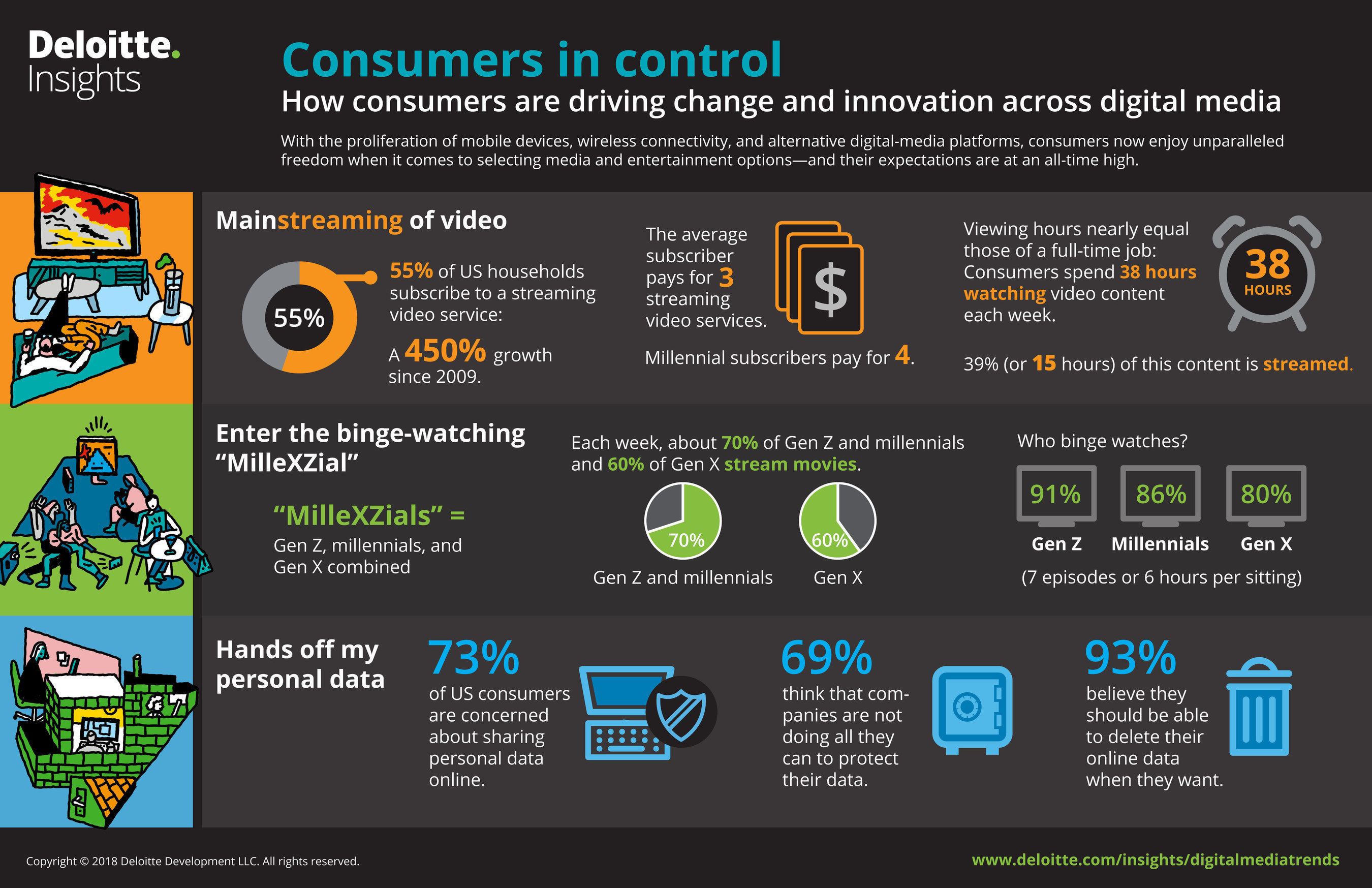
American consumers’ appetite for streaming video continues to grow, and they have no qualms shelling out cash for original content, according to Deloitte‘s 12th edition of the “Digital Media Trends Survey” (formerly the “Digital Democracy” Survey). The report found that 55 percent of U.S. households now subscribe to at least one video streaming service, a 450 percent increase since 2009.

Deloitte
2018 Digital Media Trends Survey

Also Read: Deloitte Named a Leader by Gartner in Data and Analytics Service Providers, Worldwide

The survey found, on average, Americans watch 38 hours per week of video content (39 percent of which is streamed), nearly the equivalent of a full-time job. With over 200 streaming video on demand (SVOD) options in the U.S., the average streaming video subscriber is paying for three services resulting in U.S. consumers collectively spending $2.1 billion per month on SVOD services. High-quality original content appears to be driving an increase in streaming with nearly half (48 percent) of all U.S. consumers streaming television content every day or weekly, up 11 percent year-over-year.

Conversely, the report found pay TV subscriptions declined for the first time in recent years with 63 percent of households still subscribing to a traditional Pay TV service, down from 75 percent. Pay TV’s decline is especially pronounced among Generation Z (ages 14-20), Millennials (ages 21-34) and Generation X (ages 35-51).

Kevin Westcott
Kevin Westcott

“Consumers now enjoy unparalleled freedom in selecting media and entertainment options and their expectations are at an all-time high,” said Kevin Westcott, vice chairman and U.S. media and entertainment leader, Deloitte LLP. “The rapid growth of streaming services and high quality original content has created a significant opportunity to monetize the on-demand environment in 2018.”

Also Read: Over One-Third Of Households Live-Stream TV Shows Or Sports: Parks Associates

Pay TV penetration declines

With video streaming enabling unprecedented choice and access to content, consumers perceive a widening gap between their expectations and what pay TV companies deliver, according to the report:

  • Nearly half (46 percent) of all pay TV subscribers said they are dissatisfied with their service and 70 percent of consumers feel they get too little value for their money.
  • Among respondents who said they no longer have a pay TV subscription, 27 percent reported they cancelled their service within the last year.
  • Furthermore, 22 percent of millennials say they have never subscribed to a pay TV service.
  • Twenty-two percent of all consumers without pay TV say they don’t watch enough TV to justify the expense and another 19 percent say they simply cannot afford it.
  • Fifty-six percent of current pay TV subscribers say they keep their pay TV because it’s bundled with their home internet access.

“As video streaming and demand for original content continue to grow, traditional and premium cable broadcasters will continue to rethink their business models,” continued Westcott. “Media companies are increasingly going direct-to-consumer with their own digital streaming services and snackable content. Ultimately, one challenge we see is that consumers may be reluctant to pay for exclusive content on top of their other paid subscription services and this may lead to some form of re-aggregation as limits on consumer spending could potentially hinder the growth of content platforms.”

Also Read: How GlassView’s Global Connected TV Platform is Being Embraced By Advertisers

The emergence of MilleXZials: 50 is the new 20

This year’s data indicates a convergence of media behavior across three key demographics. Gen X emerged as cutting-edge adopters of digital media embracing the digital media behaviors already adopted by Gen Z and millennials. Deloitte calls this combined demographic group “The MilleXZials.”

  • Seventy percent of Gen Z households had a streaming subscription, closely followed by millennials at 68 percent and Gen X at 64 percent, respectively.
  • About 70 percent of Gen Z and millennials stream movies compared with 60 percent of Gen X on a weekly basis.
  • Binge-watching behavior also witnessed a convergence among MilleXZials:
    • Ninety-one percent of Gen Z, 86 percent of millennials and 80 percent of Gen X binge-watch TV shows.
    • More than 40 percent of millennials binge watch weekly, and they watch an average of seven episodes and six hours in a single setting.
  • Ninety-six percent of MilleXZials multitask while watching TV.
Jeff Loucks
Jeff Loucks

“Millennials were the first generation to embrace streaming media and watching video content on smartphones,” said Dr. Jeff Loucks, the executive director, Deloitte Center for Technology, Media and Telecommunications, Deloitte LLP. “Some hoped that as millennials got older, they would settle down and watch pay TV. Instead, their Gen X parents are acting more like millennials, using streaming services, watching TV shows, movies and sports on smartphones and binge watching.”

Recommended Read: Spearfishing in a Big Net World

Brainshark Included in Sales Readiness Tools Report from Independent Research Firm

0
Brainshark Included in Sales Readiness Tools Report from Independent Research Firm

Report Helps Companies Understand the Value of Sales Readiness Tools and Identify Vendors

Brainshark Inc., delivering SaaS-based sales enablement and readiness solutions, announced its inclusion as a sales readiness provider in the “Now Tech: Sales Readiness Tools, Q2 2018” report, published recently by Forrester Research. The report – Forrester’s first analysis and articulation of the sales readiness market – recommends B2B sales and marketing leaders select vendors based on size and functionality, with Brainshark listed as one of two “large established players” among the 15 solutions examined.

As organizations across industries seek to improve sales results, more are turning to sales readiness solutions. Forrester defines the sales readiness market as: “Digital tools that increase seller and manager effectiveness through practice, coaching and collaboration… These tools help firms increase seller and manager skills, improve brand and message consistency, and enable sales leaders to make data-driven decisions to maximize commercial outcomes.”

According to the report, 42% of B2B firms indicate they have
already purchased – or intend to purchase – a sales readiness solution this year.

The report’s lead author, principal analyst Mary Shea, writes: “As the bar continues to rise for salespeople, B2B marketing and sales leaders are under pressure to better enable their direct and indirect sellers. Traditional event-based sales training, never designed to increase seller effectiveness in a digital-first world, fails to reinforce key concepts over time, is difficult to scale and lacks meaningful analytics.”

Also Read: Brainshark Unveils Sales Training Enhancements to Strengthen Learning Paths

With its award-winning sales readiness solutions, Brainshark helps reps learn and prepare wherever, whenever and however they work, so they can deliver value in any selling situation. Brainshark’s solutions for sales training, coaching and content creation make it easy for companies to address what it defines as the four pillars of sales readiness:

  • Foundational readiness: Efficiently transferring knowledge that new hires need to be successful
  • Continuous readiness: Ensuring every sales force member is up-to-date and ready with the latest releases, competitive intelligence, market insights and ongoing performance improvements – prepared to maximize every buyer interaction
  • Transformational readiness: “Re-boarding” reps in response to a holistic shift in strategy and go-to-market tactics (targeting new markets or buyers, mergers and acquisitions, new sales methodologies, etc.)
  • Reactive readiness: Preparing the field force – often within days or hours – to leverage/manage events with immediate business impact (e.g., good or bad news about the company or competitors, relevant geo-political events, etc.)

Also Read: Brainshark to Integrate with Microsoft Dynamics 365

Brendan Cournoyer
Brendan Cournoyer

“Readiness is not a one-and-done process. It’s important for all types of sales teams to address these pillars – proactively preparing reps to capitalize on every opportunity that comes their way,” said Brendan Cournoyer, VP of marketing, Brainshark. “We think this new report from Forrester underscores both the critical importance of sales readiness, as a discipline, as well as technology’s role in fostering a highly capable, always-ready sales force. We see our inclusion as validation of Brainshark’s commitment to ensuring our customers prepare their sales teams with the skills and knowledge needed to reach their full potential.”

Recommended Read: What Every Sales Leader Should Know About Conversation Intelligence Technology

Futuri Media’s Real-Time Story Discovery System TopicPulse Hits Record-High Subscriber Base

0
Futuri Media

The social media monitoring system that’s changing the face of show prep adds 100+ new station partners, including several major markets, in Q1 2018.

Futuri Media, a global leader in SaaS technology designed to drive audience and revenue growth for broadcasters, today announced that its revolutionary real-time story discovery and show prep tool, TopicPulse, has hit a record-high subscriber base, adding more than 100 new station partners in the first three months of 2018 alone. Those new partners include stations in New York CityLos AngelesChicagoSan FranciscoSeattlePortland, and several other markets.

TopicPulse, which is changing the face of show prep, uses patent-pending technology to scan social media and 100k+ sources of verified news and information every second; it then shows real-time insights into which stories will resonate with specific audiences to help drive on-air, social, and website content decisions.


TopicPulse, which is changing the face of show prep, uses patent-pending technology to scan social media and 100k+ sources of verified news and information every second; it then shows real-time insights into which stories will resonate with specific audiences to help drive on-air, social and website content decisions. With its ability to deliver target audience-specific insights on which stories will resonate, which are about to go viral, and which are on the downswing, TopicPulse provides assurance that all talk breaks, either live or voicetracked, are as timely and compelling as possible.

Also Read: Futuri Media’s TopLine Adds Appointment Prep Reports

TopicPulse’s subscriber base has grown rapidly since adding IdeaStarters™, copy that’s based on TopicPulse insights and can be used as-is on broadcasts and social and digital channels, in mid-2017. Created by a team of writers with the background in multiple radio formats, format-specific IdeaStarters™ content is updated throughout the day in the TopicPulse app and sent to subscribers via email twice-daily for AM and PM drive prep.

Daniel Anstandig
Daniel Anstandig

“Futuri Media created TopicPulse to help broadcasters and publishers focus on the right content at the right time, using real-time social data to predict what is about to go viral and which stories are most likely to resonate with broadcast, social, and digital audiences,” said Futuri Media CEO Daniel Anstandig.

As TopicPulse grows, Jasmine Rivers has been promoted to TopicPulse Operations Manager, a role in which she oversees product initiatives and the IdeaStarters team. That team recently added Joe Cristiano, former longtime producer of Q104.3’s The Jim Kerr Rock ‘n Roll Morning Show, to its roster of writers.

Recommended Read: TV May Affect the Brain But Influencer Marketing Affects the Heart

Float Left Announces Partnership with JW Player, Delivering a Complete OTT Solution for Media Companies

0
Float Left Announces Partnership with JW Player, Delivering a Complete OTT Solution for Media Companies

Float Left, a pioneer in OTT and video technology, announced a partnership with JW Player, the world’s largest network-independent video platform. By leveraging JW Player’s video delivery and intelligence technology, Float Left offers a complete OTT solution for content publishers and broadcasters worldwide.

Float Left is a well-known front-end application developer for prolific media companies such as Crackle, NBC Sports, and the Viacom Media Networks. JW Player pioneered digital video over a decade ago, and today powers delivery for large media organizations such as Fox, Vice and Univision, reaching over 2 billion unique devices monthly.


Tom Schaeffer
Tom Schaeffer

“The partnership between Float Left and JW Player allows our customers to focus on their core business, while we navigate the technology. From application development to video delivery, our OTT solution provides an intuitive and scalable approach for launching your brand and reaching a larger audience across millions of homes,” stated Tom Schaeffer, CEO of Float Left.

Also Read: Harmonic and Veygo Team Up to Deliver End-to-End OTT Solution, Successfully Deployed by Indonesia’s AMTV

As a part of the fully-managed solution, Float Left and JW Player will also provide data-driven and intelligent analytics tools. Dedicated to helping brands grow their audience and drive viewership, the robust analytics platform will help publishers and broadcasters make informed programming decisions through an insights-driven solution.

Dave Otten
Dave Otten

“Today’s digital consumer is watching more video across more devices than ever before, and that trend will only continue,” said Dave Otten, co-founder and CEO of JW Player. “JW Player’s platform is built to deliver consistent, high-quality video experiences across every digital device and screen. We are excited to extend that to OTT through this partnership with Float Left.”

Also Read: Conviva Announces Limelight Networks as the Newest Member of The Multi-Screen QoE Analytics Ecosystem Initiative

Float Left and JW Player recently partnered to relaunch Screen Media Ventures’ Popcornflix brand across millions of homes via Roku, Amazon Fire TV, and Apple TV. The OTT launch consisted of a complete rebuild of Popcornflix’s current offerings. This includes a more intuitive user experience to view Popcornflix’s library of 3,000+ high-quality movies and TV shows. The improved service was built on Float Left’s Flicast platform and JW Player’s video technology for better streaming to Popcornflix’s 15 million active users.


Ben Saxton
Ben Saxton

“Our partnership with Float Left and JW player has dramatically improved Screen Media’s ability to adapt our product to evolving technology in the OTT space,” said Ben Saxton, Vice President of Digital Product for Screen Media Ventures. “The unified Flicast experience across Roku, FireTV, and AppleTV along with the quality streams that JW provides is helping us build a better brand to serve our current users and attract new ones.”

Recommended Read: OTT Explosion Provides Safe Platform For Marketers

Stoke Pulse Ties Content to B2B Deals for Real ROI Measurement

0
Stoke

First-Of-Its-Kind Analytics Solution Helps Marketers Know the Impact Their Digital Content Has on Offline Sales

Stoke, a full-service content marketing, and analytics agency launched Stoke Pulse at Adobe Summit in Las Vegas. Stoke Pulse is a first-of-its-kind analytics solution that helps B2B marketers close the gap between knowing how customers engage with content and understanding what that has to do with their offline sales.

“Marketers are spending significant budget to develop and distribute digital content, and the need for that content continues to accelerate. We’ve developed Stoke Pulse to help marketers know where their content budget can have the most impact and justify that spend in the dollar-figure language the C-suite is fluent in,” said David Acheson, Managing Director, Stoke.

Also Read: Remesh Secures $10 Million in Series A Funding Led by General Catalyst

While tools like Adobe Analytics and Google Analytics provide data about how people arrive at a website, the time spent on a page and even a customer’s path to purchase, these tools don’t paint a full picture. The same thing goes for CRM software like Salesforce that lets sales reps follow the progress of offline deals.

Laurie Lohner“Stoke Pulse is the missing link between marketing analytics and CRM tools. Stoke Pulse plays a significant role in not only showing results but also in closing the feedback loop to develop a content strategy for the entire customer journey that can very effectively deliver on the most important performance indicator, which is revenue,” said Laurie Lohner, Managing Director, Stoke.

Stoke Pulse allows marketers to visualize every sales opportunity at every stage of the customer journey. Three main dashboards make it easy to track and interpret information:

  • Customer Journey– Visualize the entire customer journey, from the first touch to deal close. See every piece of content contacts touched, visualized by the author, content type, title or campaign.
  • Revenue Influence–  See every deal that’s been influenced by content. Measure, rank, and filter all influenced deals by industry, region and deal size.
  • Content Analysis– Measure and rank content in real revenue terms, not just visits. See what content impacted business the most—including leads, sales pipeline, and closed deals.

Also Read: Rockerbox Introduces Recency Marketing Platform to Activate Online Audiences

Technical requirements
Stoke Pulse is not designed to replace current analytics solutions and does not require any software installation. The technology is currently compatible with Adobe Analytics or Google Analytics and Salesforce CRM.

“Stoke Pulse is easy to get up and running. It connects your current analytics solution with Salesforce via a visitor ID pass-through and then uses proprietary algorithms to extract data from both sources and generate meaningful insights,” said Sam Fonoimoana, Chief Analytics Officer, Stoke.

Fonoimoana is an analytics expert and has extensive working knowledge of analytics from extract, transform and load (ETL) to visualization to machine learning. He has spent his analytics career helping companies such as DOMO, Franklin Sports, Ancestry.com, and Adobe connect their marketing efforts to revenue. Prior to joining Stoke, he was global director of marketing at DOMO and then founded Fahui Analytics.

Recommended Read: Nine Killer Ways to Market Your Tech Startup

OfficeLink Opens Professional Video and Audio Studio for Podcast and Video Production

0
OfficeLink

OfficeLink, Shared Office Concepts, a professional co-working and private executive office suite in Quincy, MA, has opened The Studio at OfficeLink, a full audio and video production studio at its Quincy location. The studio will be available at a discounted rate to tenants and members of OfficeLink and will be a resource for local businesses to create professional video content for their own use.

Also Read: Mobile-First Collaborative Learning Platform Hive Learning Raises $ 4.9 Million

“Our production company, Real Estate 360 Productions, was already producing locally and nationally distributed content, from interviews with local stakeholders in the Commercial Real Estate space and discussions about real estate trends in the region and beyond, to Real Estate Talk Boston, a show hosted by Chris Devin of Cross Country Mortgage, and distributed on Boston.com. It made sense to build out our capacity to create professional content in a new studio, and offer it to other businesses, especially with the rise of video consumption online,” said Stephen Vazza, President, Vazza Real Estate Group, Co-Owner, OfficeLink.

OfficeLink co-working spaces in Quincy and Chelmsford offer modern design, welcoming common areas, and a collaborative atmosphere. Their flexible office solutions include both traditional professional private office space and coworking options for small teams, entrepreneurs, individual contributors, and remote workers.

Also Read: Social Media Marketing Moves from Megaphone to Targeted Conversations

OfficeLink’s unique locations outside of the city allow their tenants and members to connect with like-minded professionals closer to home and enjoy the energy and atmosphere of downtown Boston, without the hassle and associated costs of additional traffic and parking.

OfficeLink is a division of the Vazza Real Estate Group, a real estate development firm in Quincy, MA, which has been actively developing and investing private and institutional capital into real estate in major US markets for over 30 years. They opened their first two OfficeLink locations in 2016 and 2017.

Recommended Read: Making the Holiday Season Work for Your Video Business

Volley Media Announces Volley — a Revolutionary New Way to Capture and Share Live Event Video

0

Audience and Brands Can Use Volley to Instantly Capture, Curate, Edit and Distribute Videos Captured

Volley Media, the leading innovator of event video capture and sharing technology, announced Volley, its groundbreaking, patent-pending platform for curating and sharing video moments of any live or pre-recorded event broadcast.

Steve Jones Volley Media
Steve Jones

“Volley represents a huge advance for event audiences and organizers. It’s the first app to effectively marry live events, video broadcasts and social media for the benefit of brands, audiences, and their extended networks. Volley delivers on the promise of brands’ number-one experiential content focus: capturing, leveraging and sharing more video at their live events,” said Steve Jones, Co-Founder, Volley Media.

Also Read: BrowserStack Introduces App Automate for Powerful Mobile Application Testing

A Win-Win for Brands and Audiences

With Volley, audiences can easily and instantly capture, edit, curate, and distribute custom moments from brands’ high-quality, brand-compliant, HD AV broadcasts. Because Volley captures and captions footage both before and after the instant a user clicks the Volley button, audiences can relax and enjoy the show. The simple and intuitive user interface makes it easy to immediately edit, save and share a Volley. And with Volley’s unique and scalable cloud architecture, there’s no file to save or send, just a link, which eliminates bandwidth or storage issues.

Also Read: Appy Pie Introduces Coupon Analytics Feature on Its DIY Platform

No other video capture and sharing app offer the amplification power of Volley. Any HD video broadcast can be Volley-enabled in less than 24 hours, making it easy for brands to share high-value video content with audiences who then share that content with their own extended networks. With Volley, audiences become curators and distributors, enabling them to grow their own social networks and brands to greatly extend the reach of their content. Volley’s robust analytics dashboards help brands and audiences track performance and reach. And the ability to include customizable sponsorship headers further extends the value of Volley to brands.

Recommended Read: New Adobe Target Mobile Capabilities Enable Always-On Personalization 

AWeber Expands Its Suite of Easy-To-Use Marketing Automation Tools

0
Aweber

New Click and Open Automation for Broadcasts Enable Small Businesses and Entrepreneurs to Build Stronger Relationships with Subscribers and Customers

These new broadcast automation give small businesses and entrepreneurs more flexibility in how they segment and communicate with their subscribers, enabling them to send more relevant and valuable emails based on subscribers’ behaviors, leading to an increase in engagement, sales and revenue.

Chris Vasquez
Chris Vasquez

“You can now automate your email and segment your subscribers like never before, without the incredibly high costs and confusing interfaces that other marketing automation tools offer. Our new automation tools not only give businesses the flexibility to communicate with their subscribers in new and exciting ways but also the ability to power their email marketing from a single email list,” said Chris Vasquez, Director Product, AWeber.

Also Read: 3dcart Integrates with AWeber to Further Expand Its Online Marketing Capabilities

With broadcast automation, AWeber customers can now automatically tag subscribers when they either open a broadcast email or click a link within the email. Customers can then send emails based on subscriber behavior using an automated email campaign or one-time broadcasts based on those tags.

These new broadcast automation and tagging features give AWeber customers the ability to manage their subscribers using a single list, eliminating the need for subscribers to opt-in again or join a new email list.

AWeber customers can now develop even stronger relationships with their audience, as well as transform interested prospects into paying customers and paying customers into loyal advocates.

The announcement of click and open automation for broadcasts comes on the heels of several feature releases and updates to the platform that saves AWeber customers time and allows them to connect more easily with their subscribers.

Also Read: Aweber’s New Feature Lets Users Segment with Tags and Send Newsletters To Tagged Segments

“For me, this is going to be hugely beneficial. Being able to tag my subscribers based on their interests, I can better focus my marketing towards them, and sell the specific products they are likely interested in,” said Donielle B, AWeber customer.

Setting up automated emails is easily accomplished using AWeber’s drag-and-drop automation builder, Campaigns. Users can also choose from over 700 mobile-responsive HTML email templates to craft the perfect messages.

Recommended Read: Beating the Big Guys Is All About Brand Loyalty

Geopath Unveils Pilot Program for OOH Audience Measurement

0
geopath

Geopath’s Program Will Develop a Location-based Data Solution For OOH Advertisers

Conventionally, marketers and advertisers have been heavily reliant on cookie-based models to capture behavioral and demographic data of audiences. In the modern tech space, that model has ceased to exist with 75% of cookies being deleted per month and almost 67% of devices connected through IPs not accepting cookies anymore. This is where people-based advertising has come to the foray allowing brands to capture data from multiple devices in a much more definitive, consolidated manner. It thus allows brands to deliver enhanced and customized CXs across print, digital, and TV.

Geopath, an audience location measurement company for OOH providers, is bringing a pilot program for location-based advertising measurement. According to their latest announcement, Geopath will invest a significant time to build partnerships with its members in the OOH space. Geopath would also work with geolocation data enablement solutions provider, Intermx, to offer an extensive tool for audience measurement for its location-based OOH members by December 2018.

Also Read: The Remaining Barriers to OTT Advertising’s Boom

Kym Frank, President, Geopath, stated that there has been tremendous growth in the OOH industry over the last few years on grounds of creating and establishing transit and roadside audience measurement. She said, “With advertisers demanding greater transparency and visibility, the time has come for us to extend that measurement capability to the place-based inventories that comprise the broader OOH marketplace. As a result of this pilot, the OOH community will be able to provide to brand marketers and their agencies an even clearer and truer understanding of the value received for their OOH investments.”

In this pilot program, Geopath member participants would identify the introductory locations for initial analytics across the US. Eventually, the pilot members would gain access to a platform featuring web-based insights with details of data like audience demographic, impression, screen, and venue. The cost associated with the pilot program hasn’t been revealed to the press yet.

Also Read: Your Buyers are Online: Why Aren’t You?

Jeff Gunderman, President and CEO, Eye Corp, ascertained that the overall OOH ecosystem comprising cinema, bars, health clubs, airports, malls, street furniture, billboards, and the likes was in need of a currency that was universal and trustworthy. Jeff added, “Geopath’s forward thinking in pushing for the entire ecosystem to have trusted third-party generated metrics will provide confidence to our buyers and will make transactions easier. Without this, the industry will have a difficult time staying competitive against emerging digital and mobile media options.”

Another Geopath member, Rapport’s CEO and Global President, Mike Cooper, expressed the criticality of the location-based data of Geopath for its medium. He went on to add that a universal, comprehensive system of measurement enables Rapport to determine the right impact of its OOH campaigns throughout the provider and format ecosystems.

For now, not just the Geopath member companies and the pilot participants, but the whole OOH or rather DOOH world, would be keen on the outcomes of this Geopath initiative. And, if it delivers the goods, the year 2019 can be touted as the next phase of personalized OOH advertising.

Also Read: Forget Mobile First, It’s Now Social First

Blis Explores the Meaning of A “Conscious Consumer” in a New Report

0
Blis Explores the Meaning of A "Conscious Consumer" in a New Report

In Their Latest Study, Blis Examines Consumer Research Married with Their Own Location-Based Data to Construct a New Framework for Conscious Consumer

The dynamic relationship between the consumers, brands, and retailers continue to drive marketers into exploring new definitions of customer experience and engagements. The fragmented retail and B2B marketing engagement strategies could finally be set on a sane path. In their recent report, Blis, a leading provider of advanced location data technology, has unvieled a report, titled, Unlocking the New Consumer Hierarchy of Needs. The research identifies a new, post-recession ‘Conscious Consumer’ and shares data-informed insights and recommendations about how to build loyalty with them.

Read More: Contextual Content and AI: The New Wingmen for Email Marketing Campaigns

Who Is a Conscious Consumer?

Unlockingthe New Consumer Hierarchy of Needs, by Blis

According to the latest Blis report, a ‘Conscious Consumer’ is the “survivor of the last recession – a period which fundamentally altered their behavior.” Characterized by a no-nonsense relationship with brands, the ‘Conscious Consumer’ has a sophisticated understanding of their value to the brands with which they engage and take a more active role as a result.

Recommended ReadKenscio Partners With eDataSource to Launch ‘Email Analyst’ for Competitive Intelligence

Over half (55%) report a ‘one strike and you’re out’ rule and almost three quarters (69%) can be swayed by a well-timed price drop, personal coupon, or product ad all the way to the checkout.

Read More: Fierce Pace of Tech Disruption Has Forced Companies to Innovate via M&As

Quick to judge and slow to forgive, they are motivated by the rational over the emotional when making purchasing decisions – a third of consumers will switch to a cheaper product if it’s of comparable quality, regardless of brand loyalty.

At the time of this announcement, Gil Larsen, VP Americas at Blis, said, “The retail landscape over the past decade has been turned on its head and the retailers who are thriving have adapted to these changes quickly. They understand that what was true of pre-2008 consumers is no longer so and have thrown out the old retail playbook.”

Gil added, “Our study examines consumer research married with our own location-based data to construct a new framework for retail brands who aren’t clear on how best to foster a relationship with this new Conscious Consumer.”

Read More: Adobe Unveils Next-Gen Content Intelligence to Transform Customer Experiences

The New Consumer Hierarchy of Needs

Consumer Hierarchy of Needs, by Blis

The Conscious Consumer has a much clearer sense of their value to brands — from personal data and peer influence to financial import–with 65% willing to share data only if it provides them tangible benefits such as money saving or exclusive access. Combined with the wealth of information they are now used to having at their fingertips, the conclusion is that brands have to work much harder not just to earn their attention, but also to keep and convert it into sales.

Gil said, “For those able to navigate the new rules, there are a number of positive takeaways.”

Read More: Top Insights on the CMO’s Best Allies, Content Marketing, and the Art of Story-Telling for Brands

Gil concluded, “Not least the fact that, while they research and compare on larger financial investments, these new consumers are spontaneous when it comes to lower cost, in-the-moment buys. Almost three quarters (83%) spend up to $50 per week this way, while the remaining 17% admit to spending $50+ on ad hoc items. This represents a significant amount of revenue on the table for brands that get it right.”

With brands still coming to terms with the new retail landscape–as seen by the multitude of store closures–the research paper provides clarity for what these new Conscious Consumers want and offer guidance on how brands can best interact with them, especially through the use of location insights. 

Methodology

Blis conducted market research through AYTM, surveying 2000 consumers across the United States at every socio-economic level, to uncover shopper preferences and how they like to best interact with brands, creating a new hierarchy of needs for brands to address.

Currently, Blis offers a proprietary technology and platform for location data that helps agencies and brands use location data to better understand consumer behavior, allowing for effective targeted advertising to drive business outcomes.

Recommended ReadMarTech RADAR 2018: Top 150 B2B Technology Companies You Should Follow