Home Blog Page 4182

TechBytes with Brian Friedman, VP, Digital Innovation, Aventri

0
Brian Friedman
TechBytes with Brian Friedman, VP of Digital Innovation at Aventri

Brian Friedman
VP, Digital Innovation, Aventri

Events are the lifeblood of marketing and the event management software sector has grown rapidly over the last few years. The advent automation has meant that advertisers can now hone on an attendee’s preferences and deliver personalization at scale. Brian Friedman, VP, Digital Innovation, Aventri (formerly etouches) spoke to us how the ideal event management software would function.

Html code here! Replace this with any non empty text and that's it.

Tell us about your role at Aventri and the team/ technology you handle.

I serve as the VP of Digital innovation for Aventri, an emerging leader in event management technology. In my role, I lead the company’s digital strategic objectives by identifying and articulating product and growth marketing visions that transform and disrupt the event market. This includes driving user experience design and research, setting product and marketing vision, guiding technical and design teams, and implementing growth marketing programs.

Prior to joining Aventri, I was the co-founder and CEO of LOOPD, a proximity marketing company that uses socially-smart wearables and analytics to help marketers understand, target, and interact with visitors in a fashion that has never been done before. With the acquisition of LOOPD by Aventri in March 2017, I assumed my current role, and Aventri complemented its pivot to a data-driven approach to enhancing clients’ event success, while boosting a complete, end-to-end solution that supports the entire event lifecycle.

What are the key differences between Event Management software and Event Automation software?

Technology that automates processes has taken hold within the events industry, and it serves important purposes. For example, platforms that help automate the attendee registration process reduce headaches for attendees. Finding an event software platform that can build a professional and automated registration website is key to a smooth registration process. Combining this with a customer relationship management (CRM) or marketing automation system can deliver several benefits including the ability to track the links or content attendees are clicking on to provide a more targeted content strategy.

That said, automating everything within the event lifecycle is neither feasible nor optimal. Instead of leveraging automation technology at every turn for the sake of doing so, event planners and marketers need to be discerning in how it’s used, and find the right technology to align. Event automation tools can integrate with event management software to link registration data, create attendee profiles, and send push notifications to attendees. In concert with automation, event management software should incorporate a balance between tasks that can be automated by back-end machines, and the keen involvement of humans to focus more on driving higher levels of engagement with their target audiences.

What are the core technology elements of an Event Automation/Management platform?

Gone are the days of manual event check-in and fishbowls full of business cards. Events have so many elements to them that need to be managed – including venue sourcing, registration and check-in, personalized content marketing, session scheduling, measurement of success, and much more.

Add-on applications in the industry can support each of these areas, but they don’t meet their potential without a platform backbone and repository of data analytics to seamlessly connect from one element to the other, keeping the attendee at the core. Brands today have advanced technology like self-service check-in and bi-directional smart tags that can exchange information and provide real-time location and engagement data. Mobile event applications and data analytics are a must for integration to event management platforms.

How do brands leverage Aventri’s event software for better sales connectivity?

Aventri offers the industry’s most comprehensive, end-to-end solution that supports the entire lifecycle of events. With a variety of offerings that are fully integrated into the company’s platform, Aventri provides clients with tools to enhance every aspect of an event, including venue sourcing, event management, real-time attendee engagement, and ROI.

In a recent survey of event professionals, Aventri found 66 percent use event management software, yet only 20 percent use a venue sourcing tool and less than half use a mobile app at their events. This inconsistent adoption makes sense given the fragmentation in the event management solution space. For event planners with limited time and strict budgets, the need to use multiple tools that don’t always work together can be overwhelming and frustrating, often causing more problems than they solve.

With the integration of LOOPD and eVS, our newly integrated venue sourcing tool, the Aventri platform now empowers event planners to use the entire solution set from planning to post-event analytics, or they can choose individual modules to meet their specific needs. Based on the insights gathered from attendee activities at events, marketing and sales professionals can keep the conversation going post-event and personalize customer engagement to generate revenue. Many companies struggle to extract or measure ROI from their events, but Aventri’ data-driven, connected solutions empower concrete results.

How do you leverage AI/ML at Aventri?

Aventri’s event management platform uses AI in several layers of the event lifecycle. For example, the AI-powered system can make relevant recommendations to attendees as they fill out an event registration form online. The system leverages its ability to sift through all of the data captured from attendees and exhibitors to say, “Here are sessions you’d likely be interested in; here are exhibitors you’d likely be interested in; here are other attendees you’d likely want to meet up with.” We’re also refining a real-time version of the event app that determines an attendee’s location while onsite so that its AI capability can make recommendations that are most relevant to that attendee and convenient at that moment.

Would AI/ML enable make it easier for the marketers to manage their events with existing Marketing Automation platforms?

AI is already making life easier for marketers and event planners within their event management and marketing automation platforms. Platforms today are using AI’s ability to sift through attendee and exhibitor data and recommend the sessions, exhibitors, or fellow attendees they might be interested in connecting with. The technology is also being leveraged in electronic concierge systems in hotel rooms, chatbots that assist attendees during registration, and real-time location intelligence in event apps that guide attendees on-site.

As the technology continues to mature, event management and marketing automation systems will incorporate even more advanced applications of AI.

What are your predictions on the “State of Marketing Event Management Software” for 2018?

Data integration and analysis is one facet of the larger event technology industry that still has room to grow. Unfortunately, at this point in the evolution of the industry, many planners and marketers use multiple, siloed platforms that don’t connect to each other to complete different tasks, such as registration and check-in, speaker management, the direction of the mobile event app, and more.

In 2018, we expect many event marketers will look for tools that enable greater integration and visibility of their data. Ultimately, a truly successful event planner and marketer needs access to data integration in order to discover trends and insights that will make their current events better, improve their strategies for future events, and bolster their strategies for marketing year-round.

Additionally, expect to see enhanced self-service check-in, attendee surveying, and more high-value AI and augmented reality applications.

While some of these ideas and initiatives may be new, others have been building in our industry for a while. Marketers should keep a close eye on what technologies are emerging that have the power to transform their events.

Thanks for chatting with us, Brian.

Stay tuned for more insights on marketing technologies. To participate in our Tech Bytes program, email us at news@martechseries-67ee47.ingress-bonde.easywp.com

Interview with Dhruv Ghulati, Founder and CEO, Factmata

0
Dhruv Ghulati
Interview with Dhruv Ghulati, Founder & CEO at Factmata

[vc_wp_text]“We need to clean up the ecosystem so that consumers want to engage with online content and can easily find trustworthy content.”[/vc_wp_text]
[easy-profiles profile_twitter=”https://twitter.com/dhruvghulati” profile_linkedin=”https://www.linkedin.com/in/dhruvghulati/”]

Tell us about your role at Factmata and how you got here. What inspired you to start the company?

I’m the Co-Founder of Factmata, an artificial intelligence startup solving the problem of factual misinformation on the internet. I like open information, transparency, the future of the web, artificial intelligence and building highly technical data products.

I started my career as an investment banker, then transitioned to a product manager role at a startup working on machine intelligence for web data. In 2015 I co-founded my first company, weave.ai and went through the Techstars business accelerator programme. After that, I was inspired to go back to university and study for a Masters degree in Computer Science. Immediately after completing my degree I was selected to join the 7th Cohort of Europe’s top accelerator, Entrepreneur First, which specializes in building deep technology companies from scratch.

Each stage of my career contributed to my belief that artificial intelligence (AI) will be the great general-purpose technological advance of our time. In November 2016, fake news was starting to become a problem and I could see the potential to use AI to solve the problems it was causing for any brand seeking to build real trust with customers and readers on the internet – Factmata was born in December that year.

What’s the most fascinating aspect of leading a tech-based media innovation company?

For me, the most fascinating parts have been what I have learned about myself. Luckily, from my investment banking years, I already knew that I was able to put in long hours and from my Masters degree I knew I could be innovative and solve problems with technology.

What leading a startup tech company has brought me is a deep understanding of how I can enable others, and pass on the joy you get from building something truly ambitious and challenging with a strong mission

The other thing that I have found wonderful is how supportive and open the investment community can be if you have a good idea. Typically, when someone invests in a startup they either know the founders or have had a “warm intro” to them. When I sought investment for Factmata I drew up a list of the people I most wanted onboard, people with varied experience who would each bring something different to the business. One of those people was Mark Cuban. I didn’t know him and I didn’t know anyone who did – so I emailed him and can now proudly say that he’s one of our founding investors.

Is machine learning the ubiquitous technology for every media company?

There’s no doubt that machine learning is spurring the media industry forward but it’s not the answer for every business. Machine learning has three main purposes: automating back-end processes, mining data, and understanding human behavior. All of these are important to media companies but whether or not machine learning can help a media company depends on their current set up and processes.

In order to evaluate whether a business is ready to embrace machine learning you need to look at whether you have the right people in place to implement and use the technology, what time and cost savings you will derive from the technology and understand what you want to get from the technology.

The reason machine learning works for many media companies is that they typically have tech-savvy staff who are used to integrating technology e.g. customer relationship management (CRM) platforms and data management platforms (DMP)s, and their business goal is to reduce the costs of running accounts. This aligns well with the benefits machine learning can bring to a business.

What is clear is that machine learning is going to be soon not just a differentiator but a must have technology for every business to be thinking about the business process optimization side of things. Where it still is a unique selling point today is in customer understanding – truly getting a sense of why your customers or users do something and what they really want from you.

Why is Fake News the biggest disruption for media companies?

Fake news is a huge problem because when a brand’s ad is displayed alongside junk content or fake news, consumers lose trust in the brand. When a brand crafts an advert with an inauthentic, biased message, consumers lose faith. If the brand produces content marketing that is not fact checked or well researched, it will suffer in the long run. Another issue with fake news is that it’s not a problem that can be solved overnight because of the volume of content that is created and shared online every day. Currently, it’s impossible to sift through all the junk that is out there at a rate that is sufficient to stop ads appearing against misinformation. As well as this, there is no right or wrong answer to Fake News, as it is sometimes subjective. The best that a machine learning algorithm can do is be built in an unbiased, effective, and explainable, interpretable manner.

Content producers largely rely on ads to generate revenue and there are some that will go to great lengths to increase the number of ads they can show a day in order to maximize revenue. On the whole content producers are good, they want to create good content that people want to read and they employ highly trained journalists to produce great, credible, accurate content. However, there are some people out there who don’t care about the accuracy or credibility of their content and these are the ones that spoil it for everyone else.

All of this has contributed to a waning of trust in the media industry which is the problem we have to solve – we need to clean up the ecosystem so that consumers want to engage with online content and can easily find trustworthy content. This will increase brands’ trust in online advertising as a way to engage their target audience in a safe, relevant environment where ultimately the most attractive customers from a viewability, purchasing power perspective actually reside

How can marketing teams leverage authentic Influencers as the ‘focus group’ for branding and social media promotions?

Any marketing campaign must start with knowing who your customers are and understanding their behavior. If you can establish that your customers use social media and are engaging with influencers you can look at building a campaign. The goal of any influencer campaign should be to develop your brand image, raise awareness of your products or services and drive sales.

One mistake brands often make is to try to work with influencers who have the greatest number of followers. The problem with this is that your target audience is likely to be a small percentage of those followers and you run the risk of seeing huge reach but low returns. In many cases, the best thing to do is to seek out niche influencers for specific use cases. The future of cult follower building is going to be about what Chris Messina calls “relationship design”, or the ability to have one on one, real talk customers with your real users across multiple platforms all at once.

Identifying influencers with a strong passion shared by their audience and whose values fit squarely with your brand is key. To do so, check their content, their network, their statistics and their audience demographics. An integrated solution like Lefty can provide you with this information

Tell us about the core tenets driving your company goals in a tech-heavy ecosystem?

Factmata is a group of entrepreneurs trying to solve a challenging problem with an amazing mission.

Our goal is to provide media buyers with a way to decide whether a particular website is the right place for them to show their ads.

We’re not in the business of trying to remove content or remove opinion from the internet. We’re here to flag potentially sensitive or biased content by providing brands and media agencies with a quality score which indicates the likelihood that a page contains misinformation. Media buyers can then use that score to decide whether they want to take the risk of advertising on that site or not.

We want to solve this problem in a scalable way and the only way to do that is via artificial intelligence and automation. Furthermore, we will remain outside the media or fact checking world so our technology can operate in a fully independent way. Another key component is the way our platform is built – using feedback and third party annotation provided by expert journalists, rather than our own potentially biased instruction. We call this community-driven explainable AI.

Given the changing dynamic of social media intelligence and audience analytics, where do you see Factmata fitting into a CMO’s tech stack?

Right now, Factmata’s core use case is going to be to help CMOs in the contextual brand safety space i.e. preventing placements of ads on low-quality content that harms reputation e.g. fake news, misinformation, sexism, controversy and hyperpartisan content. However, later down the road, we want to be more proactive with CMOs, to help them take stands proactively on subjective issues. For example, we are developing tech to allow brands to positively target pages which are pro-gun control, or against issues like nuclear warfare.

What are your thoughts on the future of ‘AR/VR/Video’ cloud marketing in 2018-2022?

Augmented reality and virtual reality are really interesting areas at the moment because we’re starting to see real-life use cases that go beyond being gimmicky. Only time will tell how widespread AR and VR become because at the end of the day it depends on user adoption. If consumers do not embrace the technology as a way to engage with brands then the advertising budgets won’t shift in that direction.

I think we will see more brands starting to experiment with AR and VR over the next few years, retail, automotive and travel brands are the likely contenders as their products are typically aspirational rather than transactional and long-term brand awareness plays a huge role in their marketing.

What startups in the technology industry are you watching keenly right now?

Fact-checking and fake news are hot topics right now, and a number of startups have emerged in these areas. Some companies appear to have similar ideas and are using AI, while others have gone down the blockchain route. Not all are our competitors, and we reach out a lot to those we think we might want to collaborate with.

We also keep an eye on startups developing technology that may help us develop and grow our own company. I am particularly interested in startups developing decentralised versions of existing successful consumer models, i.e. tokenized economies. For example, there are companies doing this in insurance, retail, travel and more. I like the idea that you raise investment from your users. They fund your development, and if it doesn’t go well, they don’t do well but they have split their risk with other users too. It seems a lot fairer because the incentives are aligned fully on product development rather than on other things like hype, reputation, ability to fundraise and have good contacts etc. I see less of the potential of chatbots than I did before and search, but am actively also looking at startups disrupting healthcare, in particular women’s health. The market for products fully focused on women is huge and very untapped.

What marketing and sales automation tools and technologies do you currently use?

We work with Streak to help us manage our sales pipeline. It’s a very quick and easy tool to customize the columns that we want to measure success against. It’s connected directly within our email system so we can see the current status and notes.  We can also output sales reports that are shared with the management team on our progress through the sales stages.

For marketing, we use a range of tools and databases, such as Meltwater,  to help us identify influencers and audiences talking about fake news and misinformation. We also use social media management tools such as Hootsuite to manage our various channels, including Twitter to Facebook.

Could you tell us about an outstanding digital campaign/ customer success story at Factmata?

We’re still in the beta testing phase with our early adopters so I can’t name any of our customers as they may be working with our competitors! Our beta phase has gone very well though, for example, we’ve successfully identified misinformation online that other technologies have failed to find. We’re confident that we’ve already helped our clients avoid brand safety scandals because we’ve seen the pages online where their ads would have appeared using their existing technology partners.

One recently quite successful digital campaign for us was on our B2C side, with our news platform briefr.cc. We have managed to grow our waiting list for the product substantially using referral techniques on a dedicated landing page, as well as subscriptions to unique news and journalist related newsletters which have had email open hit rates of 10-15% compared to the industry average of 3%.

How do you prepare for an AI-centric world as a business leader?

Factmata is an AI technology, so you could say I’ve been preparing for years! The advice I would give to others is never to lose sight of your business goals; all businesses need to embrace change but if AI steers the business away from its core purpose you run the risk of failure.

AI capabilities are expanding rapidly and have the power to revolutionize how many businesses operate. With AI you can do things faster, better and cheaper which is exciting for any business leader. However, it’s of utmost importance to fully evaluate where AI can fit into your business model. For example, if you run online advertising campaigns, it’s obvious that AI can improve the efficiency of your media buying by analyzing data in real time and optimizing where you buy ads and how much you pay for them. With other types of AI, it can be harder to understand where they will drive business improvements.

It’s also really important to talk to other people in similar situations and learn from what they have done (or not done). AI is a complicated ecosystem with many potential pitfalls if you get it wrong. Talk to specialists, research success stories and failure in AI and go to events that showcase AI technology and best practices.

If you decide that AI can improve your products or services then embrace it as long as it doesn’t harm your business values.

How do you inspire your people to work with technology?

Factmata is an advanced natural language understanding business so the people who tend to want to come and work with us are typically pretty technical, to begin with. Then there’s the fact that we’re a startup so everyone who works at Factmata is very driven to work as effectively as possible to accelerate the growth of the business.

We’re so lucky that there are so many technologies that enable people to do more with less time and the people at Factmata have been quick to adopt various collaboration tools. I actively encourage my team to always find ways of making their lives more productive and testing new tools all the time for admin they do. However, people have to do what works best for them. If someone is more comfortable writing their daily ‘to do’ list on paper I’m not going to stop them if it works for them. If I see someone struggling with something that I believe can be automated, I’ll show them how to use the technology but I won’t force them to change. You’ve got to let people be individuals.

One word that best describes how you work.

Scientifically.

What apps/software/tools can’t you live without?

Slack is brilliant for cutting down on emails and communicating with everyone in your team quickly. You can share documents and easily comment without getting lost in email chains.

I also use ToDoIst for my lists because of its amazing cross-platform functionality across all operating systems and web too, as well as even a Chrome app version. Other examples are Streak, Airtable, Revolut, momondo (for flights), Citymapper, Grip (for conferences) and Evernote.

What’s your smartest work related shortcut or productivity hack?

I wouldn’t call it a hack, but I think it’s important to set aside a block of time each day for deep work. There is so much going on and it’s easy to get distracted, but you need to be able to focus and think about your daily and longer-term goals. I prefer to do this in the mornings.

The other two tips I would recommend is using Franz, which puts your FB messages, and multiple Slack workspaces all in one desktop app, and most importantly calendly for scheduling. Calendly itself saves me at least 3 hours of thinking time a week, easily.

What are you currently reading?

I am reading Sapiens at the moment. It is incredible. I’ve used it in several talks I’ve given because what it talks about regarding human society and how we congregated as hunter gatherers vs. farmers relates a lot to Facebook and how we think about social media filter bubbles.

What’s the best advice you’ve ever received?

Don’t think about what you want to be, but what you want to do. It prevents you from being a poser, and being always objective in building a product or creating things rather than talking about it.

Something you do better than others – the secret of your success?

I don’t like to think I do anything better than anyone else, or if I do, it’s because we can’t all be good at everything. If I had to pick one thing out of all the factors that have contributed to my success I would say it’s self-belief. You’ve got to be your biggest believer because there will be times when you will feel alone as an entrepreneur and those are the times when self-belief will push you to do things you might not achieve otherwise.

Tag the one person from the industry whose answers to these questions you would love to read:

Keith Weed at Unilever

Thank you, Dhruv! That was fun and hope to see you back on MarTech Series soon.

[vc_tta_tabs][vc_tta_section title=”About Dhruv” tab_id=”1501785390157-b58e162d-0ae25a4b-c27aca64-108e51b0-80edaf37-bd3d357a-6c46d712-3b68db8f-23cb1e1d-4907″]

Dhruv is the Co-Founder of Factmata, an artificial intelligence startup solving the problem of factual misinformation on the internet. He likes open information, transparency, the future of the web, artificial intelligence and building highly technical data products.

[/vc_tta_section][vc_tta_section title=”About Factmata” tab_id=”1501785390320-2d44fa50-740c5a4b-c27aca64-108e51b0-80edaf37-bd3d357a-6c46d712-3b68db8f-23cb1e1d-4907″]

Factmata

We are a London based startup developing cutting-edge community-driven AI Brand Safety solution for advertisers. Our goal is to reduce online misinformation & abusive content from the internet.

[/vc_tta_section][/vc_tta_tabs]
[mnky_heading title=”MarTech Interview Series” link=”url:https%3A%2F%2Fmartechseries-67ee47.ingress-bonde.easywp.com%2Fcategory%2Fmts-insights%2Finterviews%2F|||”]

The MTS Martech Interview Series is a fun Q&A style chat which we really enjoy doing with martech leaders. With inspiration from Lifehacker’s How I work interviews, the MarTech Series Interviews follows a two part format On Marketing Technology, and This Is How I Work. The format was chosen because when we decided to start an interview series with the biggest and brightest minds in martech – we wanted to get insight into two areas … one – their ideas on marketing tech and two – insights into the philosophy and methods that make these leaders tick.

Less Work, More Sales with Funnel CRM, Launched This Month

0
Less Work, More Sales with Funnel CRM, Launched This Month

Funnel CRM Officially Launched This Month – Funnel Is an Intelligent CRM for Smart Teams. With Features That Will Make Your Sales Workflow Better

Long-Awaited Funnel CRM launches in the US The cloud-based customer relationship management software is designed to help small-medium businesses, startups, agencies, and freelancers close more deals without using complicated solutions.

The COO of the project, Irsa Chaudhry said on this occasion, “Two years ago, we channeled our efforts into a field that is close to our hearts. We chose to help improve the lives of salespeople and business owners by providing them with a single solution that can handle their sale process as well as lead tracking needs. Since then we have come a long way and we couldn’t be more excited to share our CRM with the world after tweaking and optimising it for a long time.”

Why Another CRM When There are Already Hundreds on the Market?

Today, sales reps are wasting much of their time on manual data entry than actually selling. And it can take them up to 3-6 hours a day just to perform manual documentation. Now that’s a lot for any sales business and it won’t take them too long before they get hit by “No Sales Syndrome”.

Also Read: New Survey Identifies Major Gaps in Fast Data Use Despite Large Corporate Investments

Funnel CRM has many unique elements that can drastically improve your sales processes and productivity. One of the best features of this CRM is the way it eliminates manual data entry with automation and makes it so easy to maintain and grow your customer database. A feature missing from many complicated CRMs.

The easy-to-use CRM system can also be leveraged to build your own contact forms without any technical knowledge. Simply use the drag-and-drop options and build one to integrate into your website in just 30 seconds. See all the contact form submissions land right into your Funnel CRM dashboard rather ending up in your messy inbox. Because email is only a mode of communication and not a tool to capture immediate sales.

The smart CRM even lets you see when your messages have been viewed by the customer which helps ensure you are communicating with the intended recipient. Now, this will significantly improve your lead qualification process, conversion rate, and sales revenue. Because you will be able to keep track of your contacts, work-related inquiries, and follow-up on deals you didn’t receive a reply on that would otherwise have disappeared into the depths of your inbox.

Shedding light on the product’s advantage, the CEO of Funnel CRM, Gohar Shafique said, “Most CRM software have two things in common: bulky feature sets and complicated workflows. Funnel, on the other hand, is a simple, yet affordable and intelligent program that can help automate the tasks salespeople and business owners hate without the bloat of features popular and complicated CRMs brings. This means more sales and less data entry.”

Since sales involve sharing proposals, quotes, and estimates with your leads, it is ensured that Funnel CRM allows you to make a professional impression by sending a winning business proposal to your potential customers. This is one of the best features Funnel has to offer and it will greatly help salespeople win far too many clients.

Also Read: Chorus.ai Named One of JMP Securities’ Hot 100 Privately-Held Software Companies

Interactions with both prospective and existing clients are also tracked automatically in the CRM. As a result, your work-related emails never get mixed up with your parent’s vacation photos. Funnel CRM convert your product, service, or deal related email inquiries into ‘Deals’ and labels them for you to identify the stage of the sales process they are in; new (deals you haven’t replied to), negotiation (deals with ongoing communication), proposal (deals waiting for reply on a sent proposal or quotation) and lastly won and lost deals.

It gives you a clear view of your entire sales pipeline with a visible dashboard. Sort your won and lost deals, interaction with customers, proposals sent over any time period and much more. In brief, it’s one heck of a tool to get all your leads, deals, contacts, interactions, and prospects in one place without using scattered solutions such as email, proposal builder, quotation tool, and lead tracking software.

On top of everything, Funnel CRM is tightly integrated with Gmail. Use it to sign into the Gmail app and send or receive notifications and messages from your customers. The Gmail integration can come in real handy when you are on the move and don’t want to mess around with signing into another service just to send a quick message or reply from your smartphone.

Who Can Use Funnel CRM?

Professional business consultants, lawyers, digital marketers, real estate agents, cryptocurrency dealers, public relationship/business development officers, tax preparers, solo freelancers, small-medium businesses, etc. can hugely benefit from Funnel CRM.

Best of all, you can sign up for a free 14 days trial and test out our fully featured service without any commitments. But, if you are already convinced that the new CRM will work for you and your business, you can choose a plan that is easy on your wallet.

Recommended Read: Digital Marketing Veteran Michael Perlman Joins Jumpshot as Chief Revenue Officer

Eight Psychological Pricing Techniques to Test on Your E-Commerce Store

2
Eight Psychological Pricing Techniques to Test on Your E-Commerce Store

Psychological Pricing Is a Strategy Which Is Based on the Idea That Prices of Certain Products Create a Greater Psychological Impact in the Mind of a Consumer. Pricing Strategies Are Important Components of Growing Your E-Commerce Business and Increasing ROI

Warren Buffett had quipped, “The single most important decision in evaluating a business is pricing power. If you’ve got the power to raise prices without losing business to a competitor, you’ve got a very good business. ”

Pricing strategies are important for any business to succeed.  An unprecedented growth in online consumerism has led to proportional rise in e-commerce businesses. Pricing products or services act as major influencers in a consumer’s preference within a buying process. Pricing an item too low may increase chances of losing a significant profit. Whereas pricing an item at a higher price may cause customers to alienate themselves from the brand.

Some e-commerce websites tend to have products that are unique and have a winning streak associated with it. Yet, the efforts may be in vain if you don’t have the power to convince customers to buy the product. Why would they buy your product? Attractive prices and features bundled together may seem like a good place to start!

What is E-commerce Psychological Pricing?

Implementing strategies which can help increase profits and conversion rates can influence people to buy products and be frequent customers.

E-commerce psychological pricing is a concept which uses the power of a price tag to influence people during a decision making process. Creating prices which help in pandering a consumer’s beliefs towards making the purchase decision successful is what sums up to be an e-commerce pricing initiative.

Implementing psychological pricing for many e-commerce owners is the source of revenue and profits which can then be layered across an entire business.

Also Read: Ten Content Marketing Ideas to Grow Your E-Commerce Brand

In What Ways Can You Tackle E-commerce Pricing?

Consumers have an inclination towards responding to certain types of pricing techniques. Appreciating how to strategically price products and run successful promotions in this world of e-commerce sales is the key to success. So if you want your consumers to forgo their inhibitions and make the right choice of purchase, following are the tips that can be implemented for the same;

  • Freebies:

The word “free” brings about a lot of exciting emotions and entices people to buy products, though they may not have intended to buy any in the first place. The BOGOF (Buy One Get One Free) concept has always been around in brick-and-mortar stores, but applying the same to e-commerce stores is known to be just as successful.

Offering free delivery is another added bonus. 28% of shoppers are known to abandon their shopping carts due to unexpected delivery charges. Amazon Prime is an excellent example of offering free delivery.

  • The Effect of Number 9

Generally, consumers are known to prefer paying less for products and often associate prices with discounts and bargains. Knowing the power of 99 is also what psychologists call the “left-digit effect” wherein consumers see the price and round it down, instead of rounding it up.

This is the reason companies like Apple price their products at $129.99 instead of $1300. The $0.01 makes a positive difference in sales surprisingly. Ending a commodity’s price at 9 would be more appealing to shoppers though they may not even be looking for discounts, yet they would go ahead and finalize a purchase.

  • Odd Prices

Prices of products which end in odd numbers such as 3,5 and 7 appear to be a calculated approach by a retailer towards a consumer. Using such pricing tactics where the odd number is given credit influences a customer to think that this is the fairest it can get in terms of pricing offered. Using odd pricing on a product launch will be beneficial in experimenting with the same and then confirming the results.

  • Pricing with Comparison

Comparison pricing is a clever marketing technique which is used for two products that are the same but have different features. For example, placing an oven of $275 next to a different model priced at $415 would make a customer feel like going for the cheaper one despite them being similar. Thus sales would nearly double.

While launching a new product, considering comparison pricing may be a useful technique in increasing sales and generating profits.

  • Premium Pricing

Taking the example of premium products and premium pricing would mean going down memory lane and considering why people went for Apple products despite it being expensive? Premium pricing works for products and companies that want to be set apart from the rest. Craving to be a part of such an elite cause would mean pricing products at an extraordinary worth. In a customer’s mind expensive = worth.

  • Useless Price Points

Useless price points are psychological pricing strategies which push a customer towards certain products when it is based on a comparison theory. This works strongly for packaging prices. For example;

Pricing A Product at $50
Pricing B Product at $100
Pricing A and B Products for $100

How does this clarify as a useless price point? Well, Product B is a useless product but combined with Product A you can perhaps get value for both at the cost of one.

So this leads back to psychological pricing techniques where you can get the perceived value of a product changed.

  • Context Pricing

Is a $1000 a lot of money? To some, yes but to the rest? Not too much. Pricing matters in the context you choose to portray it. If a person is selling a designer T-shirt at $1200, it would obviously seem like a lot of money. But when you compare buying a T-shirt from a thrift store, it would make sense to spend $1200 for a T-shirt from a designer store.

Contextual prices differ and make a significant change in the eyes of a consumer. Hence, placing product prices at a comparison rate makes a shift in the buying process, thus inducing a customer to actually go forward and make the purchase.

  • Fragmented Pricing

Paying $500 as a full amount for a year may seem a lot in comparison to $40 in installments. Placing pricing in installments is a good technique for subscription-based strategies. Fragmented pricing is a good strategy for products which are higher-priced. A consumer will be tempted to buy a product which can be bought in frequent time-spaces instead of a one-time full investment. More risk = lesser chances a product would sell.

Takeaways

Psychological pricing techniques play a heavy role in influencing customers to make a purchasing decision. Taking into account a consumer’s psychological beliefs and then gratifying their desires by offering products that are sought after is an invaluable concept for the growth of an e-commerce store. Using the above pricing techniques will be potentially beneficial towards the overall performance and ROI of a firm.

Recommended Read: Integrating AI with Social Media Marketing to Persuade Profitable Markets

Nine Ways to Make Videos That Achieve Sales Closures

1
Nine Ways to Make Videos That Achieve Sales Closures

Audiences Are Shifting to Absorbing Content Through Video. This Shift Implies That Marketing Teams Need to Expand Their Content Marketing Campaigns to Text and Video. Martech Series Lists Nine Tips to Create Videos That Help in Closing Sales Faster

Video content consumption is rising rapidly amongst consumers. This is a big opportunity for brands to showcase their products using videos. However, before getting into the creative process of creating personalized videos, publishers should have a basic understanding of the concepts that accelerate sales.

Here are nine tips on how to use video for sales-

Nine ways to make videos more effective

Knowing what information consumers look for when deciding to buy a product

At this stage, bombarding companies with product information is not the right strategy. Consumers would love to see a testimonial. Consumers want to assure themselves that the brand they are collaborating with considers client engagement to be serious business.

Knowing What Videos Are Best Suited  for Consumers When Deciding to Buy a Product

Engaging with people that are trying and loving your brand makes this audience appreciate the brand.

Enterprises can ask satisfied customers to feature in these videos. Consumers love to hear from people they relate to rather than read faceless text content.

Also Read: Fast Forward Your Video Content Strategy in 2018

Choosing the Right Channel to Broadcast the Video

Video broadcasting has to be done in conjunction with the target audience of the product. Broadcasting a business-oriented video will not gain popularity on Snapchat. Although, mediums like Facebook and YouTube, which have a very large audience reach can be engaged.

Video Quality

Modern-day demands that audiences have high standards about the quality of videos that they view. Ultimately, brands want to engage consumers in making a buying decision. Brands won’t be able to achieve this if video quality is pixelated or if the sound quality is poor.

Strategize Your Videos to Adapt to Varied Channels

Video content has to be developed according to the channel that brands intend to broadcast it on. No major Social Media platforms have similar audiences. If companies make a generic product that suits all age groups, then they would need to change content and display depending on the broadcasting medium.

Showcase People Who Operate Behind-The-Scenes

Considering the hyper-connected world of e-commerce, your customers may have never interacted with an actual human in the buying process. Video Marketing content can be created by showcasing people in the organization who have made the product possible.

Ensure That Your Audience Perceives Your Video Right

As a brand, if you sell expensive watches, video content should be created in sync with the product. If sales video content for an expensive watch appears to be a sales pitch for extreme sports, audiences will be indifferent towards the brand.

Leverage Analytics to Measure Video Success

Several third-party platforms enable marketing teams to get analytic data about branding videos. Marketers should analyze data coming in from these platforms to check video performance. Third-party video hosting platforms enable marketers with a combination of reporting options to stream through data easily.

Reflect on Derived Insights

Lastly, marketers need to reflect on campaign data from previous campaigns so that they can make better videos that provide the desired results.

Key Takeaways for Marketing Teams

Marketing teams need to mix and match their video content and take active feedback from patrons. There is no definite way to ensure that a campaign initiated via video will hit its audience’s nerve. Although, following the aforementioned capabilities increases the chances of a successful sales video campaign.

Recommended Read: Video is The Future of Content Marketing

Vonage Acquires TokBox, the Leading Programmable Video Provider

0
Vonage Acquires TokBox, the Leading Programmable Video Provider

Acquisition Enhances Vonage’s Strategy to Provide a Differentiated, Fully Programmable Communications Solution for Developers and Businesses of All Sizes

Vonage Holdings Corp. has acquired TokBox Inc., a subsidiary of Telefonica, S.A.  in an all-cash transaction for an enterprise value of $35 million, including assumed liabilities. San Francisco-based TokBox is the industry-leader in WebRTC programmable video.

Accelerates Vonage’s Platform Strategy

The acquisition of TokBox places Vonage in the leadership position in the programmable video sector with the strongest level of global adoption among video API providers. TokBox enables developers and enterprises to integrate live video into websites, mobile apps, and IoT devices with just a few lines of code.

The acquisition also meaningfully broadens the Vonage API Platform by adding video to its existing strength in voice, SMS and IP messaging.

“We are incredibly excited to announce the acquisition of TokBox, the global leader in programmable video APIs. With TokBox, our API portfolio expands beyond voice, SMS and IP messaging to include global leadership in programmable video. TokBox significantly expands our total addressable market, and it is a major step towards global leadership in cloud communications,” said Vonage CEO Alan Masarek.

Mr. Masarek continued, “The addition of the TokBox team also brings a workforce of skilled technologists to help accelerate our pace of innovation. We are excited to welcome TokBox’s team to our growing Vonage family.”

Also Read: Vonage and Nexmo Bring Cloud Communications at the Center of WhatsApp Business Solution

Significantly Expands Vonage’s Total Addressable Market

According to IDC, the US programmable video market will be a $7.4 billion opportunity by 2022, representing more than a 140% four-year CAGR. This growth is being driven by three key factors:

– The adoption of WebRTC, which has emerged as the worldwide standard for high quality video communications

– The reduction in cost and complexity that programmable video provides developers to integrate live video

– The near ubiquity of video-capable devices, coupled with improvements in network infrastructure which minimize video latency

Mark Winther, VP Telecom Consulting for IDC, commented, “Already a strong provider in programmable SMS, voice and IP messaging, this strategic move by Vonage builds out its portfolio of cloud communications capabilities. TokBox extends Vonage’s ability to gain share in the fast growing CPaaS market with a set of interactive video APIs and a customer base that proves the value of programmable video communications.”

High Quality, Enterprise Level Video Communications

Founded in 2007, TokBox has the highest level of global adoption among programmable video providers using WebRTC.  TokBox has more than 2,300 global customers across a range of applications including: online education, financial institutions, help desks, telemedicine, field services, interactive broadcasts and social media. Today, over 1,700 mobile apps use the TokBox software development kit across Android and iOS.

With the addition of TokBox to the Vonage platform, developers will benefit from a simple, flexible and scalable programmable video solution to create engaging, embedded communications experiences.

Scott Lomond, CEO of TokBox, commented, “TokBox established itself early on as an industry leader based on the belief that the WebRTC standard had significant potential to drive a wave of innovation and value creation. As WebRTC has gained traction, our growth has been supported by the ability of our platform to simplify the integration of live video into websites and mobile apps for developers.”

Recommended Read: Outreach Acquires Sales Hacker; Demonstrates Commitment To Fostering Global B2B Sales Community

TVB’s Steve Lanzano Says New Nielsen Report Confirms Dominance of Linear Television with Strong Growth in Time Spent

0
Nielsen’s Gauge Report: Holistic, But is it Relevant and Actionable for Advertisers, Brands and Marketers?

Americans’ Daily Time Spent Viewing Video Content on Traditional Television is 4x Greater Than OTT / Streaming TV and over 28x Greater Than Mobile Viewing

TVB, the not-for-profit trade association of America’s local broadcast television industry, issued the following statement from Steve Lanzano, President and CEO, on Nielsen’s Q1 2018 Total Audience Report:

The @Nielsen 1Q18 Total Audience Report reveals Americans’ daily time spent viewing video content on traditional #television is 4x greater than #OTT / streaming TV and over 28x greater than #mobile viewing.

“Nielsen’s Q1 Total Audience Report confirms Americans’ consistent preference for linear television over all other media. With so many media options both traditional and digital, adults continue to spend by far the most time with linear television, nearly five hours a day, than any other platform.”

Also Read: Conversion Labs Announces Sean Fitzpatrick as Chief Acquisition Officer

The Nielsen Total Audience Report – Q1 2018 (highlights):

  • US adults spend over 11 hours per day connected to media. At 4 hours and 10 minutes on average per day, the platform adults spend the most time with is live television. When time-shifted TV is added, that number jumps to 4 hours and 46 minutes. The next two media weren’t even close: app/web on a smartphone (2 hours and 22 minutes) and radio (1 hour and 46 minutes).
  • Among video platforms in Q1 2018, live+time-shifted TV had the highest weekly reach with adults at 88%, followed by video focused app/web on a smartphone at 58%, internet connected device (devices connected to the TV that are used to stream content such as Apple TV, Roku, etc.) at 35%, video on a computer at 28% and video focused app/web on a tablet at 26%.
  • Total multichannel homes account for 81% of television households, while broadband only homes account for 6%, and the remaining 13% are over-the-air homes. The OTA percentage is higher in ethnic households, rising to 15% in Asian households, 16% in African-American households, and 20% in Hispanic households, which means one in five Hispanic households are exclusively an over-the-air home.

Recommended Read: TV Data Company Alphonso Introduces New Suite of Digital-Like TV Advertising Measurement Metrics and Tools

Nearly One-Fifth of US Video Consumers Choose Subscription Video Only, The NPD Group Says

1
U.S. B2B Technology Channel Sales Up 9% in First Half 2021, Reports NPD

Most Consumers Now Supplement Renting and Buying Video with Netflix, Amazon Prime Video, and Other SVOD Services

While the majority of consumers in the United States view video content from a variety of sources, in both physical and digital formats, the number of people using only Netflix, Hulu, Amazon Prime Video and other subscription video-on-demand (SVOD) services is on the rise. Nearly one-fifth (17 percent) of the US population relied solely on SVOD services to view video content in the 12-months ending in March 2018, which is up from just 11 percent in 2017, according to global information provider The NPD Group.

One-quarter (24 percent) of consumers rely only on transactional methods — renting and buying videos on physical discs or in digital formats. Nearly one-third (32 percent) uses a combination of transactional and subscription video.

Also Read: Video Ads on Connected TV and Premium Publisher Properties Have Best Performance, Reveals Extreme Reach Q2 Report

With an increasing number of subscription-video options, consumers continue to expand their monthly services. Among SVOD consumers in the US, in March of this year 40 percent subscribed to only one service, 37 percent subscribed to two services, and 24 percent subscribed to three or more services.

Gen X and Boomers Driving Growth in Households with Multiple SVOD Services

Millennial consumers, age 25 to 34, were the age demographic most likely to subscribe to three or more streaming video services (42 percent), but year-over-year growth for this age demographic was flat. Generation Z consumers, age 18 to 24, who subscribed to three or more services actually declined by 5 percentage points, year over year, while Generation X, age 45 to 55, grew 3 percentage points. “As the technology gets older and less novel, as smart TVs become more common, and as more streaming content becomes available, older consumers with more disposable income are coming on board with streaming video services,,” said Ricardo Solar, president of media entertainment for NPD. “Although Millennials were the first to adopt SVOD, GenX and Boomers are now driving the growth among those subscribing to multiple services.”

Recommended Read: VideoAmp Strengthens Engineering Team, Names Josh Nisenson as New SVP of Engineering

Five Ways to Create Great B2B Content

0
Five Ways to Create Great B2B Content

Web Content Today Aims to Sell and Persuade an Audience to Actively Engage in Business. It Is the Key in a Conversion Process and Induces Customer Engagement

Content marketing, if done right can make your business stand out in the competition. You may be a blogger, a marketer, an SMB owner or perhaps a tech writer—getting a firm grip on your content is the stepping stone to succeeding in marketing.

The content marketing landscape continues to evolve at a rapid pace. It is important to connect these dots and further understand the depth of business generated through content marketing and writing.

  • At least 60% of marketers say that they create one piece of content each day. Consistency is the key to a good content writing strategy.
  • B2B and B2C marketers both believe that content marketing is one of the most important strategies ever. 53 % of marketers in 2017 claimed to have content marketing as their top inbound marketing strategy.
  • B2B marketers allocate an average of 28% of their total marketing budget to content marketing.
  • 47% of interested buyers admitted to searching through 3-5 pieces of content online before finally engaging with the sales representative.

The biggest hurdles any content marketing could face are which type of content would resonate with their audience and at what rate should they be produced.

Also Read: Ten Ways to Transform Your Employees into Social Ambassadors

Below are five ways of creating great content to establish your brand or yourself as a superior writer with quality strength;

  • Content Marketing with Images;.

According to a report by HubSpot, content which includes relevance and adds some pop to your piece is frequented by readers by a 94% upscale in views than content which is only textual.  The images must be relevant and appropriate to be matched along with the content. There are plenty of free sites for professional high-quality images such as Unsplash, Getty, Pexels, Pixabay among others.

  • Verifying Facts and Stats;

A simple way to beef up your content is to post verified stats and figures published by recognized researchers and analysts. Smarter audiences prefer analytics over randomly-parked texts Facts and reports improve quality of content, especially if you are addressing B2B tech industry.

Alexa, Amazon’s subsidiary is a trustworthy tool which helps users’ access traffic and estimates ranks based on the mass-browsing behavior. Typing in your target URL and getting a rank more than 100,000 is the simplest way of rectifying and using a high-quality link within your content.

  • The Power of an Infographic

As you read this, Infographics are created, posted and shared on social media thrice as often as any other content posted online. An infographic is 30 times more likely to be read and viewed than a text-only piece presented alongside it. An infographic can be created right from scratch using software like Adobe InDesign or there are options for putting templates to use. Some tools that can assist you in creating easy Infographics in a few short steps include Canva, Google Charts, Venngage, Infogram, Piktochart among others.  Also, ascertain including an infographic that is relevant, has high-quality and is professional to be posted.

  • The Depth, Length, and Focus

Comprehending writing gets difficult if you, as a content writer do not pay attention to the details and the depth of your writing. Content which is spotty and convoluted makes reading tricky and unfocused. Keep in mind the rules of short, medium and long-form content to better hone your skills as a writer and delivering value to your audience. The idea of content writing and content marketing is to understand what your readers want and providing them the same to keep them engaged.

  • Write with the Power of a Unique Voice

Online writing is about maintaining brand values and ethos of the company without letting personal biases take over. The content should have a unique flair; not delivered at the cost of losing brand values.  . Developing tactics to portray the essence of your own style sets you apart from the clutter of content in the digital world. This technique of writing should only keep evolving in the span of your career to create brand identity, awareness, and re-sharable content. Finding your own voice as a writer is a crucial aspect of content marketing today.

All media provided online and otherwise have begun with the same link; Words. The entire point of words is to create a narrative which is concise, precise, focused and uniform. Content which is deliverable, organized and engaging is truly what matters the most; in relation to your brand, your audience and yourself.

Recommended Read: Ten Content Marketing Ideas to Grow Your E-Commerce Brand

Facebook Commits to Introducing Features that Stop Overuse

0
Facebook Commits to Introducing Features that Stop Overuse

Critics and Medical Communities Are Strengthening Their Campaigns Against Social Media Misuse. As a Result, Facebook Has Finally Agreed to Tweak Its Services to Benefit Its Users

2018 has been a rough year for Facebook. Amidst the Cambridge Analytica situation and people’s criticism about the misuse of Facebook, the Social Media platform is seemingly slumped. However, Facebook is excelling in taking a stand. Both the issues had created a media storm. While Facebook is defending itself against the Cambridge Analytica case, it is responding to its critics by incorporating the desired changes.

Medical Community’s Argument

Mental health professionals have declared that Social Media, collectively, is a major addiction. 70% of the American population are active Facebook users. Psychiatrists say that most users are addicted to the engagement quotient of Facebook. Studies conclude that likes on a post are similar to a small amount of dopamine rush in the brain.

Other than that, Social media feed is causing depression, low self-esteem, and loneliness in a considerable amount of its users. Constant comparison with friends, peers, followers etc. on Facebook is capable of developing a strong sense of inferiority among its users.

Doctors argue that Facebook is not owning up to its own claim. This extremely popular Social Media platform’s ideology was to make the world a better place. Agreeably, there have been several positive changes that Facebook has ushered in. But they are not as significant as the negativity it has bought in ensuring weakening of the Social Fabric.

Also Read: Facebook Introduces Five New Features in Ads Manager App

Facebook has accepted the offshoot problems that are developing due to their platform. They are taking major steps to ensure applying smarter ways to reduce and filter Facebook use.

What Is Facebook Changing?

Facebook is very serious about launching a variety of features that help its users to be conscious of this Social medium’s use. Facebook wants to redevelop its application as well as the website in a way that users find healthier ways of using it.

Facebook has confirmed about the features that they will be releasing—

Dashboard

Facebook will launch a simple and special dashboard for its users. The dashboard will display the amount of time that a user has spent on Facebook.

Reminders

Facebook plans to release a pop-up feature which will act as a reminder if users are spending too much time on Facebook.

Handling Notifications

Users will now be able to mute notifications. This allows them to take a break from Facebook entirely.

Reactions to Facebook’s commitment

Organizations like the Royal Society for Public Health (RSPH) have welcomed Facebook’s commitment initiative. However, many believe that Social Media, in general, especially, Facebook has still a long way to go to truly control user behavior.

However, it has become important for all major social mediums to take steps to better user behavior. Instagram that is owned by Facebook will also have similar capabilities embedded in its application and website.

Industry stalwarts and people who would really like to see a change in user behavior will be watching important releases by Facebook.

But, only time will tell if user behaviors truly change in the future.

Recommended Read: Facebook Gets Moat On-board for Video Ad Metrics

Matrix Solutions Expands Customer Footprint to Latin America

1
Matrix Solutions Expands Customer Footprint to Latin America

Honduras-Based Grupo OPSA Deploys Matrix Solutions’ Monarch Media Ad Sales Platform

Matrix Solutions, the only global ad sales platform built for media, announced Grupo OPSA has deployed Monarch, Matrix Solution’s modern media ad sales platform. Monarch will enable Grupo OPSA to gain operational sales efficiencies and capitalize on more cross-sales opportunities throughout the enterprise. Grupo OPSA, the largest media group in Honduras, is comprised of several leading publications and digital platforms, including La Prensa, El Heraldo and Diez, as well as magazines Estilo, Buen Provecho, Motores, Casa y Hogar; including Estrategia y Negocios, leading business publication across the Central American region.

Expanding Matrix Solutions’ existing International customer footprint to Latin America, Grupo OPSA is also the first customer on the Spanish-version of the Monarch platform. The Monarch platform is fully localized, allowing for language, currency, contact and other country/region demands and customizations.

Committed to adopting and executing a new media ad sales strategy, the Grupo OPSA team had previously implemented two different CRM systems, which were an advancement from their manual processes, yet lacked the media-specific functionality they needed to sell more effectively.

Also Read: Matrix Solutions Expands Ad Sales Platform to LATAM

“We rely on multiple sales teams – national and local, within each of the markets we serve, which has made clear our need to capture and better utilize our data holistically,” shared Isabel Sabillón, Commercial Director at Grupo OPSA. “After using two non-media CRM systems, we are pleased to have adopted Matrix Solutions’ media-specific solution, which will provide us with better sales workflow processes and as a result increase our bottom line.”

In addition to the localized features of Monarch, Grupo OPSA will also inherit extensive Customer Relationship Management (CRM) capabilities, in-depth reporting and forecasting, as well as actionable insights pushed through both predictive and prescriptive analytics. Monarch, accessible 24/7 on any device, will also provide Grupo OPSA users with the necessary sales management tools to sell effectively across multiple platforms within their enterprise.

“We feel both honored and privileged to be working with Grupo OPSA,” shared Mark Gorman, CEO, Matrix Solutions. “Not only are they the largest and most credible media group in Honduras, but they are also our first customer to be based in Latin America and first to adopt a localized version of our Monarch media ad sales platform.”

Recommended Read: Kentico Positioned as Challenger in Ovum’s WEM Decision Matrix 2018-2019

Bloomberg Unveils ad.apt, a New Display Ad Format

0
Bloomberg Unveils ad.apt, a New Display Ad Format

With ad.apt Bloomberg has Simplified Advertising as it Requires very Basic Assets from Advertisers

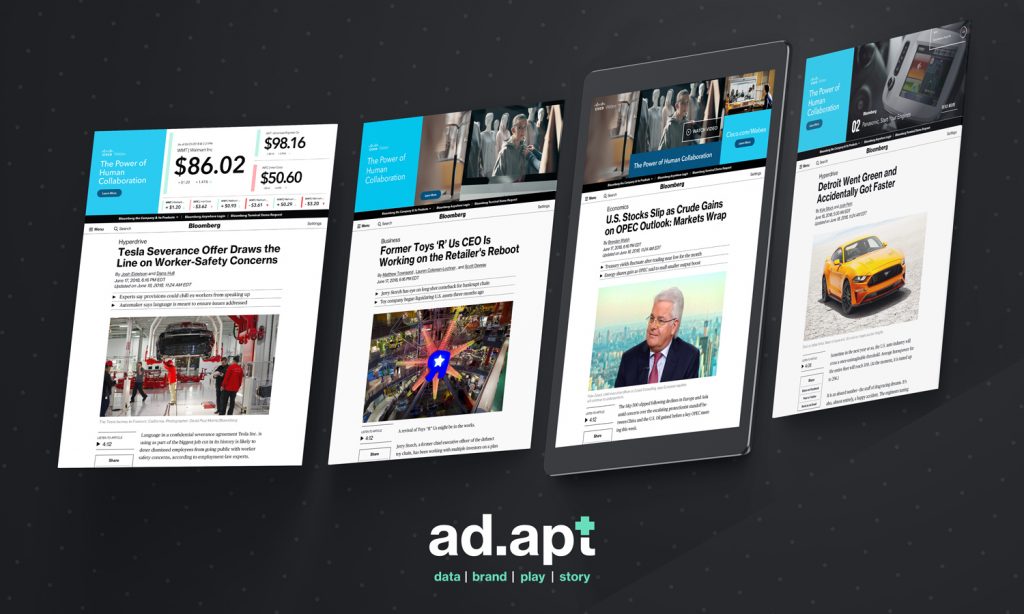
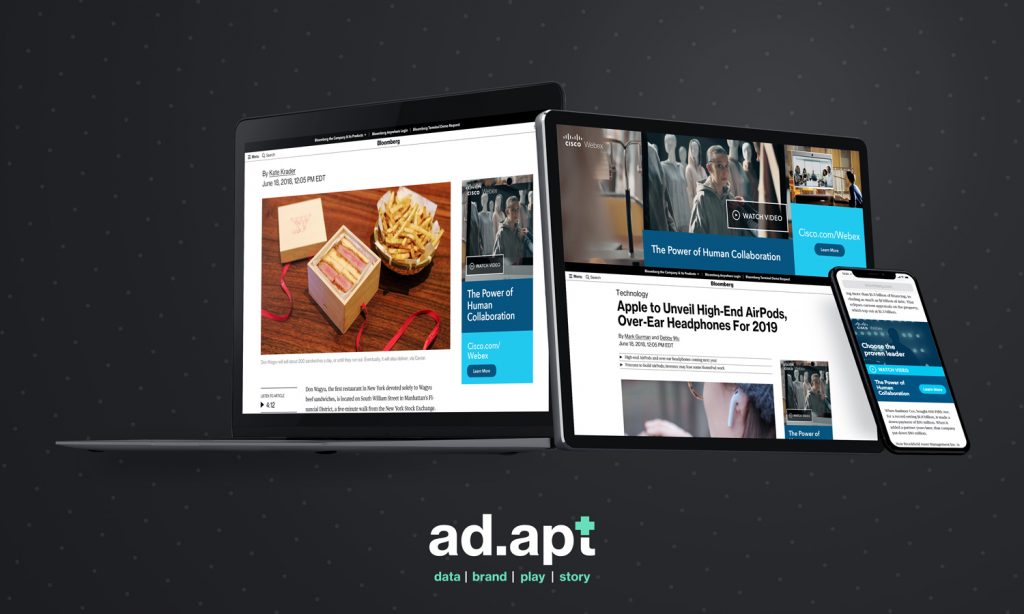
Bloomberg Media Group recently launched ad.apt, a new display ad format that introduces innovative ad solutions in display advertising. ad.apt leverages Bloomberg’s unique data, content and design footprint, enabling the company to convert a simple set of brand elements into a host of high-impact, natively designed formats.

ad.apt allows advertisers to submit a headline, subhead, logo, brand images, video and a call to action. The brand assets are then built in-house and can be turned into a video, data, or a Bloomberg-related article. It also tailors the ad based on the viewer’s browsing history.

Also Read: Facebook Gets Moat On-board for Video Ad Metrics

The dynamic elements of ad.apt include:

  1. ad.apt data: Integrates Bloomberg’s relevant data intelligence with a brand’s story, providing real-time information to Bloomberg users as they engage with market-moving news
  2. ad.apt story: Engages Bloomberg audiences with content that inspires and informs, by aligning with select Bloomberg topics or showcasing custom brand narratives
  3. ad.apt play: Highlights brand videos that are shared cinematically at scale, across screens
  4. ad.apt brand: Designed to deliver maximum brand impact with minimum brand resources

Bloomberg Unveils ad.apt, a New Display Ad Format
Courtesy: Bloomberg

ad.apt is fully scalable across all of Bloomberg Media Group’s global properties. “In an ever-changing digital environment, the advertising industry is shifting to deliver a single cross-screen ad solution, and with ad.apt, Bloomberg Media Group has built a cross-platform ad unit that is premium yet turn-key,” said the company in its press release.

Also Read: LinkedIn Joins the Bandwagon; Offers Carousel Ads For Sponsored Content

How ad.apt works

  • It puts Bloomberg’s design resources to work for you, delivering tailored solutions for the widest range of unique brand goals and capabilities.
  • The solutions extend brand assets across multi-dimensional functionalities effortlessly. A natively designed, component-based system assembles brand elements dynamically, flowing into any screen, on any device. Aspect-ratio-based sizes adjust responsively to each environment.
  • It delivers superior user experiences across a full spectrum of brand objectives, all of which can be used together to optimize impact — without an additional lift.

Bloomberg Unveils ad.apt, a New Display Ad Format
A Cisco campaign using the ad.apt Play format. Cisco is the first ad.apt advertiser. Courtesy: Bloomberg

ad.apt joins Bloomberg Media Group’s ad product portfolio, which has grown from eight products in 2015 to 21 this year.

Recommended Read: Is Google’s Responsive Search Ads the Ultimate Advertising Hack You Need?

New Capterra Research Identifies Top 10 Most Reviewed Software Categories

0
Capterra Research Identifies Top 10 Most Reviewed Software Categories

Capterra Reaches 500,000 Validated Reviews Milestone, Becomes Largest Global Software Reviews Outlet

Capterra, the leading online resource for business software buyers, announced a milestone 500,000 B2B software product reviews on Capterra.com, establishing its stake as the market leader for most verified reviews available to software purchasing decision makers. The first site to publish software user reviews, Capterra helps millions of buyers every month discover the right software for their business needs. Reaching this half-million mark, Capterra also announced new research findings illustrating why reviews are vital to software vendors seeking growth in the small and midsize business (SMB) market including the top 10 highest trending software categories, the top 10 most reviewed software categories, and the top 10 industries by reviews. Among its findings analyzed between 2017 to 2018, Capterra identified marketing-related software saw a 591 percent increase in published reviews, and network security software experienced a 463 percent increase validating marketing tools and security platforms are key priorities for small business growth.

“At Capterra, it’s our mission to be a ridiculously helpful resource — reaching 500,000 verified reviews shows our commitment to providing SMBs a platform they can trust”

The Capterra mission is to provide software buyers with unparalleled service at no cost — reaching the 500,000 reviews threshold further demonstrates the company’s dedication to serving the SMB community. The half-million mark is a major milestone, the result of a 50 percent increase in reviews published on the site since 2017. Capterra is on course to break more records: more reviews were published in the first half of 2018 than in the eight years between 2008 and 2016.

Also Read: Clarabridge Announces Support for WhatsApp Business

“At Capterra, it’s our mission to be a ridiculously helpful resource — reaching 500,000 verified reviews shows our commitment to providing SMBs a platform they can trust,” said Claire Alexander, general manager, Capterra. “All buyers rely on reviews to help them make informed purchasing decisions and we look forward to serving the next 500,000 software buyers through user reviews on Capterra.com.”

The top-five high-growth, trending software categories for 2018 are:

  • Graphic Design (591 percent growth)
  • Presentation (533 percent growth)
  • Network Security (463 percent growth)
  • Web Conferencing (410 percent growth)
  • Meeting Platforms (390 percent growth)

The top-five review categories are:

  • Collaboration
  • Project Management
  • Task Management
  • Customer Relationship Management
  • Productivity

“Buying and selling trends are constantly changing — people now rely on user reviews as resources to help them make purchasing decisions. Vendors count on reviews to gain the trust of potential customers and stand out from the competition,” said Shai Eisen, managing vice president of digital products. “We work hard to ensure that the unbiased customer testimonials are as helpful to SMB leaders as possible. That’s why Capterra helps more than 5 million businesses find the right software across hundreds of categories each month.”

Recommended Read: Eros Now Announces Partnership With InMobi

Why RCS Could Sound the Death Toll for Mobile Apps

0
Why RCS Could Sound the Death Toll for Mobile Apps

CLX LogoIn the age of the 24/7 consumer, the smartphone has become an essential tool, enabling us to achieve an ever-expanding range of tasks while on the go; from banking to shopping to booking a holiday.

Therefore, as consumers our never-ending quest for convenience means we naturally gravitate towards apps or services that make our lives more efficient and convenient.

This trend is changing the way we use smartphones.

Mobile app use is in decline and the types of app we most frequently use is evolving. We’re now spending less time playing games and using lifestyle apps, while the finite time we do have to use our smartphones is being channelled into more task orientated apps. As an example, usage of shopping apps increased 54 percent from 2016 to 2017, while the use of mobile games was down by 16 percent.

Also Read: Why Will RCS Messaging Be More Effective Than Apps

But while the type of mobile apps we are using is changing, a new next-gen messaging experience which is coming soon, could see consumers move away from mobile apps altogether. It’s called RCS.

The Arrival of RCS

After 25 years, SMS is getting an upgrade. The world’s mobile operators, handset makers and Google are now working to make RCS (sometimes called SMS 2.0) the default messaging app on millions of phones.

Unlike SMS, RCS (Rich Communications Service) offers an app-like experience to every consumer inside a chat session – without the pain of downloading a native app.

So how does RCS work? Well, imagine sending a delivery alert to one of your customers. Of course, the message will tell the recipient when the product will arrive, but here’s where RCS comes into its own. The message could also contain a menu of options to change the delivery date, edit the order, or call a customer service agent. Powered by artificial intelligence, the message might also suggest complimentary products and feature promo videos of said products, alongside a map showing the nearest stockist.

RCS also makes it easier to measure the effectiveness of mobile activity. It provides read receipts, so marketers can do A/B testing to compare the impact of different approaches.

Therefore, it’s no surprise that many experts believe RCS will upend the mobile customer care experience. Why? Because it gives brands and enterprises the tools to deliver an app-like experience without the cost and hassle of building a native app and without the big dollar marketing campaigns to get people to download it.

This is significant. For the last 10 years, a chorus of experts have told brands one thing: you need an app. They argue that social habits dictate it: customers have switched attention from traditional media to mobile. They’re shopping and performing more tasks on their smartphones too.

But with the arrival of RCS, many of those assertions no longer hold true which is why the arrival of RCS doesn’t bode well for the long-term future of apps.

Also Read: Banner Ads: Alive and Thriving in Casual Mobile Games

 The Power of Ubiquity

Currently, most people only use messaging apps to stay in touch with friends, not brands. As a result, ‘Over the Top’ messaging apps like Facebook Messenger and WhatsApp still lack one important quality: ubiquity. Now, most consumers don’t care about ubiquity. But businesses do. They want one channel to reach everyone.

This explains why SMS use has fallen among consumers, but soared among companies. We’re all familiar with enterprise use cases: delivery alerts, PIN codes, marketing offers etc. They’re concise, direct and personal – and they save huge amounts of time and effort in customer care. According to analyst Ovum, businesses sent 1.16tn SMS messages in 2016 and will send 1.28tn texts by 2019.

As the next version of SMS, RCS now promises to be the universal channel that enterprises can use for an entirely new kind of mobile messaging. Indeed, a 2017 survey by Ovum revealed many are ready. It found 36 percent of organizations say they would be interested in using an enhanced SMS service, such as RCS. And more than half would be willing to pay between 1.5 times to three times the price of an ordinary per-message SMS.

The justification for the higher price is the probable return on investment. Many of the enhanced features of an RCS message could slash costs elsewhere. Consider the button that changes the date of a delivery. That single click would cost much less than when call centres and agents manage the process.

Also Read: Connected Apps Help Drive Digital Transformation

 Dawn of a New Era

The industry is working towards a roll-out of RCS which is happening carrier by carrier. The change won’t be instant. It will start with Android on selected carriers and will take time for users to upgrade. RCS on iOS remains an unanswered question, though analysts believe it’s a matter of time before Apple supports RCS as a fallback to iMessage, as it does with SMS.

Further ahead is the prospect of building secure card transactions into a chat session. That would genuinely change shopping forever. A session that starts: ’you have a new message’ could end up with ‘you have a new lawnmower’.

Skuid Announces Skuid Portals to Optimize Business Connections and Customer Experiences

0
Skuid Announces Skuid Portals to Optimize Business Connections and Customer Experiences

New Portal Template Allows Companies to Deliver Personalized Experiences for Customers, Partners or Employees That Drive Engagement, All Without Writing Code

Skuid, the leading cloud application platform, announced Skuid Portals, an easy and code-free way to create personalized and intuitive user experiences for business needs. Skuid Portals allow companies to provide secure, personalized access to business information for customers, partners and employees, all within a central interface.

Delivering on its no-code promise, Skuid Portals are a quick and simple way to create tailor-made and fully-branded portals and communities for partner and channel selling, employee intranet and information, customer support and even content management. Skuid Portals allow companies to leverage data from multiple sources and connect it all within a single, unified user experience—all with point-and-click ease—to drive greater employer and employee adoption, business efficiency, and improved customer experiences.

As organizations attempt to integrate their back-end systems with digital experiences, portals that are simple to customize and deploy will play a major role. In Forrester’s October 2017 report, Vendor Landscape: Digital Experience Portals, analyst Mark Grannan writes, “Portals are hyper-relevant given the demand for customer self-service and onboarding via heavy back-end integration and user-customizable interfaces.”

Also Read: Aragon Research Names Contentstack ‘Hot Vendor’ in Dynamic Experience Management

Skuid Portals can help companies integrate back-end systems and other data source with their digital solutions to deliver customer value in a more streamlined and simple way.

“With Skuid we built exactly what we wanted in a streamlined and cost-effective way,” said Steve Chapman, vice president of communications for NCF. “In addition to saving $1 million in initial implementation costs, the new portal has supported us to yield $2.5 billion of grants from our donors. We estimate a 99 percent faster processing time by using Skuid Portals as a centralized and custom-made hub to manage all of our grants, contributions, funds and user profiles.”

Skuid Portals can be used for:

  • Customer Portals — With personalized customer portals, companies can simplify and accelerate the process a customer follows to engage with the business, by providing self-service on any device. Companies can connect a customer-facing portal with their back-office applications and integrate data from multiple sources such as Content Management, ERP and CRM within a single page.

Also Read: Freshworks Secures $100 Million Investment Led by Accel and Sequoia

  • Partner Portals — Companies can create portals tailor-made for each unique entity that partners with them. Skuid Portals deliver fast access to the information partners need the most, from marketing materials, to sales opportunity management, to executive and human resources metrics, revenue, accounts, commissions and more. Partner portals can be used to request information or joint marketing funds, to make customer referrals, or to find the right salesperson to work on a joint deal.
  • Employee Intranets — Companies can create an employee intranet to elevate productivity and engagement. They can provide content customized to each individual, team and department to break down organizational silos and provide easy processes for employees to connect across a company.

“Skuid Portals give our customers the power to connect to any back-end system and build exactly the front-end experience they need to drive value for customers, partners and employees,” said Skuid CEO Ken McElrath. “Skuid Portals make it easy for any company to create a rock-star online experience in a fast, flexible, agile way — with no code required.”

Recommended Read: Google and GitHub Reaffirm Partnership with Cloud Build Tool Integration

Industry Insights About Google’s New Capabilities, Design Systems, Fresh Methods for Efficient Marketing and Instagram’s Usage Control Features

0
Google's New Capabilities, Design Systems Instagram's Usage Control

Top Picks from Martech Series. Original MarTech Insights from the Week Gone By.

Our staff writers present a sneak peak about the latest from Google. They have also been covering the importance of Design Systems along with emerging Social Media methodologies. Our last round-up for the week is about Instagram’s latest user control feature and how it will help stop Social Media abuse.

Google Cloud Next ’18: Key Announcements Every CMO Should Know from the Event

Google Cloud Next ’18 Led the Way in Turning More Heads that Ever for Business Leaders and CMOs with their 100+ New Announcements

Google Marketing Platform Gets a New Enriching Destination for Content and Analytics

Google Marketing Platform Has Formally Announced Their New Home on the Website and Social Media Platforms

Design Systems Will Build the Future of Customer Experience

Business Stakeholders Are Increasingly Understanding the Importance of Providing an Outstanding Customer Experience. But How Do They Collaborate with Marketers to Take Their Products and Services in the Right Direction? Design Systems Might Just Be the Pied-Piper for Futuristic Customer Experience Endeavors

Leveraging the Power of Social Media to Garner More Customer Reviews

The Importance of Online Reviews for Businesses Can Mean a Surge in Brand Awareness and an Overall Increase in Profit in the Long Run

Ten Ways to Transform Your Employees into Social Ambassadors

Understanding Employee Advocacy to Tap into Brand Awareness and Social Engagement

Ten Ways to Transform Your Employees into Social Ambassadors

Instagram Adds Time-Spent Dashboard to Tell Screen Zombies, “You Are All Caught Up!” and How

Time-Policing Is Live on Instagram; Focuses on Screen Zombies Who Spend Too Much Time on The Apps and Are Susceptible to Suicide, Bullying, and Fake News

That’s it! It’s a wrap from our end this week. We will be back with more happenings in the MarTech landscape soon.

Tapad Partners with Twine Data to Bring Portable CRM Onboarding Capabilities to Its Cross Device Solution

0
Tapad Partners with Twine Data to Bring Portable CRM Onboarding Capabilities to Its Best-In-Class Cross Device Solution

Marketers Can Now Harness The Tapad Graph In Concert With Twine’s Vetted, Verified TrueData Identity Graph

Tapad, the company reinventing personalization for the modern marketer, announced that it is partnering with mobile data leader Twine Data to bring Twine’s hundreds of millions of deterministic mobile identity connections to The Tapad Graph. Together, the two companies will create one of the largest portable identity graph & CRM onboarding services in the US, through the integration of Tapad’s best in class cross-device capability and Twine’s deterministic identity graph.

Tapad-_-twinedata

“Twine is a respected player in the onboarding space”, said Chris Feo, SVP of Global Data Licensing and Strategic Partnerships at Tapad. “Through Tapad and Twine’s partnership, our clients can now use their first-party CRM data to leverage the full power of The Tapad Graph — fueling a wide range of data-driven marketing use cases, including audience extension, attribution, and personalization.”

At the core of one-to-one marketing and true personalization is identity resolution. For marketers, the ability to accurately and safely connect customer activity across desktop/laptop, mobile, CTV, tablets, as well as CRM and offline touchpoints is ultimately what enables informed and personalized future conversations with each customer. Tapad is known for the precision, accuracy, and scale of its cross device connections, setting them up as an ideal partner for Twine’s TrueData deterministic identity graph.

Also Read: 3 Ways Analytics Tools Drive CX Transformation

“We believe that by combining Tapad’s renowned cross-device connectivity and our deterministic identity graph, marketers will finally be able to seamlessly segment users based on digital and offline behaviors as well as easily distribute those audiences to both DMP and DSP environments for personalized messaging,” said Elliott Easterling, CEO of Twine Data.

With this partnership, Tapad will build a client’s cross-device graph off of identities onboarded by Twine from a client’s offline CRM. The resulting identity graph can either be delivered directly to brands looking to host their own identity graph, or can be leveraged in a managed fashion for marketers looking for simple connectivity of their offline CRM audiences to their DSPs. To date, Twine & Tapad have seen full connectivity rates* for CRM segments from advertisers at between 259 percent and 322 percent at major DSPs.

Recommended Read: Getty Images Launches AI Tool to Transform Search for Media Publishers

Machine Learning-Enabled Sales Research Assistant, Zymewire, Among Latest Cohort to Graduate Toronto’s Creative Destruction Lab

0
Machine Learning-Enabled Sales Research Assistant, Zymewire, Among Latest Cohort to Graduate Toronto’s Creative Destruction Lab

Currently Supporting Contract Service Companies in Pharma/Biotech, the Canadian Startup Looks to Quickly Accelerate Growth and Expand Team Size

Zymewire, a SaaS company developing machine learning-based solutions for commercial teams, announced their graduation from the 2017/2018 Artificial Intelligence stream of the Creative Destruction Lab (CDL) program at the University of Toronto’s Rotman School of Management. Zymewire uses deep learning to create insights about any company, identifying what they have done in the past, what they are doing now, and what they intend to do in the future. Their first application is a digital sales research assistant that helps business development teams uncover new opportunities for sales growth by combining this deep market intelligence with existing internal data.

After being selected for the program from over 600 applicant companies in September 2017, Zymewire is among 60 ventures in the latest cohort to graduate. “There is no question we emerged as a different company than when we started 8 months prior. Through the CDL network and the advice we received throughout the program, we now have a clear path to our next major revenue inflection point and clarity around what our company will look like as we add the next 85 team members” said Pete Bastedo, Zymewire’s CEO & Co-Founder. “The depth of expertise and raw intelligence in the room at CDL is just humbling: everyone from leading academic luminaries of AI through to entrepreneurs who have built billion dollar companies from the ground up. CDL gave us the chance to to sit down with dozens of incredible thought leaders and get insight and advice into how to move Zymewire forward in every way.” said Ryan Drake-Stoker, Zymewire’s CTO & Co-Founder.

Also Read: Trusted Media Brands Names Randy Saperstone V.P. Digital Sales

After completing CDL, Zymewire now has their sights set on adding members to their team and expanding upon the success that they have achieved. “We have big plans in the future across many more industries and verticals where we see applications of our machine learning-based technologies!”

Zymewire provides the machine learning-enabled digital sales research assistant, helping sales professionals identify new opportunities for growth by combining deep market intelligence with existing internal data, all without having to rely on analyst-populated databases. Supporting business development teams at more than 230 pharmaceutical and biotech service providers worldwide, Zymewire has become the trusted resource for sales research and prospecting.

Recommended Read: Tru Measure Adds Andrew McFadden as Director of Sales and Marketing

NessPRO Selected as OpenText Strategic Partner in Israel

0
NessPRO Selected as OpenText Strategic Partner in Israel

NessPRO to Deliver Opentext EIM Solutions On-Premises and in the Cloud, and Offer Customers Increased Local Support and Professional Services

OpenText, the global leader in Enterprise Information Management (EIM), announced that it has signed a strategic partnership agreement with NessPRO – the software distribution arm of Ness – to support Israel-based customers with EIM solutions that enable the Intelligent and Connected enterprise. The partnership enables NessPRO to resell and support all OpenText solutions, both on-premises and in the cloud, as well as offering implementation and managed services to Israel-based enterprises.

NessPRO is Ness’ software products group, and the representative in Israel for more than 30 international and Israeli enterprise software and technology companies. NessPRO has been active for 40 years in the Israeli market and serves hundreds of clients. Ness Software Products Group (NessPRO) specializes in integration, marketing, service and support, training and maintenance for enterprise customers.

“OpenText selected NessPRO for its great reputation in the delivery and support of advanced enterprise software solutions, the quality of customer service, and the commitment to the Israeli market,” said Mark J. Barrenechea, vice chair, CEO and CTO, OpenText. “This strategic partnership builds on NessPRO’s commitment to OpenText as the leading platform for Enterprise Content Management in Israel. We are confident that working with NessPRO will enable customers in Israel to maximize their use of OpenText solutions – both on premises and in the cloud – further enabling their digital transformation agendas.”

Also Read: OpenText Enterprise World Showcases the Future for The Intelligent and Connected Enterprise

OpenText has 47 data centers worldwide, providing customers with secure and scalable cloud-based EIM solutions. As part of the strategic agreement, NessPRO will establish a dedicated data center in Israel, with local support in Hebrew, to deliver cloud-based OpenText EIM solutions to local customers.

“We are pleased that OpenText has selected NessPRO as its strategic partner in Israel, following a thorough examination of the Israeli market,” said Shahar Efal, President of Ness. “This is a testament to Ness’ quality, its leading position in the Israeli market and NessPRO’s capabilities as the company’s product distribution arm.”

“We are committed to ensuring OpenText’s success in Israel and maximizing customer satisfaction,” said Dedy Dvorsky, Senior Vice President of Ness and General Manager. “NessPRO has extensive experience in Enterprise Information Management, particularly deploying applications and processes that support organizations’ digital transformation – fundamentally changing how they operate and deliver value to customers. Following the agreement, we will expand our team of EIM experts to provide professional services and solutions to customers in Israel for all OpenText products. OpenText’s selection of NessPRO as a key strategic alliance in Israel is testimony to our technological and business capabilities in marketing software products that are at the forefront of global technology.”

Recommended Read: OpenText Wins Back-To-Back Customer Contact Week Awards

Fireside Chat with Sandie Overtveld

0
Sandie Overtveld

[easy-profiles profile_twitter=”https://twitter.com/Zendesk” profile_linkedin=”https://www.linkedin.com/in/sandie”]

Sandie Overtveld talks about how sales professionals should train themselves to master sales automation, reporting and intelligence tools

Know Me

Please tell us about your role at Zendesk and about your career journey.

I lead Zendesk’s Asia Pacific & Japan Go-To-Market teams, helping our clients transform their customer service into meaningful customer engagement with beautifully simple solutions. Prior to Zendesk, I was at Hewlett-Packard Enterprise Services, where I led the Microsoft Dynamics Service Line for Asia Pacific & Japan, as well as Microsoft.

To excel in my role at Zendesk, I tapped into my prior experience at Microsoft, where I worked in various positions across Thailand, South Africa and the United Kingdom before moving to Singapore in 2009 as the General Manager for Dynamics Business Applications.

How often do you measure the performance of your sales reporting and analytics?

For me, reporting is a daily necessity, so I am constantly measuring our sales performance, as well as assessing sales opportunities and challenges on-the-go. As with any data analytics, it is essential that we integrate and streamline various customer touchpoints to help us collect and collate valuable insights into a common platform. Once the insights are available, our sales teams can access customer information with ease, and then turn these insights into meaningful conversations.

What are the dynamic elements driving your B2B sales revenue model? How do you execute Engagement Economy Vision, Strategy, Product and Corporate Development at Zendesk

Simply put, customer expectations are rising and the onus is on companies and their key decision-makers to step up. At Zendesk, the roles of CIO and CMO are currently undergoing massive changes and evolving to become close-knit in order to make decisions quicker, especially since investments are now likely to be in place for only 1-3 years.

The most significant drivers of this change are the emergence of the public cloud, the need for agility and the boom in both collaborative tool-making organisations and machine learning.

As a result of these changes, our sales strategy is two-fold: to support and invest in our high-flying customers while moving upmarket into the enterprise space, and foster relationships with our channel partners. Given our 50 percent year-on-year revenue growth for APAC, we are confident this is working.

How do you stay on top of your sales goals?

A  driving philosophy behind the design of Zendesk products is that a happy and engaged customer experience team will translate into higher customer satisfaction. That same ethos applies to our sales team as well.

Our goal is to drive remarkable growth across Asia-Pacific within the shortest time possible. This is impossible without the support of a high functioning team, which is why retaining talent is a major key to our success. By instilling a collaborative and transparent work culture, we maintain a high level of employee satisfaction while keeping turnover very low. As a result, my sales teams are motivated to ensure the organization achieves its sales targets and can scale and replicate the success of sales cycles for different verticals to generate new revenue streams.

To what extent do you rely on Sales coaching and training platforms to refine your expertise? Do you provide any sales coaching?

Regular sales coaching is vital and should be conducted regularly across all levels. Here at Zendesk, we invest in the personal and professional development of our staff by providing a well-rounded curriculum comprising both internal and external training. In traditional organizations, sales managers may oversee up to as many as eight direct reports for sales coaching and day-to-day operations, often diluting their attention and focus. Our teams have adopted a pod model where the span of control is doubled for a sales manager, who can now easily oversee 16 direct reports. The schedules of the strategic account managers are freed from the day-to-day management so that they can focus on conducting performance-based sales coaching.

Know My Team

How big is your team and what drives them to succeed in meeting small-term and long-term sales goals at Zendesk?

There are currently over 150 sales staff members in our Asia Pacific Go-To-Market team and we have been growing consistently by 50% every year for the last five years. When considering the bigger picture, we looked at how we could instill within our employees a strong sense of identity and a customer-centric mindset and achieved this by fostering an engaging work culture through a series of team-building exercises, social gatherings, and corporate events. In addition to a great team and conducive work environment, we give our talent plenty of room for growth by setting challenging but achievable targets that are incentivized by a variety of activities including sales commissions and happy hours.

How tech-savvy is your Marketing and Sales teams? How do you rate them on a scale of 1-10?

As a SaaS (software-as-a-service) business in the customer-service software space, Zendesk is always on the lookout for talented individuals with an inclination for technology and a keen understanding of pain points faced in customer service. We carry this ethos across every piece of technology we use in our daily roles. As many of our people travel frequently for work, applications such as Slack for messaging, Zoom for video conferencing, 8×8 for phone calls and data-driven marketing dashboards like Bizible make life easy for everyone.

When it comes to our own products, we believe the beauty of our software lies in its simplicity – which is why we expect a certain degree of technological competence from our talents so they can quickly pick up on how to properly use and demonstrate our products in a highly disruptive business landscape. We also focus on hiring young people who subscribe to a mobile-first mentality to help drive our innovations forward.

Beyond technical knowledge and inclination, we also look at how well these teams can understand our customers’ businesses and position Zendesk as a technological partner of value. We are a customer-oriented business, and these are all essential qualities embodied by our Go-To-Market teams.

No business, let alone sales and marketing teams, can afford not to be tech-savvy these days. In my opinion, the key to remaining ahead of the tech curve is to continually assess the tools in your shed, and invest in upgrades. For that, I give our team a solid nine as I don’t believe you can ever be perfect – there’s always room for improvement.

How do you think young sales professionals should train themselves to master sales automation, reporting, and intelligence tools?

Young professionals looking to fast-track their careers in sales should first undertake a sales graduate program offered by any of the major software players. These programs are tailored specifically to give fresh graduates an insider perspective of the sales function in a technology business, where they will have plenty of opportunities to learn about the selling process, from identifying leads through to the final negotiations, alongside corporate and technical consultation teams.

Aside from that, read as much as you can – books, blogs, anything you feel teaches or inspires you to be a better, more impactful salesperson. For example, I encourage my whole team to read Fred Reichheld’s The Ultimate Question 2.0. In the book, he explains the power of asking customers one simple question, “Would you recommend us to a friend?” His position is that this question helps you identify detractors who sully your firm’s reputation and readily switch to competitors; promoters who generate profits and sustainable growth; and what the key drivers of each are. The book is also a fantastic resource on the origin and importance of Net Promoter Scores (NPS) and how big brands have been positively impacted by focusing on this metric.

How do you scout targeted accounts using Sales Intelligence suite?

We use them mainly to identify opportunities within industry verticals.

For example, when the Australian government kicked off its fiber broadband project, we quickly identified how we could help our customer MyRepublic, a major broadband service provider, make some waves in this new playing field.

To do this, we took advantage of key learnings gleaned from insights generated by our software’s data analytics to replicate the success of other customers in that space.

Since fiber networks were a commodity at the time, there was an urgent need for differentiation through seamless customer experience, which could then be scaled accordingly to help that customer stay ahead of the competition.

Marketing and Sales Alignment: Social Media and Content Marketing Strategies

Which types of sales content do you leverage? Out of all marketing collateral, including whitepapers, brochures, ebooks, playbooks, case studies, webinars, research reports, and infographics, which resonates the most with your customers?

Our marketing mix across the region is highly varied,  and necessarily so, given the diversity and varying levels of brand awareness and maturity across our APAC markets.

For example, we have been in Australia for over seven years, in Singapore for around four years, and in India and Japan for just shy of two years. Therefore, we have to take a slightly different approach to build our marketing strategy and sales content for each market.

Omnichannel customer experiences follow an integrated approach for sales and marketing content, taking into account whether the activity is top-, middle- or bottom-of-funnel to determine impact and pipeline generation. Top-of-funnel activities include digital marketing, media relations, white-papers, ebooks, and blog content, while middle-of-funnel includes events such as webinars.

Customer Success and Technology Insights

From a tactical standpoint, how often does your organization revisit the sales tech stack?

Every three years, we conduct an in-depth global review of the tools we use at Zendesk in order to remain up to date with the latest tech solutions across our global offices. However, our regional offices review tools on a much more regular basis to ensure local relevance in prospect identification and lead matching. For instance, ZoomInfo is a B2B contact database used by our U.S. team because the contacts are very American.

How does the technology involved impact your customer building/partnership model?

We use our technology for omnichannel support to facilitate conversations with customers that flow seamlessly across channels. As a sales-driven organization, we understand the need for customer service software that is scalable and easy to implement and use.

A simple solution designed to deliver swift results and help grow and scale business operations of all sizes is crucial to supporting customer building and other partnership initiatives. After all, a company’s relationships with its customers, employees, and partners – and how these relationships are tracked – is critical to ensuring that customer needs are at the heart of every decision.

How do you see the technology you use impact the customer acquisition and success rate?

The baseline expectation is now convenience and frictionless transition across multiple customer channels. According to PWC, 73 percent of people say the customer experience is an essential factor when making purchasing decisions. This means a robust omnichannel strategy is crucial in addressing any disconnections, all while retaining the context of the interaction –- be it from human to mobile or from human to desktop. To stay up to date with consumer demands, we use the same technology that we sell to engage with our customers.

In today’s fast-moving business landscape, reliable and actionable customer data is critical for businesses to set themselves apart; with an engaging and effective customer experience, a company will receive greater success.

Do you see sales and marketing technologies unifying or evolving together to deliver higher ROI to CMOs?

Quite often we see business functions utilizing traditional, siloed customer data collection models where information is stored in multiple systems and used in isolation. This often translates to poorly tailored customer experiences, and, ultimately, poor return on investment for the business. An omnichannel strategy supported by intuitive customer service software addresses this by integrating and streamlining various customer touchpoints to help businesses collect valuable customer data on a common platform. Data is now accessible across internal teams, and these insights can be readily turned into meaningful customer engagements to boost retention and help foster new acquisitions.

Tag a person who you would like to feature in our Fireside Chat:

Guy Kawasaki

Thank You, Sandie,  for answering all our questions. We hope to see you again at MTS, soon.