Home Blog Page 4231

Kitewheel’s State of the Customer Journey Report Finds Journey Interactions Growing Exponentially Across Emerging and Legacy Channels

0
Kitewheel’s State of the Customer Journey Report Finds Journey Interactions Growing Exponentially Across Emerging and Legacy Channels

The Analysis of Billions of Interactions Shows that Customer Journey is Becoming More Complex and Mature as Brands Seek to Influence the Entire Customer Experience in Real Time

Kitewheel, a provider of the leading Customer Journey Hub, has announced the release of its annual State of the Customer Journey for 2018. The report, based on an analysis of over five billion customer journey interactions between 2014 and 2017, provides insight into how brands are investing in customer journeys across a variety of verticals and channels.

This year’s report includes data on chat interfaces for the first time and also uses Kitewheel’s recently-launched the Customer Journey Maturity Model for additional analysis on the sophistication of each industry’s journey campaigns. Overall, total customer journey interactions across the Kitewheel platform grew – exceeding 3 billion for the year.

Read More: Fractal Analytics Humanizes AI: Acquires Behavioral Architecture Firm Final Mile

Currently, Kitewheel orchestrates intelligent customer journeys by unifying decisions across all touchpoints for brands and their agencies. Kitewheel’s innovative Customer Journey Hub unifies disparate systems, touchpoints, and technologies to provide seamless customer experiences that drive real-time revenue as well as long-term loyalty.

Key findings from the report include —

  1. Adtech – optimizing the delivery of targeted and personalized ads – saw the highest rate of growth, as marketers seek to target digital ads using customer interaction data
  2. Financial services journeys grew at 129% YoY, as customer experience-based competition heats up among players in the industry
  3. The retail industry has the highest degree of customer journey maturity based on Kitewheel’s maturity analysis, a first for this year’s report
  4. Social media, once the most dominant channel by volume, declined another 60% YoY
  5. In-store interactions are growing at 115% YoY, pointing to retailers’ demand for more insight into physical behavior
  6. Mobile app interactions grew another 50% after skyrocketing last year, a sign that the overall trend towards app-based experiences is still a priority for brands
  7. Chat, a new channel this year, now accounts for 1.5% of total interactions as chatbots evolve as a customer service tool, particularly for younger adult audiences

Recommended Read: TechBytes with Andreas Gnutzmann, Chief Technology Officer, FotoWare

“Over the four years that we’ve published this report, a profound shift has taken place in the customer journey space,” said Mark Smith, President of Kitewheel.

Mark added, “What was once primarily a marketing tool is now the way that many brands design and influence the entire customer experience. We’re seeing our clients’ customer journey strategies maturing as they realize the business imperative to deliver great experiences.”

Methodology

To build the State of the Customer Journey Report 2018, Kitewheel analyzed and compared over five billion interactions across the retail, auto, travel, telco, healthcare and financial services industries from its industry-leading customer journey hub. Campaigns from 2014 – 2017 were also categorized by maturity level, per Kitewheel’s Customer Journey Maturity Model, for an additional layer of analysis. Findings reflect the customer experience strategies of a wide variety of brands and partners.

Recommended Read: Salesforce Einstein Analytics Unveils Conversational Queries to Simplify Data

comScore Partners with PushSpring to Enhance and Expand Mobile Audience Segments

0
comScore Partners with PushSpring to Enhance and Expand Mobile Audience Segments

comScore Clients Can Now Activate Mobile Audiences Across 300 Million Unique Devices in the US

comScore has announced a partnership with mobile audience platform, PushSpring. PushSpring is the largest independent provider of deterministic, mobile-originated data, to make it easier for advertisers to plan and activate mobile audiences. Through this new integration, comScore clients can use its core mobile measurement solution to analyze and define mobile audiences, and instantly send these audience definitions to PushSpring for same-day campaign execution via the marketer’s DMP or DSP of choice.

PushSpring processes billions of monthly mobile app and device-level signals to create a highly accurate and complete multi-dimensional classification of mobile app audiences, offering over 300 million targetable device IDs.

comScore has been a trusted source to advertisers and agencies for insight into app consumption, audience demographics, and other data vital to media planning. With the integration of comScore and PushSpring platforms, clients can now shift from campaign planning to execution more seamlessly and efficiently.

“The move towards audience-based buying and programmatic offers new opportunities for marketers to engage with consumers,” said Brandon Zirkle, VP of partnerships at PushSpring.

Brandon added, “The PushSpring/comScore integration ties the planning experience and the activation and programmatic buying experience together, so marketers can seamlessly find and reach the right audiences on mobile and across devices.”

The integration with PushSpring allows comScore clients to:

  • Target and programmatically reach audiences based on mobile app consumption and demographics to achieve the goals of a campaign
  • Enhance and expand mobile app audience segments in PushSpring with other unique characteristics like personas, location, etc.
  • Build mobile app audiences on-the-fly and leverage existing DMP or DSP relationships to activate their custom-built target

“Our customers need to meet consumers where they are – and that’s increasingly on mobile,” said Dan Hess, chief product officer at comScore.

Dan added, “Our integration with PushSpring allows our clients to segment and activate mobile audiences more quickly and efficiently. This builds on comScore’s commitment to closing the loop across all channels and all stages of the media buying cycle – be it planning, transacting or evaluating.”

Currently, PushSpring is the leading independent mobile app audience data provider and marketplace, offering data, tools, and intelligence products to advertisers and mobile app publishers. PushSpring Personas and custom audience segments can be accessed via the PushSpring Audience Console and distributed through industry-leading DMPs, DSPs, and programmatic platforms including The Trade Desk, Google DBM, MediaMath, Centro, LiveRamp DataStore, and Oracle Data Cloud, as well as dozens of ad network platforms, to power mobile marketing objectives for brands and app owners. PushSpring is a member of the IAB and the DAA Self-Regulatory Program.

Amperity Appoints Microsoft Veteran Chris Jones as SVP of Product

0
Amperity Appoints Microsoft Veteran Chris Jones as SVP of Product

With Chris Onboard, Amperity is Positioned to Fundamentally Grow Their Customer Data Platform

Amperity, the world’s only Intelligent Customer Data Platform (CDP), today announced that Microsoft product veteran Chris Jones has joined the company as SVP of Product. Chris Jones draws on decades of experience developing disruptive software products and will be tasked with driving the project strategy forward to serve Amperity’s rapidly growing customer base of top consumer brands.

Recommended Read: Salesforce Einstein Analytics Unveils Conversational Queries to Simplify Data

Amperity is the Intelligent Customer Data Platform empowering global consumer brands to create unique and personalized experiences by unlocking all their customer data.

“Adding Chris to the team is a major win for Amperity and for the brands we serve,” said Kabir Shahani, CEO and Co-Founder of Amperity.

Kabir added, “Chris has made significant contributions to some of the most defining software products of our generation, and will leverage these experiences to help us scale and accelerate our value in the marketplace. The problem we solve is foundational to everything marketing, analytics, and CX teams deliver at some of the world’s most loved and well-known consumer brands. With Chris onboard, we are positioned to continue to be the enabling technology that allows brands to fundamentally and holistically reinvent their relationships with customers.”

Chris Jones comes to Amperity with over twenty-five years of experience delivering products and bringing large-scale services to market at Microsoft. He most recently co-created and led an initiative to accelerate healthcare innovation through artificial intelligence and cloud computing.

Prior to that, Chris Jones drove all product development efforts for the company’s leading collaboration platforms, as Corporate Vice President. In previous roles, he led the development of  Windows, Internet Explorer, and Outlook.com.

Recommended Read: [24]7.ai Removes Time, Cost and Risk Barriers to Chatbot Deployment

“What attracted me to Amperity was the world-class talent and the bold ambition of their product,” said Chris Jones.

Chris added, “The biggest global brands have a unique opportunity to bring together their first-party customer data and deliver personalization and intelligence that delivers a better experience for their customers across the board.”

Further adding to his comment, Chris explained, “Amperity is leading the way with a purpose-built CDP that works, powered by cutting-edge machine learning. In a few short months from public availability, Amperity has already demonstrated tremendous results and measurable business value for our clients and their customers. I am thrilled at the opportunity to take Amperity’s platform to the next level.”

This announcement comes on the heels of significant product and company momentum for Amperity. The company recently announced the general availability of  “Databases” — enterprise-grade functionality that enables precise customer data models, optimized for each of a brand’s diverse use cases. Amperity also expanded its customer roster to include leading companies like GAP Inc., Kendra Scott, TGI Fridays, Wynn Hotel and Resorts, the Seattle Sounders, Pacific Market International and Stanley, among other top brands.

Using machine learning and massive computing power, Amperity stitches together all of a brand’s disparate data sources form complete customer profiles and makes those profiles available to marketers and analysts.

Read More: Transform Your Marketing Team Into A 3D Organization

Top 10 Takeaways From The Mary Meeker 2018 Internet Trends Report

5
Top 10 Takeaways From The Mary Meeker 2018 Internet Trends Report

Some of the Biggest Themes in The Internet Trends Report This Year Include Privacy, Ecommerce, China, And Work

China will soon overtake the US (in terms of technology and its consumption), Ecommerce is at an all-time high, cryptocurrency has exploded, having quadrupled since Jan 2017, and yes, artificial intelligence is proving to be more important to human history than fire.

That’s the much-awaited Mary Meeker 2018 Internet Trends Report in a nutshell.

Of course, the 294-slide report, presented by the Kleiner Perkins Caufield & Byers analyst and partner, talks about all this and much more in detail. These are the top 10 takeaways from the report:

(1) Internet Adoption:

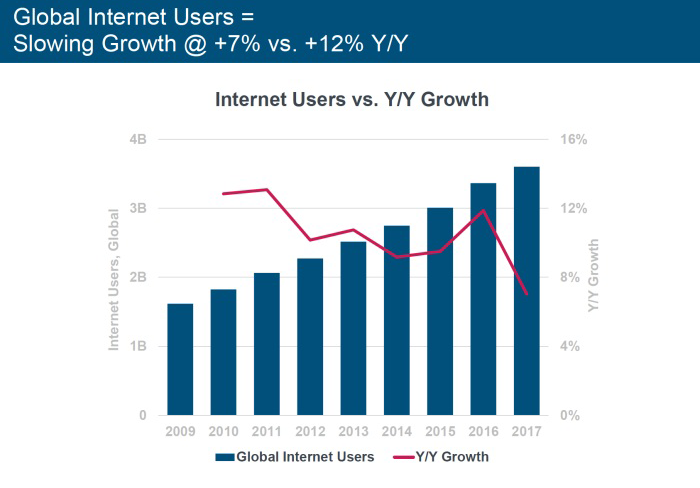
As of 2018, half the world’s population, almost 3.6 billion people, will be on the internet. The average adult spends about 6 hours per day with a digital device. All this, thanks to cheaper Android phones and WiFi becoming more available. In fact, there are around 450 million WiFi networks in the world, as compared to about 100 million networks five years ago.

Top 10 Takeaways From The Mary Meeker 2018 Internet Trends Report
Courtesy: Kleiner Perkins Caufield & Byers


(2) The Privacy Paradox:

Data improves usability, which creates a ‘privacy paradox’ according to Meeker. User data allows companies make low-priced services better, which, in turn, allows users to spend increased time on said services, and regulators want to ensure that user data is not used improperly.

Courtesy: Kleiner Perkins Caufield & Byers

(3) Mobile Usage and Advertising:

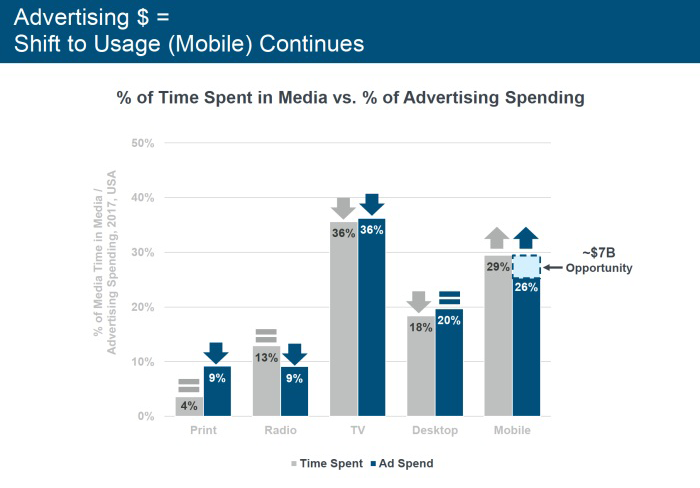
There’s a significant increase in mobile usage. More and more adults in the US are spending more time online thanks to mobile, clocking 5.9 hours per day in 2017 versus 5.6 hours in 2016. Attention is shifting to mobile more than advertising, with 29% spent on mobile, and only 26% on advertising budget, creating a $7 billion gap. Ad-hosting platforms, especially the Google-Facebook duopoly, are taking up responsibility for the placement of ads with respect to content.

Also Read: Who’s Responsible for Solving the Billion-Dollar Ad Fraud Problem?

Courtesy: Kleiner Perkins Caufield & Byers


(4) E-Commerce is Booming:

Users are more than eager to shop on their mobile, shooting Ecommerce growth in sales to 13% of all retail sales. Also, brands focussing on user experience with apps have a higher chance of replacing brick-and-mortar stores.

Courtesy: Kleiner Perkins Caufield & Byers


(5) Cryptocurrency Makes the World Go Round:

A course on Bitcoin (BTC) and cryptocurrency technologies have made it into the top 10 most popular university classes in 2017 at Princeton University. If that tells us anything, it’s that we can no longer ignore cryptocurrency. In fact, interest in cryptocurrency is exploding as Coinbase’s user count has nearly quadrupled since January 2017, which does not include cryptocurrency’s December growth when Bitcoin’s price rose to $20,000.

(6) Voice Tech:

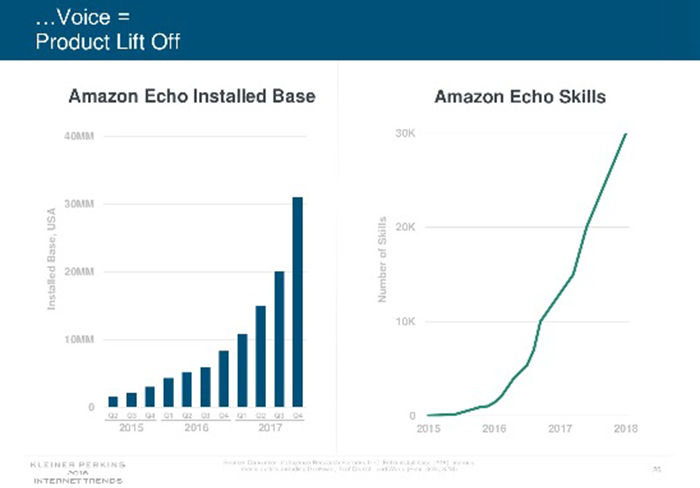
With Google’s Machine Learning speech recognition accuracy reaching 95%, the same as the human threshold, there’s a lot of mainstream adoption of smart speakers and voice assistants. Amazon Echo’s install base sales rose from 10 million to 30 million in 2017, pushing developers to build more voice skills.

Courtesy: Kleiner Perkins Caufield & Byers


(7) Alibaba vs Amazon:

Amazon has been churning a lot of revenue, yet it’s Alibaba, the Chinese commerce giant, that has more gross merchandise volume. In 2017, Alibaba had a higher gross market value at $701 billion, compared to Amazon’s $225 billion, while Amazon had higher revenue with $178 billion compared to Alibaba’s $34 billion. Alibaba has been aggressively expanding into markets like India, Pakistan, Singapore, and Indonesia, while both companies are offering services on scales that competitors can’t seem to match.


Courtesy: Kleiner Perkins Caufield & Byers

(8) China is Growing, Fast:

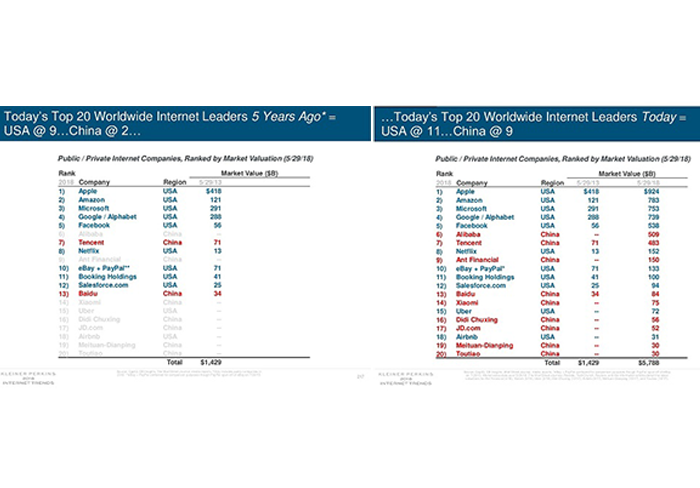
Five years ago, the US had nine companies, namely Apple, Amazon, Microsoft, Google/Alphabet, Facebook, Netflix, eBay/Paypal, Booking Holdings, and Salesforce, in the top 20 worldwide internet leaders; China had two – Tencent and Baidu. Today, the US has 11, with the addition of Uber and Airbnb, while China has added nine – Alibaba, Ant Financial, Xiaomi, Didi Chuxing, JD.com, Meituan-Dianping, and Toutiao.

Courtesy: Kleiner Perkins Caufield & Byers


(9) Is AI Going to Replace Us?:

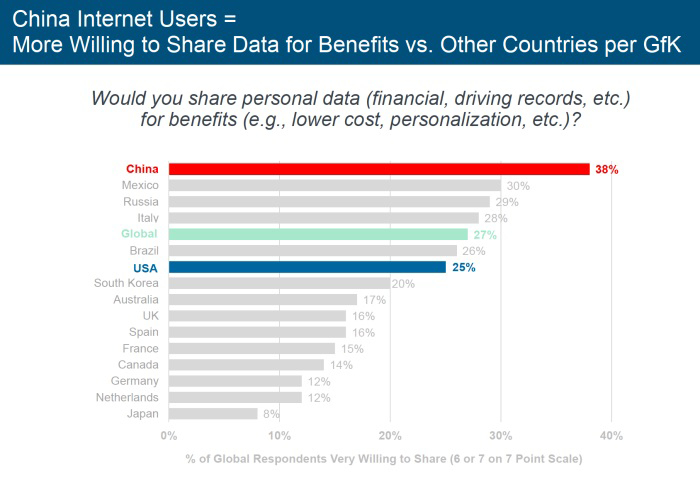
As internet leaders like Amazon and Google are enabling easier data processing and collection, Artificial Intelligence (AI) service platforms will become increasingly relevant in business. AI is a small but rapidly rising spending priority for the enterprises, says Meeker. China is gaining a significant upper hand over the rest of the world in AI. With China having the largest number of internet users in one country, and they are more willing to share data for benefits compared to other countries, 38% compared to just 25% in the US. This digital data volume is helping China make rapid AI advancements, with the Chinese government being highly focused on developing AI.

Courtesy: Kleiner Perkins Caufield & Byers


(10) Subscription Services are Going Up:

When it comes to product purchases, consumers are going from buying to subscribing via services like Netflix, which, saw 25 % growth at 118 million subscribers in 2017, and Spotify saw 48 % growth at 71 million subscribers. Newcomer service like Peloton also had 172,000 subscribers in 2017, marking a whopping 173% growth. Subscription services are appealing to consumers because they offer access, selection, price, experience, and personalization.

Recommended Read: Ask Yourself, What’s Bringing Audiences to Your Website?

Comm100 Launches Next Generation AI-Powered Chatbot

0
Comm100 Launches Next Generation AI-Powered Chatbot

Com100 Chatbot Is a Customer Engagement Solution that Also Adds Co-Browsing and Shopify Integration Features

Comm100, a global provider of enterprise-grade digital customer conversation solutions, today announced the launch of its second-generation chatbot. This latest version is enhanced with AI capabilities to create an even more productive and natural experience for both chat visitors and agents.

Read More: Convey Launches Platform to Replace Static Contacts with Live, Dynamic Connections

Com100’s AI-powered chatbot is empowering visitors to find what they’re looking for more quickly, helping agents manage chat volume more efficiently, and enabling brands to deliver a better experience.

Comm100 Live Chat allows organizations like HP, Advanced Auto Parts, Stanford University and Veridian Credit Union to exceed their customers’ expectations through more meaningful real-time conversations.

At the time of this announcement, Jeff Epstein, VP of product marketing and communications at Comm100, said, “Live chat is booming as companies recognize the significant impact it can have on their top and bottom lines.”

Jeff added, “Our AI-powered chatbot is a win-win-win: empowering visitors to find what they’re looking for more quickly, helping agents manage chat volume more efficiently, and enabling brands to deliver a better experience. AI is reaching the tipping point, and we want to make it accessible and effective for all our customers.”

Read More: S4M Co-founder Stanislas Coignard Takes Over As US CEO to Focus On US Expansion

Most chatbot conversations today are based on the question and answer model. If a visitor has a question, the bot will have an answer – if it was specifically programmed for that question. But when a chatbot is not programmed, the conversation often comes to a dead end, leading to unresolved queries and unsatisfied customers.

Adding to the frustration for people on both ends of the connection is that the tone and intent of the dialogue are often lost in translation. Despite these challenges, chatbots are booming, and the global chatbot market is estimated to reach $1.23 billion in 2025, according to Grand View Research.

Comm100’s enhanced AI-powered chatbot leverages Natural Language Processing (NLP) to create a more realistic conversation where the bot can recognize the visitor’s intent, field clarifying questions itself directly to the visitor and execute transactions – such as booking reservations or making payments – under the customer’s direction. Available in 31 different languages, it is also capable of responding with relevant images, videos, and URLs.

Comm100’s AI learns quickly and can easily be trained to perform in specific verticals. It can trigger sales transactions, create support tickets and more – forging new paths where those dead ends previously existed.

Comm100 is also deploying a Shopify integration that will make out-of-the-box live chat available to all Shopify users. With personalized customer experiences that get to the root of what customers need, brands can reduce cart abandonment rates and increase transaction value. Unlike other chat solutions, Comm100’s Shopify integration can show cart content, order history and customer details directly in the agent’s chat console.

To further enable chat to eliminate frustration and resolve issues faster for customers and other web visitors, Comm100 will also offer new co-browsing capabilities. With a single click, agents can instantly view and interact with a visitor’s web browser, making it possible to recognize where they are running into issues and to guide them through complex processes to find the best possible solution. This add-on is completely web-based and does not require plugins, downloads or installations that can further impede issue resolution.

Comm100 is a global provider of digital customer conversation software powered by clever automation, AI assistance, and a friendly interface that’s fast, easy and simple for both visitors and agents to use.

Read More: S4M Co-founder Stanislas Coignard Takes Over As US CEO to Focus On US Expansion

TechBytes with Eric Moller, Chief Technology Officer, Atomic X

1
Eric Moller
TechBytes with Eric Moller, Chief Technology Officer at Atomic X

Eric Moller
Chief Technology Officer, Atomic X

Atomic X recently launched a chatbot for marketing and sales – Rufus. Chatbots for marketing and sales are certain to rule the roost in the years to come. Thanks to their increased productivity and value-added communications, chatbots and virtual assistants can reduce the friction in business-to-user interactions. To better understand the state of chatbot automation in sales and marketing, we spoke to Eric Moller, Chief Technology Officer, Atomic X.

Html code here! Replace this with any non empty text and that's it.

Tell us about your role at Atomic X and the team/technology you handle.

As the CTO at Atomic X, my current focus is to set a strategic direction for our product and technology. I’m also making sure we’re able to deliver that on time and on budget.

We have a team of world-class designers and developers who are incredibly talented; they’re really able to make anything happen. With a team like this, my role is to make sure we’re all working towards the same goal. There’s a lot of tempting features and technology we’d love to explore, but we need to stay true to our mission right now.

Define the role of Chatbots for Marketing and Sales in 2018?

It’s hard to define exactly what that is because it’s changing so quickly right now. We’re at a stage in the technology hype cycle where lots of folks are really just trying ideas out to see if they stick.

The role I see is very specific: reduce friction. Nobody wants to talk with some fictitious AI persona who’s asking them how their day is going. People use chatbots, and in fact, many online services, to get something done. I would encourage any company implementing a chatbot to think about what that thing is and make it really easy to do. The “blab-bots” that serve only to ask open-ended questions and try to be your “digital friend” aren’t going to be around too long.

How are you competing against the established bot makers?

For the most part, I see a lot of:

  • Bot building tools, with a lot of big players here; think IBM, Google, Facebook, etc.
  • People leveraging the bot building tools. Many of these are small independent developers who are capitalizing on the freely available tools and deploying bots to Messenger or as Alexa skills.

We’ve built our entire technology stack in such a way that we can install it on-premise and have complete control over the encryption and data security on the back-end. It’s much harder to build good bots when you can’t leverage free Google APIs, but that’s exactly what we’re doing. Big players, such as banks and insurance companies, stand to make huge gains by implementing chatbots into their processes. They also can’t afford to take risks with their sensitive client data, and that’s where we come in.

Atomic X also has killer design and UX. If you want to reduce customer friction – good design is step 1.

Which segment of customers are you targeting with Rufus? How would chatbot automation ensure better customer journey analytics?

Ultimately, any customer looking for a transaction is going to be in our wheelhouse. I don’t just mean a financial transaction, but really anything. If a customer is looking for specific information, we want to make that easy. If they’re looking for a particular product or item, that’s what we do.

The beautiful thing about chatbots is if you want to know what your customer wants, you can just ask them. We’re developing proprietary technology that allows us to dynamically sort customer questions and comments – which makes it trivial to see where your processes are not meeting customer expectation.

For example, we might detect a pattern where the customer becomes angrier, or less patient, after being delivered certain content or information – that’s a sign that the current answers are not meeting customer expectations. A well-designed bot can really reduce an organization’s customer-facing blind spots.

How critical is it to distinguish customer experiences in B2B purchasing cycle? What role would your bots play?

That’s a tough space. B2B sales cycles vary by a huge amount. Bots do really well in a space where there’s a lot of volume, and hence, lots of training data. If you have long, slow sales cycles, you really won’t get too much training data, or opportunities to leverage the efficiencies a bot creates.

If we’re talking about high-volume B2B sales, I could see bots being useful. The pace of adoption and technological innovation will be in the B2C space.

What technologies in AI/machine learning are you deploying to make bot adoption agile?

We’re using deep learning algorithms to improve our classification and emotion recognition patterns. I don’t want to go into detail and give away our secret sauce, but in general we use AI to do two things very well:

  • Leverage a companies’ existing data and processes to improve the bot experience.
  • Create pipelines where each subsequent bot interaction helps train the bot, without exposing our models to coordinated attacks.

Thanks for chatting with us, Eric.
Stay tuned for more insights on marketing technologies. To participate in our Tech Bytes program, email us at news@martechseries-67ee47.ingress-bonde.easywp.com

Movable Ink Partners with Pega to Deliver AI-Powered Actions in Email Campaigns

1
Lands' End Selects Movable Ink's Da Vinci to Power AI-Driven Personalization

AI-Powered Next Best Actions and Real-Time Content Personalization Help Marketers Increase Consumer Engagement and Conversions

Movable Ink, a leading intelligent content platform for digital marketers, announced a partnership with Pega. Pega is the leader in software for customer engagement. The two companies joined hands to enable brands to personalize email campaigns using AI-powered next best actions.

Combining Pega’s ability to facilitate the right action for every customer in real time with Movable Ink’s ability to test and generate personalized content at the moment of open, marketers can ensure the best possible customer experience that’s consistent across email and other channels.

Recommended Read: Salesforce Einstein Analytics Unveils Conversational Queries to Simplify Data

Customers Would Witness Real-Time Personalization That Drives Performance, Increases Productivity, and Delivers Compelling Consumer Experiences

With Movable Ink’s intelligent content platform, marketers can leverage data from any source to power real-time personalization that drives performance, increases productivity, and delivers compelling consumer experiences. The AI-powered Pega Marketing application leverages intelligence from multiple datasets to automatically recommend the best product, service, or action to every individual customer based on continuous interactions across every channel.

The partnership will be available to mutual clients of Movable Ink and Pega immediately, giving brands access to both Movable Ink’s and Pega’s capabilities. 

Through this partnership and software integration, brands can now seamlessly use both Pega’s and Movable Ink’s technology to power email messages with the most relevant and compelling image-based offers in real time to eliminate disjointed experiences, increase productivity, and boost customer engagement and revenues.

Movable Ink-Pega Partnership is a Powerful Option for Marketers

At the time of this announcement, Vivek Sharma, CEO of Movable Ink, said, “The most effective marketing delivers more than an offer; it’s about the entire experience the offer comes wrapped in.”

Vivek added, “From images to text, delivering a perfect experience requires deep knowledge of consumers and the ability to use data to adapt in the moment. This is central to what both we and Pega enable, making this partnership a natural fit and powerful option for marketers.”

“Generating superior customer experiences is about delivering the right message, content, action, offer, or suggestion at the customer’s moment of need,” said Tom Libretto, CMO, Pegasystems.

Tom added, “This integration with Movable Ink enables marketers and salespeople to extend dynamic, personalized emails even further by injecting AI-powered next best actions into content that is optimized for each individual customer or prospect at the moment of open.”

Content Marketing and CRM come Together to Deliver Consistent Customer Experiences

Movable Ink and Pega work together to provide brands with these benefits —

Seamless Omnichannel Experience

sing Movable Ink’s Intelligent Content platform and the Pega Marketing application together, marketers can now easily integrate next best actions into email campaigns regardless of ESP (email service provider), ensuring consistent customer experiences across all channels.

Increased Customer Value

Together, Movable Ink and Pega maximize value for every customer by providing the most intelligent, hyper-personalized calls to action based on behaviors, preferences, and context.

More Revenue from Email

With content that is customized in real time, messages are more relevant and compelling, driving increased responses, click through rates, and conversions.

Pega provides an end-to-end suite of customer engagement applications for marketing, sales, and customer service powered by Pega Customer Decision Hub, its real-time artificial intelligence (AI) engine. Built on Pega Platform, the industry-leading application development platform, Pega’s CRM solutions enable clients to anticipate customers’ changing needs and provide personalized, AI-driven recommendations throughout the customer journey.

Brainshark Unveils New AI-Powered Engine to Elevate Sales Coaching and Readiness

0
Brainshark’s New AI-Powered Engine Elevates Sales Coaching and Readiness

Machine Analysis Processes Sales Rep Videos – Generating Automated Insights on Sellers’ Ability to Stay On-Message, Emotions Exhibited and More

Brainshark has unveiled Machine Analysis, an artificial intelligence (AI)-powered engine that improves sales coaching – augmenting coaches’ feedback and scoring to help sellers stay on-message and improve performance. Building off Brainshark’s award-winning, video-based sales coaching solution, these first-of-their-kind coaching capabilities offer automated, actionable insights that help ensure salespeople master critical messages before they get in front of a buyer.

Brainshark is a leading SaaS-based sales enablement and readiness solutions provider.

Sandeep-Soman, VP of Product, Brainshark

At the time of this announcement, Sandeep Soman, VP of Product at Brainshark, said, “Automated “micro-assessments” with consistent feedback and scoring to evaluate real-life sales scenarios form the basis for Brainshark’s Machine Analysis.”

Machine Analysis Word Cloud
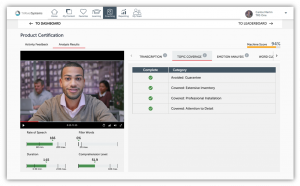
Machine Analysis - Topic Coverage
Machine Analysis – Topic Coverage


Sandeep added, “Our AI engine is designed to be taught what phrases or keywords to look for and, conversely, what to avoid as sellers submit their video responses. In addition to these, we can also figure out if sellers used too many filler words or spoke too fast and even the level of comprehension.”

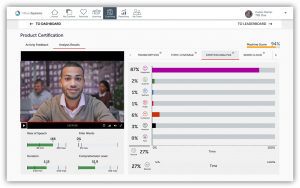
Machine Analysis-Emotion Analysis

The VP of Product at Brainshark explained, “All this (responses and inputs) is processed by our AI engine after it automatically transcribes video responses to such scenarios and generates an overall machine score. This enables sales managers to save time and streamline the coaching process, and quickly identify specific areas to improve with sellers before they get in front of a buyer.”

Sales Organizations are Early Adopters of AI/Machine Learning Technology

As AI percolates into the enterprise, sales organizations have distinguished themselves as early adopters – using AI, for example, to improve forecasting and pipeline analytics, and to manage inbound leads. Gartner estimates that by 2020, 30% of all B2B companies will employ AI to augment at least one of their primary sales processes.

Yet the technology previously has held untapped potential in the realm of sales readiness – with Brainshark now introducing a solution that creates an engaging practice environment for sellers and helps managers streamline and prioritize feedback.

Brainshark’s Sales Coaching Solution Makes Reviews and Feedback Easy

Brainshark’s Machine Analysis analyzes videos that reps submit through Brainshark’s sales coaching solution – often videos of the rep pitching a new product, handling common objections, etc. Machine Analysis transcribes the videos and auto-generates an analysis and score for each submission, factoring in whether sellers adhere to manager-defined parameters, including coverage of key topics, speaking rate, low level of filler words (“um,” “uh,” etc.) and more.

Managers have the option to sort video submissions by the machine score, before providing their own manual reviews and feedback through Brainshark’s coaching solution.

Machine Analysis also provides unique, automated insights on rep videos, including —

  • Emotion analysis – Every second of the video, Machine Analysis analyzes the seller’s facial expression for eight emotions – happiness, surprise, sadness, contempt, etc. – noting their frequency within a submission (e.g., 95% happiness, 2% sadness, 3% contempt, etc.). Managers and reps can replay the video from within Brainshark’s platform, viewing the exact moments when emotion changes are noted.
  • Personality insights – Measuring the frequency of certain categories of words, the engine detects how often the participant displays traits such as openness, conscientiousness, extraversion, agreeableness and an emotional range, to show how sellers could be perceived by buyers.

How Can AI Augment What Sales Managers and Professionals Do?

Jim Dickie, Research Fellow and Co-Founder of Sales Research Firm, CSO Insights, said, “AI has an important role to play in the future of sales. For organizations to adopt and embrace it, it’s critical to show how AI can augment what sales managers and professionals do – making them even more valuable to buyers.”

Jim added, “Technologies like Machine Analysis make sales professionals and their managers even better in their roles – enabling managers to coach and mentor in a more individualized way than ever before. This illustrates the power of dynamic coaching, where technology effectively supplements manager-led coaching to improve win-rates and overall results.”

“For many companies with large sales forces, it’s important for managers to be able to easily identify who needs the most coaching, and on what,” said Tracey Abby, Director of Global Sales and Channel Enablement at Tenable, the cyber exposure company.

Tracey added, With Brainshark’s Machine Analysis, we’re excited to see AI applied in a way that gives sales managers and coaches an automated ‘video screener’ – pinpointing which reps need the most guidance, based on their video submissions, and why. Managers can then prioritize their own video reviews and feedback – focusing on reps who need the most help, while also easily identifying standout submissions that can be used as models. These capabilities support greater sales team agility and effectiveness.”

Brainshark Committed to Building a Culture of Perpetual Sales Readiness and Greater Sales Performance

Brainshark CEO Greg Flynn said, “Machine Analysis is the next step for video coaching. With our new technology, sales managers and leaders can create more precise coaching activities and make better, data-driven decisions.:

Greg added, “Salespeople, in turn, get consistent feedback on important and, sometimes, intangible aspects of their presentations. These are powerful advances in the Brainshark platform, and we remain committed to continuous innovation – helping organizations foster a culture of perpetual sales readiness and greater sales performance.”

Brainshark sales readiness software equips businesses with the training, coaching, and content needed to prepare salespeople when, where and how they work. With Brainshark, companies can: enable sales teams with on-demand training that accelerates onboarding and keeps reps up-to-speed; validate readiness with sales coaching and practice that ensures reps master your message; and empower sales organizations with rich, dynamic content that can be created quickly, updated easily, and accessed anywhere.

Recommended Read: Microsoft To Acquire GitHub For $7.5 Billion

Interview with Lyle Stevens, Co-founder and CEO, Mavrck

0
Lyle Stevens
Interview with Lyle Stevens, Co-founder and CEO - Mavrck

[vc_wp_text]“Data science has certainly been a key ingredient for helping to make influencer marketing more automated and scalable.”[/vc_wp_text]
[easy-profiles profile_twitter=”https://twitter.com/thelylestevens” profile_linkedin=”https://www.linkedin.com/in/lylestevens/”]

Tell us about your journey into martech and how you started Mavrck?

Prior to Mavrck, I actually worked in the aerospace and defense industry as a cybersecurity product manager. One of the initiatives I worked on was building and deploying an enterprise social network to help employees securely collaborate with each other, so they wouldn’t use LinkedIn or Facebook and increase their exposure to social engineering attacks. I later helped to develop a data-driven methodology for identifying employees we deemed “subject matter experts” based on the topics they were posting about and earning the most engagement around. These subject matter experts could be used to disseminate information faster within the company. It wasn’t until I was visiting family for Thanksgiving, where two of my three younger siblings were arguing over who was more popular on Facebook, that I got the original inspiration for what is now Mavrck. Being the data nerd that I am, I asked my younger brothers to link their Facebook accounts to a very basic app that would iterate through their social posts and tally the likes and comments they received, giving them a “score” and settling the argument. Upon my return to Boston, I chatted with my now co-founder Sean, and we were curious if marketers would want to understand which customers were the most “popular” or “influential” on social networks and leverage them to spread their marketing messages. Turns out, most marketers do.

How is Mavrck different from other influencer marketing platforms?

Mavrck is the only all-in-one platform for enterprise brands to identify and activate all personas of influence. If you look at the influencer marketing platform industry, most platforms can be segmented into two camps: influencer databases and influencer marketplaces. Influencer databases have an inventory of various types of influencers for marketers to choose from, but the influencer database company doesn’t have any relationship with the actual influencer, so the marketer is on its own to build that relationship. On the other hand, influencer marketplaces do have relationships with the influencers, but usually with only one or two persona types, who jump from campaign to campaign based on the highest bidder, creating no real relationship with the brand. At Mavrck, we’ve taken a hybrid approach that allows a marketer to embed our technology within an existing database of customers that they already have (e.g., ecommerce website, email list, mobile app user, loyalty program), identify the customers with various tiers of influence within that “database” to build a genuine relationship, and activate them to drive the most value on behalf of the brand (e.g., social posts, blog posts, youtube videos, referral links, ratings, reviews, or surveys).

As a data geek, how do you foresee the power of data science in shaping up automation industry for marketing and sales?

It is an exciting time to be working in marketing. We are witnessing two massive paradigms shifts in society collide with each other. 87% of the three billion people on the internet have a social media account and spend an average 1.7 hours per day on a social network. This mass adoption of social media across the globe has resulted in a fundamental shift in how we consume and trust information from institutional to distributed, giving birth to the age of the consumer. Additionally, 90% of the data on the internet was created in the last two years, equal to 2.5 quintillion bytes per day (that’s 18 zeros worth of data per day), paving the way for our fourth industrial revolution around machine learning and artificial intelligence. The collision of these paradigm shifts is resulting in the explosion of new industries like influencer marketing and chatbots that leverage deep learning technologies to automate and scale interactions with people. Examples of these deep learning technologies include automatic speech recognition (ASR), natural language understanding (NLU), natural language classifiers, and image recognition.

How does Mavrck change the way brands communicate with their customers and displace the traditional display ad? Please elaborate.

It comes down to ideas people trust. At Mavrck, our manifesto is to empower brands to rise above the noise through content people trust and we believe people trust content from other people, not brands. In fact, studies have shown that more than 80% of consumers trust content from people they know versus a brand’s ad. Our ultimate vision is to help brands reduce their dependence on display ads to spread their messages because they have the ability to get their consumers to spread those messages on their behalf at a similar scale. One key to making this a reality is to require brands to relinquish some control over their messages, allowing their consumers to define and say them in their own authentic voices. The marketers who accept that they no longer define their brands as much as their consumers do and leverage that dynamic to drive business value will be better positioned to win in the age of the consumer.

What is the current state of Influencer technologies in 2018? How much of that state is influenced by the maturity of data science and customer experience platforms?

The current state of influencer technologies is great! Here’s what the data says: More than 80% of marketers are using influencer marketing and say it is an effective tactic. A majority of marketers are now managing always-on influencer marketing programs, versus one-off campaigns. In 2017, search traffic on Google around the topic “influencer marketing” surpassed the search traffic around the topic “social media marketing.” Over the last three years, the volume of #Sponsored content on social networks has doubled each year, but it still equates to less than 1% of all posts created on social networks, meaning we have a lot of upside still. Data science has certainly been a key ingredient for helping to make influencer marketing more automated and scalable. For the longest time, the attributes you could programmatically derive about influencers were based on text only. But the majority of the signals on social networks these days is visual, so using visual recognition to programmatically detect the attributes of influencers has been game-changing for the industry.

How is the social media analytics industry today different from when you first started? How do current audience analytics tools enable influencers to outgrow their audience reach?

We’ve entered the third phase of the social media industries evolution, or what I sometimes call Social 3.0. Phase one (2007 to 2012) was characterized by brands investing heavily in their owned social channels, amassing Facebook page fans and Twitter followers who in turn engaged with brand posted on a regular basis. However, as social networks IPO’d and the pressure of investor expectations mounted, the need for additional revenue accelerated the transition into Phase Two (2012 to 2016). This phase was characterized by brands shifting their social strategy to a paid strategy, that was fed by social listening and monitoring. Owning a social channel started to become permission to play in order to promote paid content to target audiences. While “mommy bloggers” became all the rage in 2009, we didn’t enter Phase 3 until 2016, when the number of “influencer” platforms doubled in a year. Phase 3 marked the shift of the social strategy to be more consumer-centric, with consumers spreading the word of brands at scale. With more than 21 million #Sponsored posts being created in 2017, we are now at a point consumers have developed their own personal brand and need tools to manage that brand just like a marketer would. At Mavrck, we’ve begun testing tools to help make tasks easier and more automated for the individual influencer.

How do you see the influencer marketing strategies evolving around omnichannel customer experience standards?

At Mavrck, we believe a cornerstone of your influencer strategy should be identifying and activating existing consumers with influence in the moment of interaction with your brand. Whether that’s your website, your mobile app or your customer support line, you need to know where in the influence spectrum someone falls, and leverage that information accordingly. Our Influence Plugin technology aims to do just that within these existing customer journey touchpoints. Additionally, marketers are now looking to influencer marketing to impact the entire customer journey. Traditionally, influencers were used to drive top funnel awareness, mainly because that was the easiest to measure.  With advancements in influencer marketing measurement and attribution, marketers can impact the awareness, consideration, purchase, loyalty, and advocacy stages of the customer journey.

Which startups in martech and adtech industries are you keenly following?

I’m following startups who are applying artificial intelligence or blockchain to marketing use cases. For example, Netra is using machine learning to derive visual intelligence from photos, including logos, age, gender scenes and context. Dock.io is using blockchain to give consumers more control over their data, while also enabling developers to get access to data from many sources (e.g. Facebook, Google, LinkedIn) without needing to have users authenticate each source separately.

What marketing and sales automation technologies do you use?

At Mavrck, we use platforms like HubSpot, Google Analytics, and Drift to help automate our marketing, sales and customer support processes.  We also leverage Zapier to build automation between platforms that may support integrations out-of-the-box.

Tell us about the new standards of Influencer martech engagements. Who does it best and how?

The new standard of influencer marketing involves running “always on” programs across the full spectrum of influence that work together to maximize business results. For example, we’ve powered an integrated strategy for Astral Brands that has enabled the company to run its referral, advocate, and influencer programs via Mavrck, where each program feeds the next. The result is consumer activation and value creation at scale. One of Astral’s brands, COSMEDIX, won a Shorty Award in Beauty for its influencer strategy and partnership with Mavrck.

How do you prepare for an AI-centric ecosystem as a technology leader?

I try to sponge as much info as possible on the subject, that satisfies my focus on being a lifelong learner. My go-to resources include Medium, podcasts, and subreddits on the subject. There’s also this Medium post that got me into some really interesting podcasts: The 10 Best AI, Data Science and Machine Learning Podcasts. I also like to engage in discussions with peers and colleagues on the potential impacts of artificial intelligence to make sure I understand various perspectives. Recently, I was debating with colleagues about the Google Duplex demo, and while I was really excited about all the possibilities, one colleague mentioned the fear they had around Google Duplex being able to simulate my voice and give direction to the company without it really being me.

One word that best describes how you work.

Data. I love to analyze and understand it. Every decision involves data and if the data isn’t good enough, I make a decision with commitment to revisit that decision when the data is better. At Mavrck, every company, team, or individual objective has key results that are measurable with data, making it very clear what success looks like.

What apps/software/tools can’t you live without?

Breather. When you’re on the road 50% of the time, especially when doing a day-trip to NYC, having on-demand office space to get work done, take a customer call, or just unplug for a few minutes is game changing. No matter the city, the spaces are consistent and dependable with their amenities.

What’s your smartest work related shortcut or productivity hack?

Gmail Filters. I try to check email only three times a day for an hour each: once in the morning, once midday, and once at night. Otherwise, I could spend all day reading and writing emails. In order to make each session as efficient as possible, I’ve created 58 gmail filters that categorize my email and allow me to prioritize certain types of email messages during my three daily sessions. I’ve even trained my team to put “Action Required” in the subject line if they need me to take action on something within 24-48 hours. Anything more urgent than that requires a phone call.

What are you currently reading? (What do you read, and how do you consume information?)

I typically read and listen to non-fiction audio books for maximum retention. Currently I am “reading” A Higher Loyalty by James Comey and Shoe Dog by Phil Knight. I also like to use Blinkist first to get a summary of the book, and if I like the summary, I’ll then buy the full book.

What’s the best advice you’ve ever received?

One of my first mentors gave me great advice around prioritization. He said that you can plot all work on a matrix of urgent versus important. Anything that’s not urgent or important, you can eliminate. Anything that’s urgent but not important, you should delegate. Anything that’s urgent and important you obviously do, but a key to success is to work on at least one important but not yet urgent task everyday so that important things never become urgent. I later learned this was called the Eisenhower principle based on something he once said in a speech: “I have two kinds of problems: the urgent and the important. The urgent are not important, and the important are never urgent.”

Tag the one person in the industry whose answers to these questions you would love to read

Matt Moog, CEO at PowerReviews

Thank you Lyle! That was fun and hope to see you back on MarTech Series soon.

[vc_tta_tabs][vc_tta_section title=”About Lyle” tab_id=”1501785390157-b58e162d-0ae25a4b-c27aca64-108e51b0-80edaf37-bd3d357a-6c46d712-3b68ca1e-ae67″]

Lyle is a data geek and hacker who is passionate about helping premier brands be more human through scalable word-of-mouth marketing. He believes brands must identify their most influential customers and activate them to distribute engaging content on-demand and at scale. If done right, this approach to marketing will change the way brands communicate to their customers and displace the traditional display ad.

Lyle has specialized in helping drive tangible enterprise value from large social data sets. He firmly believes that data delivers dollars.

[/vc_tta_section][vc_tta_section title=”About Mavrck” tab_id=”1501785390320-2d44fa50-740c5a4b-c27aca64-108e51b0-80edaf37-bd3d357a-6c46d712-3b68ca1e-ae67″]

mavrck
Mavrck is the leading all-in-one influencer marketing platform enabling companies such as P&G, Godiva, and PepsiCo to harness the power of ideas people trust. Marketers use Mavrck to discover and collaborate with influencers, advocates, referrers, and loyalists to create trusted content and insights for customer journey touchpoints at scale. Using its self-service influencer manager, marketers can take an automated and performance-based approach to influencer marketing. Founded in 2014, Mavrck is headquartered in Boston, MA, with offices in Denver, CO, has 30 employees, and has raised $11.3M in venture capital.

[/vc_tta_section][/vc_tta_tabs]
[mnky_heading title=”MarTech Interview Series” link=”url:https%3A%2F%2Fmartechseries-67ee47.ingress-bonde.easywp.com%2Fcategory%2Fmts-insights%2Finterviews%2F|||”]

The MTS Martech Interview Series is a fun Q&A style chat which we really enjoy doing with martech leaders. With inspiration from Lifehacker’s How I work interviews, the MarTech Series Interviews follows a two part format On Marketing Technology, and This Is How I Work. The format was chosen because when we decided to start an interview series with the biggest and brightest minds in martech – we wanted to get insight into two areas … one – their ideas on marketing tech and two – insights into the philosophy and methods that make these leaders tick.

Effective Mobile Advertising Pivots on Blockchain, AI/ML and Anti-Fatigue Technologies

0
Effective Mobile Advertising Pivots on Blockchain, AI/ML and Anti-Fatigue Technologies

S4M Is Planning to Reinforce Mobile Advertising Technology with a More Powerful System for Campaign Management and Cost Optimization

Last month, S4M scooped $12 million Series B funding to put an end to the big-divide in offline and online advertising. Currently, S4M brands their technology as ‘Shopper Marketing Made Easy’. S4M, as a global mobile advertising technology provider, connects brands to consumers by bridging the gap between digital advertising and the real-world. To prepare for this martech funding, S4M too significant steps. We spoke to S4M’s Americas CEO, Stan Coignard.

Stan Coignard, Americas CEO, S4M

How did you prepare for this funding round? What made your investors believe in you and your adtech and martech product?

To prepare our fund-raising for this series B, we had a team of senior advisors specialized in the adtech and martech industry.

We are the first platform to let advertisers optimize their media spend in real-time based on what really matters, like visits to stores. We have high ambitions to become the leading actor worldwide with this unique vision. This is one of the many aspects that set us and our technology apart in a very crowded and competitive ecosystem.

Read AlsoContent Update: Top MarTech Blogs for Every Marketer’s Platter

Of course, our investors have seen our impressive growth since the very beginning and this Series B is a sign that they continue to put their faith in our vision.

How did your new product launch- Fusio by S4M, empower you to scoop this funding?

Well, as mentioned before, we are the first in the market with this product offering for marketers worldwide. Our product leverages AI to optimize media spend in real-time based on foot traffic into physical stores to generate incremental visits for advertisers.

Would you attribute a part of your funding success to the recent MRC accreditation?

I think providing our clients with certified metrics, data security and data ownership should be a given. Every vendor should go through it to continue maturing our market from being a wild west. With the MRC accreditation, risks of fraud are limited: MRC guidelines are very strict to filter out non-visible impressions and non-human traffic to safeguard advertiser’s media investments.

Thanks to that S4M can also guarantee 100% of the users connected to selected applications or mobile sites are the intended consumers of the advertisers of the brand or product.

Which technologies are you planning to further invest?

Previously, we invested in a globally distributed ledger system with modularity at its core.

Now, we plan to reinforce this technology from previous learnings to build a more powerful system for campaign management and cost optimization. Alongside this, we have a separate blockchain initiative for a breakthrough anti-fraud system in the pipeline. We also plan to use deep-learning for image performance classification and an “anti-fatigue” system.

Where do AI/ML and attribution data science fit into your product roadmap?

Both AI and machine learning are at the core of our technology, by design since the very beginning. We wanted to build a full stack technology from a user exposure to an incremental visit online and in stores with a frictionless approach in order to use AI and ML throughout the exposure funnel.

 Recommended ReadB2B Buying Disconnect: Are You Targeting the Right Set of Customers?

Our past research was on geographic models, with classification & co and our current research is on mixing physical and virtual data (like maps of a city, travel time to reach a specific store, crown movements etc). We have also been investing in anonymization techniques for improving the accuracy of anonymous data.

How would you extend the benefits of your funding round to your customers and partners in the community?

We continue to be committed to delivering true returns on investments on ad spend for every marketing dollar. Finally, with us, marketers can be sure that even their branding dollars can be attributed to their ultimate business objectives. Another important benefit for our clients is data ownership and transparency on their campaign metrics.

Which new markets and geographies are you planning to expand?

We will reinforce our team in the US to benefit from the traction that we have built up in the past few years and focus on accelerating our growth. This year, we have already tripled our US teams and will continue this momentum in the coming weeks.

How do you see the US market for Mobile Advertising and Programmatic evolving with new-age technologies?

The US is the biggest and most mature market in our industry today. Measurement solutions are present to help brands optimizing their media spend. The coming months will be focused on how to leverage accurate location data to get the most out of the mobile marketing approach and reinforcing the fight against fraud.

Read More: Interview with John Nash, Chief Marketing and Strategy Officer, RedPoint Global

Thank you, Stan, for chatting with us!

VuePlanner Delivers Context and Brand Suitability for Pre-Buying YouTube Video Advertising Campaigns

0
VuePlanner Delivers Context and Brand Suitability for Pre-Buying YouTube Video Advertising Campaigns

VuePlanner Allows Buyers to Build Contextually Relevant Youtube Segments

Giant Media announced the launch of VuePlanner, a transparent pre-buy planning tool for brands and agencies advertising on YouTube.

“YouTube offers an incredible opportunity to reach video consumers at the moment they are most engaged with the content they care about. Through VuePlanner we’re enabling buyers to view YouTube inventory pre-bid, providing better video-level targeting by curating the most contextually relevant video content environments that are suitable for brand advertising,” said Jeremy Stewart, SVP product & engineering of Giant Media.

Also Read: Simplaex Introduces Rivr To Bridge The Programmatic Gap Between Advertisers And Publishers

Through VuePlanner, brands and agencies gain access to a suite of tools that enable them to transparently plan down to the video level, selecting each individual YouTube video URL before the campaign is bought. VuePlanner allows buyers to hand-curate and build contextually relevant YouTube segments by using proprietary data that includes engagement, scale, sentiment and relevancy rankings. VuePlanner calculates a VueScore placement quality metric for each campaign by processing and segmenting data from millions of videos on YouTube; scanning and filtering videos by concept and page sentiment through a partnership with IBM Watson; and a proprietary algorithm that determines content relevancy, user engagement and traffic trends over time.

Giant Media is a media and technology company that provides advertisers and their agencies the confidence to plan and buy contextually relevant video campaigns while identifying the environments most suitable for brand advertising. The company supports clients through a managed services approach to media buying led by VuePlanner, a transparent, insight-driven planning tool for buying advertising on YouTube. Giant Media combines proprietary technology and IBM Watson to read, understand and interpret the content and context of hundreds-of-millions videos, which helps buyers to get closer to the audiences they want to reach.

Also Read: Intersection Launches Place Exchange, the First True Programmatic Exchange for Out-Of-Home and Place-Based Media

Pega Launches Next Generation Digital Transformation Suite to Drive Customer Experiences

0
Pega

Pega Infinity™ Unifies AI, Robotic Process Automation, and CRM to Deliver Speed and Power Beyond Low-Code App Development

Pegasystems Inc, the software company empowering customer engagement at the world’s leading enterprises, announced at PegaWorld the launch of Pega Infinity™ –  its next-generation digital transformation software suite. With major enhancements to Pega’s market-leading customer engagement applications and digital process automation (DPA) platform, Pega Infinity™ will help organizations accelerate digital transformation across all areas of their business to continuously exceed their customers’ expectations.

Touching more than 1.5 billion consumers of the world’s most successful brands, Pega Infinity™ provides the industry’s only unified digital foundation that connects front-end digital customer experiences with back-end process automation. Breakthrough advances to its DPA and customer engagement capabilities will help smash silos, speed digital transformation, and enable brands to disrupt markets. Adding to Pega’s proven ability to engage without limits, automate from end to end, and Build for Change®, the new Pega Infinity™ features include:

Engage without limits

  • Self-optimizing, AI-powered marketing campaigns – Using Pega’s proven artificial intelligence (AI), the new Self-Optimizing Campaigns capability in Pega Marketing™ accelerates the journey to one-to-one marketing by automatically determining the best audience and offers for each marketing campaign. The system self-optimizes on the fly with real-time strategy recommendations as the latest results are recorded – enabling significantly higher conversion rates, lower costs, and faster results.
  • New dynamic customer interfaces – Pega provides a set of dynamic user interface (UI) templates that quickly enable clients to deploy engaging digital consumer experiences – from opening a new account to servicing a customer issue – across any channel. This also includes enhancements to Pega’s no-code UI development tools and REST-based APIs to connect to third-party UI tools.

Automate from end to end

  • Robotic automation included in all new licenses – Pega Robotic Automation™ and Pega Robotic Desktop Automation™ are now included with every new Pega application and Pega Platform™ license – making Pega the only CRM and DPA provider offering robotic automation as a standard feature. In addition, Pega Workforce Intelligence™ will be included in all new Pega applications and Pega Platform licenses for one year for up to 250 users.
  • Expanded bot library accessible to all Pega clients – Now all Pega clients can access a growing library of pre-built bots that save time on common business tasks. These include “start my day” activities for booting up applications, call wrap-up, task automation, and email processing.
  • Enhanced virtual assistant for email with OCR – Pega adds new Optical Character Recognition (OCR) capabilities for Pega Intelligent Virtual Assistant for Email™. This adds more automation to email-centric workflows by reading PDFs and other attached documents and automatically inputting the relevant data into the proper Pega data field.

Also Read: Americans Believe Tech Makes Their Lives Better But Society Worse, New Vrge Study Finds

  • Build for Change
    • Blockchain kit for Ethereum – Pega Blockchain Innovation Kit provides downloadable proof of concept (POC) templates enabling banks to demonstrate how blockchain integrates with Pega Know Your Customer™ (KYC) and Pega Client Lifecycle Management™ (CLM) onboarding software. Pega clients can test the movement of customer onboarding data to and from Ethereum, one of the predominant blockchain technologies.
    • Open drag-and-drop integration with RPA bot connectors – The new Integration Designer enables clients to connect Pega apps to other services, systems, and data sources with a simple drag-and-drop interface, eliminating the need to hard code connectors within the apps. It also treats robotic process automation (RPA) bots as connectors, making it easy to reuse where APIs for target data sources don’t exist.
    • End-to-end automated testing – Pega now extends its Automated Testing Suite by adding UI testing to its capabilities. For the first time, clients can automate testing from the logic level through UI levels natively within Pega apps, as well as through third-party testing suites.
    • Free, cloud-based, AI-powered app optimization – Starting today, all licensing deals for new and existing customers include Pega Predictive Diagnostic Cloud™, which optimizes the health of Pega apps running in Pega Cloud Services™ and on customer-managed clouds, as a standard feature at no additional cost.

Also Read: HubSpot Customers Can Now Access Rybbon’s Loyalty Marketing Capabilities

HubSpot Customers Can Now Access Rybbon’s Loyalty Marketing Capabilities

0
HubSpot Customers Can Now Access Connect Certified Partner Rybbon's Gifting Capabilities

Rybbon’s Integration with Hubspot Makes It Easy to Send Gifts and Track Rewards via Email

Rybbon announced that it has joined HubSpot as a Connect Certified Partner and participation in the Apps for Agency Services Program. HubSpot, a leading CRM, marketing, sales, and customer service platform, works closely with Connect Partners to provide more value to HubSpot users. Connect Partners are independent software vendors who have built an integration with HubSpot and passed certification.

Rybbon logoUsing gifts and rewards with surveys, research, and marketing campaigns improves results and builds brand loyalty, but it can be challenging to track and manage these programs. Rybbon’s integration with HubSpot makes it easy to send gifts and track rewards via email. This in turn makes it simple for marketers to build and run incentives-based programs without leaving the HubSpot platform.


Also Read: Intersection Launches Place Exchange, the First True Programmatic Exchange for Out-Of-Home and Place-Based Media

Referral marketing, purchase promotions, customer surveys and holiday gifting are some common examples of programs that benefit from Rybbon gifting. HubSpot users can add Rybbon’s digital gift cards like Visa, Amazon, and Habitat for Humanity directly into HubSpot workflows, minimizing the effort to automate the gifting process. Users benefit from the ability to track redemptions and get 100 percent refunds on unclaimed gifts.

“Savvy marketers have always known that rewards are a powerful way to thank and motivate customers. With the integration of Rybbon’s digital gifts into HubSpot, HubSpot customers and Agency Partners can easily and effectively manage a whole new set of marketing and sales programs from within the HubSpot platform,” Rybbon’s CEO Jignesh Shah said.

“We’re excited to have Rybbon as a Connect Partner. This integration will make it even easier for our customers to improve the results of their surveys and campaigns, and for our partners to offer more value to their clients through rewards incentives,” said Brad Coffey, Chief Strategy Officer at HubSpot.

HubSpot’s Connect Program is an ecosystem of valuable third-party integrations. Certified Partners comply with a set of requirements in addition to hitting set milestones for the amount of installs and positive reviews from customers to receive the HubSpot stamp of approval.

In addition to being a HubSpot Connect Certified Partner, Rybbon is thrilled to also be accepted into its exclusive Apps for Agency Services Program. Through this program, Platinum+ Agency Connect Partners get full access to Rybbon for free for use with their own programs. Rybbon is also offering Agency partners training on how to integrate the power of gifting into a variety of tactics, up and down the funnel. By working with Rybbon, agencies can provide more value to clients by offering a new set of incentives-based marketing tactics and programs.

Also Read: Simplaex Introduces Rivr To Bridge The Programmatic Gap Between Advertisers And Publishers

Intersection Launches Place Exchange, the First True Programmatic Exchange for Out-Of-Home and Place-Based Media

0
Intersection Place Exchange

Place Exchange Offers Agencies and Advertisers the Ability to Fully Unify OOH Media with Other Channels Through Their Existing DSP

Intersection, the leading smart cities technology and media company, announced the launch of Place Exchange, the first platform to bring the full benefits of programmatic buying to out-of-home (OOH) and place-based media. Integrated with leading DSPs, Place Exchange’s patent-pending technology offers agencies and advertisers the opportunity to fully unify buying and measurement of out-of-home media with other digital channels, leveraging the same workflow, creatives, reporting, and attribution as for online and mobile advertising.

“Out-of-home media offers a number of unique benefits to programmatic buyers, including massive reach, high-impact messaging, proximity to retail, and proven ROI. But unlike online, mobile, and other media – where roughly 80% of transactions are now executed programmatically – out-of-home has remained siloed from programmatic buying,” said Ari Buchalter, CEO of Intersection.

Also Read: Microsoft To Acquire GitHub For $7.5 Billion

Existing “programmatic” OOH solutions on the market focus simply on automating the traditional process of buying out-of-home media through private deal mechanisms, but still treat the channel as a silo. They require separate integrations, separate workflows, separate creatives, and separate reporting, and most importantly fail to deliver the impression-level buying and digital attribution capabilities that are critical to the value of programmatic.

Place Exchange offers agencies and advertisers the ability to fully unify OOH media with other channels through their existing DSP. The patent-pending technology delivers true real-time bidding, seamless workflow integration with other media, support for standard online and mobile IAB creatives, and enables digital attribution – allowing marketers to execute campaigns with OOH just as they do with online, mobile, and other digital media.

Yet, unlike other programmatic inventory, Place Exchange’s out-of-home and place-based media is always viewable, free of bots, ad blockers, and unsafe content, and reaches consumers in the physical world with high-impact creative that engages them on their daily journeys between home, work, shopping, and entertainment.

Also Read: Deskforce Announces Voice Integration With Zoho CRM

Place Exchange’s initial DSP partners will include MediaMath, Amobee, dataxu, and AdTheorent. Place Exchange is also in discussions around integrations with other leading platforms including Appnexus.

“Place Exchange adds out-of-home to the omnichannel marketing mix so advertisers can provide seamless, relevant and engaging experiences to consumers. Our clients are incredibly excited to explore the power of out-of-home media and execute campaigns in the same way they can with other digital channels,” said Lewis Rothkopf, General Manager of Media and Growth Channels at MediaMath.

“Out-of-home has never been available to programmatic marketers in the way we want to buy. Place Exchange allows me to programmatically buy contextually relevant ads in the physical world and measure performance along the metrics that drive our business results,” said Edwin Lee, Director of Programmatic at Stubhub.

Also Read: Simplaex Introduces Rivr To Bridge The Programmatic Gap Between Advertisers And Publishers

Simplaex Introduces Rivr To Bridge The Programmatic Gap Between Advertisers And Publishers

0
Simplaex Introduces Rivr To Bridge The Programmatic Gap Between Advertisers And Publishers

Rivr Is An AI-solution Purpose-built To Reduce The Complexity Of The Programmatic Ecosystem 

Simplaex, announced the beta-launch of Rivr, its new AI-powered Audience Yield Manager that enables SSPs and publishers to advance to an audience-based performance model, delivering exponential value to advertisers. The announcement was made at the AdMonsters 2018 Ops Conference in New York.

Today, programmatic advertising has passed the tipping point, and has become a highly complex and non-transparent landscape. The ever-increasing tech stack at both sides of the ecosystem is driving advertisers and publishers further apart when it comes to understanding and evaluating audiences.

Rivr promises to present a unified audience view live from the programmatic bid stream to give publishers and SSPs renewed confidence in their most valuable asset – its audiences. It’s no secret that advertisers love precision; the more precisely they can hit their prospective customers right in their key motivators, the more they stand to gain from their placement on a publishers’ site.

Also Read: Deskforce Announces Voice Integration With Zoho CRM

At its core, Rivr acts as a universal translator for the programmatic value chain to classify audiences and supports SSPs and publishers to understand and anticipate any change in the bid stream on an audience level. According to the demand-side’s “willingness to pay” for a specific audience, SSPs and publishers can also adapt to a dynamic pricing strategy that represents the real value of an audience versus the actual demand. As a result, buyers will be able to receive the specific audiences they want and sellers can optimize pricing and fill rates accordingly with a highly cost-efficient traffic distribution mechanism.

Following an intensive collaboration with several SSPs in the US and Europe, Rivr officially closed its design phase and is now moving to beta. Heading up Rivr will be Benjamin Hansz, who was recently appointed as Vice President of Strategy for Simplaex

Also Read: Microsoft To Acquire GitHub For $7.5 Billion

“In our conversations with advertisers, publishers and SSPs, we heard a number of recurring themes, all related to the fragmentation of the programmatic supply chain. Rivr addresses these themes head on without adding another layer to the tech stack,” said Jeffry van Ede, CEO and Co-Founder, Simplaex.

“We’ve worked extremely hard on ensuring that Rivr’s AI can be plugged into any existing technology to offer SSPs and publishers the ability to better forecast and price audiences, while also giving them the assurance that these audiences don’t overlap with other high-value segments and sections so they can sell more without risking under-delivery or cannibalization,” said Moti Tal, CTO and Co-Founder, Simplaex.

Also Read: Gen Z: The Rise of 1.8 Billion New Influencers is Shifting the Mobility Landscape

The following are the key benefits of Rivr:

  • Transparency: A single factual view on audiences from both sides of the supply chain, classified in real time through the programmatic interaction from within the bid stream.
  • Simplicity: Recognize and respond to any change within the bid stream and understand all factors of influence to any change in audiences on either supply- or demand side.
  • Performance: Unified audience classification and valuation based on the actual supply and demand optimizes the ROI of advertisers, publishers and SSPs.

“It’s easy to get lost in the over-complicated landscape of adtech these days, but what we’re providing is a rather simple and elegant solution. Advertisers have become used to buying audiences, and our platform enables SSPs and publishers to deliver what advertisers want,” said Hansz.

Also Read: Magnetic Launches AI-Powered Audience Segmentation Platform

Deskforce Announces Voice Integration With Zoho CRM

0
Zoho

Extension Allows Users to Connect with Customers Without Leaving the CRM Platform Interface

Deskforce, a leading provider of cloud communications for business, has partnered with Zoho to integrate Deskforce’s Cloud PBX platform into Zoho CRM platform. This integration will allow contact centers and businesses to streamline the way they engage with customers, clients and prospects by enabling seamless voice and SMS messaging for contextual customer connections.

Now available in the Zoho Marketplace, the Deskforce Extension for Zoho allows users to connect with customers or prospects without leaving the CRM platform interface.

“Whether it’s a contact center or a sales desk that monitors and provides innovative solutions, the integration of Deskforce into Zoho CRM enriches and empowers the user experience for increased productivity and enhanced customer connections,” said Elie Rubin, CEO of Deskforce.

Also Read: Microsoft To Acquire GitHub For $7.5 Billion

“DeskforcePBX integration helps us to realize our goal of providing an effortless synchronization of our customers’ communication services with their Zoho CRM workflows, while improving the efficiency of their overall sales management processes,” said Mani Vembu, COO of Zoho Corp.

With the Deskforce Extension for Zoho CRM, users can also:

– Make voice calls to contacts from within the Zoho CRM

– Track outbound call history with up-to-date call status

– Listen to recordings of all calls

– Create/manage customized voice templates

Zoho is the operating system for business – a single cloud platform with all the necessary applications to run a business entirely from the cloud. Businesses can acquire and manage customers using Zoho’s marketing, sales and customer support applications – Campaigns, CRM and Desk – and can then empower employees to create, store and distribute content on the cloud with Zoho’s productivity and collaboration applications – Office, Mail and Docs.

Also Read: Nanigans Boosts Advertising Accuracy and Speed with Snowflake Data Sharing

Deskforce is a self-funded Jerusalem-based startup with a branch office in Sofia, Bulgaria.  Focused on cloud-based Call Center software, Deskforce equips businesses with a full ecosystem of cloud-based software that consolidates the business process and strengthens business intelligence efforts. Deskforce’s real-time communication solution empowers, augments and motivates agents to increase productivity across sales, retention and support departments.

Nanigans Boosts Advertising Accuracy and Speed with Snowflake Data Sharing

0
Nanigans Boosts Advertising Accuracy and Speed with Snowflake Data Sharing

Advertising Automation Solution Provider Optimizes Campaigns for E-Commerce Customers with Snowflake’s Real-Time Data Sharing

Snowflake Computing, the data warehouse built for the cloud, announced that Nanigans, the leading provider of advertising automation software, deploys Snowflake Data Sharing to optimize retargeting campaigns for its enterprise-class advertisers, such as Rue La La, a leading fashion e-commerce company. With Snowflake Data Sharing, also known as The Data Sharehouse™, Nanigans analyzes its clients’ shared anonymized activity data to arm them with a more complete view of their cross-channel, media spend to optimize their advertising campaigns for incremental revenue.

Prior to Snowflake Data Sharing, Nanigans relied on data from tracking pixels placed on a client’s website that capture website activity, then reconciled it with manual data exports and batch job transfers. This method lacked automation, was prone to error and was suboptimal due to normal data inconsistencies from pixel data capture.

Also Read: Is Your Facebook Engagement Working For You?

To overcome these challenges, Nanigans deployed Snowflake’s Data Sharehouse™ to easily enable modern data sharing with its clients without needing to copy or move data sets of any size. Within minutes, clients grant live, governed and secure non-PII data shares so Nanigans can view and seamlessly combine their clients’ data with their own data sources. Nanigans is therefore enabled to get real-time updates and access a more comprehensive data source, as a result improving its ability to optimize advertising spend.

“We first used Snowflake for our own cloud data warehousing and saw the power of the cloud-based architecture for seamless data access. Now we’re leveraging that same cloud advantage with Snowflake Data Sharing so we can deliver more accurate advertising spend models, eliminate discrepancies in client data and empower the in-house marketing teams we serve with optimized campaigns,” Nanigans’ Product Manager Nat Taylor said.

Rue La La’s Erick Roesch, said, “We already see the benefit of using Snowflake Data Sharing in our Nanigans’ retargeting program because of the improved data matching. How often do two vendors work together seamlessly to make your life easier and your advertising spend more effective? We couldn’t be happier with the results.”

Snowflake VP of Customer and Product Strategy Matthew Glickman said, “Nanigans’ success with Snowflake Data Sharing is another great example of how simple, automated and powerful modern data sharing leads to faster and more accurate decision-making.”

Also Read: Vista Equity Partners to Acquire AdTech Leader Integral Ad Science

Microsoft To Acquire GitHub For $7.5 Billion

0
Mars and Microsoft Work Together to Accelerate Mars' Digital Transformation and Reimagine Business Operations, Associate Experience and Consumer Engagement

Acquisition Will Empower Developers, Accelerate Github’s Growth and Advance Microsoft Services with New Audiences

Microsoft Corp announced it had reached an agreement to acquire GitHub, the world’s leading software development platform where more than 28 million developers learn, share and collaborate to create the future. Together, the two companies will empower developers to achieve more at every stage of the development lifecycle, accelerate enterprise use of GitHub, and bring Microsoft’s developer tools and services to new audiences.

“Microsoft is a developer-first company, and by joining forces with GitHub we strengthen our commitment to developer freedom, openness and innovation. We recognize the community responsibility we take on with this agreement and will do our best work to empower every developer to build, innovate and solve the world’s most pressing challenges,” said Satya Nadella, CEO, Microsoft.

Also Read: Visitor Segmentation: The Key to Powerful Website Personalization

Under the terms of the agreement, Microsoft will acquire GitHub for $7.5 billion in Microsoft stock. Subject to customary closing conditions and completion of regulatory review, the acquisition is expected to close by the end of the calendar year.

github logoGitHub will retain its developer-first ethos and will operate independently to provide an open platform for all developers in all industries. Developers will continue to be able to use the programming languages, tools and operating systems of their choice for their projects — and will still be able to deploy their code to any operating system, any cloud and any device.

Microsoft Corporate Vice President Nat Friedman, founder of Xamarin and an open source veteran, will assume the role of GitHub CEO. GitHub’s current CEO, Chris Wanstrath, will become a Microsoft technical fellow, reporting to Executive Vice President Scott Guthrie, to work on strategic software initiatives.

Also Read: Artificial Intelligence is Set to Explode. Is Your Data up to the Task?

“I’m extremely proud of what GitHub and our community have accomplished over the past decade, and I can’t wait to see what lies ahead. The future of software development is bright, and I’m thrilled to be joining forces with Microsoft to help make it a reality. Their focus on developers lines up perfectly with our own, and their scale, tools and global cloud will play a huge role in making GitHub even more valuable for developers everywhere,” Wanstrath said.

Today, every company is becoming a software company and developers are at the center of digital transformation; they drive business processes and functions across organizations from customer service and HR to marketing and IT. And the choices these developers make will increasingly determine value creation and growth across every industry. GitHub is home for modern developers and the world’s most popular destination for open source projects and software innovation. The platform hosts a growing network of developers in nearly every country representing more than 1.5 million companies across healthcare, manufacturing, technology, financial services, retail and more.

Upon closing, Microsoft expects GitHub’s financials to be reported as part of the Intelligent Cloud segment. Microsoft expects the acquisition will be accretive to operating income in fiscal year 2020 on a non-GAAP basis, and to have minimal dilution of less than 1 percent to earnings per share in fiscal years 2019 and 2020 on a non-GAAP basis, based on the expected close time frame.

Also Read: Editing is the New Coding

Don’t Go Chasing (Mobile Ad) Waterfalls for Mobile In-App Publishing

1
Don’t Go Chasing (Mobile Ad) Waterfalls for Mobile In-App Publishing

Header Bidding: Digital media’s favorite phrase over the past few years. While header bidding technology has proliferated primarily around desktop and mobile web, in recent months mobile in-app header bidding, and the unified auction, have been hot topics of industry discussion – and not without reason!

The publishing industry and enterprise publishers are gravitating towards a mobile-first outlook to their businesses as user consumption habits move further away from traditional media sources, and towards mobile in-app consumption. Within this context, these publishers seek to not just build advertising-funded businesses, but rather to build advertising-funded businesses they own, operate and, most importantly, control end to end.

This is in stark contrast to a large part of the mobile in-app publishing landscape in the past decade, where games and apps depended on third-party advertising networks, exchanges and mediation platforms to drive their businesses. In 2018, while large publishers continue to expect third-party platforms to enable their businesses, their expectation from these platforms has pivoted from being solely that of generating revenue.

Also Read: What Platforms Can Do To Increase Transparency For Publishers

Instead, they’re moving more towards building advanced toolkits and technologies that allow publishers to maximize revenue, but also to create a new level of transparency and efficiency – all of which provides publishers a significant long-term advantage.

Why Header-Bidding and Unified Auction Have Started Gaining Prominence

Initially, when programmatic ad buying was still in its infancy, publishers worked with one or a small number of ad networks. As the adtech landscape grew and evolved, publishers added new players to the queue. Eventually, the current “waterfall” model became the norm, with one ad network then another, and then the next one down the line being given the opportunity to bid on available ad inventory. Header bidding addresses the shortfalls inherent in waterfalls.

So How Does a Unified Auction Help with Publisher Goals?

A unified auction is an ‘open’ auction system built to drive a fair, transparent, and wide-as-possible auction for every ad impression a publisher has available, which has multiple implications for enterprise publishers seeking deep control of their businesses.

A Unified Auction Can Help Publishers Maximize Revenue, Sustainably

In-app monetization has been dependent on traditional waterfall-based models, an obviously sub-optimal model for any publisher trying to maximize revenue. However, in-app unified auction immediately and cleanly solves the problems waterfall-based auction models present and there are three main reasons why it is preferred over the waterfall method —

Waterfall In-App Unified Auction
Waterfalls treat buyers unequally and fewer buyers compete for each impression, which leads to reduced competition and inevitably reduces pricing. An open auction treats all buyers equally for all impressions, significantly increasing competition for each impression, and thereby pricing.
Waterfalls use historical average pricing which leads to potentially outdated data driving an auction result. Furthermore, average pricing ignores the possibility that some impressions may be significantly more valuable to buyers than others, which also causes a drop in pricing. Unified auctions use real-time bids from all buyers to designate a winner, immediately removing any inefficiencies associated with historical averages.
Waterfall positions of individual ad networks are often decided through negotiation, wherein revenue shares become entirely opaque to publishers, putting them in a spot of no control. Unified auctions are fully automated, truly open and neutral, providing publishers with greater price transparency in a marketplace.

Overall, unified auction in the desktop and mobile web world has led to a revenue uptick of at least 20% for publishers and, in a maturing market like mobile in-app, the gains could be significantly higher. It’s a no-brainer for any mobile in-app publisher that displays in-app ads.

Also Read: InMobi Acquires AerServ for $90 Million to Create World’s Largest Programmatic Video Platform for Mobile Publishers

Unified Auction Affords Publishers a New Level of Transparency and Control

In traditional waterfall-based mediation platforms for in-app monetization, both the platforms and ad networks reported broad metrics such as average pricing and average fill rates, etc. To publishers, an evaluation of the value of individual user impressions is unavailable, as reporting on hygiene or performance metrics on their inventory isn’t attainable – including viewability scores and fraud metrics.

Additionally, an understanding of individual advertiser composition or their needs is impossible and feedback on ad quality and ad behavior is totally opaque except via sparse user feedback.

A unified auction is built to drive a whole new level of transparency and control. Publishers have full transparency into pricing metrics at a user and impression level, but they also have visibility into the buyer landscape and competitiveness for each impression. With this, publishers can access hygiene and performance metrics and can engage with third-party verification platforms on an in-app header bidding exchange – a difficult option in an ad network and traditional mediation world.

Another crucial advantage of open auction remains that the header bidding platform provider operates under a regime of neutrality with all other demand partners, solving another challenge of traditional waterfalls.

These gains alone can help publishers pivot to an aggressive stance on their monetization and revenue goals and drive direct relationships with ecosystem partners on the demand side.

Also Read: InMobi Expands IAS Integration to Provide Enhanced Viewability Reporting for Mobile

The Way Forward for Unified Auction

While in-app unified auction presents obvious advantages to large and medium-sized publishers, the advantage to the thousands of smaller games and apps on the App Store is yet unclear. Not all mobile in-app demand platforms are set up to support header bidding with their respective SDKs/publisher integrations.

Despite these limitations, header bidding platforms continue to usher this change worldwide, partnering closely with publishers. While multiple versions of header bidding currently exist in the mobile in-app ecosystem, including desktop-first iterations, it’s clear that they are set in the direction of maximum benefit for publishers.

In many ways, in-app header bidding and unified auctions for mobile in-app ad inventory are still in their infancy. But, early adopters have already seen the benefits of such a monetization approach. In the near future, this approach could well end up as the default mobile in-app ad delivery mechanism.

Also Read: Video Header Bidding Lives and Dies with Latency (or Lack Thereof)

Vista Equity Partners to Acquire AdTech Leader, Integral Ad Science (IAS)

0
Vista Equity Partners to Acquire AdTech Leader, Integral Ad Science (IAS)

Vista Equity Partners has Agreed to Acquire Majority Stake in Integral Ad Science, Supporting IAS’s Continued Growth

The leading adtech platform, Integral Ad Science (“IAS”), has announced that it has entered into a definitive agreement to be majority acquired by Vista Equity Partners (“Vista”). Vista is a leading private equity firm focused on investments in software, data, and technology-enabled businesses.

Recommended Read: InMobi Expands IAS Integration to Provide Enhanced Viewability Reporting for Mobile In-App VAST Video Advertising

At the time of this announcement, IAS CEO Scott Knoll, said, “Since the beginning, we have recognized the massive potential for digital advertising but also the challenges that undermine its impact.”

Scott added, “With the support from Vista, we will continue to focus on enhancing our verification capabilities to protect our customers’ assets while applying our expertise and data to help our clients to influence more consumers and grow their businesses around the globe.”

“We are thrilled to partner with the IAS team to help the company accelerate investments that boost innovation and growth to meet the needs of customers,” said Brian Sheth, Co-Founder and President of Vista Equity Partners.

Brian added, “Brand Safety, Viewability, and Ad Fraud are serious challenges to marketers and publishers around the globe. We live in a digital world and IAS plays a critical role in enabling brands, agencies, publishers, and platforms to navigate the advertising ecosystem.”

Read More: Outbrain Enters Into a Strategic Partnership With IAS

Founded in 2009 and headquartered in New York City with offices in thirteen countries, IAS has become the market leader in verification and optimization–ensuring that every digital ad reaches real consumers in brand-appropriate environments, and has the opportunity to be seen by consumers.

Vista is a value-added investor with an extensive track record of helping companies achieve operational, product, and customer service excellence by contributing professional expertise and proven best practices. Vista’s support will further enable IAS’s commitment to drive innovation and solve for the most pressing digital advertising challenges, expanding capabilities into additional advertising channels, and scaling the business into new global markets.

“Our goal at IAS was to find an investment partner that shared our vision and commitment to leveraging our expertise and data to provide valuable products and solutions that our customers depend on,” said IAS Executive Chairman Don Epperson.

Don added, “With Vista’s support, we can continue to scale our business and build solutions that help our clients protect and grow their digital investments.”

IAS investors Accomplice, August Capital, and Sapphire Ventures will remain shareholders.

The transaction is expected to fully close in Q3 2018. Citi is acting as an exclusive financial adviser to Integral Ad Science and Lowenstein Sandler LLP, Goodwin Procter LLP, and Feinberg Hanson are its legal advisers. Kirkland & Ellis LLP and Morrison & Foerster LLP provided legal counsel to Vista Equity Partners.

Currently, Integral Ad Science (IAS) is a global software company that empowers the advertising industry to effectively grow the world’s leading brands. IAS Ad Effectiveness solutions protect brands’ digital investments and ensure ads are impactful across all channels. The ad fraud, viewability, and brand safety technology is the foundation of every ad campaign for the leading brands to maximize the ability of every impression to capture consumers’ attention and drive business results on a global scale.

Read More: IAS Launches First-To-Market Mobile In-App Solution for Programmatic Brand Safety

error code: 1010