Home Blog Page 4309

Snaps Integrates With Adobe Campaign To Enhance Leading Enterprise Brand’s Messenger Chatbots With CRM Data

0
Snaps + Adobe

With This Integration, Adobe Campaign Customers Can Further Extend Their Campaign Channel To Facebook Messenger, Twitter DM, Skype, And Other Platforms

Conversational marketing platform, Snaps, one of the select companies listed in Facebook’s Platform Development Providers, announces an integration with Adobe Campaign, part of Adobe Marketing Cloud. Snaps enterprise chatbot platform empowers marketers to segment and engage customers through conversation across messaging and voice apps.

One benefit of Snaps platform is brands can leverage their existing tools and databases. Through the integration with Adobe Campaign, brands will now be able to implement their Adobe Campaign data right within an individual’s Facebook Messenger chatbot conversation. Adobe Campaign enables the orchestration and execution of personalized cross-channel marketing campaigns to fuel meaningful customer experiences.

With the integration, Adobe and Snaps enterprise customers can quickly create an exceptional chatbot experience that utilizes all existing customer data. Brands can also utilize the chatbot as an endpoint capable of reading and writing customer profile data such as preferences, addresses, purchase history, and more.

Snaps is featured in the Adobe Exchange Directory under the personalization category. “At Snaps, our vision is to enable truly personal experiences for consumers, and to lower the cost and effort for enterprise brands to deliver personalization to their customers,” said Christian Brucculeri, CEO, Snaps.  There are three initial use cases to integrate Adobe Campaign into the Snaps platform. First, the integration allows brands to get a more complete picture of their customer. This is made possible by associating email addresses, connected with Adobe Campaign, to chatbot users. Second, brands can now leverage a user’s purchase history to deliver notifications such as status updates and tracking numbers directly on their messaging platform of choice. All existing purchase history can be accessed via the bot for use cases such as reordering, returns, and recommendations. Finally, brands can send transactional messages, which are defined within Adobe Campaign.

Also Read:  TechBytes with Chris Wareham, Senior Director, Product Management, Adobe Analytics

Tubular Lab Names Buzzfeed, UNILAD, and 9GAG Named Among VideoAces of 2017

0
Tubular Lab Names Buzzfeed, UNILAD, and 9GAG Named Among VideoAces of 2017

Tubular Labs Honors Top Online Media Companies, Creators, and Brand Partners on Facebook in 2017

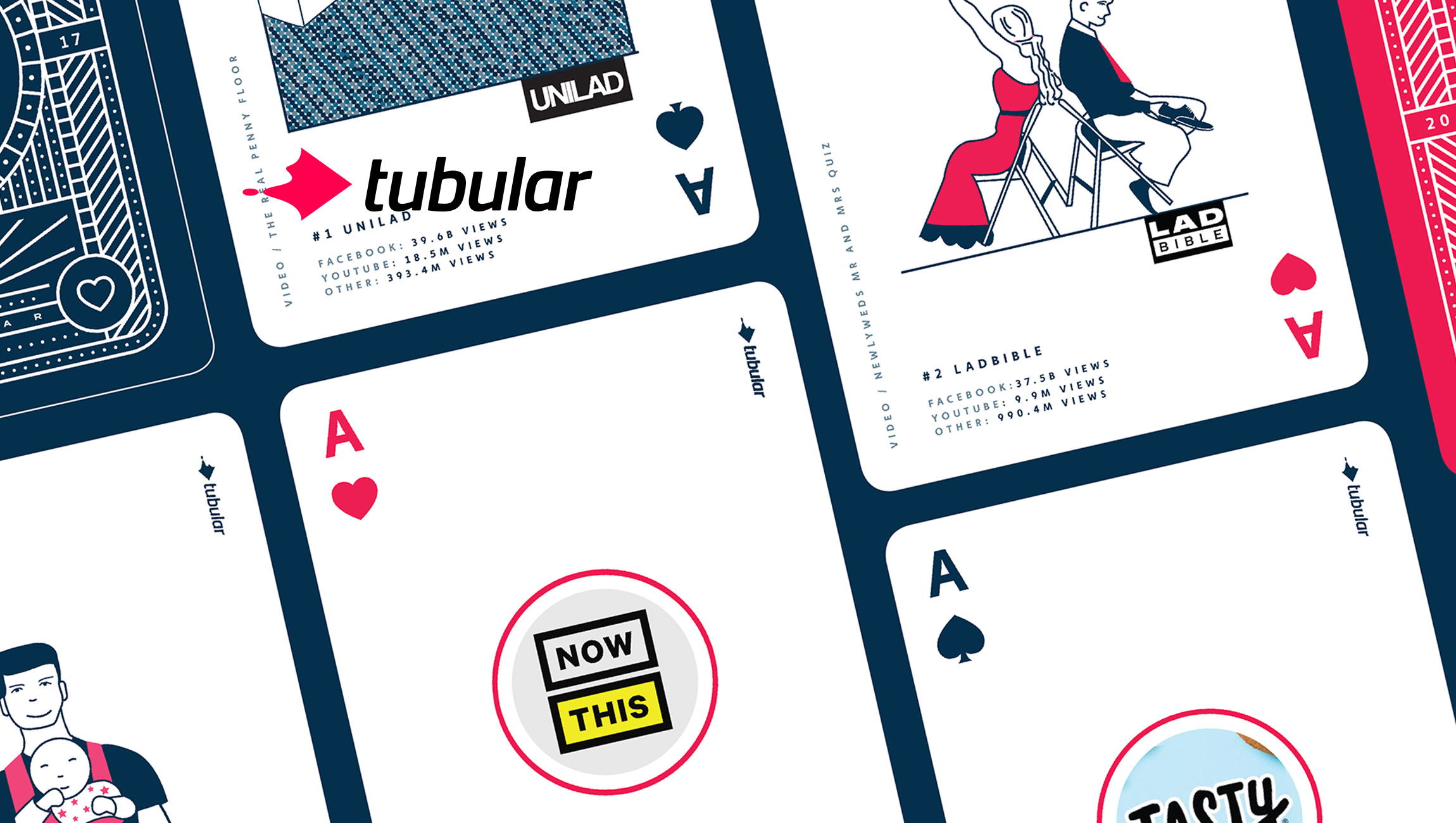
Tubular Labs, the leading global video measurement and analytics platform, announced its second annual global VideoAces Awards, honoring 2017’s top 52 media companies and creators in online video as well as the top brand partners on Facebook.  As part of the VideoAces Awards, the media company and brand partner winners will each receive a trophy. There will also be a customized deck of cards featuring illustrations of each winning creator’s most viewed video in 2017.

Recommended Read: Top Insights on the CMO’s Best Allies, Content Marketing, and the Art of Story-Telling for Brands

Allison Stern
Allison Stern

At the time of this announcement, Allison Stern, the Co-Founder and CMO of Tubular Labs, said,“With over 48% of consumers between the ages of 18 and 34 expected to switch their content consumption from television to social video by 2020, there’s no doubt that all content is converging to video.”

Allison added, “There were more than 10 Trillion video views in 2017. There’s a war for audience attention and the real winners are the publishers who create the most engaging and attention-grabbing content. Our VideoAces Awards recognize and applaud those winners as they charge forward creating the future of media.”

2017 VideoAces Award Winners

VideoAces Among the Top Global Media Companies

Buzzfeed ranked  #1 with 57.4 Billion Facebook and 7.4 Billion YouTube views followed by Time Warner with 25.0 Billion Facebook and 18.7 Billion YouTube views. LADbible, the largest online community for men ages 16-30 took the #3 spot with 51.3 Billion Facebook and 31.6 Million YouTube views.

The Walt Disney Company was at #4 with 20.6 Billion Facebook and 23.1 Billion YouTube views followed by UNILAD, a UK-based comedy and entertainment media company at #5 with 46 Billion Facebook and 18.5 Million YouTube views.

VideoAces from Top Global Media and Entertainment Creators

UNILAD held the #1 spot with 39.6 Billion Facebook views and 18.5 Million YouTube views, followed by LADbible, who held their spot at #2 with 37.5 Billion Facebook views and 9.9 Million YouTube views. VT, an online entertainment channel owned by Jungle Creations rose in the rankings this year at #3 with 31.0 Billion Facebook and 57.7K YouTube views. 9GAG: Go Fun the World, a global entertainment channel was #4 with 11.7 Billion Facebook views, followed by 5-Minute Crafts, a DIY crafts channel at 16.0 Billion Facebook and 3.4 Billion YouTube views.

Recommended Read: Outbrain Launches ‘Sphere’ for Unbiased Audience Development

VideoAces Among the Top Most Viewed Brand Partners on Facebook

BuzzFeed’s Tasty, the largest global social food network,  took the #1 spot with 1.0 Billion views, followed by NowThis, the No. 1  social news publisher in the world, owned by Group Nine Media at #2 with 406.4 Million views. The #3 spot went to VT with 341.3 Million views followed by Bleacher Report at #4 with 305.0 Million views and UNILAD, at #5 with 303.7 Million views.

VideoAces Recognized the 2017 Global Online Video Leaders Based on A Data-First Approach

Melissa Chapman, Chief Content Officer, Jungle Creations, said, “We’re proud to be recognized in Tubular Labs’ 2017 global online video leaderboards. 2017 was a massive year for Jungle Creations. Our flagship channel, VT, grew 12 million followers and went from an average of 2 to 3.2 Billion views a month, helping us become the most viewed media company on Facebook by November 2017. 2018 is set to be even bigger as we progress towards becoming the most viewed media company in the world.”

Ashley McCollum, General Manager, Tasty, said, “We’re honored to be recognized as the #1 brand partner on Facebook in the world, and proud of the massive reach and real-world results we deliver for marketers. Advertisers who partner with Tasty know what they’re getting: unparalleled reach, best-in-class creative, and a loyal, passionate fan base who are proven to make our recipes and buy the products we support.”

Read More: How is The Location Data Landscape Shaping Up in 2018?

Ashish Patel, Chief Insights Officer, Group Nine, said, “We’ve seen incredible growth over the last year since we formed Group Nine Media — emerging as a top 10 global media company. Our data-first approach has been key to guiding the evolution of our business as well as our content creation and optimization strategy.”

Ashish added, “We’re incredibly proud that NowThis (#2 in brand partners on Facebook) and The Dodo (#8 in media and entertainment creators) are being recognized in Tubular’s 2017 VideoAces awards and look forward to additional successes in 2018.”

Currently, Tubular provides the complete picture of what short-form video consumers watch and enable companies to grow digital audiences and sell brand integrations to win in the ever-evolving world of video.

Tubular’s software tracks over 4 Billion videos, 400 Million video consumers, 10 Million influencers, 90K brands, 40K media, and 48 Billion sponsored video views. In total, that’s over 350 Million more videos analyzed per month than our closest competitor.  We know it’s not just about data, it’s about insights, and that’s why we’re trusted by 7 of the top 10 global media companies, who make strategic decisions every day based on Tubular software. Behind every digital video decision – is Tubular.

Read More: Latest Katabat Customer Experience Management Releases Target Customer Centricity

StoryStream Partners With Brandwatch’s Vizia to Deliver AI-Enriched Social Content

0
storystream

The Partnership with StoryStream’s Content Marketing Platform Gives Brandwatch’s Vizia Access to Build Context for an Enriched Customer Experiences

StoryStream, leading AI-powered content marketing platform provider, today announced their partnership with Brandwatch, the world’s premier social intelligence group, on the launch of its Vizia data-visualization platform.

Read More: Adobe Unveils Next-Gen Content Intelligence to Transform Customer Experiences

The partnership will enable StoryStream’s proprietary artificial intelligence powered content management capabilities to be used within the Vizia’s platform, allowing Brandwatch customers to display the social content that matters most alongside insightful data-visualizations across organizations.

Brandwatch’s Vizia Would Leverage StorySteram’s AI-Brain, Aura to Make the Right Connections

StoryStream provides its next-generation content marketing platform powered by Aura™, an AI brain built for brands. Aura enables marketers to connect the right content with the right audiences at scale, transforming engagement and conversion.

Read Also: MarTech RADAR 2018: Top 150 B2B Technology Companies You Should Follow

Cameron Franks
Cameron Franks

At the time of this announcement, Cameron Franks, COO at StoryStream, said, “If you want to understand the true value of social and marketing data, you need to look into its context.”

Cameron added, “It can unveil a whole host of insights including the changing wants and needs of customers, new trends ahead of the curve and what customers really think when they see a brand. The partnership with StoryStream’s Content Marketing Platform™ gives Vizia access to that context. Numerical and traditionally rigid displays will now feature authentic customer and brand content together, creating a richer, and a more engaging experience.”

Brandwatch Customers Can Avail AI-Enriched Skills to Influence Customer Behavior

StoryStream’s Content Marketing Platform™ powered by Aura™, an AI brain built for brands, unifies digital asset management, multi-channel publishing, and advanced content analytics. The Platform uses Aura’s advanced AI skills to centralize, manage and publish both social and brand content directly to digital touchpoints to influence customer behavior.

With the new partnership, StoryStream can help Brandwatch customers who use Vizia to put AI enriched social content in context with its data-visualizations to deliver more engaging and authentic brand experiences.

Recommended Read: Lessons for Content Marketers from a Successful Cupid

Michael Brackpool, VP of Product for Vizia at Brandwatch, added, “The beauty of StoryStream is its ability to very quickly proving to marketers the content that resonates with their consumers. The power of Vizia is its ability to put insight right in front of key internal stakeholders and consumers, especially at the point of purchase in retail environments. With that said, Vizia and StoryStream have always felt like a natural fit.”

Time to Leverage AI-Driven Content Marketing Platform Powered by Social Media Intelligence

The revolutionary StoryStream Content Marketing Platform™ from StoryStream seamlessly combines digital asset management, multi-channel publishing and advanced content analytics with artificial intelligence to transform how marketers work, increasing efficiency and conversions with more relevant and meaningful content.

Currently, Brandwatch ranks among the world’s leading social intelligence companies, providing their flagship products — Brandwatch Analytics and the Vizia platform to fuel smarter decision-making.

The Brandwatch Analytics platform gathers millions of online conversations every day and provides users with the tools to analyze them, empowering the world’s most admired brands and agencies to make insightful, data-driven business decisions. The Vizia platform distributes visually-engaging insights to the physical places where the action happens.

Recommended Read: Top Insights on the CMO’s Best Allies, Content Marketing, and the Art of Story-Telling for Brands

Huddle Rooms and Open Office Spaces May Expand Audio Conferencing Endpoints

0
The Science of Loyalty: Intuit Mailchimp’s New Global Study Uncovers Fundamental Drivers of Consumer Behavior and Decision-Making Towards Brand Loyalty

In a Latest Frost & Sullivan Report, the Audio Conferencing Endpoint Vendors Are Adapting Their Solutions Functionality, Pricing, and Packaging to Cater to New Customer Requirements for Huddle Rooms Culture

Frost & Sullivan’s recent analysis, Global Audio Conferencing Endpoints Market, Forecast to 2021, finds that tight IT budgets, coupled with tough economic environments in different regions, deterred the demand for traditional audio conferencing endpointsHowever, new ways of working and widespread the usage of video collaboration services across organizations have considerably boosted the growth of meeting spaces in business settings.

Read More: TechBytes with Tom Rassweiler, VP, Content Reinvention, Arkadium

In addition, adoption of unified communications and collaboration (UCC) services, as well as the increased flexibility of endpoints to support multiple connectivity options such as VoIP, USB and Bluetooth, and the ability to adapt to various UCC environments, are expected to boost demand in the tabletop audio conferencing endpoint market.

Vaishno Devi Srinivasan, Industry Analyst, Connected Work, said, “The audio conferencing endpoint market is becoming highly competitive with multiple vendors expanding their product line to offer a holistic portfolio. To capture greater customer mindshare, vendors must innovate and adjust their value proposition in terms of price, product/service bundles, and product support.”

Businesses increasingly expect greater audio conferencing endpoint functionality at low price points. With the proliferation of video, incorporating it in the collaboration bundle seems to be a logical step for audio conferencing endpoint vendors. The convergence of video with audio endpoints to develop a low-cost bundle presents a significant growth opportunity for all vendors in this market.

Other highlights include —

  • By 2021, the global tabletop audio conferencing endpoints market is expected to reach $488.7 million and the installed audio conferencing endpoints market is expected to attain $73.5 million in revenue;
  • Expansion of the market will be boosted by easy-to-install and high-clarity endpoints in huddle rooms and open office spaces;
  • Convergence of video with audio endpoints to develop a low-cost audio-video bundle will cater to huddle room requirements;
  • The launch of all-in-one(AIO) installed audio-video integrated devices will entail new opportunities. AIO models are wall-mounted devices that encompass microphones, speakers, and cameras that target the less-complicated deployment use cases and professional audio requirements in huddle rooms.
  • In addition to the video, incorporation of content sharing capabilities broaden the use cases of tabletop audio conferencing endpoints. For Example, Polycom RealPresence Trio 8800.

Vaishno added, “Compelling new feature sets, attractive and user-friendly interfaces, effective pricing models and discounts, and more aggressive marketing of these value propositions will be essential to expand the user base.”

Global Audio Conferencing Endpoints Market, Forecast to 2021 is part of Frost & Sullivan’s Digital Transformation Growth Partnership Services program.

Read More: Fireside Chat with Shawn Schwegman

Mautic Announces Melissa Leffler as Their New Vice President of Engineering

0
mautic

Open Marketing Automation Leader Welcomes Accomplished Technology Executive as It Tackles Next Phase of Sharp Growth

Mautic, the world’s only Open Marketing Cloud, announced that Melissa Leffler has joined the company as its new Vice President of Engineering. Leffler brings an outstanding track record of building world-class teams and products, most recently in senior engineering leadership roles with Carbon Black.

“Adding an executive of Melissa’s caliber is a real affirmation of what we’re building, and will enable us to stay in front of expansive customer demand,” said Mautic CEO, Matt Johnston. “As our growth rate continues to climb, Melissa’s technical expertise and overall leadership will be integral to our engineering team, our expanding portfolio of marketing products and our fast-growing base of customers.”

Melissa joins the company amid rapid adoption of Mautic’s marketing automation cloud platform, most recently evidenced by a 3X increase in quarter-over-quarter sales at the end of 2017, and surpassing 100,000 organizations around the world utilizing the software.

“Incorporating flexible, open technologies is a major inhibitor to companies creating personalized experiences across their full customer lifecycle; and Mautic is the only open marketing solution that makes that easier,” said Leffler. “I’m impressed with Mautic’s incredible rate of adoption, and am thrilled to join a team whose mission aligns so well with my passion for building technology that solves important problems for business people.”

Melissa previously served in technical leadership roles for several Boston-area firms. This includes Objective Logistics, which she joined the near the time of its Series A funding. After helping scale the product infrastructure and engineering team, the company was later acquired by Carbon Black. Ms. Leffler also led engineering and business growth efforts for companies including Awareness, Liquid Machines and eRoom, which was acquired by Documentum.

Ms. Leffler will officially join Mautic at the company’s Boston-area headquarters next month where she’ll lead a growing, global team that is located predominantly in Boston and in the company’s newly-opened office in Prague.

Salesforce Is #1 in Fortune’s List Of ‘100 Best Companies to Work For’

0
Salesforce Is #1 in Fortune’s List Of ‘100 Best Companies to Work For’

Salesforce Takes First Place in the 2018 Fortune 100 Best Companies by Creating a Great Place to Work For All and Recognizing Workplace Culture Focused on Maximizing Human Potential

In a survey carried out by research firm Great Place to Work and Fortune, Salesforce emerged as the best company to work for. Salesforce has been on the list for the last entire decade, and for the first time topped the list titled ‘FORTUNE 100 Best Companies to Work For’.

Listing its reasons for the Numero Uno position for Salesforce, Fortune wrote, “From zealous encouragement of employee philanthropy to dedicated “mindfulness” rooms and entire floors celebrating the company “Ohana” (Hawaiian for “family”), Salesforce has forged an unusual corporate culture from the beginning. Now, thanks to its commitment to creating a uniquely rewarding work environment, Salesforce ranks No. 1 for the first time on Fortune’s annual list of the 100 Best Companies to Work For.”

The report added further, “It got there by offering rich rewards, both monetary and psychic. Many companies pay bounties to employees who refer new hires; Salesforce has paid out $5.5 million worth of them. The company also ferrets out strong performers who have gone 18 months without a promotion to help them find new challenges. And employees get paid 56 hours a year to volunteer in their community.”

Also Read: Salesforce to Invest $2 Billion in its Canadian Business Over Five Years

Salesforce Is #1 in Fortune’s List Of ‘100 Best Companies to Work For’

Salesforce Is #1 in Fortune’s List Of ‘100 Best Companies to Work For’
Cindy Robbins

“We are honored and humbled to be named to the FORTUNE list for the 10th year in a row, and we are proud to be featured alongside so many other inspiring companies that care about creating a culture of trust. I can attest that this has been quite a journey – we have been working toward this goal for a long time, so the recognition truly means a lot,” wrote Cindy Robbins, President and Chief People Officer at Salesforce, in a blog entry on the company’s website.

“At Salesforce, we believe nothing is more important than our people. We are an Ohana – the Hawaiian word for family – that includes our customers, employees, partners, and communities. We inspire each other and the industry through our values of trust, growth, innovation and equality. Our culture comes to life through our behaviors and the experiences we deliver that all feel uniquely us – in our products, events, and workspaces, and in the ways that we give back to make the world a better place through our 1-1-1 model,” added Cindy.

Also Read: Salesforce Chairman and CEO Marc Benioff to Speak at The New York Times New Work Summit

Salesforce Is #1 in Fortune’s List Of ‘100 Best Companies to Work For’
Michael Bush

PRNewswire quoted Michael Bush, CEO of Great Place to Work, saying, “Central to our new approach is Maximizing Human Potential. We now assess how well companies create a consistently positive experience for all employees, no matter who they are or what they do for the organization. We did this to reflect the reality of the world today and to recognize and learn from the inclusive organizations that are setting the pace. Not just for moral reasons, but for business reasons. Companies that rate most highly according to our new ‘For All’ standard grow revenue three times faster than their less-inclusive rivals. In other words, while trust fuels business performance at great workplaces, ‘For All’ accelerates it. Today we celebrate the 100 Best Companies that are leading the way in building an outstanding culture for all.”

Salesforce Is #1 in Fortune’s List Of ‘100 Best Companies to Work For’
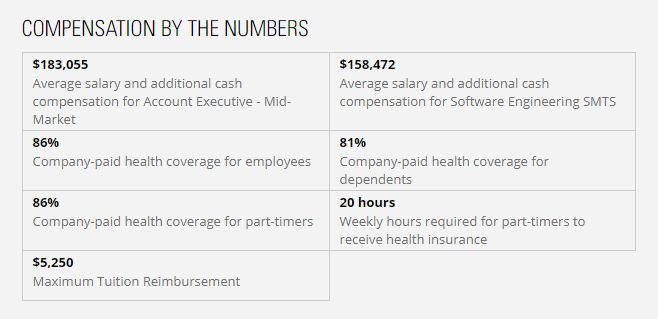
What Salesforce employees have to say about the company

The Top Ten Best Companies:

  1. Salesforce
  2. Wegmans Food Markets
  3. Ultimate Software
  4. Boston Consulting Group
  5. Edward Jones
  6. Kimpton Hotels
  7. Workday
  8. Genentech
  9. Hyatt Hotels
  10. Kimley-Horn and Associates

In its review of Salesforce, Great Place to Work cited,
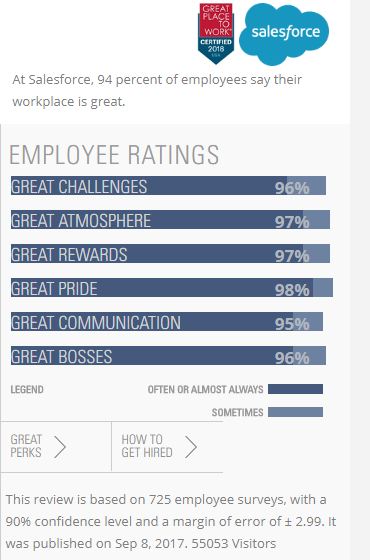
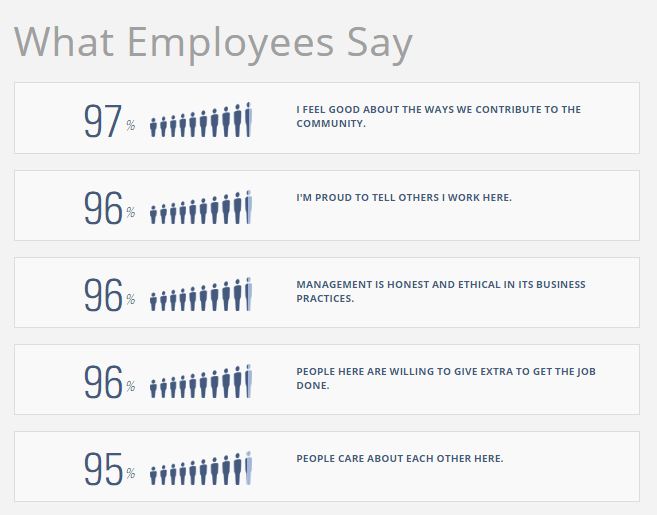
“At Salesforce, 94 percent of employees say their workplace is great.”

Salesforce has also been awarded:

  • Best Workplaces for Technology 2018 (Large) (ranked 3)
  • Best Workplaces in Chicago 2017 (ranked 10)
  • People Companies That Care 2017 (ranked 1)
  • Best Workplaces for Parents 2017 (ranked 5)
  • Best Workplaces for Giving Back 2017 (ranked 1)
  • Best Workplaces for Diversity 2017 (ranked 4)

Also Read: Iridescent Announces 2018 Technovation Alliance with Salesforce, Google’s Made with Code, Adobe Foundation and Uber

This year Great Place to Work employed new methodology using six metrics, namely, values, trust, innovation, financial growth, leadership effectiveness, and maximizing human potential — to take a more accurate reading of how a company’s great workplace culture translates to its growth and corporate excellence. Each company was scored after a review of their employee surveys and culture audit.

Salesforce Is #1 in Fortune’s List Of ‘100 Best Companies to Work For’
One of the many criteria that helped Salesforce top the list

Great Place to Work surveyed more than 310,000 employees across all sectors of the economy, assessing 50-plus elements of the workplace. These include trust in managers, compensation, fairness, camaraderie and workplace traits linked to innovation. The ranking accounted for the experiences of all employees including women, people of color, LGBT individuals, older team members, and disabled employees.

Recommended Read: The​ ​One​ ​Value​ ​that​ ​Salesforce​ ​and​ ​GDPR​ ​have​ ​in​ ​Common 

Conversica Customer CenturyLink to Present at B2B Marketing Exchange Conference

0
Conversica Customer CenturyLink to Present at B2B Marketing Exchange Conference

Award-Winning Marketing Leader Kate Cindric Federhar to Share How Conversica’s AI Sales Assistant Engages Prospects and Turns Them into Sales Opportunities

Conversica, the leader in conversational AI for business, announced that Kate Cindric Federhar, manager of marketing operations at CenturyLink, will be presenting at the B2B Marketing Exchange conference taking place this week in Scottsdale.

Conversica Customer CenturyLink to Present at B2B Marketing Exchange Conference
Kate Cindric Federhar

Federhar, a recent DemandGen B2B Innovator Award recipient, says that CenturyLink is using true conversational AI today to engage leads at scale and improve the sales funnel. At the conference, she will explain how conversational AI has enhanced her ability to help fill the top of the sales team’s funnel and why she decided to deploy her AI-powered Sales Assistant, “Angie,” which uses human-like two-way conversations to automatically engage and qualify leads, freeing up sales reps to close more business.

Also Read: Amazon Leads Home Voice Control Assessment, Says Study by ABI Research

In the conference case study session, she’ll demonstrate how Angie has improved ROI by increasing follow-up capacity and enabling CenturyLink to reach out to more prospects overall, including new audience segments. Her session, “It’s true – AI really talks with my prospects and turns them into pipeline opportunities,” will address:

  • How conversational AI is being applied today to boost lead engagement and conversion
  • How to integrate conversational AI with a marketing automation platform for best results
  • Best practices for boosting lead conversion rates, with or without automation

“I’m excited to share CenturyLink’s experience and successes using conversational AI and how attendees can use Conversica’s AI-powered conversations to contact, engage and qualify leads,” said Federhar.

Also Read: Conversica, an Oracle Partner, Now Deeply Integrated with Oracle’s Customer Experience Suite

Conversica Customer CenturyLink to Present at B2B Marketing Exchange Conference
Carl Landers

“I am thrilled to have our successful customer CenturyLink presenting their use of Conversica at the B2B Marketing Exchange. Like many of our customers, CenturyLink has increased the conversion of leads into sales opportunities by deploying our AI sales assistant to ensure prompt, personal and persistent follow-up on every single lead. Having seen Kate speak, I know conference attendees will enjoy hearing from her how the simple application of AI to their conversion process could increase the number of qualified leads they pass to their sales teams,” said Carl Landers, Conversica CMO.

Also Read: Conversica Voted Best Salesforce App at Dreamforce 17

Conversica at the Conference

In addition to attending the case study session, B2B Marketing Exchange attendees are invited to visit Conversica’s booth to see conversational AI at work engaging, qualifying and following up with sales leads in real time and learn:

  • How to boost the return on lead generation efforts by following up with every single lead in a prompt, persistent and personable way
  • How to delight Sales by automatically converting more leads into qualified opportunities
  • How to determine in real time which lead sources are producing the most engaged leads

Recommended Read: Why Every Marketer Needs to Focus on Conversations in 2018

Tapad Redefines Business to Deliver Personalization at Scale to Marketers

0
tapad

Marketing Technology Leader Tapad Shifts to Identity-Driven Model Launching New Vertical-specific Customer Data Platform

Tapad, the company reinventing personalization for the modern marketer, announced a global rebrand to focus its resources on creating best-in-class identity solutions for marketers. This rebrand includes the renaming of the company’s proprietary device graph technology to The Tapad Graph, and the introduction of the Tapad Customer Data Platform (CDP), a platform purpose-built to help marketers better connect and engage with both new and existing customers. The new offering, which makes marketers’ first-party data actionable against The Tapad Graph, is today initially being launched to the telecommunications industry.

“Tapad is always evolving with the marketplace to ensure we are continually solving for the growing complexities faced by digital marketers”, said Sigvart Voss Eriksen, CEO of Tapad. “This shift in our business serves as a strong indicator of our commitment to delivering industry-forward products, particularly where big data meets personalization. For nearly a decade we have led the market in cross-device technology, which has set us up to scale beyond devices and provide the industry with the most comprehensive identity solutions.”

Also Read:  TechBytes with Preethy Vaidyanathan, Chief Product Officer at Tapad

While many marketers have their own rich data, they often do not have a holistic view of their existing customers and lack the visibility to personalize content for external prospects. The Tapad CDP solves this challenge by providing marketers with unparalleled identity insights from the Tapad Graph, which creates a scalable cost-effective solution for marketers to view and identify customer segments.

Initially available to global telco customers, the Tapad CDP is purpose-built to offer telco marketers a highly personalized and privacy-safe platform to easily convert first and third-party data into actionable, results-driven campaigns. Tapad’s parent company, Telenor Group, has provided a critical avenue for developing the CDP solution as several Telenor subsidiaries across the globe have leveraged and found value with the CDP. For example, a Telenor Group subsidiary in the Nordics used the Tapad CDP to maximize new customer acquisition and achieve a 34 percent lower cost per acquisition (CPA). Telenor subsidiaries in Southeast Asia realized similar success, with one subsidiary achieving a 75 percent lower CPA and another achieving 7.7x ROI.

“Telenor has vast amounts of insights and data for existing customers, and we want to better utilize this to deliver more personalized customer experiences,” says Svein Henning Kirkeng, EVP and Telenor Group CMO. “With Tapad’s ability to merge data from previously siloed systems, we can coherently engage with customers across the different channels in which we operate. Furthermore, we’re able to leverage our insights to identify new potential customers with similar attributes, and deliver a personalized value proposition. What makes us really excited about this is how Tapad’s CDP enables us to build a holistic understanding of our existing and new potential customers, take action on those insights, and continuously improve the customer experience by learning from every interaction we have with our customers.”

The Tapad CDP and Tapad’s wider product suite are nearing GDPR compliance for May 2018, further establishing its ongoing commitment to privacy and transparency in every country in which it operates.

Can Publishers And Agencies Survive In A World Led By The Duopoly?

0
Can Publishers And Agencies Survive In A World Led By The Duopoly?

SonobiThere were some key buzzwords that drove a lot of the chatter in the advertising community in 2017, and none was more buzz-worthy than “the duopoly” — a word used to describe mass media platforms Google and Facebook. There is a clear reason why the duopoly became a sensational subject in the trades:

The duopoly is expected to rake in a combined 63% of US digital ad investment in 2017 — up over 15% from the previous year.

This investment trend isn’t because buyers want to massively consolidate and concentrate spend but because for buyers, sometimes it’s just easier to buy on a mass media platform where you know you’ll address the audience you want through a simple platform that has efficient ad products.  Media buyer investment became concentrated across the few simply because the duopoly enables them to deliver advertising to qualified audiences with unparalleled precision and scale.

Also Read: Facebook & Google: A Media Duopoly Under Scrutiny

Well, what is the value that the agencies are creating in a world where digital investment is being placed into a few media companies?  How can they survive and continue to drive value without purchasing power?

The value has come down to the audience tactics, they put in place, in driving effective distribution.  We saw that through multiple agencies making moves into the audience creation space such as Publicis’, Densu Ageis and our partnership with Merkle.

And despite all of this added value being created, there were problems in paradise. Brands began to notice the unsafe environments they were being placed in. The headlines focused on brands pulling out of the duopolies over concerns of brand safety. We saw complaints about brand safety issues —  ads appearing alongside videos promoting hate, racism, and violence. Blue-chip advertisers including Johnson & Johnson, Verizon, and Walmart said they would pull their advertising from these channels as a result.

Also Read: Digital Content Next Report Finds Facebook, Google Experiences Together Account for Less Than 5% of Total Digital Revenue for Publishers

In using larger scale media companies such as Google and Facebook, media buyers have limited their control over contextual adjacency. This is problematic when context can impact brand performance. Advertiser messages that are seen in a non-premium environment can damage the brand’s images in certain cases — Hearts & Science just released a massive bit of research about this.

Brands want to align their messaging with someone who has a similar “POV” or puts there the message in a context that is relevant to the sale of their products. This is where premium publishers come in.

Ironically, the premium publishers are creating content that the duopoly syndicates through user sharing.

So why isn’t the investment going to the content creator/premium publishers? Well, there are a couple of reasons that are driving this.

  1. The audience targeting is less accurate and efficient in comparison to the duopoly companies.
  2. The inventory is difficult to access and activate. You need to work with multiple parties to build out a plan.

Enter programmatic — how advertisers are bringing the targeting and scale advertisers receive through the large-scale platforms to the world of premium content.

Or so we all thought…

Also Read: GDPR Will Drive A Coach And Horses Through The Online Advertising Ecosystem

While you can use programmatic technology to get some of the value you get from the larger scale media companies of targeting, and scale there comes with it a great amount of time, effort and cost to combat issues like fraud, viewability, non-human traffic, etc that arise. In today’s complex, programmatic digital world, getting a meaningful message to an interested audience involves multiple intermediaries, making it difficult for brands and their agencies to meet campaign objectives and to manage the spend efficiently.

On top of that, GDPR is forcing brands, agencies and publishers to re-imagine the digital media conversation that is had with consumers — and will force all parties to stop assuming consent. All parties involved will need to be mindful of how the regulations apply to an individual’s right to be forgotten.

The onus falls upon the user/relation connection, the publisher OR the device itself (in cases of a Device ID) to validate the user’s acceptance and understanding of what to do with their data and handle it accordingly – and only pass through the data when approved in GDPR-enforced locations by GDPR-compliant parties. The difference between GDPR and previous industry-led initiatives are the fines for noncompliance and the belief that the EU will make an early and noteworthy example of those that are in breach of GDPR. 

Also Read: 3 Reasons Why Marketers Should Welcome GDPR (Other Than Because It’s Required!)

WTF Happens Now? What Agencies and Publishers Need to Think About Going into 2018

It takes a village to go up against a giant — agencies and publishers can work together to take on the duopoly.

It Will Take Data

Focusing on unified data solutions and collaboration will be key to connecting CRM data to publishers’ data signals. Each advertiser syncs their data into their CRM(s) of choice. Often times a single holding company of multiple national brands will support multiple CRMs based on brand-by-brand decisions. Working with multiple CRMs is immaterial within the “walled garden” where advertisers are able to sync their CRM data of choice into the ID space, offering an addressable solution.

Also Read: How to Pick the Right CRM: 3 Key Ingredients

Therefore, by applying this paradigm and creating a universal ID across CRM companies can solve for current constraints with addressable across comScore to equip agencies and publishers to deliver better business results.

To get there, we need technology that unifies data by synthesizing 1st, 2nd, and 3rd party data sources — including cookie and device data to PII compliant CRM and publisher login/registration data — in a privacy compliant manner. It will enable brands to take their first-party customer data and combines it with a publisher’s subscription/login user data in a privacy compliant manner.

The result will be that media buyers can move beyond targeting devices or content as a proxy for audiences and reach their customers on a one-to-one basis, across display, mobile, and video content.

Also Read: Why Your CRM Is Lying to You

It Will Take a Direct Platform

The publishers and agencies need to work with technology companies that can help unify the inventory ecosystem to eliminate needless intermediaries and help media buyers procure media in a simple and easy way based on their audiences. If it isn’t easy, it will not scale as quickly.

It will take Participation

Publishers need to combine their content and their data through technology. Advertisers need to shift spend towards reaching their audiences in premium content environments. A boat doesn’t move forward if everyone is paddling in their own direction.

Also Read: Sharethrough For Publishers Supply Side Platform Passes Major Milestone

2018 – The Year Ahead

With the new year and new resolutions upon us, now is an opportune time for the market to evaluate how technology can help build a fair and equitable marketplace, where agencies and publishers continue to thrive.

Publishers: Develop a plan to participate in a data strategy that creates a viable alternative around the walled gardens. Carefully evaluate how to ensure your premium content environment is surfaced directly to advertisers without intermediaries.

Agencies: Support technology that can connect your data directly to premium publishers outside the walled gardens.

Let’s work collectively to help brands make sense of the media ecosystem and drive results through the content and audiences that make the web what it is.  Through chaos, there will be clarity.

Recommended Read: Need for Data Orchestration for Contextualizing Customer Experience

Faye Business Systems Group to Sponsor SugarCRM Worldwide Sales Kick Off Conference

0
Faye Business Systems Group to Sponsor SugarCRM Worldwide Sales Kick Off Conference

Faye Business Systems Group heads to Sorrento, Italy as a Sponsor of the SugarCRM Worldwide Sales Kick Off

Faye Business Systems Group has announced their sponsorship of the SugarCRM worldwide Sales Kick Off conference in Sorrento, Italy.

Also Read: SugarCRM Elite Partner Faye Business Systems Group Acquires Oasis Solutions Sugar Clients

The SugarCRM worldwide Sales Kick Off brings together the SugarCRM executive leadership, sales representatives, and customer success managers, with the SugarCRM global partner channel, for three days of training, planning, and networking. As a Sales driven activity, the focus of this year’s Sales Kick Off is to drive alignment and a consistent strategy in the SugarCRM ecosystem for 2018.

Also Read: SugarCRM Focuses on ‘Accelerated Innovation’ with New Cloud Offering

As a sponsor of the Sales Kick Off, Faye Business Systems Group with be hosting strategic partnership meetings within the SugarCRM ecosystem and showcasing their suite of Sugar Integrations and Add-Ons.

The FayeBSG team will also be working with the SugarCRM partner community to expand the reach of their Partner Program. The FayeBSG partner program gives organizations the ability to resell FayeBSG’s suite of Sugar Integrations and Add-ons, as well as utilize the services and knowledge of a long time Sugar Elite Partner.

Faye Business Systems Group is one of only a handful of SugarCRM “Elite” Partners among 650+ global partners. They are known for their breadth of SugarCRM Integration Add-On Products and custom software solutions as well as their strong technical know-how in successful CRM implementations. FayeBSG has built Sugar integrations with ERP software, credit card processing, project management, phone systems, and more.

Also Read: SugarCRM Elite Partner Faye Business Systems Group Announces Partnership with AgileField

The FayeBSG team has over two decades of experience, specializing in extensive multi-layered CRM, ERP and marketing integrations. They concentrate on a wide array of high-value CRM, ERP, and marketing automation development and consulting services with services including project management, consulting, system builds, data migration, custom software development, training, and ongoing support.

Faye Business Systems Group to Sponsor SugarCRM Worldwide Sales Kick Off Conference
David Faye

“We’re really excited to network and connect with the global community of SugarCRM executives and channel partners in Sorrento. As a long time SugarCRM partner we value any opportunity to connect with like-minded organizations to discuss all things Sugar,” said David Faye, CEO at FayeBSG.

Recommended Read: How to Pick the Right CRM: 3 Key Ingredients

Digital Customer Experience Will Enhance India’s Role in CX Services Delivery

0
Digital Customer Experience Will Enhance India's Role in CX Services Delivery

NelsonHall and NASSCOM have launched a new study titled Digital Customer Experience Services: How India Can Lead the World which reveals that, despite suggestions that the rise of digital channels will lead to reduced outsourcing and a shift away from offshore service delivery, the opposite is the case – and India is set to benefit.

As organizations transform to ‘digital customer experience’, they will increasingly implement new digital customer service process models, combining:

  • High customer-centricity led by customer journey mapping and improved UX design
  • Increased emphasis on customer retention and sales
  • New technologies such as cloud-based platforms, NLP, analytics, RPA and machine learning, and new channels such as cognitive chatbots
  • Improved knowledge base, analytics and insights
  • Upskilling of agents to multi-channel with focus on digital channels and proactive support.

Also Read: Customer Experience Pioneer and Leader TTEC Launches New Look to Complement New Name

However, while it has been widely suggested that the rise in the use of digital channels and the decline in voice-based customer service will lead to reduced outsourcing and the transition of services to onshore, the study has found the opposite. Indeed, digital channels will lead to greater adoption of customer service outsourcing with:

  • Shoring largely unaffected by the introduction of next-generation customer service models.
  • Increased automation/digitalization leading to increased activity in India, especially in areas such as analytics.

The reasons are that customer service organizations will increasingly seek help in designing new digital services, in implementing digital channels & technologies, and in applying analytics. And India excels in these areas, with agents who are highly technically savvy.

Hence, India’s CX value proposition will increase, from one based on agent availability and scalability to one of being a high-skill digital CX center of excellence.

Also Read: Latest Katabat Customer Experience Management Releases Target Customer Centricity

While traditional customer service was largely transactional with limited multi and omnichannel provision, India’s advantages were based on the availability of a large, willing and capable talent pool, ease and speed of scalability, and competitive costs. However, in the emerging world of digital CX, India’s service delivery will become consultancy/digital transformation-led and provide full digital omnichannel service.

The report Digital Customer Experience Services: How India Can Lead the World analyses and provides guidance on:

  • Changing client requirements and expectations from next-generation CX services
  • Use of new business models & technologies, and best practice frameworks
  • The level of benefit from new business models & technologies
  • Case studies of customer service innovation
  • A roadmap for achieving leadership in next-generation digital CX services.

Recommended Read: Need for Data Orchestration for Contextualizing Customer Experience

Borderless Access Launches ‘TAPP’ – Key to the World of Consumer Behaviour and Emotions

0
Borderless Access Launches 'TAPP' - Key to the World of Consumer Behaviour and Emotions

TAPP Empowers Marketers and Researchers to Target In-Situ and Efficiently Develop Content as per Their Stories

Borderless Access, a global Digital MR Solutions Company, brings diverse consumer behaviour, emotions, and micro-moments within easy reach of brands with its new revolutionary product ‘TAPP’ This launch is in line with its vision to be the global leader in providing digital market research solutions for understanding consumer experiences and behaviours, in growth and developed markets of the world; driven by advanced Analytics and Technology.

Borderless Access Launches 'TAPP' - Key to the World of Consumer Behaviour and Emotions
Ruchika Gupta

Commenting on the launch of TAPP, Ruchika Gupta, CEO of Borderless Access, said, “As smartphones, social media and other digital communication platforms usage grows, it offers extensive opportunities to understand consumer behavior in real-time and greater detail than ever before. This can be a boon for brands that are always looking for ways to reach out to their customers at the right moment to offer their products and services. With our years of experience in understanding consumers across geographies, we built TAPP, which has been pilot tested with two major global brands, allowing them to understand life moments and experiences of consumers at different timeslots and locations.”

Also Read: Harvard Professor Stefan Thomke Joins Optimizely Advisory Board as Company Momentum Continues

The product TAPP identifies patterns and trends by looking into consumers’ interactions and their emotional state and behavior within their environment with its unique methodologies and machine learning algorithms for rich, easy to interpret, actionable insights for brands. With TAPP, marketers and researchers can understand consumers’ micro-moments to develop communication, manage brand activation, test concepts, evolve products, and much more.

TAPP empowers marketers and researchers to target in-situ and efficiently develop content as per their stories.

Borderless Access , a global digital MR solutions company, provides access to experiences and life moments of engaged consumers from hard-to-reach audiences (Consumers, B2B & Specialist Audiences, including Healthcare) in the emerging and developed markets, driven by Technology & Community Analytics to its global clientele of MR firms, Ad Agencies, Consultancy firms, and End Enterprises. Its focus on innovation extends to providing market research products & solutions, such as Panel Solutions, SmartSight, HealthSight, and TAPP.

Recommended Read: Need for Data Orchestration for Contextualizing Customer Experience

Spearfishing in a Big Net World

2
Spearfishing in a Big Net World

How Connected TV Finally Brings Digital Precision to Broadcast

SteelHouseBefore Jimmy Fallon or even Johnny Carson, there was Milton Berle’s Texaco Star Theatre, which in 1950 captured vast numbers of TV viewers. OK – it was the only thing on. In fact, on any given Tuesday it reached 9% of the US population. Back then, black-and-white TVs ran about $300, while their color counterparts cost $1,000 — respectively $3,070 and $10,240 in today’s dollars! Additionally, only those located in urban areas could get a signal. Thanks to these restrictions, what resulted was audience targeting without actually having to target. Television advertisers could reach an upscale audience of tech-forward early adopters living near metro areas, just by placing an ad on TV. The issue was, only the largest brands could afford to do so.

Also Read: SteelHouse Releases Technology that Disrupts Manual Media Buying

By 1960, a lot had changed — more than 90% of households had a television and the “big net” of broadcast tv was catching everyone. For companies like Wonder Bread, Kraft, Coke, and Volkswagen this was great, allowing them to leverage TV’s broad exposure to drive their business.

Over time, as more networks created shows that catered to specific audiences, people had more choices and so did advertisers. If you’ve ever watched the show Mad Men, you might recall how early TV buyers would evaluate every show to determine if it was a brand fit. Advertisers would get a report from Nielsen on who was watching each show, and if enough of their desired audience was included, they would purchase an ad slot. Of course, if anyone outside of their audience was watching they paid for them as well, but that was just how it worked.

Also Read: OTT Explosion Provides Safe Platform For Marketers

Here’s what’s changed about broadcast TV buying since then: nothing. For decades there have been promises and attempts to change the medium from a one-to-many, passive experience, to a fully interactive one-to-one experience. The dream always includes an ability to target individual viewers with ads that are relevant to them, during programming that is appropriate for the brand. This would finally eliminate the inefficiencies of casting such a large net, making TV advertising more accessible.

Enter Connected TV (or CTV) which has completely changed how people watch television. This isn’t user-generated content like the videos available on YouTube. We’re talking all of your favorite shows, whether developed by traditional networks like NBC or by digital-only media companies like Crackle. Premium content providers are distributing ad-supported content through their own apps, which can run on virtually any device that can access the internet. So whether you have an Apple TV, Xbox, iPhone, or any other CTV compatible device — you can stream what you want, when you want.

Also Read: SteelHouse Releases AI Technology that Disrupts Manual Media Buying

The promised vision for traditional television targeting has finally been realized, it’s just taking place on CTV. Connected TV ads are far more targeted, measurable, affordable, and efficient than traditional broadcast TV, and they’re available programmatically. Advertisers can simply buy an audience instead of ad time on individual shows that some of their audience might be watching. Thanks to targeting, brands aren’t forced to pay premiums for viewers who would never engage with their brand in the first place.

Connected TV provides all the benefits of digital. Advertisers can target by a demo, psycho, behavioral, and interest-based criteria, and it’s all brand safe. They get 100% of their audience and can reach them on the devices used the most. And these ads actually get watched, not skipped or fast-forwarded through. Brands can take advantage of cross-device capabilities to track viewers’ brand interactions across different devices, at different times, with reliable reporting so they know what works.

Also Read: SteelHouse Storms Advertising Week New York With The Los Angeles Times’ Ross Levinsohn, BuzzFeed, Magna Global, And More

CTV already has a big audience, and it’s exponentially growing. More than 60% of the Americans are watching CTV regularly and over 400,000 people are joining that rank every month. And it’s finally an audience that can be bought by brands of every size.

With all this growth and change, incorporating CTV advertising may sound like a monumental task but it can actually be managed by the same platform as the rest of a marketer’s digital mix. There’s no need to create a new team, add more team members, or even have your agency bill more. So unlike learning how to actually spearfish, targeting your audience using Connected TV is an easy addition to every brand’s digital media plan.

Recommended Read: Fast Forward Your Video Content Strategy in 2018

Interview with Nicolette Cieslak, Director, Demand Generation, Showpad

0
Nicolette Cieslak Showpad

[easy-profiles profile_twitter=”https://twitter.com/showpad” profile_linkedin=”https://www.linkedin.com/in/nicolettecieslak/”]
[mnky_testimonial_slider slide_speed=”3″][mnky_testimonial name=”” author_dec=”” position=”Designer”]“As the marketing funnel evolves, it has become increasingly important for them to focus their efforts on the bottom of the funnel and help sales bring the deal across the line.”[/mnky_testimonial][/mnky_testimonial_slider]

Tell us a little bit about your role at Showpad and the team you handle?

I lead the demand generation team globally, which includes digital marketing, programs, marketing automation, field marketing and events. My team of 10 demand marketing all-stars is spread across Europe and the US.

What draws you to the Revenue Summit 2018?

As a demand gen leader, I’ve always measured my marketing success against the same metrics as sales – pipeline and revenue contribution – and believe that alignment has been key to building effective demand engines. But as the marketing funnel evolves it has become increasingly important for marketing to focus their efforts on the bottom of the funnel and helping sales bring the deal across the line.

And as a company, Showpad is driven to bridge the gap between sales and marketing teams, which is why Revenue Summit is such a great event. The folks at Sales Hacker embody our belief that sales and marketing alignment is key to driving more revenue faster and ultimately realizing sales and marketing success.

Which sessions at the Revenue Summit 2018 would you recommend and why?

Marketing and Sales Orchestration and Full Funnel Forecasting back to back sessions on sales and marketing alignment from a qualitative and quantitative perspective.

Which verticals is Showpad looking to target to grow its revenues in 2018?

One of the best things about Showpad is that we’re intensely focused on empowering our customers to deliver a better buyer experience – and that message and belief translates across verticals. We’ve established a strong foothold in a wide range of industries – from chemical and construction to medical devices and manufacturing – and will continue to keep expanding into other verticals that value a better buyer experience as a key differentiator.

At Showpad, how is technology leveraged to help Sales and Marketing align?

We use analytics and engagement data at every stage of the funnel to garner actionable insights and have a closed loop feedback cycle established with our sales teams.

What tools does your marketing stack consist of?

WordPress, Google, GoToWebinar, Wistia, Marketo, Showpad, and Salesforce

How do you prepare for an AI-centric world as a sales leader?

The first step is to recognize that AI holds incredible potential to supercharge buyer alignment. We all know that a one-size-fits-all approach is no longer adequate for today’s sales situations. Reps need to be trusted advisors and actively bring value to sales conversations. So instead of guessing at which content works best for each customer, AI empowers them to make data-based decisions to drive prospects through the funnel.

This Is How I Work

One word that best describes how you work.

Iterative.

What apps/software/tools can’t you live without?

Google Calendar, Marketo, Salesforce.

What’s your smartest work related shortcut or productivity hack?

Hire well!

What are you currently reading?

Currently reading Originals by Adam Grant and generally, I’m an avid podcast consumer especially for professional learning, masters of scale and sales benchmark index are both good ones.

What’s the best advice you’ve ever received?

Setting boundaries helps others as much as it helps you, because then people know how best to work with you and eliminates ambiguity.

Tag the one person in the industry whose answers to these questions you would love to read:

Dave Gerhardt, Director of Marketing at Drift

Thank you Nicolette! That was fun and hope to see you back on MarTech Series soon.

[vc_tta_tabs][vc_tta_section title=”About Nicolette” tab_id=”1501785390157-b58e162d-0ae25a4b-c27aca64-108e51b0-80edaf37-bd3d357a-6c46a7f7-e7a2″]

Nicolette is a proactive, get-it-done marketing leader with 13+ years of experience in the tech industry in developing cost-effective, targeted lead generation strategies. She is dedicated to helping companies deliver engaging and valuable client experiences to guide the buyer journey.

[/vc_tta_section][vc_tta_section title=”About Showpad” tab_id=”1501785390320-2d44fa50-740c5a4b-c27aca64-108e51b0-80edaf37-bd3d357a-6c46a7f7-e7a2″]


Showpad is the world’s most powerful sales enablement platform focused on helping sales teams deliver the best buyer experience through smarter and more relevant conversations with their customers and prospects. Founded in 2011, Showpad’s intuitive and robust platform allows marketers to maximize their impact on sales success while empowering sales teams to have more personalized and impactful interactions.

[/vc_tta_section][/vc_tta_tabs]
[mnky_heading title=”MarTech Interview Series” link=”url:https%3A%2F%2Fmartechseries-67ee47.ingress-bonde.easywp.com%2Fcategory%2Fmts-insights%2Finterviews%2F|||”]

The MTS Martech Interview Series is a fun Q&A style chat which we really enjoy doing with martech leaders. With inspiration from Lifehacker’s How I work interviews, the MarTech Series Interviews follows a two part format On Marketing Technology, and This Is How I Work. The format was chosen because when we decided to start an interview series with the biggest and brightest minds in martech – we wanted to get insight into two areas … one – their ideas on marketing tech and two – insights into the philosophy and methods that make these leaders tick.

TechBytes with Ian James, GM, International, Verve

0
Ian James

Ian James
GM International,  Verve

The tech industry has come a long way in utilizing Location Data to enhance modern marketing opportunities. Most mobile apps now seek a customer’s geo-location to update and present features that could be most relevant to their real-time behavior. To dive deeper into how Digital Marketing Agencies and Customer Experience platforms could better leverage Location Data, we spoke to Ian James of Verve.

Tell us about your role at Verve and the team you handle.

As the General Manager International at Verve, I am in charge of the strategic direction of the business across international markets. I primarily oversee my team of nine who are responsible for the business development, sales, product and marketing departments at Verve. In addition, I work alongside the global leadership team to strategize the growth of the company.

From a digital marketer’s perspective, how would you define ‘Location Data”?

The advent of the internet is the single biggest transformational event that has affected the way in which we communicate. The catalyst that saw the beginning of the web as we now know it, took hold of our screens and transformed our daily lives.

And then the mobile device grew in power. This was a never seen before opportunity for marketers, opening the doors to new ways of communication. Technology has moved the digital world into our pockets, and consumers are now targeted at every single touch point of their daily journeys, which has led to a demand for personalization, relevancy and transparency.

Location data, albeit still holding some misunderstanding due to poor management and use in the past, is beginning to provide advertisers with the niche golden ticket to solve their business problems; attracting more real-world actions, and driving revenues.

Location data is the ‘secret sauce’ of communication, relevancy and personalization.

Also Read:  Hitting The Spot with Location Data

How relevant is it for marketers to work on location data?

Location-based services provide added value for individuals in the form of new utilities embedded in their personal device. These services help us to understand consumers’ frequently visited places, behavioral patterns and interests, neighboring venues, cultural influencers and so on. For marketers, these are unique, invaluable insights that other data sets simply cannot provide.

It is a technology that allows human beings to encounter personalized experiences in a kind of technologically augmented serendipity.

But this pool of data is just one apparatus that belongs in a much bigger toolkit. Information is everywhere. Data is everywhere. Consumers are everywhere. The industry needs to decipher the good amongst the bad and join the dots among the goldmines to take us into the next chapter of digital marketing.

Also Read:  Five Smart Campaigns To Make The Most Of GeoLocation

How does Verve Movement Science deliver relevant customer experiences?

The verve product suite offers everything from data collection, cleansing and scoring, to audience building, creative design, and measurement. We use a location-smart SDK technology to extract both accurate and precise location data from the mobile device.

Verve’s data is trusted, consented first-party data that provides invaluable insights by allowing us to benchmark an individual’s favorite places, behavioral habits, points of interest, movement patterns, and so on. In turn, this data is then used to build specific audience profiles, dramatically enhancing the traditional demographic data sets. This allows marketers to determine the most relevant creative to be matched with that audience, based on precise campaign objectives.

For example, a retailer using our popular format, Tap-to-Map, takes the load off a consumer who’s ‘in the moment’ and provides them quick and easy directions to the nearest store, without having to lift a finger. Literally.

In order to bridge the online and offline gap, this data can start to overlay and sync with other data sets including Beacon data (tracking in-store movements), POI data (understanding points of interest) and CRM data (unlocking the power of loyalty cards). In turn, this enables us to measure the true, accurate, real-world behaviors and impacts that a specific campaign has had, so we can better understand the physical and digital movements of that consumer. It’s movement science at its finest.

Why is there such a huge discrepancy in the accuracy of location data? How should mobile marketing companies ensure the accuracy of their location data?

Location data has typically been sourced via the exchange pool – a scaled pool of data that holds both accurate, and inaccurate data. And that’s exactly the point, there’s no way of telling whether the data pulled from the exchange is accurate or not. In fact, 80-90% of location data is inaccurate.

At Verve we use our patented technology, location-smart SDK – a small piece of code, embedded directly into an app which sources first-party data directly from the device. This piece of technology provides deeper insight that allows us to measure the accuracy, and precision, through four key metrics.

Firstly, the lat/long measurement is significantly more specific, meaning we can ensure that we are accurately pinpointing where that consumer is in the world. Secondly the data is accompanied by a time stamp, to tell us how ‘fresh’ the data is, and in turn, how much that represents the consumer’s current habits. Thirdly we receive a horizontal measurement that reveals the degree of ‘confidence’ that the device has that it is in that place. Finally, we also have insight on dwell time, to show the duration which a user was in a specific place.

These key measurements allow us to build up a detailed and accurate picture of the user’s habits and interests. The location-smart-SDK is changing the future of location data intelligence.

How do you see the contemporary location-based mobile marketing landscape evolving in 2018-2020?

I think we’ll continue to see advertisers recognizing the true importance of quality data. As our industry stands under the spotlight this year regarding data protection, the data we are using to enhance the advertising experience needs to be quality, useful and engaging for the consumer, but above all, transparent. I hope that, as a result, this will encourage brands to be more clued in on their data, the data available to them and how they use it.

On a slightly different note, I think we’ll see the marketing and ad tech worlds aligning more. We saw the shift take shape in 2017, with the LUMA partners describing the movement as MarTech ‘healing’ ‘AdTech’. What do we mean by this? Well, every marketer’s dream is to reach the right person, with the right message at the right time. Ad tech can’t always guarantee the right message is seen, as we still contend with fraudulent traffic and viewability issues. However, marketing tech can help to overcome these, as the on and offline data worlds collide. Online impact, resulting in offline actions is hugely powerful for advertisers – and we’re getting closer to the ability to join these experiences together.

I strongly believe the mobile device sits at the heart of this movement. It’s the only device that can join the on and offline data dots that surround the consumer, whilst opening up opportunities to genuinely impact real-world behaviors.

What are the major challenges to the way location data is collected? Is data privacy the biggest challenge?

Data privacy isn’t so much a challenge for the SDK technology itself, however an opportunity to focus on the transparency and control offered to consumers. Verve is introducing policy changes to the way it governs access to, and the use of data, through its platform, with committed cross-functional resources and investment in its European data center infrastructure.

I look forward to seeing privacy and protection laws ensure publishers are more explicit about why that data is being used, what for and by whom.

Brand safety will also improve and additionally decrease fraud by requiring data processors to disclose all partners with whom they work. This will encourage better user experiences and stronger relationships between the brand and consumer. GDPR will inspire companies to innovate and increase their added value to consumers and brands.

How do you see AI-driven data management platforms improving the value of location data? How do you leverage AI/ML at Verve?

I’m going to be honest – I’m not the biggest fan of the term ‘AI’. I feel the industry has taken the latest buzz word and overused it until it’s rough around the edges! Having said that, many of the innovations I am seeing from technologies and platforms across the industry are extremely exciting. Our machines and learning processes are continuing to make our worlds more efficient – and that’s only ever going to be a good thing.

I think what’s perhaps more exciting than the technology itself growing in intelligence, is the collaborations between technologies and services across our landscape. We saw this trend developing throughout 2017, with a shy number of new entrants launching in the market, but over double the number of acquisitions and mergers. I think we’ll see value in the clever matching of companies and platforms; the smart collaborations that will bring both strength and intelligence to the fore.

Also Read:  You Are in Control… How GDPR Will Revolutionize location marketing

Thanks for chatting with us, Ian.
Stay tuned for more insights on marketing technologies. To participate in our Tech Bytes program, email us at news@martechseries-67ee47.ingress-bonde.easywp.com


Boost.ai Secures $5 Million Investment to Expand Internationally

0
Boost.ai Secures $5 Million Investment to Expand Internationally

Boost.ai, One of the Fastest Growing AI Companies in the Nordics, Receives Series A Funding for International Expansion from Leading VC Firm, Alliance Venture

Boost.ai, the provider of some of the world’s most robust chatbots and virtual assistants, announced the closing of a new round of financing from Alliance Venture. The terms of the transaction were not disclosed, but the deal will potentially inject up to $5 million into the company. The company ownership will remain firmly in the hands of the founders and employees, who still retain more than two-thirds of the company.

Boost.ai Secures $5 Million Investment to Expand Internationally
Lars Ropeid Selsås

“The investment comes at a very exciting time for boost.ai and will enable us to expand internationally, at greater pace. After acquiring several major clients in recent months, we have identified several areas in which to strengthen our operations, helping us meet the demands of our rapidly growing customer base. It will also help us continue our cutting-edge research on natural language processing,” said Lars Ropeid Selsås, founder and CEO of boost.ai.

Also Read: WalkMe Artificial Intelligence Anticipates User Actions in Enterprise Applications

Superior Virtual Assistant

The financing will be used to strengthen the technical and commercial teams within boost.ai, and to support expansion beyond Scandinavia, where the company enjoys significant commercial success and holds a substantial market share.

Boost.ai Secures $5 Million Investment to Expand Internationally
Johan Ggjesdahl

Johan Gjesdahl, Partner at Alliance Venture, said: “Lars and his team have developed a superior virtual assistant in the James platform, combined with an impressive ability to deliver their product to exacting customers. Our diligence calls confirm this – it is seldom we see such strong customer satisfaction with both a product and the team that delivers it. We are very happy to back such an exceptional team and are looking forward to help growing boost.ai outside the Nordics.”

Also Read: Iridescent Announces 2018 Technovation Alliance with Salesforce, Google’s Made with Code, Adobe Foundation and Uber

Rapid Expansion

Boost.ai was incorporated in May 2016, and secured its first customer in December of the same year. Since then, boost.ai has secured deals with more than 40 major organizations, including leading Scandinavian companies such as Telenor, Nordea, Sparebank 1, Santander and Storebrand. Additionally, boost.ai has become the prime supplier of chatbots for local governments, with over 20 Scandinavian municipalities signing up to provide their citizens with digital guidance through virtual assistants. The boost.ai team has grown from 6 to over 50 members of staff in the same period.

Also Read: Pessimistic Security, Embedded AI and GDPR to Reign Supreme in the Legal Sector in 2018

Boost.ai is a Norwegian software company that specializes in artificial intelligence (AI) and building virtual assistants for enterprise. Boost.ai has developed James; a market-leading platform for virtual assistants. Over 40 major companies and organizations – among them many of the biggest banks in Scandinavia – currently employ a virtual assistant that was built on the James platform.

Thanks to the James platform’s market-leading natural language processing (NLP) algorithms, the virtual assistants understand what users are asking about, even if they use slang, dialects or have made spelling mistakes. Boost.ai constantly researches and develops cutting-edge features and improves its unique algorithms to ensure that their virtual assistants remain the most robust in the world.

Together with its partners, boost.ai delivers virtual assistants to companies and organizations that are ready to adopt the next generation of customer service. Boost.ai is leading the charge for worldwide virtual assistants and will always push the boundaries of what is possible for the digital employees of the future.

Recommended Read: 28 Ways Artificial Intelligence Will Affect Your Business and Life in 2018

With Tetra, No Need to Record And Transcribe Calls

0
With Tetra, No Need to Record And Transcribe Calls

With New Inbound Call Features, Tetra Is the First Integrated Call Recording and Transcription Service

Tetra is an AI-powered notetaker for phone calls. While the tool has previously only worked for outgoing calls, Tetra is announcing they are launching their service for inbound calling as well.

Tetra is the easiest way to record and transcribe phone calls on iOS. Unlike competitors, Tetra integrates recording into their VoIP dialer app, so users don’t need to hassle with complicated procedures to merge a third line. Instead, users receive a Tetra number similar to Google Voice, and all calls dialed out or received at their business line will be recorded automatically. Furthermore, users don’t have to rely on other tools for transcription or note taking.

Also Read: Amazon Leads Home Voice Control Assessment, Says Study by ABI Research

How does Tetra work?

Tetra captures and summarizes spoken conversations using deep learning and NLP. Tetra built the calling tool from the ground up, allowing them to record audio optimized for speech recognition and achieve higher accuracy than Siri and visual voicemail services.

Tetra then summarizes the transcription and organizes the notes into a productivity tool similar to Evernote. Tetra users can search across conversations, and click on words in the transcript to re-listen to the audio. Users can guide the AI in generating summaries by tagging important moments during the call, which augment the automatically extracted “Magic Highlights” and conversation topics.

Also Read: CloudEngage Announces AI-Powered Live Chat Solution ‘Chord’

Tetra differs from other tools in two regards. First, there is no complicated set-up procedure to make sure calls are actually being recorded. Unlike Tape-a-call, users don’t have to merge calls and create a 3-way conference while on a live call. Instead, Tetra subscribers receive a dedicated phone number that they can dial from in the app, and any call involving a user’s Tetra number will be automatically recorded.

Second, Tetra users no longer have to manage multiple services in their workflows. Previously, people who wanted audio and transcripts of their conversations had to first use a call recording tool and then extract the recordings and send them to professional transcribers. With Tetra, the recording and transcription happen through the same app. Furthermore, Tetra transcripts are available 5-10 minutes after a call instead of the standard 24-hour turn-around and include AI-generated summaries.

Now with full functionality for incoming calls as well, Tetra is the only integrated call recording and transcription service.

Recommended Read: How Businesses Can Effectively Implement Chatbots: PointSource

Are You Ready for The Revenue Summit ’18?

0
Are You Ready for Revenue Summit '18?

The Revenue Summit Is Known for Empowering B2B Leaders to Accelerate Full Funnel Growth

Sales and marketing reps are busy gearing up for this year’s Revenue Summit. Hosted by Sales Hacker, the leading resource for sales innovation, acceleration, and the future of sales, The Revenue Summit will be held on 1 March, 2018 in San Francisco, California.

Also Read: Interview with Jaclyn Klein, Co-Founder, Product Designer, Growlabs

Who should attend it?

Said to be the only conference in the country that aligns sales, marketing, and customer success through the lens of technology, the Revenue Summit is known for empowering B2B leaders to accelerate growth across the entire funnel.
The one-day event will not only teach executives the most innovative and actionable best practices to scale revenue, but also promises to be a phenomenal destination for c-level enterprise leaders, junior sales, sales management, and demand generation marketers.

Sales Hacker terms The Revenue Summit 2018 as a “must-attend event for sales and marketing professionals seeking to explore revenue and building high-velocity lead generation machines”.

Also Read: The Most Effective Way to Sell, Backed by Science

Some of the speakers who will be presenting at Revenue Summit this year include:

Also Read: Interview with Jaimie Buss, VP Sales, Americas, Zendesk

What are you set to learn at Revenue Summit 2018?

Given the above-mentioned speakers, attendees are bound to learn a lot at The Revenue Summit this year. There will be keynotes from industry-leading sales practitioners across two tracks – strategic and tactical, including the following topics:

  • Revenue Operations Technology — Harnessing Automation and AI for a Killer Sales and Marketing Stack
  • Enterprise Sales – Selling to the Enterprise from Seed to IPO
  • Revenue Operations – Scoring, Nurturing, and Tracking Opportunities with Marketing Analytics
  • Building a High Performing Sales Culture – Training, Onboarding, Ramp, Comp Plans, Spiffs, Incentives, Pipeline Reviews
  • Inbound Lead Routing – Forms vs Chatbots – The Process of Routing, Timing, and Conversion Rate Optimization
  • How to leverage SEO & Content Strategy to Build an Evergreen Lead Machine
  • Enterprise Sales Development – Using A Multi-Channel Approach – Leveraging Cold Calling, Cold Emailing, Outbound & Inbound Channels, Intimate Events, Texting and Video
  • The Psychology Behind Objection Handling – Mastering the Sales Discovery Process – Crafting Winning Sales Decks & Demos
  • Perfecting the SDR Playbook – How to Increase Sales by 800% with a Highly Targeted Outbound Process
  • Cold Calling – Everything You Need to Know in 2018

So, are you set for the event? We know we are.

Recommended Read: Talk to People, Not Numbers: How Email Personalization Can Turn a Cold Lead Warm

Justin Yopp Of Pedowitz Group To Lead Interactive Workshop On Tracking And Optimizing The Right KPIs At B2B Marketing Exchange

0
Justin Yopp Of Pedowitz Group To Lead Interactive Workshop On Tracking And Optimizing The Right KPIs At B2B Marketing Exchange

TPG CEO Jeff Pedowitz Too Shares Revenue Marketing Insights with Attendees

Revenue Marketing consulting firm, The Pedowitz Group (TPG), announced recently that Marketing Strategist Justin Yopp will present an interactive workshop on “Tracking and Optimizing the Right KPIs in 2018 & Beyond” on February 19, 11 am – 2 pm at the B2B Marketing Exchange. This year’s conference is being held at the Fairmont Princess Hotel in Scottsdale, AZ.

Justin Yopp Of Pedowitz Group To Lead Interactive Workshop On Tracking And Optimizing The Right KPIs At B2B Marketing Exchange
Justin Yopp

An award-winning Revenue Marketing Coach, Justin was just voted “Most Innovative Employee of the Year” by his peers for his ground-breaking client work. For the last decade, he has been crafting business and marketing strategies for local and global businesses, with an emphasis on demand generation.

According to Yopp, marketing leaders are responsible for maximizing their team performance, which requires making data-driven decisions. The selection of Key Performance Indicators (KPIs) is fundamental to being data-driven and helps marketing teams prioritize objectives, collaborate effectively and focus team effort for peak creativity and measurable impact.

Also Read: The Pedowitz Group and Allocadia Partner to Guide Marketing Operations Leaders to Revenue Accountability

During Justin’s “Tracking and Optimizing the Right KPIs in 2018 & Beyond” workshop participants will unpack this complicated challenge and establish the foundation for extracting immense value from data-driven decisions within their marketing groups.

Participants will learn how to:

  • Transform into a data-driven marketing organization
    • Top challenges keeping marketing organizations from being data-driven
    • 6 Key Questions to answer to become data-driven
  • Select KPIs that are meaningful and manageable
    • Pitfalls of the wrong KPIs
    • How to select KPIs and develop a KPI roadmap
    • Which KPIs to stop measuring in 2018
  • Implement and capitalize on a data-driven mindset in your team
    • Steps you can take immediately to help instill a data-driven mindset in your team
    • Next steps for completing and implementing your KPI roadmap

Also during the B2B Marketing Exchange Conference, TPG CEO Jeff Pedowitz will host 1:1 mini-sessions at the B2BMXpert bar in the Marketplace on Tuesday starting at 7:45 am to discuss critical CMO challenges around Marketing Attribution. Jeff will also moderate the CMO panel general session on Wednesday at 9:10 am.

Also Read: Fireside Chat with Jeff Pedowitz

About B2B Marketing Exchange

Hosted by DemandGen Report, B2B Marketing Exchange is a must-attend conference for modern marketers and content marketers managing the complex sales cycles and group buying realities common in B2B industries. Six thought-provoking tracks promise to take sales and marketing efforts to a new level. This year’s annual event also host the 2018 Killer Content Awards for marketing innovators. Events will be held in Scottsdale, AZ, February 19-21, 2018 at the Fairmont Princess Hotel.

Recommended Read: TechBytes with Sam Melnick and Debbie Qaqish – Allocadia & The Pedowitz Group