Home Blog Page 4277

Accelerate Sales Within Your Team with New Reply Team Edition Functionality

0
Accelerate Sales Within Your Team with New Reply Team Edition Functionality

Reply Team Edition Allows Sales Reps to Effectively Collaborate on Prospects, Email Campaigns, Manage Workload and Permissions Between Team Members, and Perform Account-Based Selling in Teams

Reply, a sales acceleration platform for SMB to automate one-to-one communication at scale, is launching the Team Edition. Reply Team Edition is a new functionality for sales professionals to accelerate sales in teams. Currently, this is available for all Reply subscribers at no additional cost.

Currently, Reply provides its sales acceleration platform for SMB teams, which automates one-to-many communication and scales cold outreach capability, while keeping it completely personal.

Oleg Campbell, CEO and Founder of Reply
Oleg Campbell, CEO, and Founder, Reply

At the time of this announcement, Oleg Campbell, CEO and Founder of Reply, said, “The Reply Team Edition enables sales professionals to make the most of teamwork and maximize efforts to accelerate sales in Reply.”

High-performing sales teams are 2.1x more likely to be very good or outstanding at their prospect collaboration capabilities according to Salesforce research, while in-person communication still remains sales’ top channel for connecting with customers.

Challenges for SMB Sales Teams in Driving Better ROI from Their Sales Campaigns

To Get a Response from Prospects

The most impactful ROI-challenge for SMB sales team is to get a response from prospects. Whatever sales tactics you may use – inbound, outbound, or account-based selling – it’s all about sending relevant messages, providing value and help, and streamlining communication to the exact action prospects should take. When I say ‘communication’, I mean a sales campaign, which is a series of messages crafted and tailored to address the needs of a particular target audience.

To Prospect Relevant Leads

Prospecting the relevant leads is definitely related to the first challenge. We have two perspectives here: on the one hand, this is about extremely targeted leads for outbound sales while staying aligned with marketing efforts for inbound. On the other, lead qualification is crucial for a sales team to focus on hot, bottom-of-the-funnel leads while passing the rest to nurturing campaigns.

To Scale Sales Efforts Without Growing the Team

Once you’ve identified a target audience and tailored messaging for a sales communication sequence, think about how you can scale these efforts to build something like an automatic lead generation conveyer. This is the point when sales acceleration tools, like Reply.io, come into play by helping to reduce your time and effort spent executing your campaigns while ensuring your emails are opened and replied to.

By automating sales prospecting, you’re able to reach more people in less time, send fully personalized emails so that you don’t sound like a machine, A/B test your message, track ‘Interested’ responses, and check out team performance.

Top Factors That Would Impact Sales Productivity in 2018

We asked Oleg about the biggest factors that impact sales productivity, and how does Reply enable the sales team to better collaborate on their campaigns. Here is what Oleg had to say —

“Sales productivity is affected by internal factors such as process gaps and miscommunication within the sales team, unclear targeting and sales goals; external factors such as misalignment between the core departments – sales, marketing and operations, to name a few.”

Oleg added, “Reply’s new Team Edition functionality allows sales team to effectively collaborate in a single environment, while accelerating sales: work together on prospects, email campaigns, schedules, create and share email and campaign templates, transfer contacts from one team member to another, stay aware of prospect activity, emails and replies.”

He further mentioned, “Thanks to the account management tools, Reply provides sales teams the ablility to perform account-based selling, and be sure that whenever a rep starts working an account, all other employees of the same organization are not being touched by other reps.”

“Whatever sales tactics you may use – inbound, outbound, or account-based selling – it’s all about sending relevant messaging, providing value and help, and streamlining communication to the exact action prospects should take.”  — Oleg Campbell, CEO, Reply

Reply Team Edition Focuses on Three Main Workflows

The Reply Team Edition functionality provides sales professionals with a single environment to effectively collaborate on three main workflows —

– Inbound Sales – manage workload among team members, change campaign owners and transfer contacts from one team member to another

– Cold Outreach and Outbound Sales – work on prospect lists, stay aware of prospect activity, check out current and finished campaigns and prospect statuses, emails, and replies

– Account-Based Selling in teams – collaborate on prospect and company levels for better outreach

Team members are able to share the best performing email and campaign templates within the team or use pre-written ones with proven efficiency.

Reply’s Team Edition offers a set of tools for team owners to manage the team and specify permissions by choosing between Public or Private modes, which covers different requirements of flat and hierarchical sales team structures. Admin features allow team owners to add and remove users and enable Team Edition from any Reply account.

 

Insider Launches Growth Management Platform With Injection Of US$11 Million Series B Led By Sequoia

0
Insider Launches Growth Management Platform with Injection of US$11 Million Series B led by Sequoia

Insider’s AI Helps Leading Brands Like Singapore Airlines, Uniqlo and Tokopedia Drive Growth

Insider announced the launch of its Growth Management Platform (GMP), which raised a US$11 million Series B investment. Primarily, GMP helps marketers create more intelligent interactions with their customers through exposing them to the most relevant content on their preferred channels, delivering fuss-free experiences. The platform offers digital marketers a full suite of features across the entire growth funnel, from Acquisition to Activation, Retention and Revenue. Powered by deep AI and Machine Learning capabilities, the Insider platform delivers real-time insights and personalization across the web, mobile web, mobile app and ad channels.

The main cost for startups, or any company going digital, used to be infrastructure and talent; today it’s a race for growth and customer acquisition costs are now the make or break item on the P&L. Brands are pouring an increasing proportion of their marketing budget into digital channels in a bid to reach consumers in today’s fragmented media landscape. Yet too many marketing dollars are spent on the wrong customers: those that don’t convert, spend, and come back. Complex and costly marketing clouds are not a viable option for many companies. The alternative is using a range of different point-solutions to drive growth, but this creates fresh headaches for organizations that must then deal with managing multiple vendors, integrating solutions, and standardizing data sets.

Also Read: Bit by Bit, Moving Away from Goo.gl

Insider has set out to solve this challenge. Built on a unified data layer, Insider’s Growth Management Platform is easy to implement and use, avoiding the need for complex integrations. The platform is based on the latest technologies based on knowledge activation and neural network-based models making technology almost invisible to users. The company democratizes AI and Machine Learning algorithms to help digital marketers across industries focus on the right segments to minimize marketing costs and offer a better brand experience that ensures growth over time.

Hande Cilingir

“Customers are demanding more personal, meaningful and smoother experiences, no matter what channel they are on. Delivering a personalized experience to each and every customer at scale increasingly requires robust AI and machine learning technologies,” said Hande Cilingir, CEO & Co-founder of Insider.

“That’s why we have built the first integrated Growth Management Platform, which gives digital marketers a holistic end-to-end capability across the entire growth funnel, from customer Acquisition to Activation, Retention and Revenue. Our aim is to make it easier for digital marketers to take a leading role in driving revenue, growth and loyalty in their organizations. Above all, our mission is to help brands deliver relevant and delightful experiences that are mindful of their customers’ attention and time.” she added.

Also Read: Meet the Jetsons: Are We As Close to Achieving Control Over AI As We Thought?

The launch of Insider’s Growth Management Platform has been backed by a US$11 million investment led by Sequoia India, which has partnered with some of the fastest-growing startups across India and Southeast Asia, including Tokopedia, Go Jek, Carousell, Byju’s and Zomato. Existing investors Wamda Capital and Dogan Group also participated in the round.

Pieter Kemps

“We were impressed with Insider’s AI platform, and the profound impact on their customer’s key metrics: lower customer acquisition costs, higher retention, faster growth. These customers quickly started to use more and more products from the Insider platform. That has put Insider on a fast growth trajectory, especially in Asia,” said Pieter Kemps, Principal at Sequoia India (Singapore) Pte Ltd.

Insider will use this investment to double down in Asia, where it has experienced exceptionally strong demand.

Recommended Read: Eight Predictions for 2018


AutoAlert Teams With Conversica In Ongoing API Push

0
Conversica Announces Virtual Assistant-Powered Website Chat for Free

Within AutoAlert’s CXM Platform Lies a Predictive-Analytics Algorithm Model, Similar to Conversica’s AI-Powered Sales Assistant

AutoAlert, in keeping its promise of an open API to integrate all vendors in automotive, has announced a new partnership with the Artificial Intelligence (AI)-powered sales assistant, Conversica.

This development brings together two former VinSolutions executives in Mike Dullea, former CEO of VinSolutions and current CEO of AutoAlert, and David Marod, former Sales Executive of VinSolutions, and current Automotive Industry General Manager at Conversica.

The partnership connects two companies that are both on the cutting edge when it comes to using big data as the engine in connecting dealers with their customers in an automated, yet highly personalized, way.

Within AutoAlert’s CXM platform lies a predictive-analytics algorithm model that the company has been utilizing for over 13 years. The same can be said for Conversica’s AI-powered sales assistant that has learned from millions of customer conversations.

Also Read: Conversica Voted Best Salesforce App at Dreamforce 17

“The thing about programs like Conversica’s, is that they get smarter with every touchpoint and transaction, making our AI engine smarter today than it was yesterday, last month, or last year — obviously the same can be said for AutoAlert and its predictive analytic algorithm,” Marod said.

AutoAlert can pinpoint the best opportunities within a dealership’s customer base, ensuring that it is sending the right message, to the right customer, at the right time. Conversica’s sales assistant can automatically reach out and communicate that message.

Mike Dullea

“We have always been aware that the number of opportunities we create out of our dealerships’ DMS database can be overwhelming at times,” Dullea said. “This is why we put some much emphasis on automated communication. At the same time, we never want to lose sight of the ultimate goal, which is providing customers with the best shopping experience possible. That is why the partnership with Conversica makes so much sense for our dealers.”

Also Read: Conversica Customer CenturyLink to Present at B2B Marketing Exchange Conference

This partnership becomes particularly beneficial for dealerships that understand the importance of maintaining consistent relationships with their current customers. It is particularly important in the tumultuous world caused by the high turnover that has plagued the automotive industry for years. Dealerships don’t currently have the additional headcount available to handle such a task.

The announcement is the second in as many weeks, indicating how quickly the team at AutoAlert is willing to move to integrate its CXM platform with strategic partners.

“We have drawn much of our inspiration from Salesforce and its AppExchange,” Dullea said. “Vendors from other verticals are much more willing to integrate with each other for the betterment of their customers, and Salesforce is a prime example of that. We want to be the first to offer that same level of collaboration with all vendors in the automotive space.”

Recommended Read: Conversica Wins 2018 Awards for Applying Conversational AI to Automotive Customer Acquisition and Retention

Six Ways CMOs Can Keep Pace with Technology Innovation

0
Six Ways CMOs Can Keep Pace with Technology Innovation

visualiqMarketers have been leveraging technology for years. But the growing number of adtech and martech solutions available to CMOs has created new demands on budgets, staffing, training, and time. Weighing which new innovations to add to existing marketing technology stacks means identifying those that will drive the best results for the business.

To navigate the ever-evolving and expanding technology ecosystem, CMOs should harness these six principles:

Understand The Differences between Adtech And Martech

While adtech and martech are essential tools for any business, each serves a distinct purpose. Martech is primarily used to target known or existing customers, while adtech looks to reach anonymous audiences. The two converge when valuable interaction and audience data from core systems, like customer relationship management and marketing automation software, feed into programs such as email, search engine marketing, and display advertising. The challenge for CMOs is unifying all of this disparate data in order to generate actionable insights that can be used to inform and improve marketing programs.

Drive Success With Data Agility

Getting actionable insights requires sophisticated data aggregation techniques or working with a partner to collect and de-duplicate disparate performance, cost, and audience data into a single repository. Consolidating this data enables marketers to gain a holistic view of the consumer journey. More importantly, it can help marketers discover how their marketing and advertising is influencing desired actions and business outcomes, so they can optimize accordingly.

Also Read: How B2B Marketers Can Prove Their Effectiveness to the C-Suite

Test And Verify For Best Fit

Every marketing organization faces its own unique set of challenges, requiring CMOs to build a flexible tech stack that meets their specific needs. It’s not about simply ‘tweaking’ the core but adding new technologies that enhance collaboration and facilitate interactions with customers and prospects at every stage of their journey. To determine the best fit, CMOs should pilot new software prior to full-scale implementation. Looking for short free or paid pilot programs will provide the time needed to assess a platform’s usefulness and compatibility with the existing stack before committing.

Factor in ROI

ROI should be a core consideration when evaluating any technology investment. CMOs need to determine whether the new software will act as an accelerator toward team goals, or if it will be just another platform to manage and maintain. Furthermore, while technology can help organizations better achieve the scale they need, CMOs need to factor in team size and structure to ensure they have the right people and resources required to support an implementation.

Also Read: TechBytes with Wayne St. Amand, Chief Marketing Officer, Visual IQ

Take Advantage Of AI And ML 

When evaluating new technology, CMOs should ensure that vendors have artificial intelligence and machine learning in their product roadmaps. AI and ML can identify and draw insights from big data on a scale that humans can’t match. Leveraging AI and ML’s ability to think and act quicker, marketers can harvest the real-time data they need to respond to changing consumer behaviors and quickly capitalize on optimization opportunities.

Pursue a People-Based Approach

Ultimately, the goal of adtech and martech is to help marketers reach the right person, with the right message, at the right place and time. Also known as people-based marketing, this approach requires the ability to identify individuals across multiple channels and devices. But in today’s mobile-centric world, marketers can no longer rely on cookies to tell the entire story of a consumer or their journey to conversion. Adopting a people-based approach means looking for technology that can accurately identify who individual consumers are, what they are like, and how they behave – no matter what device they use to interact with a brand. Only then can marketers unify a customer’s experience and tailor it to their needs and expectations, while optimizing spend and campaign effectiveness.

Each year, new tech implementation gets substantially more demanding. Harnessing the possibilities of martech and adtech innovation requires guts, insight, and a fair amount of tech-savvy. By embracing these six practices, CMOs can get the most out of the expanding technology ecosystem.

Also Read: The Wrong Way to Buy MarTech

Jerrick Media Announces Agreement to Form Abacus in Joint Venture with Thinkmill

0
Jerrick Media Announces Agreement to Form Abacus in Joint Venture with Thinkmill

Abacus to Provide Users with Powerful Subscription-Based Content Creation, Publishing Tools, and Support for Content Creators and Influencers Worldwide

Jerrick Media Holdings Inc., a digital technology company and the creators of Vocal, recently announced that it entered into a Memorandum of Understanding (MOU) outlining the terms of a proposed joint venture with Thinkmill Inc., a digital development company based in Sydney, Australia.

Under the terms of the MOU, Jerrick and Thinkmill will establish Abacus, a new Delaware entity that will retain a non-exclusive license of the Vocal technology, users, and content from Jerrick for a five year period. The mission of Abacus will be to develop powerful solutions for content creators by further developing both the Vocal platform and the established communities and content that exist today. This will result in a significantly enhanced value proposition for Vocal users and open up several new revenue opportunities for Jerrick–including subscription-based recurring revenue streams. Jerrick’s and Thinkmill’s contributions to the creation and development of products and software pursuant to the Joint Venture are subject to entry into a definitive Joint Venture Agreement.

Jerrick and Thinkmill first began collaborating in early 2015 with the design and engineering of Vocal, Jerrick’s long-form publishing platform, successfully launched at the end of Q4, 2016. Vocal now supports over 200,000 content creators and influencers.

Also Read: Jerrick’s Vocal Platform Adds Two New Social Publishing Communities, Serve.Media and Viva.Media

Capitalizing on the momentum of Vocal, Abacus will build on the current capabilities and expand the offerings for content creators and audiences. Vocal will continue to provide a suite of tools for content creators to produce compelling multimedia stories, engage with targeted audiences, advance their craft through collaboration, and access opportunities to monetize their creative output sustainably. These solutions do not exist today within a single comprehensive offering.

Vocal’s revenue model is not reliant on targeted advertising and will focus on sustainable monetization of its platform in the interest of both Abacus and the Vocal community, based on the principles of Time Well Spent, which address the ethics of technology design.

Jeremy Frommer

“When the vision for Vocal was first conceived, we understood that moving from vision to reality required the most talented and advanced technology development team and that these teams must align culturally. Thinkmill has exceeded our expectations across all metrics. Partnering to co-create additional products that can be leveraged to provide broader solutions in the marketplace is a natural next step,” said Jerrick CEO Jeremy Frommer.

Also Read: Jerrick’s Vocal Platform Unveils 6 New Social Publishing Verticals

Jed Watson

“The growth momentum that Vocal has demonstrated provides the proof of concept that has led to our decision to enter into a new partnership with the Jerrick Media team to leverage our collective know-how and create a new platform for content creators and online communities,” commented Thinkmill co-CEO and co-founder Jed Watson. “We are looking forward to embarking on this new phase of creative partnership with the Jerrick team.”

With the formation of Abacus, the Thinkmill and Jerrick entities are uniquely aligned around the goal of providing a wide spectrum of content creators and brand sponsors the solutions, services, and socially enabled communities to efficiently facilitate self-sustaining and evolving thought leadership ecosystems. Abacus is therefore positioned for immediate market share acquisition and competitive advantages.

In addition, Abacus may also leverage the architecture and content management framework of Vocal to develop non-competing platforms (lateral products) for specific industries such as educational and medical institutions. Jerrick will retain the right to use the existing Vocal platform directly or through its affiliate or related entities. Due to licensing fees and expected subscription-based revenue opportunities, this Joint Venture is designed to be accretive to Jerrick.

Recommended Read: SMBs Win Big with All-New Act! Premium Plus

Introducing Pixerr: The First Ever Platform for Easier Product Photography

0
Introducing Pixerr: The First Ever Platform for Easier Product Photography

Pixerr, an Innovative Online Platform, Offers Amazon and E-Commerce Sellers a Simpler Way to Automate Their Professional Product Photography Needs

Welcome to the world of professional product photography: necessary, expensive, time-consuming…and ready for an upgrade. That’s the idea behind Pixerr, a web-service that offers e-commerce sellers a simpler, easier, and more affordable way to automate their product photography needs for marketplace listings. Moving away from the industry standard of hiring an in-person studio photoshoot, online sellers from anywhere can navigate the Pixerr site to select their image needs, input product details and specify desired angles before sending over their products via mail for a seamless transaction.

Also Read: HubSpot Recognized by Facebook as Badged Marketing Partner, Releases Direct Instagram Publishing

The concept behind Pixerr is as simple as their service promise: online sellers can simply upload their product details, note any specifications, and provide a quick picture from their phone or camera of the desired angles before ordering their images. After checkout, sellers ship over their product sample and receive professional-quality images as soon as 2-3 business days. With Pixerr’s quick transactions and 24/7 access, sellers can avoid the lengthy, expensive, and often complicated process of hiring — and working with — a one-on-one product photographer in their area. Even for those willing to look abroad, locating a reliable, professional-quality photographer can be difficult. Whether due to amateur photographers or communication errors, results from budget or overseas photographers are often low-quality and unsuitable for product listings.

Also Read: FotoWare and Imagga Partner to Deliver AI Auto-Tagging and Content-Aware Cropping for Photos

“Ultimately, product photography is one of the most important steps for selling online, but the high costs and inconvenience of hiring a photographer make many sellers reluctant,” says Pixerr’s CEO, adding, “Before investing in almost any part of their business, sellers need to ask themselves, ‘Am I displaying my product to make a sale-worthy impression?’ Ultimately, your customers buy products that look good, and Pixerr makes looking good easier than ever.”

And it’s not just the ease of purchase that’s upgrading the industry. Each product sent to Pixerr is photographed by industry experts, including positioning and lighting, for professional images that increase listing visibility and popularity.

Also Read: Pixrit Launches New All-In-One Social Media Management and Gallery Platform for Photographers

For the team of industry veterans behind Pixerr, the platform’s mission is more than snapping great photos. With a concept developed through years of experience in the market, Pixerr is launching with the belief that an automated and simplified product photography process will service online sellers and benefit the growing e-commerce market. With a smoother, more cost-effective process, Pixerr aims to open up e-commerce success for a wider scope of sellers by providing reliable services, fair pricing, and the same fast-paced results as every other aspect of the digital market.

Pixerr is a user-guided online platform, streamlining product photography services for the digital marketplace.

Recommended Read: Refresh Your Space with Facebook Marketplace

Interview with Des Cahill, VP, Global Outbound Product Management, Oracle CX Cloud Suite

0
Interview with Des Cahill, Executive Marketing Leader, Oracle CX Cloud Suite Modern Customer Experience 2018

[vc_wp_text]“Marketing is rapidly evolving from just being a creative process to being a data-driven process.”

[/vc_wp_text]

[easy-profiles profile_twitter=”https://twitter.com/descahill” profile_linkedin=”https://www.linkedin.com/in/descahill/”]

Tell us a bit about your professional journey. What drew you to marketing a cloud suite?

I spent 9 years at Apple and 17 years in Silicon Valley cloud-based CX startups as a CEO or marketing leader and now I’m at Oracle leading product management for our CX Cloud Suite. I joined Oracle because I saw both tremendous products and people in the CX organization, yet the brand wasn’t well known in the larger CX community. As a marketer, that is a challenge that I love to take on.

How has cloud computing democratized access to technology? 

Cloud computing has democratized access to technology in a number of ways:

  1. Removed capital expense (servers, traditional software license, etc.) and complexity as barriers to adoption of new software
  2. Empowered a line of business leaders to drive choice of software vendors, rather than IT
  3. Lowered overall cost per seat or at least made costs more predictable for the customer
  4. Increased overall innovation rate as cloud software update rates are 4 to 10 times faster than on-premise software

What draws you to the Modern Customer Experience 2018? Which sessions are you looking forward to? 

I am so excited that over 5,000 customers, partners, analysts and press in the Oracle CX community will be together for three days. There’s so much sharing of information, experiences, best practices and stories. Everyone leaves the event that much more inspired and educated about the critical role CX plays and what tangible steps they can personally take to create legendary experiences for their own customers.

I’m looking forward to our keynotes – Casey Niestat, our new GM of Oracle Marketing Cloud, Shashi Seth, and our CEO Mark Hurd will all be speaking. I’m excited that we have Michael Krigsman from CXOTalk joining us at Modern Customer Experience to conduct interviews. Our general sessions for marketing, sales, commerce and service are all going to be amazing.

Register Now With Special MarTech Series Promo Code: DMMAR2018*

What are your thoughts on the evolving role of B2B marketing?

I think that marketing is rapidly evolving from just being a creative process to being a data-driven process. So we’ll be sharing a lot of exciting news with our B2B marketing customers about ways they can use Oracle Marketing Cloud to advance their use of customer data to drive improved customer engagement.

How does Oracle approach modern CX? What prominent trends, in this sector, do you foresee in the next five years?

We talk about three main themes for modern CX – Connected Data, Connected Intelligence and Connected Experience. Connected Data is about being able to leverage traditional and new (IoT, digital, third party, social) data types to get a deeper understanding of your customer. Connected Intelligence is about deriving insight, in real-time, from that deeper customer understanding. AI plays a big role in that real-time understanding as well as behavioral analytics on digital and IoT data. Finally, if you have real-time insight about a customer, you have to be able to deliver that insight in the channel of the customer’s choice, when the customer wants it. That’s Connected Experience – being able to contextually engage with a customer in commerce, sales, service or marketing channels.

What are your thoughts on modern marketing’s emphasis on breaking down silos?

The most effective marketing organizations will be those who are best at effectively managing customer data. We have a number of exciting announcements we’ll be making in this area that will empower marketers.

What startups are you watching/keen on right now?

I am fascinated by the Unicorns and whether they reach escape velocity or end up as the pioneers with the arrows in their backs. Will the Spotify IPO fare well going forward? Will Tesla get the Model 3 out the door? Can the new CEO turn around all the problems at Uber? While these are all big companies, as we’ve seen over last 20 years, capitalism is destructive.

What tools does your marketing stack consist of?

Oracle Marketing Cloud is our data-driven marketing platform. Overall, modern marketers look to our platform to create ideal customer experiences and increase revenue. They use integrated information from cross-channel, content, and social marketing with data management to deliver personalized customer experiences across all marketing channels. Oracle Marketing Cloud’s portfolio consists of Responsys, Eloqua, Maxymizer, Social and Content Marketing.

Would you tell us about a standout digital campaign? 

This is more of a transformation, rather than a campaign, but the one example that comes to my mind is how Oracle customer Mack Trucks drove its CX transformation. Mack Trucks is one of America’s most iconic brands, now being 118-years-old. But just like any organization, Mack Trucks didn’t rest on the strength of its brand alone. It needed to keep moving with the times. Not just with the technology in its trucks, but in the way, it markets its products and services and engages customers, dealers and the broader ecosystem. Mack Trucks was launching a new highway truck model, Anthem, and this was the first major launch in 15 years. When you think about it, the world really has changed in that time – mobile phones were only used to make phone calls, Google and Facebook didn’t exist and mainstream broadband Internet access was a distant dream. And instead of resting on previous marketing strategies and tactics, Mack Trucks embraced modern marketing approaches. Leveraging the latest in B2B marketing and social media technologies, the marketing program for Anthem included a comprehensive social media program, influencer marketing, event marketing and even virtual reality headsets that enabled potential customers to take a virtual tour of the trucks. The company’s result was a hugely successfully launch that went far beyond simply generating awareness for the new Anthem trucks and instead generated tangible leads for sales.

How do you prepare for an AI-centric world as a marketing leader?

Ask questions. It’s important to get grounded in reality around AI as there is so much hype in the marketplace. There is a very small portion of the general population that could accurately define AI beyond referencing the movie Terminator. Also, one big thing that marketers miss is the importance of data. Ask what data is the AI working off of. This piece is often overlooked, but critical – data is the fuel that the algorithm engine runs off on. If you have bad or absent data, there is a good chance your AI is going to be generating bad results. As with most things in marketing, it all comes back to the data.

One word that best describes how you work.

Fast.

What apps/software/tools can’t you live without?

Evernote is my extended memory. Zoom, it’s a great way to stay in touch with Oracle CX’s global community of customers, partners and employees.

What’s your smartest work related shortcut or productivity hack?

Always have a great slide designer on tap. I can put my ideas on a piece of paper and have killer slides the next day.

What are you currently reading? 

Fire and Fury: Inside the Trump White House is currently on my Kindle. At work, I consume information in the normal ways – email, Slack, presentations and meetings. From my startup days and as I’ve advanced in my career, I’ve learned to filter out the noise and cut to the heart of the matter in any communication channel.

What’s the best advice you’ve ever received?

The oxen are slow, the earth is patient. Meaning, Rome wasn’t built in a day. You have to think strategically for the long term, while you are acting day to day and getting stuff done. Otherwise, when you look back a year or six months, you won’t have advanced toward your bigger goals.

Something you do better than others – the secret of your success?

I can take very complex concepts and frame them into simpler and relatable messages.

Thank you Des! That was fun and hope to see you back on MarTech Series soon.

Register Now With Special MarTech Series Promo Code: DMMAR2018*

*The code, for new registrations only, offers Mar Tech Series’ readers a $705 discount.

[vc_tta_tabs][vc_tta_section title=”About Des” tab_id=”1501785390157-b58e162d-0ae25a4b-c27aca64-108e51b0-80edaf37-bd3d357a-6c46d712-3b68b168-fef8″]

Des is a high-energy and high-bandwidth marketing leader who has spent most of his career in Silicon Valley SaaS B2B software helping companies scale and win. He is hands-on when he needs to be and is also a natural leader who loves to build amazing marketing teams. He began his marketing career at Apple.

[/vc_tta_section][vc_tta_section title=”About Oracle” tab_id=”1501785390320-2d44fa50-740c5a4b-c27aca64-108e51b0-80edaf37-bd3d357a-6c46d712-3b68b168-fef8″]

oracle
The Oracle Cloud offers complete SaaS application suites for ERP, HCM and CX, plus best-in-class database Platform as a Service (PaaS) and Infrastructure as a Service (IaaS) from data centers throughout the Americas, Europe and Asia. For more information about Oracle (NYSE:ORCL), please visit us at oracle.com.

[/vc_tta_section][/vc_tta_tabs]
[mnky_heading title=”MarTech Interview Series” link=”url:https%3A%2F%2Fmartechseries-67ee47.ingress-bonde.easywp.com%2Fcategory%2Fmts-insights%2Finterviews%2F|||”]

The MTS Martech Interview Series is a fun Q&A style chat which we really enjoy doing with martech leaders. With inspiration from Lifehacker’s How I work interviews, the MarTech Series Interviews follows a two part format On Marketing Technology, and This Is How I Work. The format was chosen because when we decided to start an interview series with the biggest and brightest minds in martech – we wanted to get insight into two areas … one – their ideas on marketing tech and two – insights into the philosophy and methods that make these leaders tick.

Laserfiche Ranked Highest for Usability in Nucleus Research ECM Technology Value Matrix 2018

0
Laserfiche Ranked Highest for Usability in Nucleus Research ECM Technology Value Matrix 2018

Laserfiche is also Ranked Highest Vendor in the Matrix for Usability

Laserfiche — a provider of innovative enterprise content management (ECM) solutions — has been named a leader in the Nucleus Research ECM Technology Value Matrix 2018 for its superior end-user experience and robust functionality. In addition, Laserfiche is the vendor ranked highest in the matrix for usability.

Barbara Peck

“Advanced functionality is valuable only when it’s easily adopted and provides a great customer experience,” said Nucleus Research analyst Barbara Peck, adding, “Laserfiche excels in both functionality and usability—two characteristics evaluated in the Value Matrix that indicate an application’s ability to deliver both ROI and value over time.”

“Customers surveyed cite Laserfiche’s high functionality, ease of use, innovative offerings and responsiveness to user-defined needs. Also, artificial intelligence and machine learning are featured components in the roadmap, which leverages these technologies to deliver a comprehensive suite of services,” added Peck.

Also Read: Nucleus Research Recognizes Infor in CRM Value Matrix

In addition to ECM capabilities such as business process automation, Laserfiche enables digital transformation by integrating with core technologies such as CRM and ERP systems. These integrations and federated search capabilities allow organizations to eliminate data siloes, leveraging information across applications.

Laserfiche’s focus on robotic process automation (RPA) will further support enterprise-wide digital transformation by enabling non-technical users to train software bots to complete repetitive, routine tasks. As a result, organizations can reduce the risk of human error, reduce costs and empower employees to focus on more strategic matters.

Chris Wacker

“Our position as a leader and high ranking for usability underscores our customer-centric business model,” said Chris Wacker, CEO of Laserfiche. “As we innovate, Laserfiche continues to keep the customer at the forefront of every decision. We offer highly usable, scalable solutions that meet organizations’ needs at every phase of digital transformation.”

Also Read: 45% Enterprise Marketers Clueless About How B2B Organizations Measure Content Marketing Success!

The report also highlighted Laserfiche’s Records Management Edition for its DoD 5015.2-STD version 3 certification, of particular importance in the current regulatory climate. “For GDPR and compliance, Laserfiche helps customers facilitate data subject requests, classify and manage personally identifiable information (PII), enforce access controls, and apply retention policies,” said Peck.

Thomas Phelps

“Laserfiche excels in managing and securing information with our workflow automation and security tools,” said Thomas Phelps IV, Vice President of Corporate Strategy and CIO of Laserfiche, adding, “Standard features such as encrypting data at rest are coupled with audit trail—capabilities that are critical in highly-regulated industries.”

Laserfiche is a leading global provider of enterprise content management software empowering organizations to take control of information and business processes. With intuitive on-premises and cloud solutions for document management and process automation, Laserfiche improves productivity, efficiency and strategic decision-making for organizations looking to transform into a digital workplace.

Recommended Read: Content Will Always Be the King

TabMo Partners with adsquare to Launch ‘Branding to Store’ Mobile Advertising Solution

0
TabMo Partners with adsquare to Launch 'Branding to Store' Mobile Advertising Solution

TabMo’s New ‘Branding to Store’ in Partnership with adsquare Combines Mobile Ad Creative Automation with Real-Time Campaign ROI Measurement 

Leading mobile programmatic adtech platform for agencies and advertisers, TabMo has launched its ‘Branding To Store’ mobile advertising solution. Branding To Store’ mobile advertising solution uniquely combines the automated creation of a drive-to-store ad format. This unprecedented ad format offers the ability to measure the real-time uplift in footfall traffic resulting from the campaign.

Read More: Five Video Marketing Blogs You Should Read

tabmo_Tadsquare

The unique feature in TabMo’s mobile advertising solution has been built to meet the needs of TabMo’s retail brand clients and the agencies representing some of these brands. It is available on TabMo’s self-service creative mobile demand-side platform (DSP), Hawk, in partnership with mobile data exchange — adsquare.

‘Branding To Store’ is the only product of its kind in the mobile advertising ecosystem that simplifies the creative process by enabling advertisers to build their ad directly on the advertising platform. adsquare data and analysis separate organic store visits from those generated directly by the mobile ad, giving retailers a true figure for their return on advertising investment.

TabMo’s Hawk platform is the first mobile DSP to combine programmatic ad buying with proprietary creative ad units.

The new offering provides the consumer with a new mobile shopping experience. Once they have engaged with a brand message, the rich media ad format offers features such as a GPS map showing the best route from their current location to their nearest store.

Read More: SXSW: Mobile Video, YouTube, Facebook – 3 Data-Driven Takeaways

At the time of this announcement, TabMo co-founder, Hakim Metmer, said, “Mobile advertising is entering a new era which offers unprecedented opportunities for retailers. ‘Branding To Store’ combines programmatic, creativity, transparency and efficiency in one easy-to-use feature for the first time, giving retail marketers a head start when it comes to running effective and innovative mobile campaigns.”

‘Branding To Store’ is a powerful tool for retailers wanting to drive customers to their outlets and FMCG brands that need to attract consumers to stores that stock their products. Combining both the branding with ROI measurement, it is the first end-to-end solution that enables the creative ad-build, location settings, real-time tracking and post-campaign reporting to all be undertaken on one platform.

Currently, TabMo bridges the worlds of programmatic and creativity by onboarding automated creative modules inside its Hawk platform. It offers advertisers and agencies the ability to manage their entire purchasing process and mobile creative production, in one single adtech stack. Hawk by TabMo is the first self-service programmatic software combining creativity and programmatic.

Recommended Read: Mobfox Introduces Audience Analytics for Better In-App Monetization

TechBytes with Idan Shchori, VP Global Monetization, Playbuzz

0
Idan Shchori
TechBytes with Idan Shchori, VP Global Monetization - Playbuzz

Idan Shchori
VP Global Monetization, Playbuzz

In 2018, there are immense opportunities for marketers to monetize their content. Global marketers have successfully built their content empires by sticking to one major goal — deliver relevant, interactive, and personalized content to customers. Playbuzz is a successful authoring platform for storytellers, and to understand how they bring core monetization offerings to global publishers and brands/agencies, we spoke to their VP, Global Monetization, Idan Shchori.


Html code here! Replace this with any non empty text and that's it.

Tell us about your role at Playbuzz, and the team and technology you handle.

As VP of Monetization, I oversee Playbuzz’s revenue pillars which bring the interactivity of our storytelling tools, to various ad offerings we are rolling out globally. The main goal of my team is to enable our direct publisher partners to drive revenue.

Premium publishers such as ABC, ESPN, HuffPost, BBC and more utilize the Playbuzz platform to create interactive editorial in order to drive audience engagement. In the simplest of terms – we help them monetize that editorial, as well as connect them with top brands who would like to advertise on their website in order to reach their target audiences.

In addition, we have conceptualized and produced innovative forms of advertising that put content and the reader’s journey first as we believe that users should not have to tolerate ads, but instead be compelled to engage with them.

What are your core monetization offerings to global publishers and brands/agencies?

Our monetization offerings span from long-form, interactive articles that brands utilize to natively advertise on publishers’ sites, as well as branded elements that are relevant to the editorial they are placed in. We are committed to quality, which is why these campaigns attract 99% human, non-fraudulent traffic as confirmed by White Ops. Our offerings include:

  • Branded Campaigns: We produce long-form, interactive narratives via our storytelling platform and distribute them at scale to relevant publishers whom already utilize our editorial tools. These campaigns have achieved an average CTR of 4.6+% and an average 86% brand lift, as reported by Nielsen. In the past year, we have produced such campaign for brands including Netflix, Unilever, Shell and more.
  • Branded Elements: Earlier this year we began rolling out our latest monetization offering – ad units that take the interactivity of our storytelling tools, while natively blending into editorial, so users have a positive reading experience sans pop-ups or dull static banners.
  • Ad Serving: Using our in-house ad serving technology, we can monetize the interactive stories our publisher partners create with the Playbuzz platform. This includes instream video advertising – utilizing our own video storytelling tools – which complies with Google’s Ad Exchange policies. My team ensures we get as granular as possible in regard to hypertargeting needs of brands in order to successfully reach their desired audiences in our network of publishers.

The results of these offerings speak for themselves: We are ranked #7 in comScore’s Lifestyles Category and #27 in the company’s list of Top 100 Video Properties based on our high-quality, broad distribution of interactive native ads. Not to mention, Playbuzz-powered campaigns garner metrics high above industry standards, such as an average of 97%+ in-item viewability confirmed by MOAT and 2-4 minute average session times (as compared to the 15 second industry average).

Also Read: Interview with Shachar Orren, Chief Storyteller, Playbuzz

Which content experience technologies are you keenly following? How do you leverage that research for creating better storytelling tools at Playbuzz?

Today’s readers spend an average of 15 seconds or less on a piece of content, meaning it’s crucial publishers start experimenting with how to harness their increasingly decreasing attention spans. Thus, I am focused on any consumption experience that involves the user. Today, readers want to flip, tap, swipe, and vote. Though many have incorporated such opportunities into editorial, it should be applied to monetization as well.

In addition, I’m a proponent of ad experiences that are relevant to the user. Content and monetization must go hand-in-hand – the more contextual native ads are to the stories a reader has clicked on, the more engaging and more successful your monetization efforts will be.

If advertisers continue to push out meaningless, irrelevant ads, it will only fuel the existing fire of widespread content fatigue.

Tell us the key differences between your Monetization offerings compared to others in the market?

At Playbuzz, we choose to put our partners first – publishers and advertisers alike. Our #1 priority is to promote the creation of visually-stunning, interactive and data-driven content to align with today’s content consumption habits. By putting our vision of what content should be above everything, and by applying that to our monetization strategy, we have been able to enter the market with unique ad products focused on interactivity.

That network of thousands of publishers worldwide utilizing our tools, also sets us apart as we are able to connect them with brands who are seeking space to place their campaigns.

At Playbuzz, how do you balance the art of Creative Marketing and the science of Data Management and analytics?

Data goes hand-in-hand with our offering as our partners must know how their content is performing in order to optimize future content based on their audience’s behavior. Our data tool, Playbuzz Analytics, provides publishers and brands with a breakdown of their content’s performance in real-time. This includes in-article engagements, drop off rates, completion rates, top-performing elements within an article, insights based on performance and more.

We see this tool as crucial. The media environment continues to shift and publishers must do away with archaic metrics such as clicks, and instead focus on engagement-based KPIs that truly showcase whether or not someone had a meaningful consumption experience with their content.

We make sure to communicate the ability to see such data in our platform to our partners, whether that be through email marketing, face-to-face conversations, our social channels, or within the press.

How should content monetization platforms better leverage AI/ML capabilities for relevant, personalized media buying and streaming?

Personalization is key as it makes users’ consumption experience feel unique to them. Of course, Facebook and Google know this well.

Making users’ feeds as customized to them as possible will drive increased eyeballs, dwell time and thus, the ability to better monetize. In 2018, you shouldn’t be offering apples to someone who prefers oranges.

What are your predictions for customer experience platforms and ad campaign performance tools in 2018?

I foresee much more demand coming from advertisers and simultaneously, more restrictions that promote a more quality consumption experience.

GDPR came from users, not from advertisers. Though it’s being met with some hesitation, I believe it serves as quality control and an opportunity to genuinely improve online advertising as it will enhance the personalized experience for consumers. The same can be said for Google implementing ad blocking in Chrome on February 15 for those publishers who refuse to uphold more elevated ad standards.

Thanks for chatting with us, Idan.
Stay tuned for more insights on marketing technologies. To participate in our Tech Bytes program, email us at news@martechseries-67ee47.ingress-bonde.easywp.com

Global CMOs Appreciating the Rise in Status but Feeling the Pressure, Says a Study by NewBase

0
Global CMOs Appreciating the Rise in Status but Feeling the Pressure, Says a Study by NewBase

The Report, Titled The Evolving Marketer, Shows That CMOs Feel Their Status Has Risen as Marketing’s Value in Driving Revenue Has Come to the Fore

NewBase, the marketing and advertising consultancy, recently launched its latest report “The Evolving Marketer”. This global study of senior marketing leaders reveals five key themes firmly on the CMO agenda: revenue generation, customer experience, data, content and processes.

  • Only four in ten CMOs are going to increase advertising spend but three quarters (72%) are growing budget in content marketing.
  • 80% of senior global marketers are going to spend more on data but only a quarter claim to be making full use of the data they have access to.
  • Only three percent of global CMOs think they currently have the perfect internal skill set in place and just a third are not looking to bring more services back in-house

NewBase spoke to 120 global CMOs and asked them about their views on everything from where budgets were increasing to how they used data and good their team is. The report shows that CMOs feel their status has risen as marketing’s value in driving revenue has come to the fore.

Also Read: Brands Demand Greater Accountability on Media Spend, says NewBase Marketing Priorities Report

Here are some of the findings:

Go for growth

82% of CMOs think that marketing’s influence has increased internally.

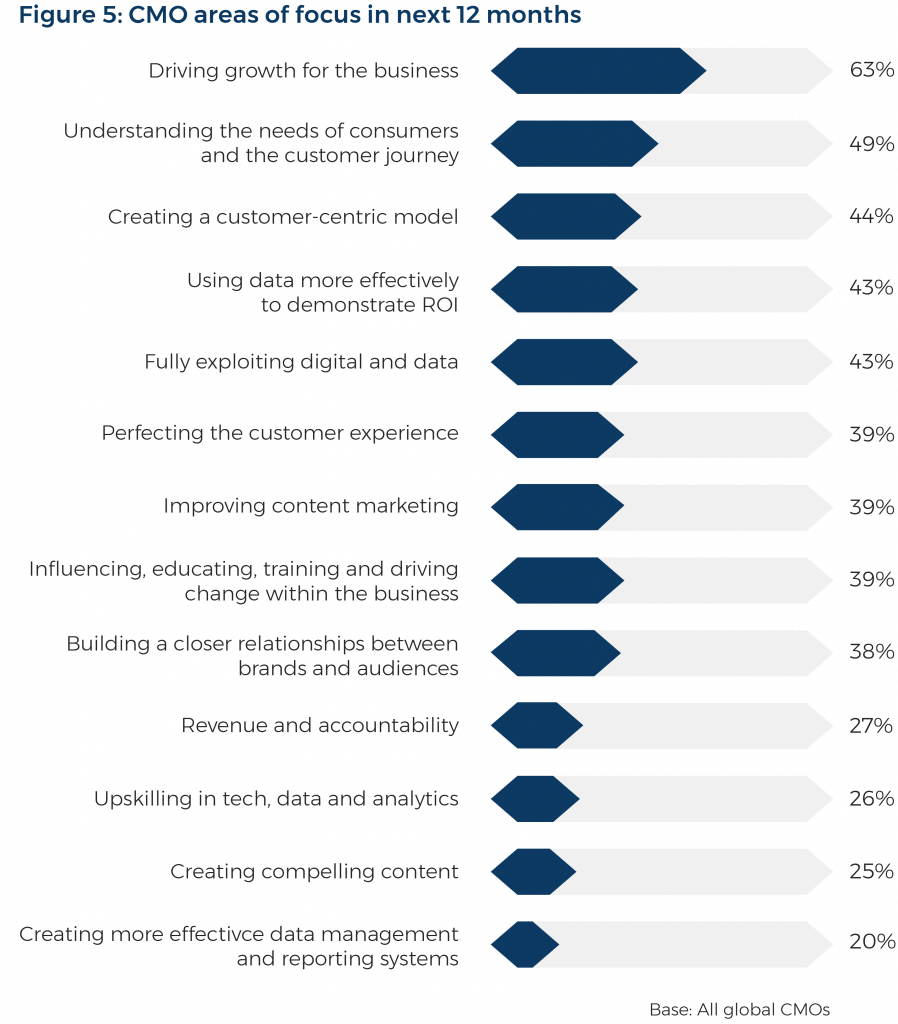
Business growth is a given and driving this is undoubtedly a core part of the marketing leader’s remit, as underlined by the move to rename CMOs ‘Chief Growth Officers’. The emphasis on revenue is keenly felt by senior marketers with over eight in ten (82%) of CMOs saying the role has become more financial results focused. Almost two thirds (63%) of marketing leaders say their key priority is going to be driving growth for the business. With this concentration on the bottom line, it is only natural that the status of marketing should have risen.

Global CMOs Appreciating the Rise in Status but Feeling the Pressure, Says a Study by NewBaseCustomer minded

It is understandable that those focussed on growth are going to turn their attention to understanding customers’ needs to see if there are any issues to be addressed or processes to be streamlined. One in two CMOs have looked at the consumer journey top of their to-do-list and almost half (44%) of marketing leaders also say that they are going to ensure a customer-centric model is in play. Two-thirds of global CMOs state marketing decisions should be based on how they impact the customer rather than the business.

It’s all about the data

With the heightened focus on both the customer and growth, data is more important than ever. One in two senior marketers says currently they have budgetary control for data and analytics. However, this is set to grow, as more than 80% of CMOs are saying they are getting more money to invest in data. This budget will no doubt be gratefully received as more than three quarters state data management and analytics is taking up more of their time. But simply having more data available does not necessarily mean that it can be used effectively.

Also Read: Why Contact Centers Are Critical to Omnichannel Marketing Strategies

Data mountain

Global CMOs highlight over half the data available to the business is not being used to its fullest potential and three quarters agree they are only able to use a small portion of the data they have at hand. This is an opportunity for senior marketers, with over nine out of ten (92%) saying that creative and analytics need to work more closely to drive business success. With the budget offered for data increasing but over half of all data not being used to its full potential, there is scope for CMOs to marry the ‘magic and the maths’ using brand awareness advertising, story-telling and experiential with data to drive revenue.

Global CMOs Appreciating the Rise in Status but Feeling the Pressure, Says a Study by NewBaseIn/Out

Two-thirds of CMOs are moving towards more in-house marketing services, but only 3% say they currently have the perfect skill set internally. Marketing bosses looking to bring more functions in-house are challenged by both budget and team capabilities.

Just under one in two CMOs have good internal team capability, and 68% say that it is essential to have people on board who are skilled enough to evolve with technology developments. However, due to the martech explosion and dramatic growth of digital marketing and programmatic advertising, more than half of CMOs (55%) state they have an internal skills shortage.

With the skills gap and implied talent scarcity it looks as if outsourcing suppliers (agencies, martech vendors, etc.) is still going to be essential in ensuring CMOs can deliver on their objectives.
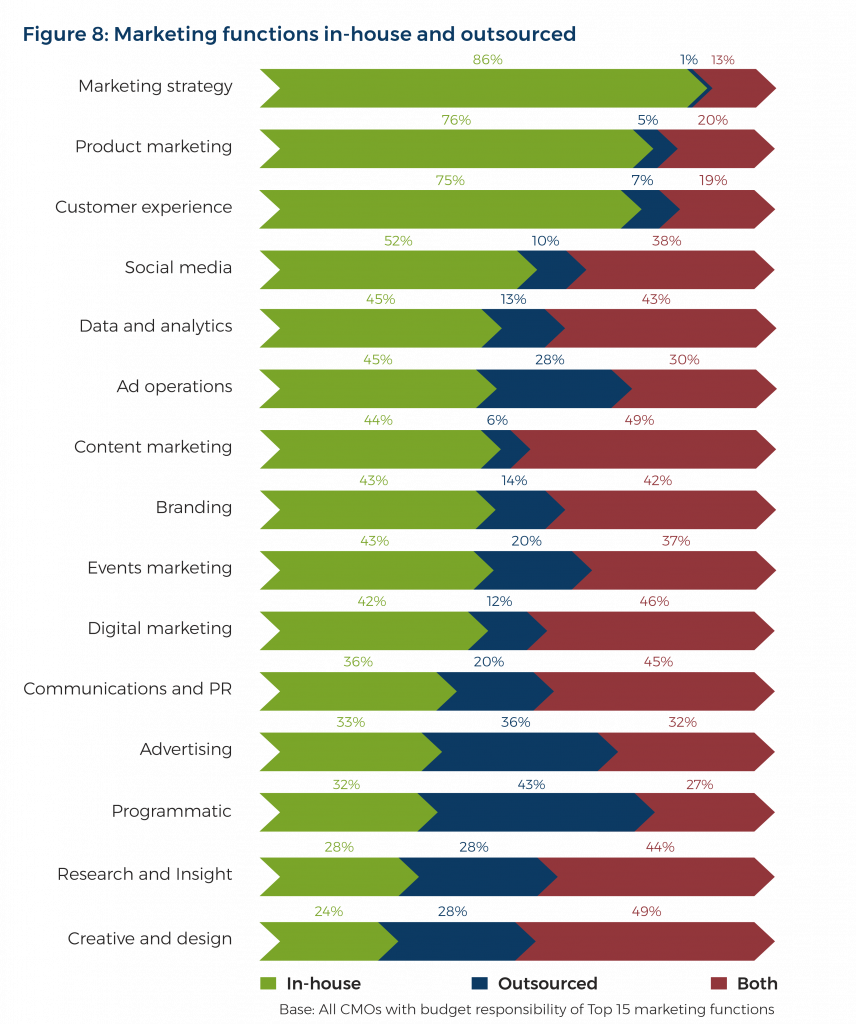
The results reveal that 43% of CMOs still entirely outsource programmatic, which is the highest fully outsourced function. Over a third of senior marketers outsource advertising (36%), and over a quarter fully outsource creative and design, and research and insight (both 28%).

Key elements such as marketing strategy, pricing and product marketing as well as customer experience tend to be handled in-house. Among the top 15 areas where marketing leaders have budget responsibility, marketing strategy is the number one function delivered entirely in-house (86%), followed by product marketing (76%) and customer experience (75%).

Also Read: CMOs Struggling To Meet Needs Of Local Audiences And Geographies With Adaptive Marketing Creative, Says New CMO Council Study

Global CMOs Appreciating the Rise in Status but Feeling the Pressure, Says a Study by NewBase

Budgets

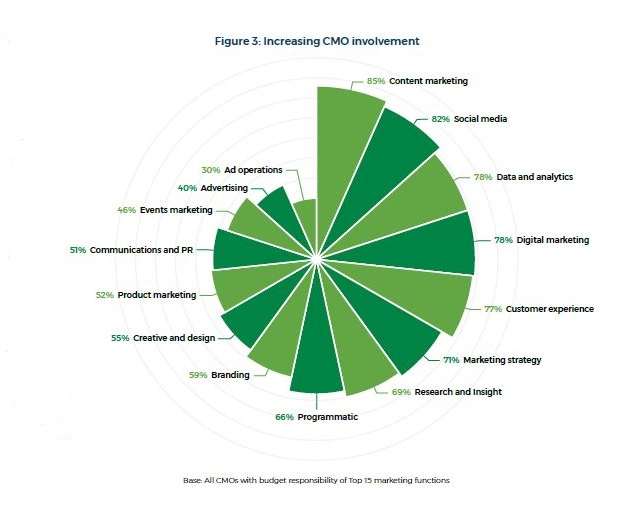
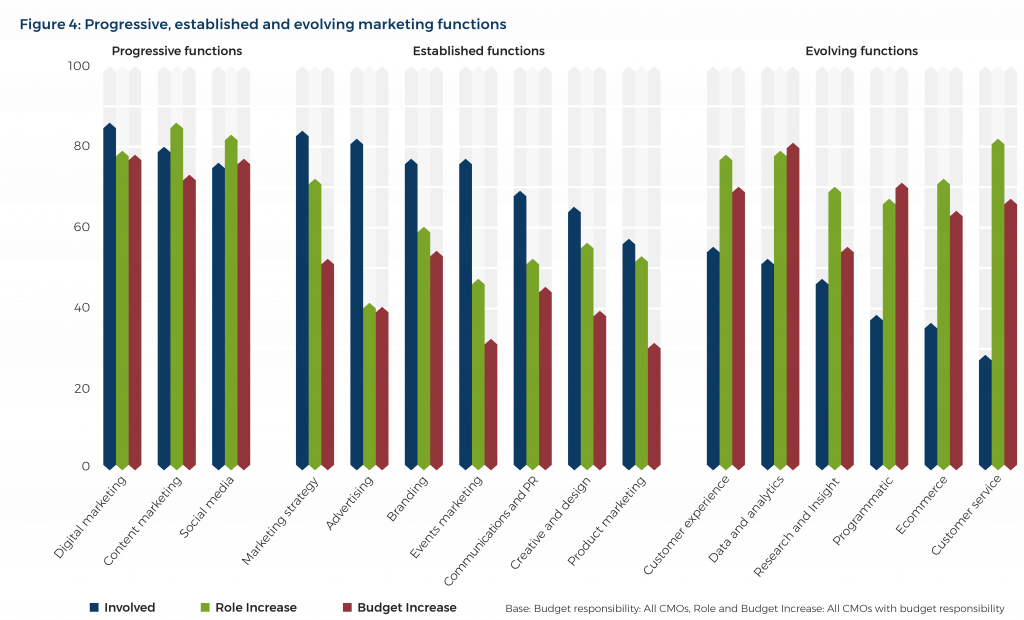
While CMOs overall say they have to achieve more with less, there are some functions where involvement is already high and budgets are increasing, along with the time investment required by marketing. Marketing leaders are expecting to spend more on digital, content marketing and social in the short term with three quarters of marketing leaders allocating increased budget to these channels. They are also expecting the time that they have to invest in these functions to increase along similar lines. These are described as ‘Progressive marketing functions’.

For more ‘Established marketing functions’ such as marketing strategy, advertising, branding, PR, design and product marketing, while a minority of CMOs are anticipating budget rises, the majority are not. Four in ten senior marketers are envisaging advertising spend increase, one in two are forecasting a rise in branding investment and almost 40% are going to spend more on design. Just under half are also looking to invest more in communications and PR in the next year.

There are some ‘Evolving functions’ where currently CMOs are seeing their expertise called upon, and alongside this, budgets increased. Customer experience, customer service, e-commerce, data and research are now increasingly important too. However, because these areas are not solely marketing’s remit the CMO does not presently have total budget control over these, but this is likely to change.

Three-quarters of CMOs say they will receive more budget for customer service and a similar proportion are expecting an increase in customer experience.

Also Read: CMOs Own Initiatives in Customer Experience; Focus Sharply Moving Towards No-Screen Engagement

The influence of time

“The Evolving Marketer” reveals significant variations in the global CMO agenda based on length of tenure. Those in their roles for over five years, the established CMOs, are firmly entrenched, their priorities (bar driving growth) are very different from more recent CMOs (under five years’ tenure). One in two established CMOs is focussing on building internal collaboration (45%) and perfecting the customer experience (47%).

More recent CMOs (under five years) are still in the set-up stage for their role and thus focussing on sorting out infrastructures, putting new systems and processes in place and creating models to exploit the data they have access to.

Newer CMOs are emphasizing the customer journey (57%) vs. only 39% of established CMOs and creating a customer model that aligns with business strategy (52% vs. 33%). Using data to its fullest potential is prioritized by half (49%) of recent CMOs as opposed to only a third (35%) of established CMOs.

Revenue and accountability are prioritized almost three times as much by established CMOs compared to newer marketers (41% vs. 17%).

Global CMOs Appreciating the Rise in Status but Feeling the Pressure, Says a Study by NewBase

Making an impact

84% of newer CMOs claim it takes less than five years to really make a difference, whereas only half (49%) of established CMOs think the same.

Mike Jeanes

Mike Jeanes, global head of insight, NewBase comments, “Over the past few years the CMO’s remit has escalated significantly from a largely promotions and creative role to becoming the centralised lift-shaft of the business, servicing every level and function of the organisation, and providing the data-driven connection between the brand and the consumer. The role of the CMO is varied and complex. They are increasingly challenged to drive business growth and adjust their resources to keep up with industry change and consumer demands.”

Also Read: How Marketers Can Optimize $682 Billion in Expected Spend in 2018

Survey Approach

The Evolving Marketer is an online global survey among 120 CMOs in over 20 markets exploring the role of the CMO, and the changing marketing landscape. The survey was undertaken by Synergy Research and Consulting and fielded between November 2017 and January 2018.

All respondents are senior brand marketers with budgetary responsibility working across a range of sectors with 40% in finance, technology or retail. 53% of respondents are female with the average age 46. A quarter work in b2b organizations 35% b2c, and 40% work for businesses covering both. 57% of all respondents work for larger organizations (250+ employees) and 43% for SMEs (under 250 employees) and on average, they have been in their current role for just over 5 years.

In this report, the CMO term generically refers to a company’s top marketing leader.

Recommended Read: Marketing Teams Will Struggle to Make Sense of the Hype around AI

DeepMarkit Launches Gamify For All Platforms

0
DeepMarkit Launches Gamify For All Platforms

Gamify Was Launched on Shopify on February 14, 2018

DeepMarkit Corp announces that its Gamify conversion tool for online merchants is now available for all e-commerce platforms and websites.

Gamify was launched on Shopify on February 14, 2018, and has been downloaded by hundreds of merchants who have collected thousands of emails for customers and converted hundreds of sales. With this new product, any e-commerce merchant can use the free Gamify app to have their own branded game running on any site in a matter of minutes. Gamify’s unique brand of e-commerce gamification helps merchants engage with, identify and direct website traffic and also combines the delivery of purchase incentives to convert that traffic to sales.

Also Read: S4M Granted Continued MRC Accreditation for Post-Click Measurements

“Since the launch of Gamify in February we have seen amazing results from our customers. So many online stores struggle with converting their visitors into customers, it’s a real pain point for a lot of online merchants. We built Gamify to help solve some of these issues, and we are thrilled to see it performing well and helping our customers increase their sales,” said Carter Chalmers, Director Sales & Business Development, DeepMarkit.

Engaging and entertaining games are at the core of the DeepMarkit conversion tools. The games are customizable to deliver positive brand association for merchants and both fun and rewards for consumers. The Company plans to increase its marketing initiatives in the coming months, to target the broader audience of potential customers and will be rolling out more e-commerce and email service platform custom integrations.

Also Read: DeepMarkit Adds Serious Marketing and Technology Strength

DeepMarkit is a gamification technology company inventing new ways to engage consumers and other audiences. The Company’s proprietary promotions platform enables businesses and agencies to create branded games that incentivize customers, thus driving sales, capturing data and generating leads. DeepMarkit offers marketers both free and paid solutions which are suitable for campaigns of all sizes, targeting multiple channels on the web, mobile and social media.

Recommended Read: Mobile World Congress 2018: What’s Next for Industry Innovation?

InsightSquared Named Leader In Business Intelligence Platforms For Four Straight Years

0
InsightSquared Named Leader In Business Intelligence Platforms For Four Straight Years

InsightSquared  Also Named a Leader in Sales Analytics

InsightSquared, the most-awarded provider of sales intelligence solutions for high-growth technology companies, announced that it has been named a Leader in G2 Crowd’s Grid Report for Business Intelligence Platforms, outranking 33 industry vendors to place first in Customer Satisfaction. The company was also recognized as a Leader in G2 Crowd’s Grid Report for Sales Analytics and received 11 additional awards across the two categories, including Best Support, Easiest Admin, and Best Results.

Fred Shilmover

“The role of customer success is the responsibility of our entire team, not just one department. We are honored to receive these awards, but especially humbled by the awards for Best Relationship and Best Results as they directly reflect our commitment to have every interaction answer the question: ‘How does this help the customer?,” said Fred Shilmover, CEO & Co-founder, InsightSquared.

Also Read: The Boston Globe Names InsightSquared a Top Place to Work for 2017

Based on reviews submitted by hundreds of business intelligence software users, G2 Crowd ranks vendors by customer satisfaction, market presence, vendor size, and social impact. More than 96% of users on G2 Crowd rate their InsightSquared experience with either 4 or 5 stars.

“I’ve now implemented InsightSquared at two different companies. It’s my go-to BI tool. We are able to drive all of our quarterly business reviews right from the dashboards, no PowerPoints needed. My executives like having the ability to directly access the info from Salesforce.com and appreciate the high reliability of the data,” said Melissa Warner, Senior Director Global Sales Operations, CoreOS.

Also Read: InsightSquared Partners with LinkedIn, Integrates with LinkedIn Sales Navigator

InsightSquared provides sales-, marketing- and business operations professionals, together referred to as “revenue operations,” with the insights they need to help sales leadership forecast more accurately, collaborate with marketing and prospecting teams to ensure pipeline goals are met, empower sales management to coach reps more effectively, and provide executives with an actionable, retrospective analysis of sales performance.

“InsightSquared has been identified as a Leader in our recent Business Intelligence Platforms and Sales Analytics Grid Reports,” said Marty Duffy, vice president of research at G2 Crowd. “These rankings can be largely attributed to their high scores in the quality of support, ease of use, and ease of doing business with categories; making for very happy customers.”

Recommended Read: GDPR: Developing a Proportionate Response


The CMO Club Announces The Formation Of First Ever Advisory Board

0
The CMO Club Announces The Formation Of First Ever Advisory Board

CMO Club’s Newly Appointed Board Members Will Be Focused on Providing Strategic Guidance and Insights to the Club and its  800+ Members Worldwide

The CMO Club, the world’s largest and most engaged community of Senior Marketing Executives, today announced it has formed its first-ever advisory board. The all-star lineup of marketers includes Phil Clement, former Global CMO, and Advisor to the CEO of Aon, John Costello, former CMO of Dunkin Brands, Kim Feil, former CMO of Walgreens, Trish Mueller, former CMO of The Home Depot, and Greg Welch, Senior Partner at Spencer Stuart.

Also Read: The State Of Play With OTT Sports Streaming

Pete Krainik
Pete Krainik

“Our board members’ demonstrated expertise in innovation and inspiring others to make them each an ideal fit to ensure the value of our programs to CMOs as they join the Club. This group represents the best and the brightest in marketing, and they will be instrumental in continuing to curate an environment of openness and collaboration that enables members to excel at what they do and solve their biggest CMO challenges,” said Pete Krainik, founder,  The CMO Club.

The board members will be focused on providing strategic guidance and insights, helping to power the continued explosive growth of the club and the professional development of its 800+ members worldwide.

“I am thrilled to be a part of a such an outstanding group of peers who support each other’s marketing missions, as well as creating environments that foster lifelong leadership, learning, career opportunities and relationships for CMOs. I’m looking forward to taking the CMO Club, as well as the CMO Solutions Clubhouse to the next level,” said Kim Feil, Chairperson, CMO Club Solutions.

Also Read: Is January 1 Really the “Black Friday” of Fitness?

Advisory board members are:

  • Phil Clement, recent Global CMO and Advisor to the CEO, Aon: In my role as Aon’s Global CMO and Executive Committee member, I focused on marketing programmes to support the firm’s strategic plans for industry leadership, growth and globalization. At Aon I enjoyed rolling out SFDC, client voice programmes such as NPS, and globalizing our brand work with our Manchester United partnership in 120 countries. I pride myself on being an LGBT ally and sitting on Aon’s diversity council.
  • John Costello, former President – Global Marketing and Innovation of Dunkin Brands: John currently serves as CEO of Bottom Line Branding since retiring from Dunkin’ Brands (the parent company of Dunkin Donuts and Baskin Robbins). He previously served as Executive Vice President of The Home Depot, Chief Global Marketing Officer of Yahoo, Senior VP of Pepsi-Cola USA and President of Nielsen US. He began his career at Procter & Gamble and rose to lead all advertising and marketing for P&G’s Beauty Care Division. John is also past Chairman of the Association of National Advertisers, Mobile Marketing Association and Ad Council.
  • Trish Mueller, former CMO of The Home Depot: Trish Mueller served as the Chief Marketing Officer of The Home Depot from 2011 until 2016. She is an expert in the retail industry with 30+ years of experience in strategic branding, marketing, advertising, interconnected retail strategy, retail sales management and store operations. Trish has also managed consumer analytics, research insights, gift card sales, CRM, database marketing and strategic business development functions. She is most recently known for successfully driving the shift from print and traditional media channels to digital while CMO of The Home Depot.
  • Greg Welch, Senior Partner at Spencer Stuart: Greg Welch is a key member of Spencer Stuart’s Consumer Practice and served as its global practice leader for five years. He also launched the firms marketing officer practice over a decade ago.  He is widely viewed to be the search industries leading CMO recruiter, placing many of the world’s top marketing leaders.  He is also an active member of the North American Board and CEO practices.
  • Kim Feil, former CMO of Walgreens: Kim is the CMO/CSO and Board Director of Aspire Healthy Energy Drinks and President of The CMO Club Chicago. As a former CMO across multiple industries, Kim is no stranger to dynamic market forces facing today’s CMOs. She has been a retailer, general manager, consultant and e-commerce leader in marketing, sales and strategy at OfficeMax, Walgreens, Sara Lee, Kimberly-Clark, Information Resources Inc, Dr. Pepper/7UP and Frito-Lay, giving her a unique 360-degree multichannel perspective. Kim will share her unique insights on the strategies marketing leaders need to adopt and master in order to thrive.

The CMO Club is the world’s most engaged and inspired community of Senior Marketing Executives who help each other solve their biggest challenges, within a candid, trusted, and sharing environment. Collaboration fueled by inspiring events and within the members-only Digital Solutions, Clubhouse raises the standard for what is required to be a successful Chief Marketing Officer.

Recommended Read: GDPR: Developing a Proportionate Response

Vlocity Announces Industry Cloud Continuous Delivery Solutions For Salesforce, Powered By Copado

0
Vlocity Announces Industry Cloud Continuous Delivery Solutions For Salesforce, Powered By Copado

Copado Forms Strategic Alliance with Vlocity to Reduce Software Release Time and Deployment Costs for Industry Cloud Apps

Vlocity, Inc., a leading industry cloud software company, and Copado Solutions, a leader in cloud-based enterprise-class change and release management solutions for Salesforce, announced the formation of a strategic alliance and the launch of Vlocity Industry Cloud Continuous Delivery solutions, now available on the Salesforce AppExchange. By bringing together the technical capabilities and shared customer success focus from two of Salesforce’s partners, the integrated solution will optimize release management processes for industry cloud deployments across multiple environments.

Also Read: Salesforce Integration Cloud Arrives to Build Connected Customer Experiences

As more companies in customer-centric industries move to the cloud and digitally transform their operations with Vlocity, it’s become essential for CIOs and IT departments to ensure a succinct and timely delivery of industry cloud apps. This partnership between two Salesforce partners will help companies in the communications and media, insurance and financial services, health insurance, energy and utilities, and the public sector industries better manage their cloud implementations. By combining Copado’s expertise and best practices in the area of release management with Vlocity’s industry-specific functionality, the two companies enable IT departments to quickly capture more benefits from their digital and cloud transformations.

Neeracha Taychakhoonavudh

“Vlocity and Copado are valuable contributors in the Salesforce ecosystem, and we are delighted that these two companies are working closely together to drive mutual customers’ success in our focus industries,” said Neeracha Taychakhoonavudh, SVP, Industries at Salesforce.

Also Read: Vlocity Receives Accolades Recognizing Company Growth, Strength of Product and Customer Success

Rip Gerber

“By teaming up with Copado to offer industry-specific continuous delivery software, we’re able to accelerate cloud deployments and further enhance the agile functionality of our applications. We’re always striving to provide industry-best value to our customers, and this new alliance with Copado ensures that future deployments will be rapidly executed, verifiably integrated and easily visible to change approvers, developers and project partners,” said Rip Gerber, Chief Marketing & Alliance Officer, Vlocity.

Widely recognized for its cloud and mobile applications that embed digital, omnichannel processes for customer-centric industries, Vlocity selected Copado for its Salesforce expertise, ability to deliver cleaner and quicker deployments, and demonstrated success in overcoming the challenges of metadata-driven environments.

“Copado will allow Vlocity to better monitor and perform tests for potential bugs and conflicts, and provide internal users with precise version control and visibility of changes via Git. Essentially, Vlocity Industry Cloud Continuous Delivery ensures that the deliverables for any cloud implementation project meet stakeholder expectations, from initial development to production,” said J.J. Jakubik, Chief Architect, Vlocity.

Also Read: Introducing Salesforce Lightning Flow: The Power of CRM Process Automation for Every CX

Federico Larsen

“As large-scale digital implementations become more complex and increasingly involve additional partners and multiple features, it’s important that businesses not only have a release management strategy but automated release management software that ensures seamless integration and efficiency. With this new partnership, we can now extend our next-generation cloud-based release management solution to the industry-specific applications that Vlocity deploys, opening up a rich new world for both companies to explore and collectively building on the advancements that the Salesforce Platform provides,” said Federico Larsen, Co-Founder, CTO, Copado Solutions.

Vlocity Industry Cloud Continuous Delivery is a complete release management solution, including agile project management, continuous delivery, version control, automated deployments, automated regression testing, rollbacks and scheduled metadata back-ups. In conjunction with the launch of Vlocity Industry Cloud Continuous Delivery, Copado is offering their award-winning enterprise-class release management solution at no extra charge to all Vlocity customers for a limited time to demonstrate the benefits of its new industry-specific approach.

Recommended Read: Interview with Adam Blitzer, EVP And GM Sales Cloud, Salesforce

Orange Belgium And Orange Polska Partner With Salesforce And Vlocity To Strengthen Their Digital Transformation

0
Orange Belgium And Orange Polska Partner With Salesforce And Vlocity To Strengthen Their Digital Transformation

Orange Belgium and Orange Polska Partner with Salesforce and Vlocity to Strengthen Their Digital Transformation

Orange Belgium and Orange Polska announced that they signed an agreement with Salesforce, the global leader in CRM, and Vlocity, a leading industry cloud company. Salesforce and Vlocity will help Orange achieve business agility faster and reduce time to market by leveraging cloud-based solutions across Orange’s digital and assisted channels.

Given today’s digital landscape, it has become imperative for Orange to strengthen its position in mobile and convergence markets with a customer-centric focus. Thanks to the expertise of Salesforce and Vlocity, Orange can further improve the quality of its customer experience by introducing a robust omnichannel experience for its customers. In addition, Orange sales teams and channel partners will be able to sell new innovative products and services smarter, helping them go the extra mile for Orange customers.

Also Read: Dropbox and Salesforce Form Strategic Partnership

Orange Belgium continues to digitalize the Orange customer journey

Michaël Trabbia

“Orange Belgium continues its digital transformation. Next, to renewing certain levels of our order management, we will now start strengthening our CRM capabilities and unifying our digital channels. With this perspective in mind, we partnered up with Vlocity and Salesforce. We chose Salesforce and Vlocity because they demonstrate advantages on multiple fronts, including speed to deployment, accelerated time-to-market and streamlined service delivery. This collaboration will indeed enable us to further digitize our customer journey and to be even more relevant to our customers, who remain at the heart of the Orange Belgium strategy,” said Michaël Trabbia, CEO, Orange Belgium.

Orange Polska takes a significant step in its digital transformation

Jean-François Fallacher

“Orange Polska is moving a step further in its digital transformation. Having reached a significant level of consolidation of its digital and sales channels, Orange Polska now aims to offer a differentiating customer experience. We choose Vlocity and Salesforce for their deployment speed but also for their advanced products and journey management capabilities. This partnership will enable us to meet our customers’ expectations for simple, transparent, easy-to-use and easy-to-manage offers. Innovation and customer experience are significant cornerstones of the Orange strategy,” said Jean-François Fallacher, CEO, Orange Polska.

Also Read:  Salesforce Signs Definitive Agreement to Acquire MuleSoft

Salesforce and Vlocity empower Orange to fully engage in digital transformation

Jo Buvens

“By embracing the cloud, Orange has taken an important step in its core mission to achieve outstanding customer connectivity and make its services easier to access and sell. We’re thrilled to be working with Vlocity on this important project. By leveraging Vlocity’s industry-specific cloud solutions and omnichannel applications, Orange can now fully engage in its digital transformation,” said Jo Buvens, Country Manager, Salesforce, Belgium & Luxembourg.

Dominic Dinardo

“We’re incredibly excited about this opportunity to join forces with Salesforce to provide Orange with the industry-focused digital software that they need to transform the way they do business. We’re thrilled to be selected as Orange’s digital transformation technology and look forward to helping Orange capture more value from the cloud, reach more customers, sell smarter and sell more efficiently,” said Dominic Dinardo, EVP, Managing Director EMEA, Vlocity.

Also Read: Vlocity Receives Accolades Recognizing Company Growth, Strength of Product and Customer Success

Vlocity Communications takes advantage of the omnichannel capabilities of Salesforce Service Cloud and includes comprehensive Enterprise Product Catalog, CPQ (Configure-Price-Quote), Contract Management, Retail Clienteling and Order Management functionality, and a comprehensive library of pre-built sales, service and billing inquiry management processes. Engineered specifically for communications service providers, Vlocity Communications conforms to TM Forum industry standards and integrates flexibly with third-party systems through pre-built APIs and web services.

Recommended Read: Interview with Adam Blitzer, EVP And GM Sales Cloud, Salesforce

Image Protect Inc. Releases New Disruptive Digital Licensing Model IPShare

0
Image Protect Inc. Releases New Disruptive Digital Licensing Model IPShare

IPShare Is Set to Disrupt the Current Copyright and Licensing Landscape

Image Protect Inc., the global leader in end-to-end copyright software, is excited to announce that the company has expanded its technology with a new theft proof, trackable, and shareable image format, IPShare.

According to management, this disruptive digital image technology offers the Company striking new top and bottom-line growth potential by streamlining costs involved in image-tracking as well as expanding the Company’s primary revenue model to overlap the $558 billion global advertising space.

Also Read: AI to End Brand Safety Crisis? AnyClip Got the Answers…

IPShare generates a block of code that allows photos to be copied and pasted into any website – similar to code references on sites that embed Youtube or Vimeo content. After the photo has been embedded, it appears on the website even though it is technically stored on Image Protect servers. Once that step has been taken, the image is theft-proof and cannot be downloaded or captured through screenshot software. If someone tries to capture the image through advanced tools, a watermark will appear on top of the image rendering it unusable. The image can then be monitored from the Image Protect client dashboard.

This new format is unique and allows the Company to monetize the image by overlaying an advertisement (which is also embedded in the image). These “in-image ads” will generate a recurring monthly income for the rightsholder of the image via click-throughs and impressions. The cost to advertisers will follow the standard social media model: the more the image is viewed and shared, the more revenue it generates. In-image advertising drives revenue from the global digital advertising market, which is expected to grow to $291B by 2020

Lawrence Adams

“This is a win-win for all parties. The rightsholder captures revenue converted from the Advertising model. We capture revenue otherwise considered lost. And the website/blog owner enjoys the use of the image without penalties or fees,” said Lawrence Adams, CEO, Image Protect Inc.

Also Read: How Contextual Blocking Tactics Can Ensure Brand Safety at the Page Level

Image Protect has detected unlicensed use of client images across millions of personal blogs and forums over the years. As an alternative to the standard DMCA takedown notice (which results in zero revenue for the company or the rightsholder), the company has developed a new model: those infringing on copyright privileges by using an image can replace that image with the new embeddable, trackable, and secure image. It’s as simple as copying and pasting the embedded code into the user’s website: the image is instantly transformed into an online billboard containing in-image advertising, hot links, social sharing, and dynamic messaging.

IPShare is set to disrupt the current copyright and licensing landscape by mobilizing the power of secure content sharing and revenue growth through online advertising.

Recommended Read: OTT Explosion Provides Safe Platform For Marketers

Nift Raises $16.5 Million in Series A Funding for AI Platform

0
Nift Raises $16.5M in Series A Funding for AI Platform that Empowers Main Street Merchants

Nift Plans to Expand Nationally, with up to Five New Markets and an Increase in Its Team of 400 Percent over the next Twelve Months

Nift announced $16.5 million in Series A funding from Spark Capital, Foundry Group and Accomplice. The platform has seen unprecedented success in Boston, Providence and Washington, D.C., and with the new capital, Nift plans to expand nationally, with up to five new markets and an increase in its team of 400 percent over the next twelve months.

The shadow on retailers’ backs is Amazon, which accounts for four percent of all US retail sales in 2017. But accessibility to products via two-day shipping hasn’t stymied the influx of young people to cities. They’re moving to cities at a higher rate than ever before, creating a boon for niche retail and high-touch city experiences that people want from small businesses, which make up half of the national economy. However, once these cities are populated, how do businesses bring in new customers?

Even before Amazon, opening a small business was insanely difficult; 20 percent fail in their first year. And as new people move in, there’s an opportunity for these businesses to keep dollars from escaping the local economy. The problem is that what works for large enterprises doesn’t translate to small, local businesses who are cash-strapped. Advertising on Facebook and Google only generates clicks, and results are unclear, whereas other services like Groupon bring deal-seeking vulture consumption that isn’t sustainable — or profitable.

Also Read: Amazon Marketing Channel Outshines Google and Facebook Says New Research

Unlike these advertising vehicles, Nift empowers small businesses with a free machine learning platform that matches the right neighborhood gift to the right customer in seconds. The goal is all about helping businesses get discovered and fostering a healthy local ecosystem. With over 2,000 merchants, using Nift; this translates to 250,000 unique customers activating more than 500,000 Nift cards just in the greater Boston area. Eighty-eight percent of customers who use Nift say they’ll return to the local business, and eighty-six percent of customers either visited for the first time or hadn’t visited the business in over a year.

Elery Pfeffer

“We want to give power back to Main Street businesses and help fuel the growth of local economies by banding these businesses together,” said Elery Pfeffer, founder and CEO of Nift. “The social community contract, inherent to the way we shop, never left local merchants. Now Nift is imbuing it with sophisticated machine learning technology to help these businesses get discovered, build affinity, and bring quality customers in the door.”

Also Read: Predictive Analytics: Unlocking the Value in Understanding the Customer

How Nift works:

  • It all starts with a Nift, a neighborhood gift that a merchant gives a loyal customer – this is a physical or virtual card with a code on the back.
  • The customer then inputs that code on Nift’s website.
  • After the customer answers a few questions, Nift’s algorithms provide a choice between one of two free gifts from other local merchants.
  • Nifts introduce your best customers to other local businesses, and in return, other neighborhood businesses give Nifts to their best customers, introducing them to you.
  • Free gifts can immediately be spent as cash in-store, creating a win-win for everyone in the community.

Also Read: The Age of Choice: How Marketing & Business Will Change in 2018

“Retail has changed dramatically with the widespread adoption of e-commerce, but something has been missing for small businesses at the local level,” said Seth Levine, Founding Partner, Foundry Group. “Nift is providing a way for merchants to deliver the experiences customers want, while fostering a healthy ecosystem. The success of the platform illustrates the impact it’s already having in strengthening these businesses and revitalizing communities. Customers are spending over three-times the value of their gifts, which makes the system more powerful than any other advertising medium available, including Facebook and Google.”

Nift was founded by Pfeffer, a Harvard data scientist whose previous company, Pursway, helped Fortune 500 companies identify social influencers. Nift’s platform has been developed over three years by leading data scientists from MIT, including Chief Scientist, David Parkes, who is the co-director of Harvard’s Data Science Initiative. The rest of the executive team is comprised of experts from companies like TripAdvisor and Nokia, with over 100 years of combined experience in brand building and digital consumer experience.

Recommended Read: How AI is Driving a New Era of TV Advertising

Evergage Named an EContent ‘Trendsetting Product’ for Second Year in a Row

0
Evergage Named an EContent 'Trendsetting Product' for Second Year in a Row

Evergage Honored for Helping Digital Marketers Deliver Real-Time, Individualized Experiences That Improve Customer Loyalty and Conversions

Evergage, the real-time personalization platform company, announced that it has been named to EContent magazine’s “Trendsetting Products of 2018” list. This is the second year in a row that Evergage has received a Trendsetting Products award – honoring solutions that shape the digital content industry while helping businesses solve marketing, content and publishing challenges.

Also Read: Evergage Named a Top Rated A/B Testing and Personalization Tool on TrustRadius for Second Year in a Row

Every year, EContent’s editorial staff selects solutions for inclusion, considering their innovation and importance to the industry. Editors evaluate hundreds of products based on their independent research, coverage, and the news they receive and consume. Personalization has been a key topic in EContent over the last year, as digital marketers seek to deliver highly relevant content and experiences to customers and visitors at the individual level.

Theresa Cramer

“The digital content industry continues to grow and has given rise to a glut of tools on the market. Our annual list helps buyers identify the most interesting and potentially helpful tools – enabling marketers to reach their audiences with immediacy and impact and helping content creators stay on top of their game. Congratulations to Evergage and our other winners on their important solutions and the results they’ve achieved,” said Theresa Cramer, editor, EContent.

Also Read: TechBytes with Josh Baumrind, SVP of Partners and Corporate Development, Evergage

Evergage enables B2B and B2C marketers to provide 1:1 personalization in real time across websites, web and mobile apps, onsite search and email campaigns. The company delivers personalized experiences to more than 3 billion people based on deep behavioral analytics, a full customer data platform (CDP) and machine learning.

Also Read: Evergage Acquires MyBuys to Heighten Cross-Channel Customer Experiences

Andy Zimmerman, Chief Marketing Officer at Evergage
Andy Zimmerman

“The word ‘person’ is, of course, the most important part of ‘personalization.’ Evergage is committed to enabling our clients to recognize each person they interact with as an individual – and providing helpful, relevant and delightful experiences. We’re excited and proud to be recognized by EContent again for helping our clients create better customer experiences, and improve loyalty, conversions, and revenue,” said Andy Zimmerman, CMO Evergage.

Recommended Read: Interview with Andy Zimmerman, CMO – Evergage

404