Home Blog Page 4170

Agora.io Brings Live Video and Broadcasting Solutions with Global Scalability to IBC 2018

0
agora.io

Agora.io, a global leader in real-time communication solutions, announced that it will showcase its high-definition, ultra low-latency voice, video, and live broadcasting solutions at the 2018 International Broadcasting Convention (IBC) in Amsterdam from September 14-19. Agora.io team members will be on hand at IBC in Hall 14, Stand D54 to share information, hold live demonstrations, and answer questions about Agora’s RTC solutions.

Powered by a powerful proprietary software-defined real-time network (SD-RTN™) that boasts 99.995% uptime and a machine learning-based dynamic routing algorithm that monitors traffic in real-time to automatically choose the most efficient path, Agora is the only globally deployed solution capable of delivering true quality of service (QoS) with an average end-to-end global latency of under one second at scale.

Also Read: Clari Names Cornelius Willis as Chief Marketing Officer

Agora currently processes between 300 million to 500 million minutes of communications per day through its network, providing Real-time Communication and Real-time Interactive Broadcasting solutions for a wide range of industries and verticals, including social discovery, online dating, retail, telehealth, mobile gaming, education, enterprise productivity, and more. The Agora SD-RTN™ is the only mobile-first platform created to empower next-generation mobile applications, including real-time use cases like live trivia, social gaming, and much more.

With over 200 globally distributed data centers, Agora’s SD-RTN™ delivers uninterrupted, high-quality voice and video to end users around the world. Agora’s suite of APIs gives developers access to its robust network so they can easily integrate voice, video, and interactive broadcasting into existing applications with ease.

Also Read: Sprinklr and Snaps Drive Human-Robot Collaboration for a New Era of Customer Care

The demand for live and interactive voice and video functionalities embedded within existing mobile and web applications has seen an uptick in recent years as brands look to better engage audiences and customers, create new channels for monetization, and increase user stickiness. “As we continue to invest in our proprietary network and developer community, we’re committed to moving the RTC industry forward into the global era as we explore exciting new use cases in media & entertainment, social media, social discovery, collaborative gaming, and more,” says Tony Zhao, founder and CEO of Agora.io.

“We provide a lot of value to our customer through a simple and affordable communications platform as a service solution (CPaaS), and we’re excited to be able to do that by harnessing the true power of public internet,” says Reggie Yativ, Agora.io’s CRO & COO. “Our customers know better than to pay unnecessary premiums to private network providers for lower quality solutions. We continue to grow and evolve our global operations to provide developers, customers, and partners not only with the highest QoS value for their money, but also excellent service and customer experience.”

Also Read: Impact Announces the Acquisition of Mediarails

Sprinklr and Snaps Drive Human-Robot Collaboration for a New Era of Customer Care

0
Sprinklr and Snaps Drive Human-Robot Collaboration for a New Era of Customer Care

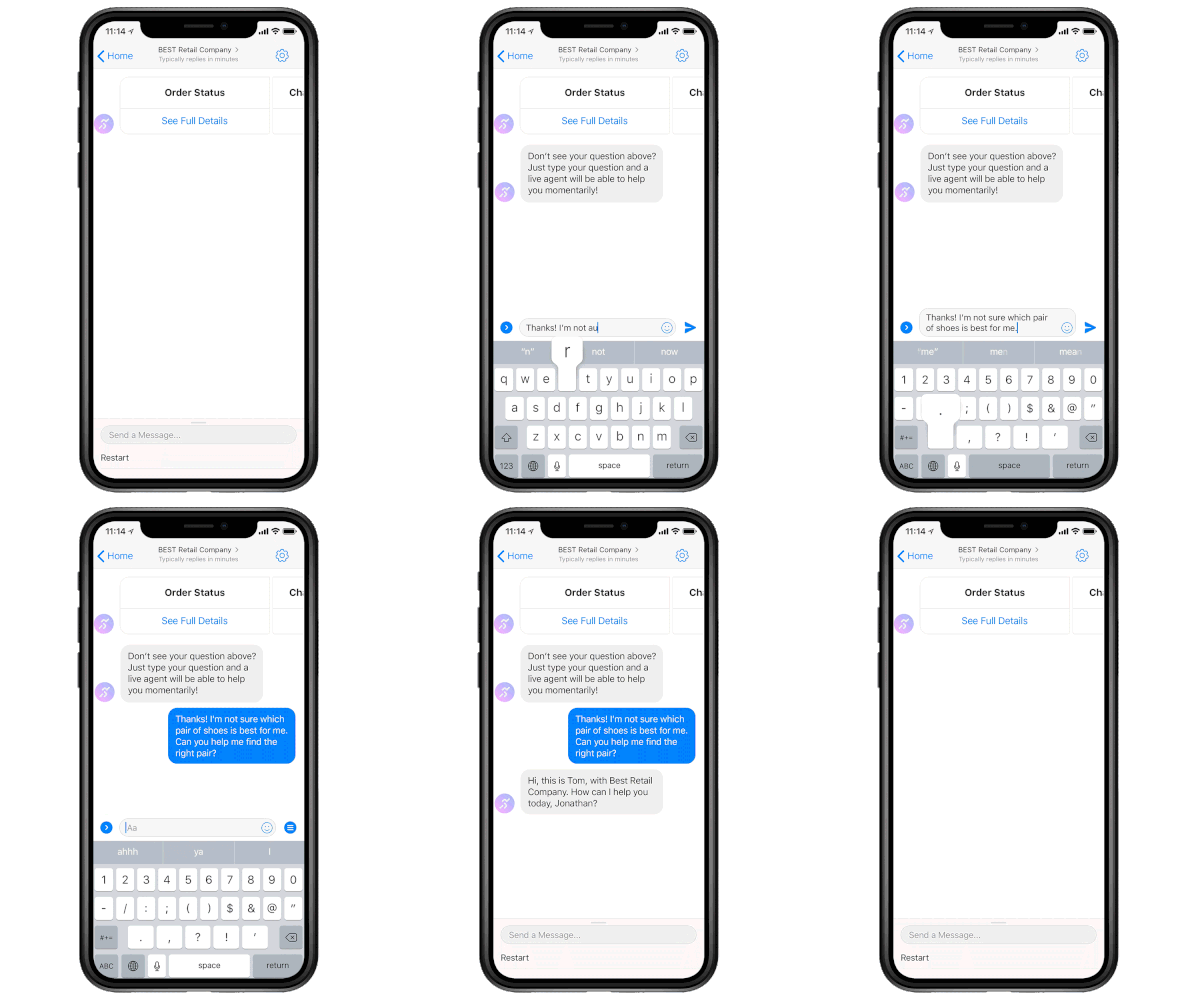
Sprinklr, the world’s #1 social media management platform, announced its integration with Snaps, the leading conversational marketing platform. The companies are launching the Sprinklr and Snaps Agent Handoff, which helps brands easily manage the transition between an automated chatbot and a human agent for complex customer care questions in Facebook Messenger, Twitter and SMS. Now, brands can provide a personalized experience on messaging platforms while reducing customer care costs.

The Challenge: Improving the Chatbot Experience

Snaps is an enterprise chatbot platform that helps companies like Nike Jordan Brand and Simon Property Group build chatbots to improve customer care on Facebook Messenger, Twitter and SMS.

Snaps understands that nine out of 10 consumers want to use messaging to communicate with brands. To meet consumer needs, an increasing number of brands are implementing chatbots to help them scale customer service on messaging platforms. However, these brands often face a major challenge: how can they incorporate automated and live agents into a seamless customer care experience? And, if a customer asks a complicated question on Facebook Messenger, how can the brand ensure the bot transfers this customer to the appropriate customer care agent?

Also Read: Forbes Names Hootsuite Among ‘Best and Brightest’ Private Cloud Companies in Cloud 100

The Solution: Sprinklr + Snaps Agent Handoff

Sprinklr and Snaps Drive Human-Robot Collaboration for a New Era of Customer Care
Sprinklr and Snaps are solving a brand’s biggest chatbot challenge by developing a new agent handoff for brands to manage the transition between automated and human agents on Facebook Messenger, Twitter and SMS.

Top benefits of the Sprinklr and Snaps Agent Handoff include:

  • Gives customers access to chatbots and responsive customer care agents via mobile and social applications they use daily.
  • Allows customer care agents to quickly turn bot automation on and off.
  • Automatically triggers agent support after someone types a designated number of characters.
  • Provides a full view of the customer’s conversation with the chatbot and the agent all in the Sprinklr platform.
  • Sprinklr and Snaps launched the agent handoff in beta last quarter, and it is now the default solution for dozens of brands.

For example, a leading hotel chain is already using the Sprinklr and Snaps Agent Handoff to dramatically improve customer care. If a guest asks a complicated question on Facebook Messenger, an automatic agent handoff is triggered from the Snaps bot and the guest will be sent to the appropriate customer care representative. When the agent closes a ticket, another automatic handoff is triggered to re-activate the Snaps bot and the guest receives a message on Facebook Messenger to let them know they are back in the bot experience. This entire customer journey is tracked in Sprinklr.

Also Read: SOCi Releases SOCi Go Enabling Multi-Location Brands to Access and Manage Social Content from Anywhere

“Millennials are demanding that companies communicate with them with asynchronous messaging platforms — the way they talk to their friends. By 2025 75% of the workforce will be millennials and customer care is going the same way, with most customer care experts predicting that 50% of all customer service requests will be managed over social media in the next two years,” said Grad Conn, Chief Experience and Marketing Officer, Sprinklr. “We’re excited to partner with Snaps to power this exciting transformation in customer care!”

“We’re thrilled to invest alongside Sprinklr in making seamless experiences for brand marketers,” said Christian Brucculeri, CEO of Snaps. “Today, consumers expect service in multiple channels at any time. We’re living in an instant generation. By integrating with Sprinklr, we’re helping brands solve one of their biggest problems: scaling commerce and customer service while maintaining customer satisfaction scores.”

Also Read: Marketing Technology Bulletin covering the Week Gone By

Clari Names Cornelius Willis as Chief Marketing Officer

0
Clari Names Cornelius Willis as Chief Marketing Officer

Clari, the leading provider of AI solutions for sales, announced the appointment of Cornelius Willis as Chief Marketing Officer (CMO). With more than 25 years of industry experience, Cornelius joins Clari at a time of record growth and market momentum. As CMO, Cornelius will be responsible for telling the Clari story, creating and executing an integrated marketing strategy and increasing awareness.

Cornelius Willis, Chief Marketing Officer, ClariCornelius’ experience spans 10 years at Microsoft and a decade spent in the startup trenches as an employee, founder, consultant and angel investor. He has also held leadership positions at BEA, Rackspace and VMware. Most recently, he led product marketing and strategic communications for Google Cloud Platform. During his tenure, Cornelius’ team launched several innovative AI products including TensorFlow and Cloud Vision API, and debuted Google in two different Gartner leader’s quadrant for Storage and Infrastructure as a Service.

Also Read: SOCi Releases SOCi Go Enabling Multi-Location Brands to Access and Manage Social Content from Anywhere

“Clari’s growth is accelerating, with heads of sales starting to understand the critical value of predictive analytics in calling and making their number. As we look at the opportunity ahead for the company and our customers, we’re really just getting started,” said Andy Byrne, CEO of Clari. “To help drive the next phase of our growth, we were looking for a marketing leader with strategic and operational experience and a proven track record of establishing brands in fast-growing markets. Cornelius’ expertise across marketing disciplines is an incredible asset, and we’re excited for him to execute on our mission to make selling easier and more predictable.”

Also Read: Marketing Technology Bulletin covering the Week Gone By

Cornelius joins Clari on the heels of its series C funding led by Tenaya Capital, with participation from Thomvest Ventures and Blue Cloud Ventures and existing investors Sequoia Capital, Bain Capital Ventures and Northgate Capital. The new capital will be used to scale sales and marketing and accelerate product innovation for Clari’s solutions which use sales-ready AI to drive better and more predictable sales execution and forecasting.

“Sales is the most critical business process in every company, and Clari customers love the product because it makes selling more effective and just plain easier. It’s clear to me this is a company with purpose and vision — and one I want to be a part of,” said Willis. “The fact they have been able to achieve such growth so quickly is impressive, and I am thrilled to be joining the team.”

Also Read: Forbes Names Hootsuite Among ‘Best and Brightest’ Private Cloud Companies in Cloud 100

Forbes Names Hootsuite Among ‘Best and Brightest’ Private Cloud Companies in Cloud 100

0
Forbes Names Hootsuite Among ‘Best and Brightest’ Private Cloud Companies in Cloud 100

Hootsuite, the leader in social media management trusted by more than 16 million customers and employees at 80% of the Fortune 1000, has been recognized by Forbes as one of the top private cloud companies in its Cloud 100. This is the second year in a row that Hootsuite has appeared on the list.

“We are incredibly honored and humbled to again be included in the Forbes Cloud 100,” said Ryan Holmes, CEO of Hootsuite. “It is a privilege to lead Hootsuite’s high performing team in driving industry innovation to help our customers succeed with social. This award is a testament to the value organizations of every size, industry, and geography are achieving with Hootsuite.”

Also Read: SOCi Releases SOCi Go Enabling Multi-Location Brands to Access and Manage Social Content from Anywhere

“For the past three years, the Cloud 100 list has identified the top cloud companies that are reshaping their respective industries,” said Alex Konrad, Forbes editor of The Cloud 100. “I am consistently impressed by the caliber of companies honored on the Cloud 100 list. It is an exciting time to be a cloud company and founder.”

“All of the twenty-five cloud IPOs and major cloud acquisitions over the past three years have been prior members of the Cloud 100, and we absolutely expect that the dominant public cloud companies of the future will also come from this list,” said Byron Deeter, a top cloud investor and partner at Bessemer Venture Partners. “The 2018 Cloud 100 represents well over $135B in private shareholder value–an astonishing figure that reminds us yet again of the power of the cloud. The way we do business will be dramatically different as a result of these companies and I am honored to celebrate the remarkable accomplishments of the founders and teams behind each company on the 2018 Cloud 100.”

Also Read: Radius Launches Radius Unify to Become First Enterprise B2B Customer Data

As part of the rigorous selection process for the 2018 Cloud 100, Bessemer Venture Partners and the Forbes Cloud 100 judging panel, including top public cloud company CEOs, reviewed data to select, score and rank cloud companies from all over the world. The evaluation process involved four factors: market leadership (35%), estimated valuation (30%), operating metrics (20%), and people & culture (15%).

“The business opportunity for cloud companies is tremendous today as capital investment, customer demand, and rate of adoption continues to grow,” said Matt Garratt, Managing Partner, Salesforce Ventures. “We’re excited to see the potential of these companies and look forward to seeing what innovative technology they deliver around the world.”

Also Read: Ooyala and ODMedia Collaborate Streamlining Video Processing and Global Delivery

SOCi Releases SOCi Go Enabling Multi-Location Brands to Access and Manage Social Content from Anywhere

0
SOCi Releases SOCi Go Enabling Multi-Location Brands to Access and Manage Social Content from Anywhere

SOCi, Inc., the leader in social media and reputation management for multi-location brands, today announced the launch of its new mobile app SOCi Go, allowing both corporate and local representatives of multi-location brands to leverage the company’s award-winning social and reputation management software from the palm of their hand. The app addresses the needs of today’s business environment, which requires workers to be constantly connected.

Also Read: Optimizely Introduces Adaptive Audiences To Personalize Digital Experiences Through Machine Learning 

Today, brands are under increasing pressure to not only be present across a growing number of consumer search, social, and review sites such as Facebook, Google My Business, and Yelp, but also be actively engaged in the real-time conversations, questions, and reviews taking place there. In fact, the latest research found that 75% of customers who post a critical review expect to hear back from the brand; 40% want a response within 24 hours. This pressure is exponential for multi-location brands who manage hundreds, sometimes thousands, of pages and conversations.

SOCi Go was developed to help both corporate and local brand representatives quickly access these critical conversations as they happen, allowing users to react and respond to customer feedback—no matter where it’s happening—in real-time. In addition, the app provides access to the most important features of the SOCi platform mobile optimized for speed and efficiency including creating and scheduling localized content and monitoring data and analytics in just a few clicks. With the app, brands can improve their feedback response time, increasing customer conversions, ongoing loyalty, posting, and engagement—all vital ingredients for a healthy and successful highly-visible digital brand.

Also Read: Discourse.ai Unveils the First AI-based System of Record for Customer Conversations, Unlocking the Value of Customer Conversation Data

“SOCi Go delivers the power of the SOCi platform in an easy-to-use mobile interface, allowing busy franchisees, regional managers, and individual business owners to respond to customers and publish content anywhere they are,” said Alo Sarv, CTO and co-founder of SOCi. “Customer engagement doesn’t end because your social media team is out of the office. As more customers engage with brands on social media and local review sites, it has become increasingly important for brands to be able to manage those conversations on the go.”

To emphasize the growing importance of social conversations and reviews on consumer purchase decisions, SOCi conducted a consumer survey—in partnership with the Local Search Association—which found that online reviews are the top information that influences purchase decisions. In fact, in selecting a location to visit, review information trumped a convenient location three-to-one. Reviews have become so vital to the customer journey that 48% of respondents claim they wouldn’t even consider a business if it didn’t have any ratings or reviews. If reviews are addressed quickly and appropriately, businesses can avoid those losses—the research found that nearly 90% of reviewers would change a negative comment if their problem was appropriately addressed in a timely manner.

Also Read: Marketing Technology Bulletin covering the Week Gone By

Marketing Technology Bulletin Covering the Week Gone By

0
Marketing Technology Bulletin Covering the Week Gone By

Top Picks from Martech Series. Original Martech Insights from the Week Gone By.

This bulletin covering important news occurring in the world of Marketing Technology. This bulletin is the best source to glance through major Martech developments last week.

Measuring Quality and Impact of Event Marketing on Revenue Critical to Most Businesses

New Research Proves Correlation Between Events and ROI for Enterprise Companies; Finds Rapid Revenue Growth Is Fueled by Event Marketing

Deloitte’s Acquisition of Magnetic’s Business Platform Enables New Capabilities for Deloitte

Deloitte Wants to Intensify Client Engagement Initiatives by Investing in Targeting Audiences and Artificial Intelligence

Read More:  Four Signs Your Document Management Tools Need a Fresh Look

Content is The “Lion Factor” in Succeeding with ABM and Person-Based Marketing

Do Enterprise Decision Makers Actually Consume B2B Content?

Amazon Marketing Agency CPC Strategy Acquired by Elite SEM

Enables Businesses to Demonstrate Compliance with Comprehensive Global Standards

New Content Personalization, Segmentation Tools and Insights to Be Salient Features of Nosto’s New Platform

Leading AI-Powered E-Commerce Personalization Platform, Nosto Expands Its Inventory to Deliver Targeted Shopping Experiences and Much More

Read More: What Type of Content is Best for Lead Generation?

MullenLowe Profero Australia Appoints Hamilton Jones to Managing Director

Former Deepend MD Joins to Evolve the Agency’s Business Transformation Capability

Google Taps CMU Dean Dr. Andrew Moore to Lead AI Research

A Former Googler, Andrew Moore, Would Replace Fei-Fei Li as She Moves Back to Stanford

Google Announces New Capabilities for Advertisers to Test AMP Performance

The Announcement Is a Part of Google’s Initiative to Help Brands Better Assess Ad Performance

Read More: For Brands, It’s Time To Start Paying Attention…To Attention

It’s Time to Expand Social Media as a Business Value Beyond Marketing

Hootsuite Reveals Social Media Marketing’s Value Across the Organization: 90% for Brand Building; 71% for Community Engagement; 61% for Lead Conversion and Sales; 50% for Market Insights; 47% for Client Support

Ooyala and ODMedia Collaborate Streamlining Video Processing and Global Delivery

This alliance ensures channelizing global content distribution through a single source

Read More: The Trouble with Digital Advertising Agencies

Radius Launches Radius Unify to Become First Enterprise B2B Customer Data

Platform New Platform in $1B Market Brings 360-Degree View of Every Possible Customer

Adobe Announces Next Level Innovation in the Video at IBC 2018

Adobe Creative Cloud adds Upgraded Features to Its Inventory to Support Video Professionals

That’s a wrap from us for this week. We will be back with more news next week.

Read More: Amazon’s Prime Day ‘18 Witnessed 3x More Sales Than Usual

Fireside Chat with Mike Cotoia

0
Mike Cotoia

[easy-profiles profile_twitter=”https://twitter.com/techtargetceo?lang=en” profile_linkedin=”https://www.linkedin.com/in/mike-cotoia-10b3911/”]

Mike Cotoia talks about how young sales professionals should train themselves to master MarTech and Adtech skills

Know My Team

Tell us about your role at TechTarget. How did you come to lead the company from a Sales background?

I’ve been CEO here at TechTarget since 2016. However, I’ve been at the company for more time… almost sixteen years. I view my role as having three major components. These are:

I need to be focused on our customers and their needs at all times.

I want to be the enabler-in-chief of the team here.

And as a team, I want us to all deliver on the promises we make to our stakeholders.

Coming from sales has been invaluable because you get to understand your client’s opportunities, goals, and challenges they are working through every month, quarter, and year. Having a solid understanding of what can make your customers successful and applying that recipe(s) to our business model is very effective.

How do you manage to stay on top of your game in this tech-heavy industry?

I’m fortunate in that I learn every day from two directions. As I noted, I spend a lot of time every week with customers and that is something that I hope to never relinquish. And here at TechTarget, we have 175 editors who keep their ears to the ground on everything that’s happening in the Enterprise Tech markets.

A Beginners Guide to Positioning a Strong Online Brand…

team huddle

How tech-savvy are your marketing, sales and branding teams? How do you rate them on a scale of 1-10?

We haven’t gotten where we’ve gotten by resting on our laurels. It’s fair to say that very few at TechTarget are ever fully satisfied that they’ve cracked every code. But that said, we’ve got amazing teams. I’d rate them at an 11! And then look to them to do even better.

What is the most powerful advice you have received on achieving Sales Mastery? How do you improvise on that advice?

During my first sales job, the CEO of the company said, “God gave you two ears and one mouth, so listen twice as much as you speak.”

It’s important that you build a bond with your customers and listen deeply to what they are saying. You might not always like what you hear but transparency and understanding what really makes your customer successful will only benefit both sides.

And they will tell you if let them! I try to continue to improve on this lesson every week because I know I haven’t mastered it.

We do a lot of role-playing and practice selling within TechTarget and our teams do a great job of prepping reps across all experience levels. I know a lot of people outside of sales might think sales is solely about personality and relationships. Yes, that’s a huge part of it but it is also about work ethic, preparation, understanding your client’s needs, and how to position the right solutions to your clients that will drive success.  It’s the only job I can think of where you might get 50 “Nos” before you get a “Yes”. You can’t take things personally. You need to learn, apply, and power through it.

Content is The “Lion Factor” in Succeeding with ABM and Person …

rep huddle

How do you think young sales professionals should train themselves to master MarTech and Adtech skills?

Teachers, doctors, athletes, musicians, and mechanics all need the training to become the best in their field. Sales professionals need training, which takes discipline, but a lot of the training tools are right in front of them. Research your clients, research your market, understand how to better reference-sell, work with your product team to understand the right positioning of your solutions, train through role-playing and, most importantly, ask for feedback. You must also get out of your comfort zone because that will open up a whole new set of capabilities. Lastly, dive in and learn from your mistakes and your successes during your sales calls.

How do you collaborate with CEOs and CMOs in the industry, to manage the full-funnel customer experience?

CEOs and CMOs come to us for a few essential reasons. They need help understanding their markets They need help identifying and accessing more demand. They need to scale up their marketing and sales performance. So we provide help with inputs, outputs and outcomes. Our inputs help them directly with their work on customer experience because when you understand better you can anticipate and respond better. Our outputs and outcomes give them more freedom to pay attention to other parts of their business that require a different focus.

cafe

What are the biggest challenges to meeting revenue targets and goals? Why do sales teams continue to lag in their revenue targets?

To be honest, our sales teams have not been lagging in hitting their revenue targets in recent memory, but if I take the question outside of that context, it really is about what you can do to truly impact your customer’s business. Our customers have one common goal and that is to accelerate pipeline and revenue opportunities with new accounts as well as within existing accounts. If you can’t make the time to understand how your solution can solve a real customer need and help them reach their ultimate goal, you’re going to have a hard time generating productive sales conversations.

From a tactical standpoint, how often does your organization revisit the content technology and sales automation stack?

As a tech innovator ourselves, we have a culture of continuous product improvement.  So if you take that “always be shipping” mentality into the guts of our own company, you can understand how we’re either always evaluating a technology or we’re tuning and tweaking what we have to get more out of it. At the same time, I’d say we’re pretty conservative about assessing what we really need so we’ve avoided the trap of trying to use technology as the driver of change. We like to try to model the change we want and when we see it pay off, we’ll consider adding to our stack to build scale and take more cost out of the equation.

main conf hallway

How does the technology involved impact your customer building/partnership model?

That’s pretty simple. We add technology to deliver better outcomes for our customers. We add technology or build it so that we can deliver more cost-effectively to them, in the areas where tech helps. Where human beings make the difference, tech helps us free them up to deliver more value to their clients.

How do you see the technology you use impact the customer acquisition and success rate?

We’re doing quite a bit in both areas, on the outbound and inbound sides, and as well, from the fulfillment and customer success angles. We have evolved quite a bit over the past several years as a company leveraging technology for customer acquisition and success rate metrics. It’s critical to have the right output goals identified and the technology and goals are only as good as the data inputs we add into the systems.

cafe wall

Do you see sales and marketing technologies unifying or evolving together to deliver higher ROI to businesses?

Absolutely. I think they have to or there will just be a lot of confusion and complexity without measurable results.

In a heavily tech-loaded ecosystem, how do you enable companies to create meaningful business opportunities?

As you know, our model is built on our publishing foundation where we create tons of original, hyper-granular editorial content every year. We built this business by supplying the information enterprise tech buyers hunger for to help them address their business issues and make better buying decisions. The whole concept – our engine – runs on understanding buyer needs. So we help our tech clients understand what to do based on what their market and their prospects are actually thinking about, how they are going about trying to solve real issues in their businesses. When you orient around solving business needs from the customer’s perspective, you’re able to maximize your capture of existing opportunity and you can even do the work to manufacture opportunity before others have a chance to get in on a deal.

How do you identify with the ‘generation gap’ among the various advertising platforms?

We don’t really think in terms of age as part of how we understand our audience. We think of serving the needs of the audience in terms of how they prefer to ingest information: they’re preferred channels, formats, the construction of the articles themselves, etc. The key thing to remember is that the enterprise tech industry keeps getting deeper and broader. By that, I mean that people are applying tech to entirely new categories, and in parallel, they’re re-inventing existing ones. And this manifests itself as increasing specialization. So the key thing for us is to stay abreast and slightly ahead of markets such that we can address both the “fat head” of where the bulk of the market is and the long tail of where it’s going. Things like age-related demographics are a somewhat interesting overlay on that, but not the key element. Now, since this technology is pretty deep stuff, the formats and channels we need to deliver in are a bit different from what you’d see on the consumer side. We need to be able to communicate a lot of detail because that’s what our audience wants. Contrast this with super short video on mobile, for example, and you can begin to envision why tech progress is really the driver more than demographics. Generally speaking, people consume our content to help in their work and their profession. We need to make the experience as helpful as we can.

How often do you measure the performance of your marketing analytics and sales reporting?

I would say we are rapidly evolving in this area and have made some significant investments. Our approach is to build, deliver, measure, and modify based on what is working and what is not working. If we see something that is working we will mobilize very quickly in order to scale success. If there is something that isn’t driving measurable ROI we stop it quickly.

front stairs

What are the dynamic elements driving your B2B customer engagement model? How do you execute your Engagement Economy vision, and your Strategy, Product and Corporate Development?

The Engagement Economy is real, but it’s not just about screens. It’s also about both the functionality in the product for ease of use and the experience we deliver around growing marketing competency aided by our partnership with our clients. We spend a ton of time working with our clients on their marketing, sales and business challenges, at all levels of their companies. As I mentioned, our editors have their fingers on the pulse of their respective segments. Our publishers provide strategic guidance to tech vendors. Our client consulting, client services, and customer success professionals, support and coach clients in their evolution. On the product side, our belief is that better data sits at the core of business success, so it begins there. Then our strategy is all about helping clients get the most they can out of what we deliver to them. So it’s about supporting the highest-value use cases, making things repeatable and scalable and then providing the guidance they need, the visibility, to inspire their own innovative actions. We come at corporate development from the same angle. Our first thought is: what can we do to give our clients even more leverage on the investments they’re already making?

Could you provide us a sneak peek into your MarTech acceleration strategies?

Over the past two years really, we’ve been building up a wealth of learning from our 600 clients who are directly accessing our real purchase intent data. Within those clients, we’ve got thousands of users in the system every day. We also have an active program of user group events around the world. So this has enabled us to focus things like our onboarding processes as clients first get engaged with real purchase intent insight. That accelerates value realization right from the start.  We have also been focusing a lot of energy on making sure that our data seamlessly fits within our customers’ workflow as well as visualization to better help them understand success across their core marketing initiatives. On top of that, we’ve been building out a robust set of documentation and learning aids – an evolution program — that is helping clients get better and better at marketing and sales more programmatically.

What is that one piece of advice you received that you would like to pass on to the MarTech industry?

Stay focused on delivering value and transparency to the customer.

Thank You, Mike,  for answering all our questions. We hope to see you again at MTS, soon.

Discourse.ai Unveils the First AI-Based System of Record for Customer Conversations, Unlocking the Value of Customer Conversation Data

0
Discourse.ai

The Ground-Breaking Discourse.ai Cognition™ Platform Reduces the Time and Cost to Deploy Intelligent Assistants and Drives More Informed Customer Interactions

Today’s CMOs and CIOs are challenged to deliver on the promise of a premium customer experience. 89% percent of companies expect to compete mostly on the basis of customer experience (Gartner). However, companies do not have a centralized System of Record for customer conversation data to identify conversation patterns and train agent assistants and chatbots. As a result, business analysts, data scientists, and bot developers are forced into a manual trial and error process that doesn’t fully leverage existing conversation data from disparate systems and results in a poor customer experience. Today, at Opus Research’s Conversational Commerce Conference, Discourse.ai unveils the first AI-based System of Record for Customer Conversations, which unlocks the value of customer conversation data.

Read More: Data Innovators Coming to San Francisco for JOIN 2018

The state-of-the-art System of Record for Customer Conversations is part of Discourse.ai’s patent-pending Discourse.ai CognitionTM platform, which includes a Conversation Graph data store, Conversation Insights for analyzing customer behavior, integration with common bot frameworks, and a RESTful API for predicting the next best action or intent and extracting entities using a proprietary financial services ontology. The Cognition platform ingests historical and real-time customer chat and transcribed voice conversations and then automatically classifies and annotates the data with semantic meaning, readying it for analysis and decision making by data scientists, developers and business analysts. Its Conversation Graph stores the organizational knowledge and customer content for all agent and chatbot conversations. It creates quality, automated conversations and transactions for customers and produces higher performing outcomes costing 90% less than current human-centric techniques.

“The Discourse.ai Cognition platform promises significant business value by providing a much needed conversation ‘system of record’ that makes the most of disparate data sources to support a broad spectrum of bots, virtual agents and intelligent assistants,” said Dan Miller, Lead Analyst & Founder, Opus Research.

Read More: Sizmek DSP Brings in Contemporary AI/Machine Learning Technology for Better Programmatic Control and Efficiency

The team behind the Discourse.ai Cognition platform has extensive experience in governance, risk management and compliance, building secure systems that handle sensitive financial services data. This knowledge has been utilized to architect a secure conversational AI platform, and has driven an initial focus on large financial services companies.

The company was founded by Jonathan Eisenzopf, an expert in the Semantic Web, structured and unstructured knowledge extraction, speech recognition and natural language conversational systems who has worked with conversational systems for almost a quarter of the Fortune 100. Eisenzopf said, “Our research shows that only 30% of customer interactions are automated today. We are filling this void in the market with technology that solves the problems inherent with the process of automation. Every conversation a company will have today is probably well represented in all of the conversations they’ve had with customers to date. Since customer service agents are the front line of any company’s brand, they know how to have customer conversations better than anyone in the organization. It makes sense to harvest, centralize, and extend this expertise instead of starting from scratch, which is time consuming, expensive, and often frustrates users.”

Read More: DoubleClick Search and adMarketplace Partner to Launch Engine Track Reporting Integration

There is a vital need in the industry to reduce the time to value for automating customer service tasks. Discourse.ai allows organizations to have the right conversation with customers at the right time to deliver a customer experience that is unrivaled. By using the Cognition platform, Discourse.ai customers expect to reduce time to value from years to months.

Current automation technology requires a development team to spend several weeks to deploy a single intent. With large financial services companies averaging between 1,000 to 3,000 intents, it could take years to fully automate all human agent tasks. Now with the Cognition platform, Discourse.ai customers can create thousands of intents using existing call and chat conversations in as few as 12 weeks. Additionally, current chatbots on average support a max of four conversational turns before requiring human assistance. Discourse.ai has already proven performance of over 30 conversational turns before human assistance would be required, meaning a far greater success in automation and in context delivered by a chatbot that goes to a live agent.

Read More:  Four Signs Your Document Management Tools Need a Fresh Look

Key benefits of the Discourse.ai Cognition platform include:

  • Automating the data enrichment process for data scientists, significantly reducing human annotation tasks.
  • Automating intents drives dramatic cost savings and improved ROI.
  • Intents can be created in approximately three months – a fraction of the time normally required – reducing time-consuming development cycles.
  • Automating intents for chatbots helps businesses scale, without hiring new agents, and frees up customer service agent headcount to focus on more complex and personalized conversations with customers.

Discourse.ai’s platform can support all industries, and today is focused on serving large business-to-consumer financial services companies.

Read More: What Type of Content is Best for Lead Generation?

Mel Edwards Named Wunderman’s Global CEO

0
Mel Edwards

Wunderman, the leading global digital agency and a WPP company, today announced the appointment of Mel Edwards as Global CEO, effective immediately. She succeeds Mark Read, who was recently named CEO of WPP.

As Global CEO, Edwards will oversee 9,200 people across 200 offices in 70 markets and build on Wunderman’s strengths as a leading digital agency and trusted partner for brands looking to become future ready. She will also uphold Wunderman’s strong culture and pursue its vision of Creatively Driven. Data Inspired.

Read More: For Brands, It’s Time To Start Paying Attention…To Attention

Mel Edwards
Mel Edwards

Edwards is a globally recognized leader with a proven track record of driving innovation and business transformation. In the past year alone, she has helped to consolidate Wunderman’s position in the marketplace by spearheading the agency’s place on Shell’s Agency of the Future roster, launching on-site solution Wunderman Inside and hiring top talent including Client Lead Jason Warnes, Global Client Consulting Lead Kathryn Arbour and Wunderman Inside Managing Director James Sanderson.

Read More: What Type of Content is Best for Lead Generation?

Mark Read, CEO, WPP said: “Mel is an exceptional leader who demonstrated her ability to build the business by winning new clients and developing existing ones, attracting top talent and integrating technology into our offer. The agency has become a powerhouse in Europe and I have every confidence that it will continue its success globally with her leadership of an outstanding team around the world.”

Edwards has been with Wunderman since 2012 and for the past three years has served as EMEA CEO. During her six years at Wunderman, Edwards has been instrumental in helping to win and retain some of the agency’s largest clients including Shell, BT Group, EY and Samsung Europe. She is recognized throughout the industry as one of the most influential people shaping the digital landscape, featuring in this year’s BIMA 100 and Ad Age’s Women to Watch Europe list. Prior to joining Wunderman, Edwards served as CEO of M&C Saatchi’s LIDA.

On her appointment, Edwards said: “I’ve been honored to call Wunderman my home for the past six years. It’s a place that empowers people to do their best work and attracts today’s brightest talent. I’m proud to accept this new responsibility as Global CEO and I’m excited to work with the people of Wunderman to drive the agency forward – combining our creative, data and technology capabilities to deliver the best work and results for our clients.”

Read More:  Four Signs Your Document Management Tools Need a Fresh Look

Vonage’s Nexmo Connect Partner Program Launches with over 100 Partners Ready to Build Innovative Solutions for Enterprise Customers

0
Vonage

Program Enables Partners to Take Advantage of $18 Billion CPaaS Market Opportunity

Vonage (NYSE : VG ), a business cloud communications leader, today announced the Nexmo Connect Partner Program (Nexmo Connect), the cornerstone for a community-based, collaborative ecosystem of Nexmo partners.

Vonage built Nexmo Connect in order to better meet the needs of enterprises that require complete solutions customized to their unique requirements. Already more than 100 partners strong, Nexmo Connect is designed to help Nexmo partners find new opportunities, strategize to stay ahead of the competition, and ultimately create more compelling customer experiences for the enterprises they serve. A growing number of industry-leaders, including Microsoft, Facebook, MuleSoft, Built.io, Tray.io, Converse.ai, and Aspect Software have already joined the Nexmo Connect partner ecosystem.

Read More: Data Innovators Coming to San Francisco for JOIN 2018

As businesses and consumers demand better, more intuitive applications that make communication personal, relevant, and seamless, the need for partnerships and collaboration between innovative solution providers will only grow. In fact, according to a recent forecast from industry analyst firm IDC, the voice and text messaging CPaaS market is poised to experience huge growth with revenues totaling more than $18 billion over the next three years.[1] Combining the strengths of the Nexmo team, its partners, and customers via Nexmo Connect empowers Vonage to build fully customized and unique communications experiences for enterprise customers of all sizes and across industries.

“This new partner program allows enterprises to fast track innovations using rich communications,” said Mark Winther, VP Telecom Consulting for IDC. “By empowering a wide array of technology partners with modern API communications capabilities, Nexmo is further democratizing the developer experience to accelerate development and deployment cycle times.”

Read More: Data Innovators Coming to San Francisco for JOIN 2018

“No single business can do everything for all customers, which is where a Partner ecosystem comes in. Nexmo Connect enables us to develop stronger relationships with our valued partners, while they benefit from the depth of knowledge held within the full community,” said Mark Summerson, Global Partner Program Director for Nexmo, the Vonage API Platform. “This combination of Nexmo + Partners is already creating huge value for our mutual customers.”

Read More: DoubleClick Search and adMarketplace Partner to Launch Engine Track Reporting Integration

He continued, “Through this program, Nexmo partners have access to our comprehensive programmable communications platform, which includes core communication APIs across voice, SMS, IP messaging and video. Nexmo partners will be empowered to help their customers develop unique experiences, creating a stronger and more personal level of engagement with their business that would not be possible without this technology.”

Nexmo Connect differs from a typical partner program in a number of key ways, but its unique, community-based approach stands out. Unlike other partner programs that offer a one-on-one channel experience, Nexmo Connect includes an extensive support system of Nexmo partners and experts that are ready to collaborate on building, selling and marketing. Partners are categorized by the solutions that they take to market, including Application Partners who offer pre-packaged applications, Integration Partners who offer custom solutions, and Technology Partners who offer complementary APIs and platforms.

Adobe Announces Innovations in Video Suite at IBC 2018

0
Adobe

Adobe Creative Cloud adds Upgraded Features to Its Inventory to Support Video Professionals

Adobe Creative Cloud’s expanded capabilities will provide faster production rates, and seamless workflows, among many other features to enable video creators to bring their ideas to life.

Adobe announced the salient features of their latest Creative Cloud Release-

  • Adobe Sensei-powered animation
  • Intelligent audio cleanup tools
  • Selective color grading
  • Advanced data-driven motion graphics templates
  • End-to-end VR 180 support

These features ensure that video makers will get more time to build creative ideas rather than edit. Adobe products like the Premiere Pro, After Effects and a few other Cloud-based applications, are instrumental in producing some of the best video work, in recent years.

Steve Warner, vice president of digital video and audio at Adobe, said, “Video professionals face short deadlines, clunky handoffs and long lists of deliverables. This latest Creative Cloud release introduces new innovation and capabilities to address these challenges and make common tasks faster and easier.”

This announcement comes soon after Adobe’s Project Rush, which was exclusively developed for online video content creators. Project Rush is an all-in-one, cross-device video editing application.  Project Rush opens a world of streamlined and instinctive user experience that permits efficient video content creation and sharing. Project Rush projects further amplify after harnessing the power of Premiere Pro and After Effects. Project Rush is scheduled to go live later this year.

Read More: DoubleClick Search and adMarketplace Partner to Launch Engine Track Reporting Integration

Adobe will be adding several other capabilities to achieve faster workflows in video editing. Here is a brief of these additions:

Animation

Creators can leverage Mesh Sculpting (in After Effects) to access a multitude of options to produce animation. Adobe Sensei is now leveraging Artificial Intelligence and Machine Learning to enable instant animation. Characterizer, allows users to create unique puppets of themselves using device cameras.

Sound

Adobe facilitates high-quality sound when processed in intelligent cleanup tools, DeNoise and DeReverb, in Adobe Audition’s Essential Sound Panel.

Read More: Sizmek DSP Brings in Contemporary AI/Machine Learning Technology for Better Programmatic Control and Efficiency

Color

Premiere Pro and After Effects are helping creators eliminate trial and error from their methodologies. By leveraging Lumetri color tools, creators can simplify and add more precision when using colors, while editing.

Moving Data

Premiere Pro equips uploading data sheets into pre-loaded video templates to present data in a video format.

Immersive Video

Creators can also experiment with futuristic visual methods like Virtual Reality and 180-degree Video that are a part of the Premiere Pro and After Effects Suites.

Team Collaboration

Easy access to collaborate with teams and individual contributors through enterprise address books.

Pre-Loaded Stack

Creators have access to a pre-loaded library of 4K and HD visuals as a part of Premiere Pro and After Effects.

Evidently, Adobe is realizing that sales, branding and marketing initiatives will be deployed with video as the core theme. The company is taking steps to develop a platform that ensures that creative pursuits in the future are lucrative.

Read More: Data Innovators Coming to San Francisco for JOIN 2018

Bitsclub Vision Program Enters Strategic Partnership With Contentos to Create Decentralized Global Content Ecosystem

0
Bitsclub Vision Program

The Bitsclub Vision Program (BVP), a project birthed by collaboration between Bitsclub and a variety of renownedentrepreneurs and businesses, and Contentos (COS), a decentralized global content ecosystem, announced a plan for strategic cooperation (BVP-COS) on September 6th. COS is now BVP’s first project, and BVP will provide a full range of technological, asset, and media support to the Contentos team.

Bitsclub Vision Program (BVP) and Contentos (COS) have joined forces (BVP-COS) to further expand the blockchain ecosystem and investigate potential future business opportunities as a collaborative unit.

The BVP-COS partnership now officially codifies COS as the first flagship project of BVP and gives BVP the opportunity to integrate COS’s high-quality user base into their ecosystem to bring a further robustness to the platform. 

Read More: DoubleClick Search and adMarketplace Partner to Launch Engine Track Reporting Integration

The mechanics of the partnership will have both project teams collaborating towards building a modern, decentralized blockchain-based global content ecosystem. Objectives of the ecosystem include, finding solutions to solve the pitfalls of the content industry (inadequate copyright protections, opaque control of the flow of traffic, etc.), facilitate P2P revenue distribution, and ensure the monetary value of a person’s created content is not siphoned off by outside forces.

Cooperation

The Bitsclub Vision Program (bitsclubvp.io) was founded in August 2018 by Bitsclub China’s first angel club focusing on cryptocurrency digital assets, and blockchain.

The partnership will see Bitsclub and Nebulas founder (and BVP initiator) Hitters Xu, join COS as a technical advisor to provide guidance and support.

Read More: Sizmek DSP Brings in Contemporary AI/Machine Learning Technology for Better Programmatic Control and Efficiency

Significance

The partnership with Contentos helps BVP come closer to their goal of introducing 100 million high-quality users to the blockchain world via technologically robust and sound projects with stable user groups and mature business models.

Additionally, working with BVP will aid Contentos in expanding their global ecosystem, which currently consists of more than 3 million videos and nearly 160 million pieces of live content.

Contentos will also have access to BVP’s extensive roster of founders, who stand ready to provide expertise and guidance, and are world-renowned entrepreneurs and highly regarded figures in the blockchain industry who span the entirety of the industrial chain.

Read More: Data Innovators Coming to San Francisco for JOIN 2018

Optimizely Introduces Adaptive Audiences To Personalize Digital Experiences Through Machine Learning

0
Optimizely

New capabilities automatically source and serve up highly relevant experiences at scale

Optimizely, the world’s leader in digital experience optimization, announced a major enhancement to its experimentation and personalization engine with Adaptive Audiences. The new capability powered by machine learning will enable brands to deliver exceptional personalized experiences for their customers at scale.

According to research by eMarketer, a lack of resources is the leading barrier for global companies to achieve their personalization goals. With Adaptive Audiences, Optimizely customers save time and resources by automating the processes that segment audiences in order to deliver personalized experiences. Optimizely’s machine learning algorithm harnesses real-time browsing data and user behavior to inform audience segment builds, eliminating the laborious manual build process.

Read More: Data Innovators Coming to San Francisco for JOIN 2018

Among the many challenges for brands implementing personalization at scale, data and technology remain two key hurdles that prevent brands from delivering an unrivalled customer experience. Traditional machine learning-based personalization products require a significant amount of upfront time collecting data in order to deliver tailored experiences. With Optimizely, customers are up and running in a matter of days and can start rolling out personalized experiences immediately. Marketers can use Adaptive Audiences in conjunction with data from first and third party integrations in order to more effectively target audiences.

“Consumers crave a tailored experience and every brand that we talk to understands the importance of personalization, but puts it off due to the challenges,” said Jon Noronha, Director of Product at Optimizely. “There is no longer a choice but to optimize for the individual consumer; however, there hasn’t been a solution that adapts in real-time until now. Too often consumers see an impersonal experience because companies set specific manual rules. For example, if you recently looked at phones online but after purchasing your new phone continued to see targeted ads for phones, you’re understandably going to get frustrated. Our needs change from day to day, hour to hour, and minute to minute. Optimizely’s Adaptive Audiences ensures consumers get the best experience for what they’re interested in right now.”

Read More: Sizmek DSP Brings in Contemporary AI/Machine Learning Technology for Better Programmatic Control and Efficiency

Adaptive Audiences leverages real-time browsing behavior and natural language processing to understand each visitor’s intent, matching them with experiences that are highly relevant and best suited for each individual. Optimizely customers also now have technology to purposefully broaden the reach of their campaigns, expanding their impact without sacrificing their relevance.

In addition to Adaptive Audiences, Optimizely utilizes machine learning in its current offerings such as, Stats Acceleratoralgorithm testing with Full Stack, and Recommendations. Adaptive Audiences is currently in testing and will soon be available in beta across Optimizely’s Web Experimentation and Personalization products.


A Beginners Guide to Positioning a Strong Online Brand

0
Phreesia Names Alexandra Beneville Vice President of Life Sciences Content Strategy

curiousvisionWhether you’re starting a new business or revamping your company image, establishing your online brand is key to your success. So how do you go about successfully creating a strong online brand?

Think before you act

Don’t jump straight in at the deep end. Before you spend time, money and effort in promoting your business online, take a step back and think about what you want to achieve. Make sure you have a clear idea of who you are as a company, what your priorities, ethics and morals are as well as what your goal is before you make any decisions.

Sit down with your business partners or staff and brainstorm what your business is about. Once you’ve got a clear idea in your own minds, then you are ready to move forward and build your brand.

Also Read: Three Trends Shaping the Messaging Space – and What They Mean for Marketers

Put yourself in your customers’ shoes

Before you can create a brand that appeals to your customers, you need to think about who your customers are and what they want. Think about the demographic you’re trying to appeal to and what they are most likely to respond to.

For example, if your customer base is couples looking for wedding bands in Sydney, then your branding and marketing output should reflect their needs. Things like location, availability and pricing will be extremely important to those types of customers so your marketing content should refer to these points as much as possible.  All your imagery and videography should also be wedding-focused. Try and include something wedding-related in your logo or tagline too so that customers immediately know what services you offer.

Also Read: A Guide for Choosing the Right Content Marketing KPIs for Your Business

Be consistent

Once you’ve come up with a brand, make sure it’s across all of your content and marketing output. Keep your tone of voice the same across all your content and keep your logo consistent too. From your company letterhead and email signatures to your company Linkedin profile picture or Facebook posts, everything should be on-brand.

Also Read: Why Millennials Gravitate Towards Minimalistic Branding

Have a plan

Whether you’re doing it yourself, hiring an in-house team or outsourcing the work to a professional digital marketing agency, make sure you have a clear plan in place for your online marketing strategy. Think about what you want to achieve and what steps you’re going to take to get there. Of course, some unforeseen challenges may arise as you go, but having a clear plan, to begin with it paramount to your success.

Having a content calendar created for the upcoming months is a great way to make sure you stay on track. It doesn’t have to be complicated, just a simple grid or spreadsheet detailing what content you will publish and when. It can combine social media, blog posts, guest blogs and range of other things.

Don’t just wing it. Taking the time to carefully plan your strategy at the beginning will save you time, effort and money further down the track.

Also Read: The Top 7 Form Conversion Killers And How to Thwart Them

Be social

Social Media is here to stay and it’s a fantastic way to target certain demographics and spread the word about your brand. It’s cheaper than traditional outbound marketing like TV and Radio advertising and it also allows you to target specific consumers based on a variety of factors like age, sex, location, relationship status, date of birth, preferences, browsing habits and hobbies.

When utilizing social media as a marketing tool, make sure to consider all the principles discussed above. Be consistent in your tone of voice, make sure you think about what who your customers are and what they want and make sure you have a plan.

Remember to post regularly and encourage users to comment, share and interact with your content. Feel free to post photos, articles and videos from various sources and not just your own content.

Also Read: Influencer Marketing… But Not as You Know It

Consistent Branding

Take your time to get the big picture confirmed in your head before you embark on the branding and marketing journey. If you don’t have a clear idea in your own mind, then your message to your customers won’t be clear.

Think about your customers at every point in the journey. Their needs and desires should be key in the construction of your brand.

Once you have a brand, keep it consistent. Plan your marketing strategy ahead of time and make sure that all your content reflects your brand both visually and tonally.

And finally, don’t be afraid to get social! Share your content with your audience and don’t be afraid to ask them to engage.

Establishing a new brand can be both an exciting and scary time. It’s easy to get overwhelmed by new and ever-changing digital marketing techniques but as you can see, the primary principles of building a strong brand are simple and evergreen.

Also Read: The Secret to True Brand Authenticity

DocuSign Drives Innovation in Fall ’18 Release

0
DocuSign

New capabilities include Responsive Signing, Smart Sections, mobile document scanning, Intelligent Insights, and Ethereum blockchain integration

As part of its continued commitment to help organizations connect and automate how they prepare, sign, act-on, and manage agreements, DocuSign announced the general availability of its Fall ’18 Release, showcasing innovation enhancements across the board.

The DocuSign Fall ’18 Release includes updates to the company’s eSignature solution and its broader System of Agreement Platform—the most significant of which include Smart Sections, Intelligent Insights, mobile document scanning, and an Ethereum blockchain integration.

Read More: Data Innovators Coming to San Francisco for JOIN 2018

“The Fall ’18 Release builds on the exciting announcements we made around our System of Agreement strategy at our annual customer and partner event, Momentum, in June this year,” explained Ron Hirson, chief product officer at DocuSign. “It focuses on updates and enhancements across all four stages of the agreement lifecycle—prepare, sign, act and manage.”

Smart Sections adds onto the Responsive Signing functionality announced in the Summer ’18 Release. Responsive Signing automatically converts a PDF into HTML so it’s easy to read on any size screen with any orientation. Smart Sections then takes this several steps further by defining collapsible sections, page breaks, custom formatting options, and more. For longer and complex agreements, this additional structure and interactivity delivers a further streamlined experience.

Read More: Sizmek DSP Brings in Contemporary AI/Machine Learning Technology for Better Programmatic Control and Efficiency

The mobile document scanning feature enables customers to capture, crop, resize and add multiple pages directly from an iOS or Android device before importing into DocuSign to send and sign. This is useful in both personal and business environments—when on the move, or when a professional scanner is not readily available.

Intelligent Insights—powered by one of DocuSign’s partners, Seal Software—goes beyond keywords to ‘understand’ concepts in agreement clauses, as a human analyst would. For example, it would recongnize that a clause about Internet cookies related to privacy, even if the word ‘privacy’ was absent.

Read More: DoubleClick Search and adMarketplace Partner to Launch Engine Track Reporting Integration

The same technology can automatically classify and compare how different agreements handle various topics, so customers can spot anomalies, risks and opportunities quickly. To this end, also available is an add-on to Intelligent Insights, the GDPR Compliance Pack powered by Seal. It is designed to help companies meet the European Union’s GDPR regulations by analyzing agreements for risk and exposure.

Lastly, while DocuSign can verify the signatures and integrity of any DocuSigned document natively, there is increasing interest in accessing similar evidence via blockchain technology. DocuSign is therefore including a pre-built integration with the Ethereum blockchain in the Fall ’18 Release.

“For customers that opt in, DocuSign will compute a one-way cryptographic hash fingerprint for every completed transaction, and write the value to the Ethereum blockchain—the most popular blockchain for smart contracts in our view,” explained Hirson. “This hash acts as tamper-proof evidence for the transaction, and enables any completed document to be validated independently. And by using the Ethereum blockchain, that third party evidence for a transaction is accessible to anyone.”

Read More:  Four Signs Your Document Management Tools Need a Fresh Look

Five Things to Consider When Marketing to College Students

2
Five Things to Consider When Marketing to College Students

flytedeskAs an industry, we love to treat young people as mythical beasts whose motivations and desires must be deciphered through tea leaves. Marketing to college students is particularly crucial since they’re a generation of consumers coming into their own during an observable time in an observable place. There are 20 million U.S. college students with $44 billion in estimated buying power, so they’re an important demographic for brands to reach. These five truths are the bedrock of any effective college marketing strategy…

They’re expressly experimental

When students arrive on campus, they have a once-in-a-lifetime opportunity to redefine who they are and decide who they want to become. Gone are the reputations of high school, the political beliefs of mom and dad, the activities they stuck with only to put in a college application. College is a time and place built for experimentation – students are surrounded by new people, new ideas, and limitless opportunity. Brands have always been part of this reinvention and self-definition process. A recent Flytedesk survey found that more than half of college students (54%) are less likely to shop at a store if their parents shop there. The brands that students choose to align themselves with, project to others who they are, in both a real and aspirational sense.

Also Read: Blockchain Naysayers: The Real Source of Their Pessimism

Stand for something

College isn’t just an obvious time to be part of an expanded consideration set — brands with strong missions stand out to students more than older audiences. Students are idealistic and they’re encouraged to form opinions and defend them to their peers and professors. All our research concludes that purpose is the constant driver of students’ actions, beliefs, and brand choices. When we saw Trojan Condoms’ first message conveyed to campus communities, it wasn’t about prices or products, it was about the importance of consent on campus. Nothing cuts through the noise like a brand taking a stand on a relevant issue where they have domain expertise.

Also Read: Vertical Video is Spectacularly Misunderstood

College is a physical space

Students spend a lot of time on their phones and only an infinitesimal percentage of that time is spent sharing purchasing habits. Students are deeply motivated by the brand choices of their peers and a college campus is the perfect venue for those choices to be made apparent. Students don’t share what type of dish soap they buy, or what brand of paper towels – but they routinely occupy each other’s living spaces. They see the full spectrum of brand choices their friends make because they’re in each other’s dorms and homes on a daily basis.

Also Read: Keeping up with Everyone’s Insatiable Appetite for Visual Content

They’re digital natives

Today’s college student has never known a world without technology. They’ve expertly navigated the internet since they were in diapers – so if you think they’re waiting patiently while your video ad finishes, or while your display ad slows down their webpage, or while your pop-up offers what might otherwise be a perfectly great deal, you’re kidding yourself. College students grew up with digital advertising and they grew up avoiding it. A full 69% of Generation Z Americans block ads online and many never even had a cable television cord to cut. While their moms are spending every waking moment on Facebook, they’re more likely to be found on emerging social media platforms with less developed ad products. This makes it more important to creatively earn their attention.

Also Read: Unmasking the State of Influence in Men’s Grooming

Don’t overthink it

Students are making brand choices about almost every product for the first time – that’s an opportunity marketers just can’t afford to miss. Students come to college with a household income twice the amount of their non-college peers and they’ll make over $1 million more in their lifetimes. They are the highest lifetime value consumers ready, willing and able to try out and develop an affinity for a new brand. Simply put, advertisers can’t afford not to make students a top priority.

Also Read: People-Based Marketing: 5 Ways to Win

Interview with Santi Pierini, President and COO, CAKE

0
Interview with Santi Pierini, President and CEO at CAKE

[vc_wp_text]“Our goal is to give marketers a detailed picture of how all the elements of their campaigns are contributing to the end result.”[/vc_wp_text]
[easy-profiles profile_twitter=”https://twitter.com/spierini” profile_linkedin=”https://www.linkedin.com/in/santipierini/”]

Tell us a bit about your role at CAKE.

Currently, I oversee CAKE’s business operations, plus our global technology and corporate strategy. As a marketing technology provider, our main focus is marketing intelligence. We build SaaS solutions that deliver accurate and granular insights about marketing campaign performance. Today’s marketers have so many options when it comes to where and how to invest their budget, and they want to be able to quickly and easily understand what’s working, what’s not, and identify the channels and approaches across the end-to-end customer journey that are really moving the needle on conversions and sales. Our technology makes it so they don’t have to be data scientists to do this, thus freeing up marketers’ time to tap more into their creative sides.

What are the core tenets of Journey by CAKE?

In an incredibly complex digital advertising landscape, marketers can easily end up making expensive mistakes with their campaigns. The causes can either be because they are using analytics based on flawed attribution models, like “last-click,” or because they are missing key insights about specific touchpoints along a consumer’s path to a conversion. Journey by CAKE, our flagship product, leverages innovative technology to ensure that every step along the customer journey is captured and analyzed. The solution combines multi-touch attribution (MTA), an advanced analytics dashboard and integrations with popular digital media platforms to give marketers a complete and accurate view of the customer journey. Our goal is to give marketers a detailed picture of how all the elements of their campaigns are contributing to the end result. This enables them to achieve three key objectives – make more intelligent marketing decisions, focus more time and energy on their creative strategies, and achieve maximum Return On Advertising Spend (ROAS).

What are the top three best practices that advertisers should follow for measuring and understanding the customer journey?

  •  Stop measuring in silos

Marketers must switch their focus from measuring the performance of individual channels to measuring channels within the context of the entire cross-channel customer journey. Ultimately, you want to understand which unique combination of touchpoints is going to get the desired results. For example, what happens when Google Ads is combined with a retargeting source? How will removing paid Facebook advertising from your campaign impact conversions? Marketers can only understand the nuances of how everything works together with multi-touch attribution that’s able to measure and weigh the individual and collective impact of touchpoints across channels and devices.

  • Prioritize first-party data.

First-party data is data that marketers collect through their own platforms, including information about what consumers have clicked and purchased on e-commerce sites, information collected through loyalty programs, CRM systems and more. This data is extremely valuable to marketers because it’s accurate and can be used to personalize offers and communication. That said, third-party data (which comes from a variety of outside sources including data aggregators) is useful when combined and analyzed in conjunction with first-party data to help marketers gain a more complete picture of cross-device behaviors.

  • Move away from “last-touch” attribution.

Consumers typically interact with a host of diverse marketing touchpoints before making a purchase. Yet too many marketers still use “last-touch” attribution models to assess and reward performance, giving the bulk of the credit to the final message a consumer encounters before making a purchase. Again, this is where MTA is key because it allows marketers to see which touchpoints are most effective and structure their campaigns accordingly. It simply doesn’t make sense to prioritize a touchpoint based on its position in the funnel – you want to prioritize touchpoints based on their overall effectiveness and impact, in the entire customer journey.

What is the one piece of advice you have for B2B marketers in 2018?

According to eMarketer, improved measurement and attribution are top priorities for marketers. The research provider last year cited an Interactive Advertising Bureau (IAB) and Winterberry Group survey that scored interest in “better reporting, measurement and attribution” at more than 73 percent among respondents. But, while the majority of marketers believe that attribution is important, they often find themselves struggling to make it work in practice. B2B marketers who prioritize solutions that leverage the latest innovations in advanced Multi-Touch Attribution modeling and machine-learning will find themselves ahead of the pack when it comes to attribution and will likely see their campaigns becoming more successful as a result.

How would you leverage multi-touch attribution to drive customer acquisition?

Multi-Touch Attribution helps marketers gain valuable insight into how they can optimize the customer journey, drive higher customer acquisition rates and maximize their ROAS.

We compiled a comprehensive checklist that outlines the components needed to set you up for multi-touch attribution success.

What aspect of multi-touch attribution do marketers tend to overlook the most and why?

Certain aspects of the customer journey can be challenging to track, such as when a consumer searches for a product, or reads reviews and compares prices before taking any action to identify themselves. Yet these largely ignored first steps at the top of the marketing funnel – what we call the “anonymous customer journey” – are among the most crucial to gain insight into. It’s this critical part of the journey that marketers most often overlook. Just as Salesforce opened up a more complete view into sales campaigns, now it’s time to deliver the same for marketers.

What does CAKE’s martech stack currently consist of?

Below outlines the solutions included in CAKE’s martech stack used internally for our marketing campaigns:

Most importantly, we use our own platform, Journey by CAKE, to get a complete, granular view of how all our marketing efforts are performing so we can quickly determine campaign effectiveness and optimize our digital spend.

How do you prepare for an AI-centric world as a business leader?

For decades AI has been progressing in small increments. Many of us have already been subtly preparing for the inevitable collision of man and machine, without realizing it, through marketing campaign optimizations and personalization, for example. We are also seeing instances where machine learning and psycho-analytics have resulted in the need for personal privacy initiatives such as GDPR. As business leaders, we need to closely monitor trends, embrace technology advances where they make sense, all while understanding that we have an obligation to protect the privacy of individuals.

One word that best describes how you work.

“Facilitator”

What apps/software/tools can’t you live without?

At CAKE, we use Slack to communicate and collaborate across the company. This tool has really improved our agility and productivity. I also love listening to Spotify during the day to keep my right brain from becoming complacent. I find it ideal to keep the analytical and creative sides equally engaged.

What’s your smartest work-related shortcut or productivity hack?

I stay accessible and engaged on as many communications channels as possible (e.g. Slack, email, text, telephone, etc.) from 7 am to 7 pm, but then try to focus on family and health as much as possible outside of that window. I also prioritize responsiveness by channel so that employees and customers get accustomed to using some channels for emergencies, but others for less time-critical issues. E.g. immediate response to texts, then Slack/Skype, then email a few times a day.

What are you currently reading? (What do you read, and how do you consume information?)

I just started “Everything I Know About Business I Learned from the Grateful Dead”. No joke. Without intending to, the band pioneered marketing and business ideas that are now essential parts of American business practices. I consume information on every “channel” possible, from books and podcasts to Twitter and cable news to you name it. Sometimes I will find something interesting on Twitter then explore more about that topic on other channels.

What’s the best advice you’ve ever received?

“It’s better to regret the things you’ve done than the things you haven’t done.” I believe it is a quote from Lucille Ball that my father borrowed and shared with me.

Something you do better than others – the secret of your success?

Everyone uses both sides of their brain to process information, but I have striven to sharpen and improve my ability to easily and quickly shift between both sides. Over the years I’ve learned to process analytical information, but also trust decisions steered by my instincts and intuition. I believe this capability is key to innovation and incorporate it into various aspects of my life. Much of my off-work time is spent playing music and tapping into my creative side, which balances all the detailed, analytical thinking required at work.

Thank you, Santi! That was fun and hope to see you back on MarTech Series soon.

[vc_tta_tabs][vc_tta_section title=”About Santi” tab_id=”1501785390157-b58e162d-0ae25a4b-c27aca64-108e51b0-80edaf37-bd3d357a-6c46d712-3b68db8f-23cb26f6-449f”]

Santi is currently President of CAKE Software and Chief Operating Officer for the parent company, Accelerize, Inc.

Prior to joining CAKE, He was VP of Product Strategy and Marketing for TodoCast, an ad serving platform for live and on-demand video, responsible for product strategy and global marketing. Prior that, Santi served as Chief Marketing Officer of InQuira, a knowledge-based management software provider, where I developed the cloud-based software go-to-market with Oracle, which ultimately led to Oracle’s acquisition of InQuira in 2011.

Prior to InQuira, He served in executive marketing positions at Day Software as it transitioned from a Swiss services-oriented business to a global enterprise content management software company. During this tenure at Day the company’s stock increased in value thirty-fold. Day was acquired by Adobe Systems for $270 million in 2010. Santi was also an executive officer at OnDisplay, a business-to-business data exchange and e-commerce provider, where sales went from pre-revenue to an annual run rate of over $50 million, a successful IPO in 1999, and ultimate acquisition by Vignette for $1.7 billion in 2000.

Earlier, Santi was Director of Field Marketing at industry-leading enterprise software company Dun & Bradstreet, Systems Architect at Jet Propulsion Laboratory and a Senior Management Consultant for Andersen Consulting (now Accenture).

[/vc_tta_section][vc_tta_section title=”About Cake” tab_id=”1501785390320-2d44fa50-740c5a4b-c27aca64-108e51b0-80edaf37-bd3d357a-6c46d712-3b68db8f-23cb26f6-449f”]

CAKECAKE provides proprietary cloud-based solutions to collect, attribute and optimize the performance of digital marketing return on investment, in real-time.

In today’s complex $137.5 billion global digital advertising industry, marketers are confronted with a daunting challenge – navigating through the vast volume of information generated from campaigns and determining where to allocate online advertising dollars for the biggest impact. CAKE solves these issues. Powered on feature-rich technology, the CAKE SaaS-based solution provides a centralized, multi-channel view for real-time tracking and reporting, from acquisition through conversion. By consolidating all data and insights coming from different sources, CAKE arms savvy digital marketers with the tools necessary to make well-informed, smarter decisions.

[/vc_tta_section][/vc_tta_tabs]
[mnky_heading title=”MarTech Interview Series” link=”url:https%3A%2F%2Fmartechseries-67ee47.ingress-bonde.easywp.com%2Fcategory%2Fmts-insights%2Finterviews%2F|||”]

The MTS Martech Interview Series is a fun Q&A style chat which we really enjoy doing with martech leaders. With inspiration from Lifehacker’s How I work interviews, the MarTech Series Interviews follows a two part format On Marketing Technology, and This Is How I Work. The format was chosen because when we decided to start an interview series with the biggest and brightest minds in martech – we wanted to get insight into two areas … one – their ideas on marketing tech and two – insights into the philosophy and methods that make these leaders tick.

TechBytes with Andrew Barrett, Director, Email Deliverability, Compliance, & ISP Relations, Braze (formerly Appboy)

0
Andrew Barrett

Andrew Barrett
Director, Email Deliverability, Compliance, & ISP Relations at Braze

The performance of Email Marketing campaigns can be measured in many ways. One of them is to  check if your emails are actually landing in the desired inbox. To understand the trends in Email Deliverability, we spoke to Andrew Barrett, Director – Email Deliverability at Braze (formerly Appboy).

Html code here! Replace this with any non empty text and that's it.

Tell us about your role at Braze and the team/technology you handle.

At Braze (formerly Appboy), I provide consultative services to customers and internal teams on how to improve their ability to reach their e-mail recipients quickly and reliably, and to show them how the implementation of best practices can accomplish that. I use visualization tools to show how concomitant changes in their practice are improving their email ROI and other KPIs (or how their current practices are killing them).

What are your predictions on the State of Email Deliverability Trends in 2018-2020?

There are two key trends I’m looking out for. First is the complete death of the “batch-and-blast” mentality that many marketers still can’t seem to shake. Too many senders rely on bad math that fails to consider diminishing returns. More mail is not the same thing as more revenue. Sometimes the best thing senders can do for their e-mail practice is to not send an e-mail.

I’m also watching as marketing automation evolves into fully realized AI-based solutions. There’s no doubt that automation is still transforming e-mail marketing, but automation relies on fundamental, underlying assumptions made by senders around recipient behavior that is often unsupported by data, or that are just plain bad habits. AI has the potential to obviate the need for any of those assumptions altogether to achieve the best possible results.

How do you see trends in Artificial Intelligence driving improvements in Email Deliverability?

Deliverability often seems counter-intuitive when we approach it in an ad hoc or piecemeal manner, but it’s really quite elegant and internally consistent. Marketers don’t often have the time or opportunity to become deliverability experts. I get that, it’s just not their job, and the business imposes other commitments or constraints on their time and resources.

What they’ll find though, is that AI will obviate the need for deliverability expertise, because, over time, AI will learn what works best and what doesn’t. If you care to look under the hood, you’d find that machine learning will arrive independently and entirely programmatically at a set of behaviors that is almost perfectly aligned with deliverability best practices.

How do you prepare for the disruptions in the industry?

The best deliverability pros I know understand that, at its core, the relationship between stakeholders in the e-mail ecosystem—that is, e-mail senders and inbox providers—is one of symbiosis. It’s not one that must necessarily be combative or contentious. There are plenty of opportunities to collaborate with each other to protect the viability of the entire channel from new threats. When that happens, we not only get an early read on important shifts, but we occasionally have an opportunity to inform or influence them and how they impact us.

Which tools and technologies best serve email personalization campaigns?

Facebook, Apple, and Google have competing platforms to serve up responsive design and content based on the data they collect on individual recipient preferences and behaviors. Facebook and Apple have a head start, but in the end, I think Google’s AMP (Accelerated Mobile Pages) is going to win out. Gmail now occupies the lion’s share of any sender’s target ISPs, and they’ve open-sourced the platform. Both mean less friction around broader and faster adoption.

Which features should B2B teams focus on while scouting for Email Marketing tools?

In my opinion, the distinction between B2C and B2B marketing is a complete fiction. Businesses don’t read e-mail; people read e-mail. In that sense, what works for one works for the other. There’s no real difference between the two, and I assure you that Google, Microsoft, and other providers of hosted e-mail infrastructure don’t care about any such distinction either.

What are the core tenets of your emails for customer engagement?
Test, measure, lather, rinse and repeat.

Thanks for chatting with us, Andrew.

Stay tuned for more insights on marketing technologies. To participate in our Tech Bytes program, email us at news@martechseries-67ee47.ingress-bonde.easywp.com

MarketSource Selects Phobio as a Key Technology Partner and its Rodio Workforce Communication Platform to Transform Communication and Collaboration with Retail Employees Nationwide

0
MarketSource

MarketSource and Phobio Utilize Analytics and Artificial Intelligence to Provide the Capability to Engage Retail Employees More Effectively

Phobio, a leading provider of software and services that empower the retail industry, announced that MarketSource, the proven alternative to outsourcing sales, with a proprietary process that drives better sales, has selected Rodio to help build its Representative Engagement Platform (REP) and to drive workforce communications, engagement, and execution across tens of thousands of retail locations. Supporting major brands and retailers, MarketSource is rolling out the REP technology solution, which includes Rodio, to all full- and part-time employees.

#PartnershipNews: @MarketSourceInc and @gogophobio Utilize Analytics and #ArtificialIntelligence to Provide the Capability to Engage #Retail Employees More Effectively

Read More: Data Innovators Coming to San Francisco for JOIN 2018

The MarketSource REP is an integrated framework that provides critical workforce management and productivity tools to employees through a consolidated, efficient mobile app. Rodio Workforce Communications is a key component of the platform.

Employee communications, especially in retail environments, is radically changing. Email is no longer effective and is being replaced by mobile messaging apps, primarily because a majority of retail employees do not work from a traditional desk. Moreover, attitudes towards communication are changing and employees are demanding more flexible tools to collaborate and access business critical information, instantly.

Read More: Sizmek DSP Brings in Contemporary AI/Machine Learning Technology for Better Programmatic Control and Efficiency

Rodio provides MarketSource with a centralized workforce communication and collaboration system to deliver timely messages to front-line employees using iOS and Android devices. It enables MarketSource to educate and notify sales representatives on pertinent promotions and corporate updates; significantly improving their ability to positively impact the customer experience while also driving operational efficiencies.

“We realized email was no longer a viable platform to connect and engage with our employees so we began a search for innovative solutions,” said Steve Wilson, MarketSource Executive Director of Services and Capabilities. “We were drawn to Rodio’s versatility and the platform’s reporting and analytics which provide visibility into workforce engagement and its impact on performance. This concept will allow employees to log into our company’s social network, not just for collaboration and communication, but also as a vehicle for:

  • Viewing their schedule and routing their work
  • Keeping current with training
  • Completing reports and receiving tasks
  • Capturing images of store displays for brand compliance
  • And more…

Read More: DoubleClick Search and adMarketplace Partner to Launch Engine Track Reporting Integration

All while utilizing one login in the same system on a mobile interface. Additionally, Rodio’s artificial intelligence functionality will empower our retail employees by instantly providing real-time, accurate information when they need it.”

Integrating artificial intelligence (AI) technology, Rodio’s Rodiobot allows users to interact with company knowledge bases through conversational language and interactive workflow. Users can ask questions such as “What is the sales promotion for this product?” and Rodiobot will instantly present the answers. This simplifies employee access to information from any system Rodiobot is connected to in real-time.

Read More:  Four Signs Your Document Management Tools Need a Fresh Look

With Rodio, employees can communicate with one another and targeted announcements can be sent to select teams or to the entire organization to ensure everyone is informed. Comprehensive reporting and analytics provide verification that critical communications are read.

“With thousands of employees located throughout the United States, MarkertSource needed a flexible communication platform to deliver timely messages across its organizational structure,” said Rich Helfrich, Executive Vice President of Business Development for Phobio. “Rodio provides MarketSource and its employees with an effective social technology that manages what content is being shared, at what time, and to who. By utilizing AI and analytics, Rodio delivers an engaging experience that helps improve the bottom-line.”

“We believe Rodio is helping retailers transform operations, by delivering a workforce communications platform that aligns with their business, workflow, and most importantly, the needs of key employees who continue to play a strategic role in day-to-day operations,” adds Helfrich.

Read More: What Type of Content is Best for Lead Generation?

Radius Launches Radius Unify to Become First Enterprise B2B Customer Data

0
Radius

Platform New Platform in $1B Market Brings 360-Degree View of Every Possible Customer

Radius​,the leader in connecting B2B data and intelligence, today announced the launch of ​Radius Unify​,the first-ever enterprise B2B customer data platform (CDP) that is powered by the largest, most accurate B2B data source – The Network of Record . With Radius Unify, B2B enterprises now have access to a single, 360-degree view of each prospective customer and the full market so they can streamline their pipeline, transform their data strategy and improve customer experiences with trusted, real-time data.

Incomplete or inaccurate data, data silos, and a lack of data analytics resources continue to plague B2B marketers. CDPs have emerged as the prime solution to address these issues and refine data strategies for many B2C marketers. The CDP market continues to experience rapid growth, with ​CDP Institute estimating vendor revenues to reach $1B by the end of 2018 and ​Gartner​client inquiries doubling year-over-year. But until now, there haven’t been any major B2B players.

Read More:  Four Signs Your Document Management Tools Need a Fresh Look

“Existing go-to-market systems have reached their limit for B2B marketers,” said Darian Shirazi, CEO and Founder, Radius. “With Radius Unify, our customers now have real-time access to their entire universe of data on customers and prospects, giving them the data foundation to successfully execute digital transformation, omnichannel, ABM, and customer experience strategies.”

Radius Unify provides direct access to The Network of Record and the real-time platform that has powered the Radius application, newly named Radius Discover. Enterprise customers like Allstate, iHeartMedia, and HomeAdvisor can now use a combination of Radius Discover for core audience discovery and channel activation, and Radius Unify for deep data integration and data management.

Read More: DoubleClick Search and adMarketplace Partner to Launch Engine Track Reporting Integration

With Radius Unify’s flexible ecosystem, now B2B data and marketing teams can:

  • Improve Data Quality Across Any System: Get all your systems clean and complete, and maintain data quality automatically with API-powered onboarding and enrichment.
  • Drive Growth with Trusted, Real-time Data: Advanced targeting across every expand account and contact data access coupled with massive reach across every channel.
  • Gain a 360° View of Every Possible Customer: Create “master records” with a persistent, accessible, and enriched data store with unlimited scale for enterprise data volumes.
  • Reduce Data Costs & Streamline Pipeline: Centralize your universe of first– and third–party data alongside The Network of Record for an always-on, standardized database.
  • Access Real-time APIs & Build Custom Applications:Connect any data sources, configure data management rules, and develop bespoke data intelligence applications.

Read More: Sizmek DSP Brings in Contemporary AI/Machine Learning Technology for Better Programmatic Control and Efficiency

“Accurate data that is real-time and connected to our internal systems and digital channels has allowed Sam’s Club to build better relationships with our customers–and bring on more of them,” said Taylor Duersch, VP of Memberships, Sam’s Club. “We’ve seen double-digit return on investment in Radius’ enterprise customer data platform, and it is our data foundation for long-term growth and innovation.”

Further establishing Radius as a CDP pioneer and leader, Radius is now a member of the ​Customer Data Platform Institute​,a vendor-neutral organization dedicated to helping marketers manage customer data. David Raab, founder of The CDP Institute and who coined the term CDP, ​recently published a new report​that defines the B2B market, use cases for CDPs, and Radius’ potential.

“As business marketers recognize the growing need for comprehensive, unified customer and prospect data, they are increasingly looking at Customer Data Platforms as solutions,” said Raab. “We are pleased to welcome Radius as one of the CDP vendors with capabilities tailored to the special requirements of the B2B universe.”

Read More: Data Innovators Coming to San Francisco for JOIN 2018